


Impact Resistant Glass Market Size
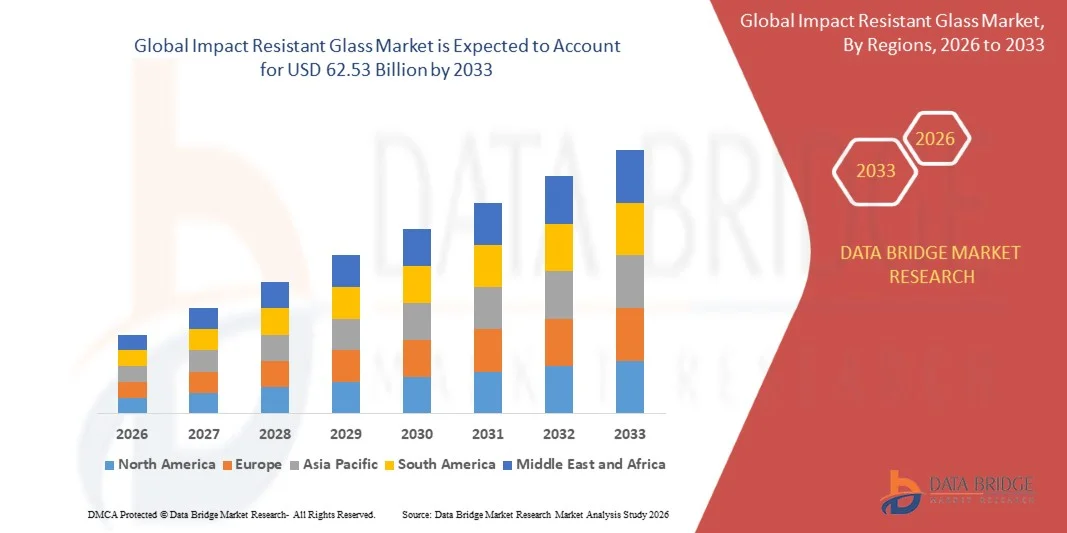
- The global impact resistant glass market size was valued at USD 32.39 billion in 2025 and is expected to reach USD 62.53 billion by 2033, at a CAGR of 8.57% during the forecast period
- The market growth is largely driven by increasing demand for advanced safety and security solutions in residential, commercial, and industrial infrastructure, supported by rapid urbanization and large-scale construction activities across emerging economies
- Furthermore, rising incidences of extreme weather events, security threats, and the growing need for disaster-resistant building materials are accelerating the adoption of impact resistant glass in modern architectural applications
Impact Resistant Glass Market Analysis
- Impact resistant glass refers to specially engineered glazing solutions, typically laminated or tempered, designed to withstand high impact, pressure, and external forces while maintaining structural integrity and transparency, making them suitable for safety-critical applications
- The escalating demand for impact resistant glass is primarily fueled by stringent building safety regulations, increasing focus on energy-efficient and secure construction materials, and expanding applications across automotive, aerospace, and infrastructure sectors
- Asia-Pacific dominated the impact resistant glass market with a share of 40.38% in 2025, due to rapid urbanization, expanding construction activities, and increasing adoption of safety and security glazing in commercial and residential infrastructure
- North America is expected to be the fastest growing region in the impact resistant glass market during the forecast period due to strong demand for advanced safety glazing in commercial construction, automotive manufacturing, and defense applications
- Polyvinyl butyral segment dominated the market with a market share of 49.13% in 2025, due to its strong adhesion to glass, high optical clarity, and proven ability to enhance impact resistance in laminated glass systems. It is widely used in architectural and automotive applications due to its cost effectiveness and reliable safety performance
Report Scope and Impact Resistant Glass Market Segmentation
|
Attributes |
Impact Resistant Glass Key Market Insights |
|
Segments Covered |
|
|
Countries Covered |
North America
Europe
Asia-Pacific
Middle East and Africa
South America
|
|
Key Market Players |
|
|
Market Opportunities |
|
|
Value Added Data Infosets |
In addition to the insights on market scenarios such as market value, growth rate, segmentation, geographical coverage, and major players, the market reports curated by the Data Bridge Market Research also include import export analysis, production capacity overview, production consumption analysis, price trend analysis, climate change scenario, supply chain analysis, value chain analysis, raw material/consumables overview, vendor selection criteria, PESTLE Analysis, Porter Analysis, and regulatory framework. |
Impact Resistant Glass Market Trends
“Rising Use of Safety Glazing in Modern Construction”
- A significant trend in the impact resistant glass market is the increasing adoption of safety glazing solutions in residential, commercial, and infrastructure projects to enhance structural protection and occupant safety. This trend is being reinforced by stricter building codes and growing emphasis on resilient construction materials across high-risk and high-density urban zones
- For instance, Şişecam Group supplies laminated and tempered safety glass widely used in commercial buildings and transportation infrastructure projects. Such applications enhance structural integrity and improve resistance against impact, breakage, and extreme environmental conditions
- The growing integration of impact resistant glass in high-rise buildings and smart city developments is further accelerating demand, as developers prioritize materials that combine safety with durability and energy efficiency. This is reshaping architectural design approaches toward more secure and sustainable building envelopes
- Increasing adoption in automotive glazing systems is also strengthening this trend, as manufacturers focus on improving passenger safety and vehicle structural performance. This includes use in windshields, side windows, and sunroofs that require high impact resistance and optical clarity
- Demand is also rising in public infrastructure projects such as airports, metro stations, and government buildings where security and durability are critical requirements. This is encouraging broader deployment of advanced laminated glass solutions across large-scale developments
- Overall, the trend is reinforcing the shift toward high-performance glazing systems that combine impact resistance, safety, and long-term reliability across multiple end-use sectors
Impact Resistant Glass Market Dynamics
Driver
“Growing Demand for Safe and Durable Building Materials”
- The growing demand for safe and durable building materials is a key driver of the impact resistant glass market, supported by rapid urbanization, infrastructure expansion, and increasing awareness of structural safety. This demand is particularly strong in regions experiencing frequent extreme weather conditions and rising construction activities
- For instance, Xinyi Glass Holdings Limited supplies high-performance architectural glass widely used in skyscrapers and commercial complexes across Asia-Pacific. These products enhance building safety while meeting modern requirements for strength, transparency, and energy efficiency
- The expansion of smart cities and large-scale urban infrastructure projects is further driving the need for impact resistant glass, as governments and developers prioritize resilient construction solutions. This is leading to increased adoption in both public and private sector developments
- Rising automotive production is also contributing to this driver, as manufacturers integrate advanced glazing systems to improve crash resistance and passenger protection. This includes laminated glass solutions that enhance vehicle safety standards
- Growing focus on energy-efficient and sustainable construction materials is further supporting market growth, as impact resistant glass helps improve insulation and reduce energy consumption in buildings. Overall, this driver is strengthening the shift toward advanced glazing solutions that ensure safety, durability, and long-term performance across multiple industries
Restraint/Challenge
“High Manufacturing Cost of Advanced Glass Solutions”
- The high manufacturing cost of advanced impact resistant glass solutions remains a major challenge for market growth, primarily due to the use of specialized raw materials, complex production processes, and energy-intensive manufacturing requirements. These factors increase overall production costs and limit affordability in price-sensitive markets
- For instance, Schott AG utilizes advanced material engineering and precision manufacturing techniques to produce high-performance specialty glass used in demanding applications. These processes require significant investment in technology, skilled labor, and quality control systems, contributing to elevated production costs
- The production of laminated and multi-layered glass structures requires advanced bonding technologies and strict quality standards, which further increases manufacturing complexity. This results in longer production cycles and higher operational expenses for manufacturers
- Energy-intensive float glass and tempering processes also add to cost pressures, particularly in regions with high energy prices. This impacts the scalability of advanced glass production across emerging markets
- Overall, high production costs continue to challenge widespread adoption, particularly in cost-sensitive construction and automotive applications, despite growing demand for high-performance safety glazing solutions
Impact Resistant Glass Market Scope
The market is segmented on the basis of interlayer and end use.
• By Interlayer
On the basis of interlayer, the impact resistant glass market is segmented into ionoplast polymer, ethylene vinyl acetate, polyvinyl butyral, and others. The polyvinyl butyral segment dominated the largest market revenue share of 49.13% in 2025, driven by its strong adhesion to glass, high optical clarity, and proven ability to enhance impact resistance in laminated glass systems. It is widely used in architectural and automotive applications due to its cost effectiveness and reliable safety performance. Manufacturers prefer PVB because it ensures consistent bonding strength and improves acoustic insulation properties. Its established supply chain and compatibility with large scale glass processing further strengthen its market position.
The ionoplast polymer segment is anticipated to witness the fastest growth rate from 2026 to 2033, driven by increasing demand for high strength and advanced safety glazing solutions. Ionoplast interlayers offer superior structural rigidity and higher penetration resistance compared to conventional materials, making them suitable for hurricane resistant and security focused applications. Growing adoption in high rise buildings and critical infrastructure projects is supporting expansion. Improved durability under extreme temperature and weather conditions further enhances its suitability for modern construction standards. Increasing focus on resilient building materials continues to accelerate adoption.
• By End Use
On the basis of end use, the impact resistant glass market is segmented into automotive and transportation, construction and infrastructure, and others. The construction and infrastructure segment dominated the largest market revenue share in 2025, driven by rising demand for safety glazing in residential, commercial, and institutional buildings. Increasing urbanization and stricter building safety regulations are encouraging the use of laminated and impact resistant glass in facades, windows, and skylights. The segment benefits from large scale adoption in high rise buildings where protection against windborne debris and forced entry is critical. Continuous investments in smart city development further strengthen demand across the construction sector.
The automotive and transportation segment is anticipated to witness the fastest growth rate from 2026 to 2033, driven by rising emphasis on passenger safety and vehicle crash protection standards. Automakers are increasingly integrating laminated impact resistant glass in windshields and side windows to enhance occupant protection and reduce injury risks. Growth in electric vehicles and premium vehicle segments is further accelerating adoption due to higher safety and comfort expectations. Technological advancements in lightweight glazing solutions support improved fuel efficiency and performance. Expanding automotive production and safety regulations continue to drive strong market growth.
Impact Resistant Glass Market Regional Analysis
- Asia-Pacific dominated the impact resistant glass market with the largest revenue share of 40.38% in 2025, driven by rapid urbanization, expanding construction activities, and increasing adoption of safety and security glazing in commercial and residential infrastructure
- The region benefits from strong manufacturing capabilities, rising investments in smart city projects, and growing demand from automotive and transportation sectors for advanced safety glass solutions
- Expanding industrialization, supportive infrastructure development policies, and increasing focus on energy-efficient building materials are further accelerating market growth across developing economies
China Impact Resistant Glass Market Insight
China held the largest share in the Asia-Pacific impact resistant glass market in 2025, supported by massive urbanization, large-scale commercial construction projects, and strong automotive production capacity. The country’s focus on modern infrastructure development, high-rise buildings, and public safety standards is driving widespread adoption of laminated and tempered glass solutions. In addition, strong domestic manufacturing capabilities and continuous investment in advanced glass processing technologies are supporting market expansion across construction and transportation sectors.
India Impact Resistant Glass Market Insight
India is witnessing the fastest growth in the Asia-Pacific region, driven by rapid urban development, increasing residential and commercial construction activities, and rising safety awareness in building design. Government initiatives focused on smart cities and infrastructure modernization are boosting demand for impact resistant glass in metro rail, airports, and commercial complexes. Expanding automotive production and growing adoption of energy-efficient and safety-enhanced glazing solutions are further contributing to market acceleration.
Europe Impact Resistant Glass Market Insight
The Europe impact resistant glass market is expanding steadily, supported by strict building safety regulations, strong emphasis on energy-efficient construction, and rising demand for high-performance glazing systems. The region’s focus on sustainable infrastructure and renovation of aging buildings is increasing adoption of advanced safety glass in both residential and commercial applications. Growing use of impact resistant glass in automotive safety applications is also strengthening market growth.
Germany Impact Resistant Glass Market Insight
Germany’s impact resistant glass market is driven by its advanced construction sector, strong automotive manufacturing base, and leadership in engineering and material innovation. High demand for safety glazing in premium vehicles, industrial facilities, and modern architectural projects is supporting steady growth. The country’s focus on energy-efficient buildings and strict safety compliance standards is further encouraging the use of laminated and tempered glass solutions.
U.K. Impact Resistant Glass Market Insight
The U.K. market is supported by rising investment in commercial real estate, infrastructure redevelopment projects, and growing demand for secure and weather-resistant building materials. Increasing emphasis on building safety standards and sustainable construction practices is driving adoption of impact resistant glass across residential and public infrastructure. Expanding use in transportation systems and urban renovation projects is also contributing to market growth.
North America Impact Resistant Glass Market Insight
North America is projected to grow at the fastest CAGR from 2026 to 2033, driven by strong demand for advanced safety glazing in commercial construction, automotive manufacturing, and defense applications. Rapid adoption of hurricane-resistant and security-enhanced building materials is significantly boosting market expansion. Rising investments in smart infrastructure and increasing focus on resilient building design are further strengthening regional demand.
U.S. Impact Resistant Glass Market Insight
The U.S. accounted for the largest share in the North America market in 2025, supported by a well-established construction industry, strong automotive sector, and high demand for security and safety glass solutions. The country’s focus on disaster-resistant infrastructure, including hurricane and impact protection standards, is driving widespread adoption of laminated glass systems. Continuous innovation in architectural glass design and strong presence of key manufacturers are reinforcing the U.S. leadership position in the region.
Impact Resistant Glass Market Share
The impact resistant glass industry is primarily led by well-established companies, including:
- Central Glass Co., Ltd. (Japan)
- Şişecam Group (Turkey)
- Taiwan Glass Industry Corporation (Taiwan)
- Vitro, S.A.B. de C.V. (Mexico)
- CGS Holding Co., Ltd. (China)
- Xinyi Glass Holdings Limited (China)
- Cardinal Glass Industries (U.S.)
- Euroglas GmbH (Germany)
- China Luoyang Float Glass Group Co., Ltd. (China)
- Trulite Glass & Aluminum Solutions (U.S.)
- Schott AG (Germany)
- Scheuten Glass (Netherlands)
- Sangalli Group (Italy)
- China Specialty Glass AG (China)
- Syracuse Glass Company (U.S.)
- Gulf Glass Industries (U.A.E.)
- Qingdao Kangdeli Industrial & Trading Co., Ltd. (China)
- Jin Jing (Group) Co., Ltd. (China)
- Fuso Glass India Pvt. Ltd (India)
Latest Developments in Global Impact Resistant Glass Market
- In December 2025, Vitro Architectural Glass entered a multi-year research collaboration with Penn State to scale up LionGlass, a next-generation glass technology designed to significantly enhance damage resistance across architectural and automotive applications. The innovation offers nearly 10 times higher crack resistance than conventional soda lime glass while also enabling a substantial reduction in manufacturing carbon emissions of around 50% due to lower melting temperatures. This development is expected to strengthen the impact resistant glass market by advancing large-scale commercial viability of high-performance, low-carbon glass materials
- In April 2025, MITER Brands’ Diamond Glass was recognized as the 2025 Sustainable Product of the Year, reinforcing its position as a key innovation in lightweight laminated glass solutions. The product delivers improved energy efficiency while providing strong resistance against hurricanes, intrusions, UV exposure, noise, and other external stresses. This development is expected to positively influence market demand by accelerating the adoption of sustainable and multifunctional impact-resistant glazing in construction and infrastructure sectors
- In March 2025, Corning Incorporated launched Corning Gorilla Glass Ceramic, a strength-enhanced glass-ceramic material designed to improve drop resistance and durability in mobile device displays. The product addresses growing consumer demand for tougher and more reliable smartphone screens, particularly on rough surfaces such as concrete, while maintaining high transparency and structural strength. This innovation is expected to drive market growth in the consumer electronics segment by expanding the application scope of impact resistant glass technologies
- In June 2024, Corning Incorporated introduced Gorilla Glass 7i, a new cover glass technology aimed at improving durability for mid-range and value-segment smartphones. The product offers enhanced drop resistance of up to one meter on asphalt-like surfaces along with up to two times better scratch resistance compared to competing lithium aluminosilicate glasses. This development is expected to broaden the accessibility of impact resistant glass technologies, supporting wider adoption across cost-sensitive consumer electronics markets
- In March 2024, researchers from the University of Science and Technology of China (USTC) under the Chinese Academy of Sciences (CAS) developed an advanced composite glass combining a nacre-inspired structure with shear stiffening gel technology. The material maintains optical transparency while offering exceptional thermal insulation and enhanced impact resistance performance. This breakthrough is expected to influence future material innovation in the impact resistant glass market by enabling bio-inspired, multifunctional glass solutions for high-performance applications

- Interactive Data Analysis Dashboard
- Company Analysis Dashboard for high growth potential opportunities
- Research Analyst Access for customization & queries
- Competitor Analysis with Interactive dashboard
- Latest News, Updates & Trend analysis
- Harness the Power of Benchmark Analysis for Comprehensive Competitor Tracking
Global Impact Resistant Glass Market, Supply Chain Analysis and Ecosystem Framework
To support market growth and help clients navigate the impact of geopolitical shifts, DBMR has integrated in-depth supply chain analysis into its Global Impact Resistant Glass Market research reports. This addition empowers clients to respond effectively to global changes affecting their industries. The supply chain analysis section includes detailed insights such as Global Impact Resistant Glass Market consumption and production by country, price trend analysis, the impact of tariffs and geopolitical developments, and import and export trends by country and HSN code. It also highlights major suppliers with data on production capacity and company profiles, as well as key importers and exporters. In addition to research, DBMR offers specialized supply chain consulting services backed by over a decade of experience, providing solutions like supplier discovery, supplier risk assessment, price trend analysis, impact evaluation of inflation and trade route changes, and comprehensive market trend analysis.
Data collection and base year analysis are done using data collection modules with large sample sizes. The stage includes obtaining market information or related data through various sources and strategies. It includes examining and planning all the data acquired from the past in advance. It likewise envelops the examination of information inconsistencies seen across different information sources. The market data is analysed and estimated using market statistical and coherent models. Also, market share analysis and key trend analysis are the major success factors in the market report. To know more, please request an analyst call or drop down your inquiry.
The key research methodology used by DBMR research team is data triangulation which involves data mining, analysis of the impact of data variables on the market and primary (industry expert) validation. Data models include Vendor Positioning Grid, Market Time Line Analysis, Market Overview and Guide, Company Positioning Grid, Patent Analysis, Pricing Analysis, Company Market Share Analysis, Standards of Measurement, Global versus Regional and Vendor Share Analysis. To know more about the research methodology, drop in an inquiry to speak to our industry experts.
Data Bridge Market Research is a leader in advanced formative research. We take pride in servicing our existing and new customers with data and analysis that match and suits their goal. The report can be customized to include price trend analysis of target brands understanding the market for additional countries (ask for the list of countries), clinical trial results data, literature review, refurbished market and product base analysis. Market analysis of target competitors can be analyzed from technology-based analysis to market portfolio strategies. We can add as many competitors that you require data about in the format and data style you are looking for. Our team of analysts can also provide you data in crude raw excel files pivot tables (Fact book) or can assist you in creating presentations from the data sets available in the report.













