


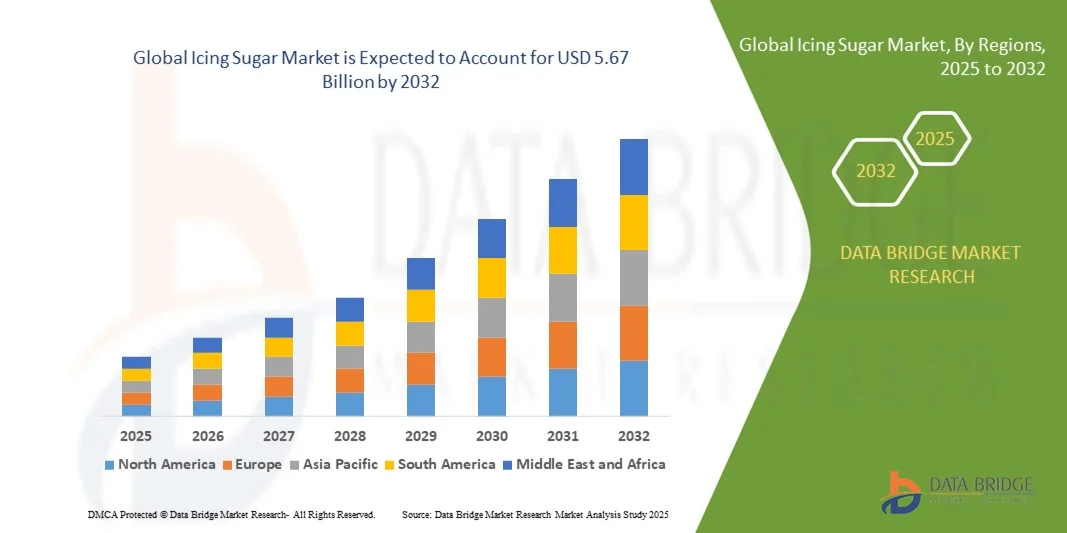
What is the Global Icing Sugar Market Size and Growth Rate?
- The global icing sugar market size was valued at USD 3.36 billion in 2024 and is expected to reach USD 5.67 billion by 2032, at a CAGR of 6.75% during the forecast period
- Major factors that are expected to boost the growth of the icing sugar market in the forecast period are the rise in the need to maintain a fine structure and texture in food. Furthermore, the augmented utilization of icing sugar for chocolate and confectionary products is further anticipated to propel the growth of the icing sugar market
- Moreover, the growing food and beverages industries and the qualities of icing sugar that made it serviceable over convectional sugar in bakery and confectionery products is further estimated to cushion the growth of the icing sugar market
What are the Major Takeaways of Icing Sugar Market?
- The unhealthy amount of calorie intake which leads to unnatural weight gain which is further projected to impede the growth of the icing sugar market in the timeline period
- In addition, the increasing need for bakery and confectioners products will further provide potential opportunities for the growth of the icing sugar market in the coming years
- Europe dominated the icing sugar market with the largest revenue share of 39.7% in 2024, driven by the strong presence of established bakery and confectionery industries, along with a growing preference for premium dessert products
- The Asia-Pacific icing sugar market is poised to grow at the fastest CAGR of 8.6% during 2025–2032, driven by rising disposable incomes, urbanization, and the growing Western influence on bakery and dessert consumption
- The Finely Ground segment dominated the market with the largest revenue share of 48.6% in 2024, owing to its wide application in bakery, confectionery, and dessert preparation where smooth texture and quick solubility are essential
Report Scope and Icing Sugar Market Segmentation
|
Attributes |
Icing Sugar Key Market Insights |
|
Segments Covered |
|
|
Countries Covered |
North America
Europe
Asia-Pacific
Middle East and Africa
South America
|
|
Key Market Players |
|
|
Market Opportunities |
|
|
Value Added Data Infosets |
In addition to the insights on market scenarios such as market value, growth rate, segmentation, geographical coverage, and major players, the market reports curated by the Data Bridge Market Research also include in-depth expert analysis, pricing analysis, brand share analysis, consumer survey, demography analysis, supply chain analysis, value chain analysis, raw material/consumables overview, vendor selection criteria, PESTLE Analysis, Porter Analysis, and regulatory framework. |
What is the Key Trend in the Icing Sugar Market?
Rising Demand for Convenient and Ready-to-Use Baking Ingredients
- A key and accelerating trend in the global icing sugar market is the growing consumer preference for ready-to-use and easy-to-apply baking ingredients, driven by the expansion of the home baking segment and increased demand from the confectionery industry
- Manufacturers are introducing pre-sifted, lump-free icing sugar variants that save preparation time and ensure smooth texture for frosting, glazing, and dusting applications. For instance, Tate & Lyle and Südzucker AG have launched fine-grade icing sugars ideal for professional and home bakers, supporting this trend
- The increasing popularity of home baking shows and social media food trends has fueled consumer interest in aesthetically appealing desserts, driving higher consumption of icing sugar for decorative purposes. Moreover, convenient packaging such as resealable pouches enhances storage and usability
- The integration of icing sugar into ready-to-mix bakery kits and instant dessert formulations further boosts market penetration among time-constrained consumers seeking convenience and quality
- This shift towards convenience-oriented, premium, and versatile icing sugar products is shaping future innovations, prompting key players to expand product lines with enhanced texture, organic options, and cleaner labeling for health-conscious consumers
What are the Key Drivers of Icing Sugar Market?
- The rising consumption of bakery and confectionery products, coupled with the increasing trend of home baking, is driving the demand for icing sugar globally. The product’s wide use in cakes, pastries, cookies, and desserts underpins steady market growth
- For instance, in March 2024, ASR Group (U.S.) expanded its production of fine-grade icing sugar to meet growing demand in both retail and industrial segments. Such expansions highlight the industry’s response to changing consumer preferences
- The rising influence of social media baking trends, alongside greater consumer interest in decorative and artisan bakery items, is further boosting market sales. Consumers are increasingly experimenting with frosting techniques, sugar art, and home-based baking businesses
- Moreover, the trend toward premiumization in bakery ingredients, including organic and low-calorie icing sugar variants, is creating opportunities for innovation. Companies are focusing on product diversification and improved shelf life to attract a broader audience
- Increasing urbanization and disposable income levels, especially in emerging economies such as India and Brazil, are expanding the customer base for bakery and dessert products, strengthening the global icing sugar market outlook
Which Factor is Challenging the Growth of the Icing Sugar Market?
- The fluctuating prices of raw materials, particularly refined sugar, pose a significant challenge to the icing sugar market. Volatility in global sugarcane and beet production due to climate change and trade regulations directly impacts production costs
- For instance, in 2024, weather disruptions in Brazil and India led to sugar price hikes, creating supply chain constraints for icing sugar producers. These cost variations often affect profitability and pricing stability in the end market
- In addition, growing consumer awareness about the health risks associated with high sugar consumption, such as diabetes and obesity, is restraining demand growth, prompting many to seek alternative sweeteners
- To address this, manufacturers are investing in low-calorie and natural sweetener-based icing sugar alternatives using ingredients such as stevia and erythritol. Companies such as Wholesome Sweeteners Inc. (U.S.) are developing organic and reduced-sugar icing products to cater to evolving health-conscious consumers
- Nevertheless, maintaining taste, texture, and functionality while reducing sugar content remains a technical challenge, making innovation and R&D investment crucial for sustainable market expansion
How is the Icing Sugar Market Segmented?
The icing sugar market is segmented on the basis of type, nature, starch source, end use, packaging, and distribution channel.
- By Type
On the basis of type, the icing sugar market is segmented into Coarse Grained, Finely Ground, and Ultra Refined. The Finely Ground segment dominated the market with the largest revenue share of 48.6% in 2024, owing to its wide application in bakery, confectionery, and dessert preparation where smooth texture and quick solubility are essential. Its use in icings, frostings, and whipped creams drives steady demand across both household and commercial sectors.
The Ultra Refined segment is expected to register the fastest CAGR from 2025 to 2032, driven by its growing adoption in premium confectionery and decorative dessert applications. Its superior fineness enhances gloss and smoothness in frosting, making it a preferred choice among professional bakers and food manufacturers. With rising demand for high-quality bakery finishes and visually appealing desserts, manufacturers are expanding offerings in the ultra-refined category to cater to evolving consumer preferences.
- By Nature
On the basis of nature, the icing sugar market is segmented into Organic and Conventional. The Conventional segment held the dominant market revenue share of 67.3% in 2024, primarily due to its wide availability, cost-effectiveness, and established usage in large-scale food production. It remains the preferred choice for commercial bakeries and food processors seeking consistent taste and texture at competitive prices.
However, the Organic segment is projected to grow at the fastest CAGR during 2025–2032, driven by increasing consumer awareness about health and sustainability. Organic icing sugar, free from synthetic pesticides and additives, is witnessing growing demand in premium bakery, confectionery, and household applications. Brands such as Wholesome Sweeteners Inc. (U.S.) and Billington’s (U.K.) are expanding their organic product portfolios to meet this demand. The rising focus on clean-label ingredients and eco-conscious consumption will further support the organic segment’s rapid growth.
- By Starch Source
Based on starch source, the icing sugar market is segmented into Tapioca, Maize, Wheat, Potato, and Others. The Maize-based segment dominated the market with the largest revenue share of 41.8% in 2024, owing to its abundant availability, stable pricing, and favorable texturizing properties in icing sugar production. Maize starch is widely used as an anti-caking agent, ensuring a smooth and lump-free product.
Meanwhile, the Tapioca-based segment is expected to witness the fastest CAGR from 2025 to 2032, attributed to its gluten-free nature and increasing demand from health-conscious and allergen-sensitive consumers. Tapioca starch offers superior brightness and neutral flavor, making it highly suitable for premium confectionery applications. Manufacturers are increasingly adopting tapioca as a sustainable alternative to traditional starch sources, aligning with the clean-label movement and growing preference for plant-derived, minimally processed ingredients in the global food industry.
- By End Use
On the basis of end use, the icing sugar market is segmented into HoReCa or Foodservice, Food Processing Industry, Bakery Products, Confectionery, Desserts and Household, and Retail. The Bakery Products segment dominated the market with the largest revenue share of 39.4% in 2024, driven by the extensive use of icing sugar in cakes, pastries, doughnuts, and frostings. Rapid urbanization and the growing culture of café chains have further amplified demand.
The Confectionery segment is expected to record the fastest CAGR during 2025–2032, fueled by the increasing production of candies, chocolates, and decorative sweets. Rising consumer preference for visually appealing treats and festive confectionery items is driving the segment’s growth. In addition, expanding HoReCa activities and household baking trends, supported by social media inspiration, continue to enhance icing sugar usage across diverse culinary applications worldwide.
- By Packaging
On the basis of packaging, the icing sugar market is segmented into Retail, Canisters, Packets, Boxes, and Bulk. The Packets segment accounted for the largest market revenue share of 36.9% in 2024, driven by its suitability for both household and small-scale bakery applications. Packets offer convenience, easy handling, and portion control, making them a preferred choice for individual consumers.
The Bulk segment is expected to exhibit the fastest CAGR from 2025 to 2032, fueled by the rising demand from industrial bakeries, food processing units, and HoReCa establishments requiring large quantities for continuous production. Manufacturers are also innovating in eco-friendly and moisture-resistant packaging solutions to extend shelf life and reduce waste. This evolution in packaging formats enhances product safety, freshness, and sustainability, aligning with modern distribution and consumer expectations.
- By Distribution Channel
On the basis of distribution channel, the icing sugar market is segmented into Direct/B2B, Indirect/B2C, Hypermarkets or Supermarkets, Modern Grocery Stores, Specialty Stores, and Online Retail. The Indirect/B2C segment dominated the market with the largest revenue share of 45.7% in 2024, driven by strong product visibility across hypermarkets, supermarkets, and specialty stores. Consumers prefer these retail formats for assured quality, product variety, and promotional offers.
The Online Retail segment is expected to witness the fastest CAGR during 2025–2032, owing to the rapid digitalization of grocery shopping and the increasing popularity of e-commerce platforms. The convenience of doorstep delivery, wide brand availability, and frequent discounts have made online platforms a key sales channel for both retail and bulk consumers. Leading brands are strengthening their digital presence and direct-to-consumer strategies to capture this fast-growing segment.
Which Region Holds the Largest Share of the Icing Sugar Market?
- Europe dominated the icing sugar market with the largest revenue share of 39.7% in 2024, driven by the strong presence of established bakery and confectionery industries, along with a growing preference for premium dessert products. The region’s deep-rooted baking culture and high per capita consumption of bakery goods contribute significantly to icing sugar demand
- Consumers in Europe increasingly prefer ready-to-use, finely milled icing sugar for convenience and consistency in home baking and professional patisserie applications. This trend is supported by the expansion of artisanal bakeries and the growing popularity of home-based baking businesses
- The dominance of leading sugar producers such as Südzucker AG (Germany), Tate & Lyle PLC (U.K.), and Nordic Sugar A/S (Denmark) further strengthens regional production capacity. In addition, the rising inclination toward organic and low-calorie variants supports innovation and product diversification across the European icing sugar market
U.K. Icing Sugar Market Insight
The U.K. icing sugar market captured the largest revenue share of 29% within Europe in 2024, fueled by the growing popularity of home baking and the thriving café and patisserie culture. Baking shows, social media trends, and festive confectionery consumption continue to boost demand for icing sugar. The country’s strong retail infrastructure, featuring brands such as Billington’s and Silver Spoon, ensures product accessibility across supermarkets and online channels. Moreover, the U.K.’s rising preference for organic and sustainably sourced sugars is encouraging manufacturers to expand eco-friendly and clean-label product lines, supporting continued market growth through 2032.
Germany Icing Sugar Market Insight
The Germany icing sugar market is projected to expand at a steady CAGR during the forecast period, driven by the country’s strong industrial food processing base and high consumer demand for premium-quality bakery and dessert products. Germany’s leading sugar producers, including Südzucker AG, play a pivotal role in supplying both domestic and export markets. The market benefits from robust demand in confectionery and large-scale bakery manufacturing, with a growing shift toward organic and allergen-free sugar alternatives. In addition, innovation in packaging formats such as resealable pouches and bulk bags is enhancing product convenience and shelf life, further propelling growth.
France Icing Sugar Market Insight
The France icing sugar market is expected to grow at a significant CAGR throughout the forecast period, supported by the country’s rich patisserie heritage and strong consumer affinity for decorative desserts. French bakeries and pastry houses are key drivers of icing sugar consumption, especially for high-end cakes, macarons, and desserts. The rise of artisan patisserie chains and the expanding retail bakery sector continue to elevate the demand for finely ground icing sugar. Furthermore, the market is witnessing a rise in organic and specialty sugar adoption, aligning with France’s broader focus on premiumization and clean-label food production.
Which Region is the Fastest Growing Region in the Icing Sugar Market?
The Asia-Pacific icing sugar market is poised to grow at the fastest CAGR of 8.6% during 2025–2032, driven by rising disposable incomes, urbanization, and the growing Western influence on bakery and dessert consumption. Expanding food processing industries and increasing investments by international bakery chains are further propelling icing sugar demand. The region’s large population base and growing preference for packaged desserts and bakery mixes contribute to robust market expansion. In addition, the availability of cost-effective refined sugar production in countries such as India and China supports strong regional supply capabilities.
India Icing Sugar Market Insight
The India icing sugar market is gaining momentum, driven by the expanding bakery and confectionery sector and the rise of small-scale baking enterprises. Increasing exposure to global dessert trends, along with social media-inspired home baking, has significantly boosted icing sugar consumption. Local manufacturers such as Amrut International and Blue Bird Foods (India) Pvt. Ltd. are expanding their product portfolios to include fine and ultra-refined icing sugar variants. The growing adoption of modern retail channels and e-commerce platforms is also making premium icing sugar brands more accessible across urban and semi-urban markets.
China Icing Sugar Market Insight
The China icing sugar market held the largest revenue share within Asia-Pacific in 2024, supported by rapid urbanization, a growing middle-class population, and increasing consumption of Western-style desserts. The proliferation of bakeries, cafés, and international confectionery brands has driven substantial demand for high-quality icing sugar. The country’s strong production capabilities, coupled with favorable government policies promoting food processing, have encouraged both domestic and export-oriented growth. In addition, the shift toward low-calorie and natural sweetener-based icing sugars is gaining traction, aligning with China’s growing focus on health-conscious food consumption.
Japan Icing Sugar Market Insight
The Japan icing sugar market is projected to grow at a notable CAGR during 2025–2032, driven by rising interest in Western-style baked goods and the expansion of the premium patisserie segment. Japanese consumers prioritize texture and aesthetics, favoring finely milled icing sugar for delicate dessert decorations. The market is also benefiting from innovations in sugar-free and low-glycemic formulations, catering to Japan’s health-conscious population. Moreover, the growing influence of high-end cafés and international bakery chains is fostering demand for superior quality icing sugar, positioning Japan as a key growth contributor within the Asia-Pacific region.
Which are the Top Companies in Icing Sugar Market?
The icing sugar industry is primarily led by well-established companies, including:
- Südzucker AG (Germany)
- ASR Group (U.S.)
- Imperial Sugar (U.S.)
- American Crystal Sugar Company (U.S.)
- Taikoo Sugar Limited (Hong Kong)
- Wholesome Sweeteners Inc (U.S.)
- Nordic Sugar A/S (Denmark)
- Zucchero & C Srl (Italy)
- Raunak Enterprises (India)
- Amrut International (India)
- M. B Sugar And Pharmaceuticals (India)
- Radiant International (India)
- Pooja Traders (India)
- RB FOODS (India)
- Astrra Chemicals (India)
- Tiwari Brothers (India)
- Skyline Food Products LLP (India)
- Blue Bird Foods (India) Private Limited (India)
- Pruthvifoods (India)
What are the Recent Developments in Global Icing Sugar Market?
- In July 2025, Cargill announced a major expansion of its blending facilities in Indonesia, aiming to strengthen its foothold in the Asian powdered sugar market by boosting production capacity and enhancing regional distribution capabilities. This strategic move is expected to significantly improve Cargill’s competitiveness and supply chain efficiency across Asia
- In January 2025, Sucro Can Sourcing began construction of Canada’s largest sugar refinery at the Port of Hamilton, featuring an annual capacity of 1 million metric tonnes and a total investment of USD 135 million. This development marks a milestone in strengthening domestic sugar refining capacity and reducing import dependency in Canada
- In August 2024, Michigan Sugar Co. inaugurated a new molasses desugarization facility in Monitor Township, designed to extract an additional 80 million pounds of sugar annually from molasses byproduct. With a total investment of USD 109 million, the facility doubles processing capacity to 650 tons of molasses per day. This expansion enhances sugar production efficiency and ensures a more consistent powdered sugar supply
- In April 2024, Indiana Sugars acquired 55 acres at Buffington Harbor in Gary, Indiana, to build new headquarters and expand its manufacturing operations. Phase 1 construction began in Q2 2024, with the facility expected to be operational by early 2025. This project underscores the company’s commitment to meeting growing customer demand and diversifying its powdered sugar product portfolio

- Interactive Data Analysis Dashboard
- Company Analysis Dashboard for high growth potential opportunities
- Research Analyst Access for customization & queries
- Competitor Analysis with Interactive dashboard
- Latest News, Updates & Trend analysis
- Harness the Power of Benchmark Analysis for Comprehensive Competitor Tracking
Global Icing Sugar Market, Supply Chain Analysis and Ecosystem Framework
To support market growth and help clients navigate the impact of geopolitical shifts, DBMR has integrated in-depth supply chain analysis into its Global Icing Sugar Market research reports. This addition empowers clients to respond effectively to global changes affecting their industries. The supply chain analysis section includes detailed insights such as Global Icing Sugar Market consumption and production by country, price trend analysis, the impact of tariffs and geopolitical developments, and import and export trends by country and HSN code. It also highlights major suppliers with data on production capacity and company profiles, as well as key importers and exporters. In addition to research, DBMR offers specialized supply chain consulting services backed by over a decade of experience, providing solutions like supplier discovery, supplier risk assessment, price trend analysis, impact evaluation of inflation and trade route changes, and comprehensive market trend analysis.
Data collection and base year analysis are done using data collection modules with large sample sizes. The stage includes obtaining market information or related data through various sources and strategies. It includes examining and planning all the data acquired from the past in advance. It likewise envelops the examination of information inconsistencies seen across different information sources. The market data is analysed and estimated using market statistical and coherent models. Also, market share analysis and key trend analysis are the major success factors in the market report. To know more, please request an analyst call or drop down your inquiry.
The key research methodology used by DBMR research team is data triangulation which involves data mining, analysis of the impact of data variables on the market and primary (industry expert) validation. Data models include Vendor Positioning Grid, Market Time Line Analysis, Market Overview and Guide, Company Positioning Grid, Patent Analysis, Pricing Analysis, Company Market Share Analysis, Standards of Measurement, Global versus Regional and Vendor Share Analysis. To know more about the research methodology, drop in an inquiry to speak to our industry experts.
Data Bridge Market Research is a leader in advanced formative research. We take pride in servicing our existing and new customers with data and analysis that match and suits their goal. The report can be customized to include price trend analysis of target brands understanding the market for additional countries (ask for the list of countries), clinical trial results data, literature review, refurbished market and product base analysis. Market analysis of target competitors can be analyzed from technology-based analysis to market portfolio strategies. We can add as many competitors that you require data about in the format and data style you are looking for. Our team of analysts can also provide you data in crude raw excel files pivot tables (Fact book) or can assist you in creating presentations from the data sets available in the report.













