


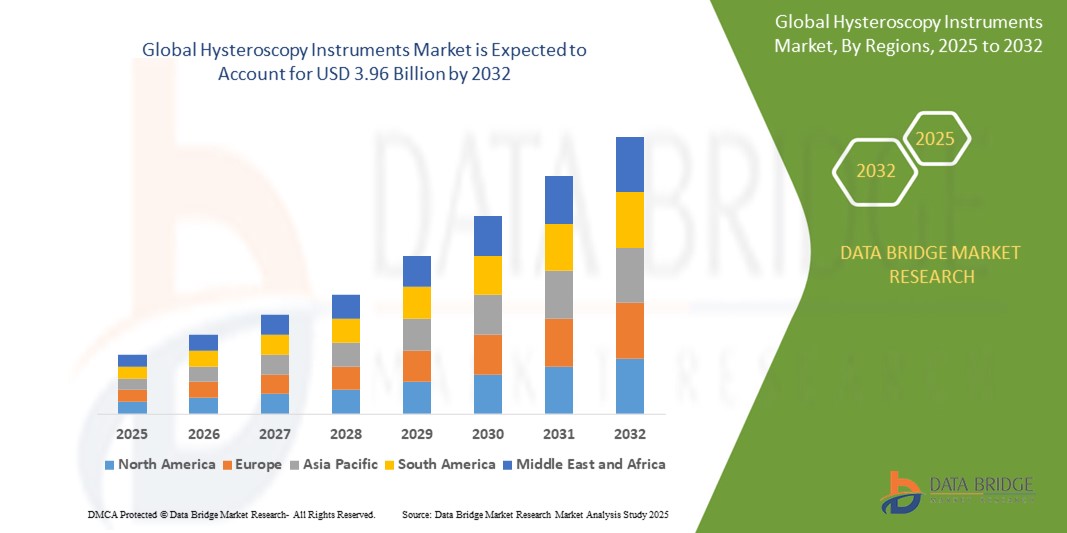
Hysteroscopy Instruments Market Size
- The global hysteroscopy instruments market size was valued at USD 2.19 billion in 2024 and is expected to reach USD 3.96 billion by 2032, at a CAGR of 7.70% during the forecast period
- This growth is driven by factors such as the increasing preference for minimally invasive gynecological procedures, rising prevalence of uterine disorders, and advancements in hysteroscopic technologies
Hysteroscopy Instruments Market Analysis
- The hysteroscopy instruments market is experiencing growth with rising demand for high-clarity imaging tools. Medical centers are prioritizing precision and efficiency in minimally invasive gynecological procedures
- Surgeons are increasingly using compact and ergonomic devices for better control and patient comfort
- North America is expected to dominate the hysteroscopy Instruments market with 44.12% share due to its advanced healthcare infrastructure and widespread access to specialized medical services
- Asia-Pacific is expected to be the fastest growing region in the hysteroscopy Instruments market during the forecast period due to rising awareness of women’s health and increasing healthcare modernization
- The disposable hysteroscope segment is expected to dominate the hysteroscopy Instruments market with the largest share of 60.90% in 2025 due to increasing demand for infection control, reduced need for sterilization, and convenience in outpatient and office-based procedures
Report Scope and Hysteroscopy Instruments Market Segmentation
|
Attributes |
Hysteroscopy Instruments Key Market Insights |
|
Segments Covered |
|
|
Countries Covered |
North America
Europe
Asia-Pacific
Middle East and Africa
South America
|
|
Key Market Players |
|
|
Market Opportunities |
|
|
Value Added Data Infosets |
In addition to the insights on market scenarios such as market value, growth rate, segmentation, geographical coverage, and major players, the market reports curated by the Data Bridge Market Research also include import export analysis, production capacity overview, production consumption analysis, price trend analysis, climate change scenario, supply chain analysis, value chain analysis, raw material/consumables overview, vendor selection criteria, PESTLE Analysis, Porter Analysis, and regulatory framework. |
Hysteroscopy Instruments Market Trends
“Rising Use of Disposable Hysteroscopy Instruments”
- The market is seeing a strong shift toward disposable hysteroscopy instruments due to their safety benefits. Hospitals prefer them to lower contamination risks and simplify post-procedure handling
- Disposable tools help reduce downtime between procedures in high-volume medical settings. This leads to improved scheduling and better patient flow throughout the day
- New disposable devices now come with advanced imaging for more accurate intrauterine diagnostics
For instance, high-resolution optics in single-use scopes enhance visibility during procedures
- Companies are developing eco-friendly disposables to address growing concerns about medical waste. These include instruments made with biodegradable or recyclable materials
- In conclusion, the ease of use and reduced need for maintenance make disposables a cost-effective choice. Their growing popularity reflects a broader move toward efficient and patient-friendly care
Hysteroscopy Instruments Market Dynamics
Driver
“Increasing Preference for Minimally Invasive Procedures”
- Rising patient and clinician preference for minimally invasive gynecological procedures is driving demand for hysteroscopy instruments, with real-time examples such as the increasing use of diagnostic hysteroscopy at Cleveland Clinic and Mayo Clinic for evaluating abnormal uterine bleeding
- Hysteroscopy offers direct visualization of the uterine cavity, aiding accurate diagnosis and treatment of fibroids, polyps, and infertility with minimal discomfort and shorter recovery, as seen in growing outpatient procedures at Kaiser Permanente and Mount Sinai Health System
For instance, Hospitals and clinics are investing in advanced systems such as the Olympus VISERA ELITE II and KARL STORZ IMAGE1 S for high-definition imaging and enhanced precision during operative hysteroscopies
- The market is seeing increased adoption of portable and integrated visualization platforms such as Medtronic’s TruClear system, supporting office-based interventions for faster turnaround and reduced procedural burden
- Healthcare providers are transitioning to outpatient models to minimize hospital stays and cut procedural costs, a trend evident in practices across Johns Hopkins Medicine and Sutter Health
- In conclusion, this growing adoption is making hysteroscopy a preferred choice in gynecology for both patients and providers
Opportunity
“Integration of Artificial Intelligence in Hysteroscopy Systems”
- Integration of AI and machine learning in hysteroscopy instruments is emerging as a major opportunity, with companies such as Olympus and Medtronic exploring AI-powered image enhancement and real-time diagnostic support
- AI can detect subtle imaging patterns missed by clinicians, aiding early identification of endometrial abnormalities such as hyperplasia and cancer, as shown in pilot studies at institutions such as MD Anderson Cancer Center and Stanford Health Care
- Standardized diagnosis and real-time decision support from AI algorithms reduce variability between operators, helping streamline outcomes in diverse clinical environments including outpatient gynecology clinics
- Beyond diagnostics, AI is enabling automated procedure documentation and workflow optimization in high-volume centers such as the Cleveland Clinic, where time and accuracy are critical
For instance, smart hysteroscopy platforms with AI features such as anomaly detection and guided navigation are under development, including collaborations between device manufacturers and health-tech startups adapting to evolving FDA and EMA regulations
- In conclusion, with AI-driven systems, hysteroscopy is becoming more precise, consistent, and efficient
Restraint/Challenge
“High Initial Cost of Advanced Equipment”
- High upfront costs of advanced hysteroscopy systems such as HD scopes and integrated video platforms remain a significant challenge, especially for smaller clinics and rural hospitals with limited capital budgets
- Total investment extends beyond equipment to include training, software updates, and maintenance, as seen in clinics struggling to afford platforms such as the KARL STORZ IMAGE1 S or Olympus VISERA ELITE II
- Lack of standardized reimbursement frameworks makes it harder for providers to justify the cost, with many facilities, including in developing healthcare markets, hesitant to adopt without clear ROI evidence
- Rapid tech evolution leads to shorter device lifespans and frequent upgrades, creating a recurring financial strain, especially in regions with slower procurement cycles such as parts of Southeast Asia and Eastern Europe
- In conclusion, balancing innovation with affordability is key to unlocking the full potential of hysteroscopy. Sustainable pricing and support models will shape how far and fast the technology spreads
Hysteroscopy Instruments Market Scope
The market is segmented on the basis type, function, technology, material, level, application.
|
Segmentation |
Sub-Segmentation |
|
By Product |
|
|
By Usability |
|
|
By Application |
|
|
By End User
|
|
In 2025, the disposable hysteroscope segment is projected to dominate the market with a largest share in application segment
- The disposable hysteroscope segment is expected to dominate the hysteroscopy Instruments market with the largest share of 60.90% in 2025 due to increasing demand for infection control, reduced need for sterilization, and convenience in outpatient and office-based procedures
The endometrial ablation segment is expected to account for the largest share during the forecast period in hysteroscope segment
- In 2025, the endometrial ablation segment is expected to dominate the market with the largest market share of 24.90% due to its effectiveness in treating abnormal uterine bleeding, rising preference for minimally invasive treatments, and growing availability of advanced ablation devices in clinical settings.
Hysteroscopy Instruments Market Regional Analysis
“North America Holds the Largest Share in the Hysteroscopy Instruments Market”
- North America leads the hysteroscopy instruments market with 44.12% share due to its advanced healthcare infrastructure and widespread access to specialized medical services with CAGR of 5.5%
- The U.S. hysteroscope market held a substantial market share of 85.3% in North America
- The region benefits from early adoption of innovative hysteroscopic technologies and strong presence of established medical device manufacturers
- High awareness among patients and healthcare providers about minimally invasive procedures supports consistent demand
- Favorable healthcare policies and structured reimbursement systems make advanced hysteroscopy tools more accessible across clinical settings
- Ongoing investment in gynecological care and emphasis on patient safety reinforce North America's dominant market position
“Asia-Pacific is Projected to Register the Highest CAGR in the Hysteroscopy Instruments Market”
- Asia-Pacific is experiencing rapid growth in the hysteroscopy instruments market driven by rising awareness of women’s health and increasing healthcare modernization
- Expanding hospital infrastructure and growing medical training programs are accelerating adoption of hysteroscopic procedures
- Countries in this region are focusing on improving access to minimally invasive care in both urban and rural areas
- Greater investment in public health and technological advancements are encouraging the use of modern diagnostic tools
- The rise of medical tourism and a growing population base contribute to a strong demand for efficient and affordable hysteroscopic solutions
Hysteroscopy Instruments Market Share
The market competitive landscape provides details by competitor. Details included are company overview, company financials, revenue generated, market potential, investment in research and development, new market initiatives, global presence, production sites and facilities, production capacities, company strengths and weaknesses, product launch, product width and breadth, application dominance. The above data points provided are only related to the companies' focus related to market.
The Major Market Leaders Operating in the Market Are:
- KARL STORZ SE & Co. KG (Germany)
- Olympus Corporation (Japan)
- Richard Wolf GmbH (Germany)
- Stryker (U.S.)
- Hologic Inc. (U.S.)
- Medtronic (Ireland)
- Ethicon USA LLC (U.S.)
- B. Braun Melsungen AG (Germany)
- Boston Scientific Corporation (U.S.)
- MEDGYN PRODUCTS INC (U.S.)
- CooperSurgical Inc. (U.S.)
- Timesco Healthcare Ltd (United Kingdom)
- Optomic (Spain)
- MGB Endoskopische Geräte GmbH Berlin (Germany)
- Delmont imaging (France)
- Vimex Sp. z o.o. (Poland)
- SCHÖLLY FIBEROPTIC GMBH (Germany)
- RUDOLF Medical GmbH + Co. KG (Germany)
- Cook (U.S.)
Latest Developments in Global Hysteroscopy Instruments Market
- In October 2023, Hologic, Inc. entered into a partnership with AAGL and Inovus Medical to enhance OB-GYN training in minimally invasive surgical techniques. As part of this collaboration, Hologic became the primary supplier of hysteroscopes for AAGL’s Essentials in Minimally Invasive Gynecologic Surgery (EMIGS) hands-on hysteroscopy training program for OB-GYN residents
- In April 2024, Inovus Medical launched the Bozzini Hysteroscopy Simulator, a portable and cost-effective training tool designed to enhance hysteroscopy skills using real endoscopic instruments. The simulator provides a realistic and affordable solution for medical professionals and trainees. It aims to improve access to high-quality surgical training while supporting patient safety and clinical outcomes
- In April 2025, KARL STORZ continues to lead in gynecological endoscopy by offering a comprehensive range of miniaturized instruments tailored for both diagnostic and operative hysteroscopy. Their portfolio includes advanced tools such as the CAMPO TROPHYscope with a 2.9 mm diameter for atraumatic uterine access, the fully reusable Intrauterine BIGATTI Shaver (IBS) designed for outpatient procedures, and bipolar resectoscopes available in sizes as small as 5 mm, facilitating interventions without general anesthesia

- Interactive Data Analysis Dashboard
- Company Analysis Dashboard for high growth potential opportunities
- Research Analyst Access for customization & queries
- Competitor Analysis with Interactive dashboard
- Latest News, Updates & Trend analysis
- Harness the Power of Benchmark Analysis for Comprehensive Competitor Tracking
Global Hysteroscopy Instruments Market, Supply Chain Analysis and Ecosystem Framework
To support market growth and help clients navigate the impact of geopolitical shifts, DBMR has integrated in-depth supply chain analysis into its Global Hysteroscopy Instruments Market research reports. This addition empowers clients to respond effectively to global changes affecting their industries. The supply chain analysis section includes detailed insights such as Global Hysteroscopy Instruments Market consumption and production by country, price trend analysis, the impact of tariffs and geopolitical developments, and import and export trends by country and HSN code. It also highlights major suppliers with data on production capacity and company profiles, as well as key importers and exporters. In addition to research, DBMR offers specialized supply chain consulting services backed by over a decade of experience, providing solutions like supplier discovery, supplier risk assessment, price trend analysis, impact evaluation of inflation and trade route changes, and comprehensive market trend analysis.
Data collection and base year analysis are done using data collection modules with large sample sizes. The stage includes obtaining market information or related data through various sources and strategies. It includes examining and planning all the data acquired from the past in advance. It likewise envelops the examination of information inconsistencies seen across different information sources. The market data is analysed and estimated using market statistical and coherent models. Also, market share analysis and key trend analysis are the major success factors in the market report. To know more, please request an analyst call or drop down your inquiry.
The key research methodology used by DBMR research team is data triangulation which involves data mining, analysis of the impact of data variables on the market and primary (industry expert) validation. Data models include Vendor Positioning Grid, Market Time Line Analysis, Market Overview and Guide, Company Positioning Grid, Patent Analysis, Pricing Analysis, Company Market Share Analysis, Standards of Measurement, Global versus Regional and Vendor Share Analysis. To know more about the research methodology, drop in an inquiry to speak to our industry experts.
Data Bridge Market Research is a leader in advanced formative research. We take pride in servicing our existing and new customers with data and analysis that match and suits their goal. The report can be customized to include price trend analysis of target brands understanding the market for additional countries (ask for the list of countries), clinical trial results data, literature review, refurbished market and product base analysis. Market analysis of target competitors can be analyzed from technology-based analysis to market portfolio strategies. We can add as many competitors that you require data about in the format and data style you are looking for. Our team of analysts can also provide you data in crude raw excel files pivot tables (Fact book) or can assist you in creating presentations from the data sets available in the report.













