


Hybrid Video Surveillance Market Overview
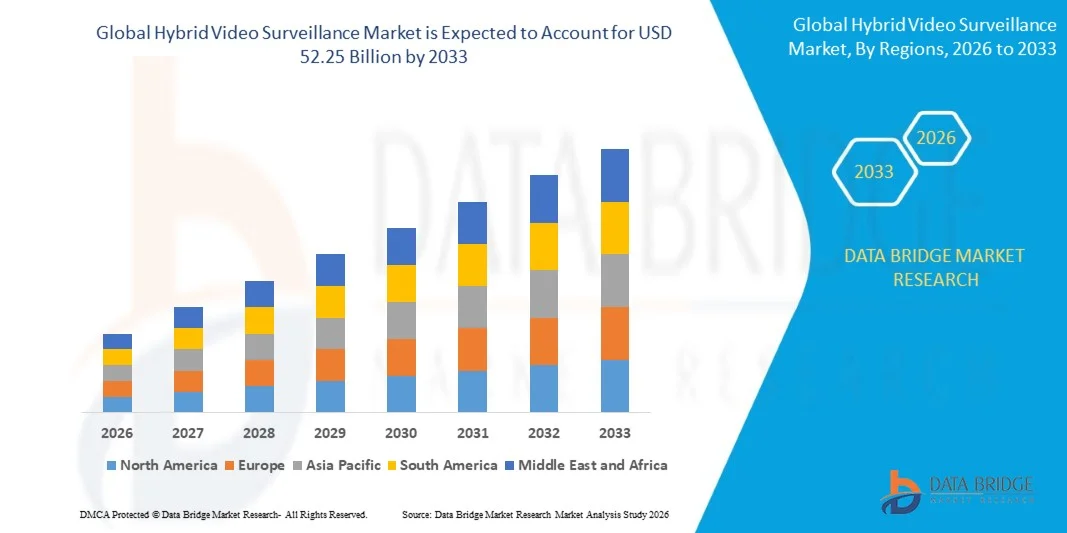
As per Data Bridge Market Research analysis the Hybrid Video Surveillance Market was valued at USD 32.29 billion in 2025 and is projected to reach USD 52.25 billion by 2033, growing at a CAGR of 6.20% from 2026 to 2033. The market is witnessing steady expansion driven by the increasing need for integrated security systems that combine on-premises infrastructure with cloud-based video management, enabling enhanced scalability, flexibility, and cost efficiency across enterprises and public safety applications.
The growing emphasis on advanced security and real-time monitoring across commercial, industrial, and government sectors is significantly boosting adoption of hybrid video surveillance solutions. Rising urbanization, increasing deployment of smart city projects, and the integration of artificial intelligence and video analytics for threat detection are further accelerating market growth. In addition, organizations are increasingly shifting toward hybrid architectures to balance data privacy requirements with remote accessibility and centralized surveillance capabilities.
Key Market Trends & Insights
- North America dominated the hybrid video surveillance market with the largest revenue share of 38.6% in 2025, supported by high investments in smart city infrastructure, widespread adoption of cloud-based video management platforms, and strong demand for AI-enabled surveillance systems across enterprises, transportation networks, and government facilities.
- Asia-Pacific is expected to be the fastest-growing region, recording a CAGR of 8.9% from 2026 to 2033. Growth is driven by rapid urbanization, expanding smart city initiatives, increasing public safety investments, and growing adoption of AI-powered surveillance infrastructure across China, India, Japan, and South Korea.
- The IP Video Surveillance System segment held the largest market revenue share of approximately 71.4% in 2025, driven by rising demand for high resolution imaging, remote accessibility, and AI enabled video analytics integration across smart city and enterprise security infrastructure. IP systems are increasingly preferred due to their scalability, ease of integration with cloud platforms, and enhanced cybersecurity features compared to legacy analog systems.
- The Analog Video Surveillance System segment is projected to witness steady growth at a CAGR of 4.9% from 2026 to 2033, primarily supported by cost sensitive installations in small scale enterprises and developing regions where full digital migration is still in progress. Continued use in basic monitoring applications and hybrid retrofit deployments is sustaining demand in this segment.
- The Hardware segment held the largest market revenue share of approximately 62.3% in 2025, driven by widespread deployment of cameras, storage devices, and network infrastructure across commercial, industrial, and public safety applications. Increasing installation of high definition and AI enabled surveillance cameras in urban surveillance projects is further strengthening hardware demand.
- The Software segment is projected to register the fastest growth at a CAGR of 11.6% from 2026 to 2033, driven by rising adoption of video management systems, AI based analytics platforms, and cloud integrated surveillance dashboards. Growing demand for intelligent monitoring features such as facial recognition, anomaly detection, and predictive analytics is accelerating software adoption across enterprises and government organizations.
- The B2B segment held the largest market revenue share of approximately 78.9% in 2025, supported by large scale deployments across enterprises, government institutions, transportation hubs, and industrial facilities. Increasing investments in smart infrastructure and centralized security operations centers are driving strong enterprise adoption of hybrid surveillance systems.
- The B2C segment is projected to grow at a CAGR of 8.7% from 2026 to 2033, driven by increasing adoption of smart home security systems, wireless IP cameras, and mobile connected surveillance solutions. Rising awareness of residential security and affordability of cloud based monitoring subscriptions are supporting segment expansion.
- The Large Scale Enterprise segment held the largest market revenue share of approximately 55.6% in 2025, driven by extensive deployment across airports, smart cities, defense installations, and critical infrastructure facilities requiring advanced surveillance capabilities and centralized monitoring systems.
- The Small Scale Enterprise segment is projected to witness the fastest growth at a CAGR of 9.8% from 2026 to 2033, supported by increasing availability of cost effective cloud based surveillance solutions and subscription based video management platforms that reduce upfront infrastructure investment requirements.
- The Commercial segment held the largest market revenue share of approximately 28.7% in 2025, driven by widespread adoption across retail stores, office complexes, banking institutions, and logistics centers for security monitoring and operational efficiency.
- The Public Facility segment is projected to register the fastest growth at a CAGR of 10.5% from 2026 to 2033, driven by increasing smart city initiatives, urban surveillance programs, and government investments in public safety infrastructure. Rising deployment of AI enabled surveillance networks across transportation systems, stadiums, and crowded urban spaces is significantly boosting segment growth.
Market Size & Forecast
- Global Market Value (2025): USD 32.29 Billion
- Expected Market Value (2033): USD 52.25 Billion
- Forecast CAGR (2026–2033): 6.20%
- Leading Region in 2025: North America
- Fastest Growing Region: Asia-Pacific
Report Scope and Hybrid Video Surveillance Market Segmentation
|
Attributes |
Hybrid Video Surveillance Key Market Insights |
|
Segments Covered |
· By System: Analog Video Surveillance System and I.P. Video Surveillance System · By Offering: Hardware and Software · By Customer Type: B2B and B2C · By Size: Small Scale Enterprise, Medium Scale Enterprise, and Large-Scale Enterprise · By End User: Infrastructure, Commercial, Military and Defence, Residential, Public Facility and Industrial |
|
Countries Covered |
North America · U.S. · Canada · Mexico Europe · Germany · France · U.K. · Netherlands · Switzerland · Belgium · Russia · Italy · Spain · Turkey · Rest of Europe Asia-Pacific · China · Japan · India · South Korea · Singapore · Malaysia · Australia · Thailand · Indonesia · Philippines · Rest of Asia-Pacific Middle East and Africa · Saudi Arabia · U.A.E. · South Africa · Egypt · Israel · Rest of Middle East and Africa South America · Brazil · Argentina · Rest of South America |
|
Key Market Players |
• Axis Communications AB (Sweden) |
|
Market Opportunities |
• Smart City Expansion • Artificial Intelligence Driven Video Analytics Adoption |
|
Value Added Data Infosets |
In addition to the insights on market scenarios such as market value, growth rate, segmentation, geographical coverage, and major players, the market reports curated by the Data Bridge Market Research also include in-depth expert analysis, geographically represented company-wise production and capacity, network layouts of distributors and partners, detailed and updated price trend analysis and deficit analysis of supply chain and demand. |
Hybrid Video Surveillance Market Trends
Trend: Growth In Cloud-Edge Hybrid Architecture And AI Powered Video Analytics Adoption
Increasing demand for scalable, intelligent, and cost efficient surveillance systems is accelerating the shift from fully on premise infrastructure toward hybrid models combining edge storage with cloud based video management. Traditional analog and standalone IP surveillance systems are increasingly unable to handle modern requirements such as real time analytics, remote accessibility, and high resolution multi camera monitoring, driving adoption of hybrid video surveillance solutions across enterprises and government sectors.
In modern smart city deployments, hybrid systems are being integrated with AI enabled video analytics to support real time threat detection, traffic monitoring, and crowd management. For instance, major urban surveillance projects in countries such as China and India are deploying AI powered cameras capable of processing edge level analytics to reduce bandwidth consumption while maintaining centralized cloud storage for long term data retention.
In retail and banking sectors, hybrid video surveillance platforms are being used to enhance fraud detection, customer behavior analysis, and branch security operations, enabling organizations to combine on site recording reliability with cloud based investigative tools. In addition, increasing cybersecurity requirements and data sovereignty regulations in regions such as Europe are encouraging hybrid deployments that allow sensitive video data to remain on premises while leveraging cloud intelligence layers for analytics. Large scale smart city programs launched in 2024–2025 across Asia Pacific have reported operational improvements of 20–30% in incident response times after deploying AI integrated hybrid surveillance systems.
Hybrid Video Surveillance Market Dynamics
Key Market Driver: Rising Demand For Smart Security And AI Enabled Monitoring Systems
Growing urbanization, increasing crime rates, and expansion of critical infrastructure are driving strong demand for advanced surveillance solutions capable of real time monitoring and predictive threat detection. Governments and enterprises are increasingly investing in intelligent video surveillance systems integrated with facial recognition, motion detection, and behavior analytics to enhance public safety and operational efficiency.
Law enforcement agencies are deploying AI powered hybrid surveillance networks across transportation hubs, smart cities, and public venues to improve situational awareness and emergency response capabilities. For instance, large scale deployments in cities such as Singapore and Dubai have integrated centralized surveillance command centers with edge based camera analytics to support rapid identification of security incidents and reduce response delays.
In commercial applications, retail chains and logistics companies are increasingly adopting hybrid video surveillance systems to monitor inventory movement, prevent theft, and optimize operational workflows. Data center operators and critical infrastructure facilities are also leveraging hybrid architectures to ensure continuous monitoring with reduced latency and improved system redundancy. Global smart city investments exceeded USD 1 trillion cumulatively by 2025, further strengthening demand for intelligent surveillance infrastructure across developing and developed economies.
Key Restraint/Challenge: Data Privacy Concerns And High Integration Complexity
Despite strong adoption potential, hybrid video surveillance systems face significant challenges related to data privacy regulations, cybersecurity risks, and complex system integration requirements. The combination of cloud connectivity and distributed edge devices increases vulnerability to cyberattacks, requiring advanced encryption and continuous security monitoring.
Regulatory frameworks such as GDPR in Europe and emerging data protection laws in Asia Pacific impose strict limitations on video data storage, processing, and cross border transmission, increasing compliance costs for enterprises deploying large scale surveillance networks. Organizations are often required to maintain separate infrastructure for sensitive data, adding operational complexity.
In addition, integrating legacy analog systems with modern AI enabled cloud platforms presents technical challenges and high upgrade costs. Many small and mid sized enterprises struggle with interoperability issues between different vendors and hardware generations. Industry studies from 2025 indicate that integration and deployment costs for hybrid surveillance systems can account for 25–35% of total project expenditure, particularly in large scale smart city and industrial installations.
Key Market Opportunity: Expansion Of Smart Cities And AI Driven Security Infrastructure
The rapid expansion of smart cities, connected infrastructure, and AI driven public safety initiatives is creating significant opportunities for hybrid video surveillance market growth. Governments are increasingly investing in intelligent surveillance networks to enhance urban security, traffic management, and emergency response systems.
Hybrid architectures are particularly well suited for smart city applications as they enable real time edge processing while maintaining centralized cloud based analytics for large scale data aggregation. For instance, smart city projects in India, such as the Smart Cities Mission, have deployed thousands of AI enabled surveillance cameras across urban centers to improve traffic flow monitoring and public safety enforcement.
In addition, rising adoption of IoT enabled infrastructure, autonomous transportation systems, and AI based predictive policing tools is further accelerating demand for advanced surveillance platforms. Large scale deployments in North America and Asia Pacific during 2025 have demonstrated improvements of 18–25% in incident detection accuracy and significant reductions in false alarm rates through AI powered hybrid surveillance integration.
Hybrid Video Surveillance Market Scope
The market is segmented on the basis of system, offering, customer type, size, and end-use application.
- By System
On the basis of system, the hybrid video surveillance market is segmented into analog video surveillance system and IP video surveillance system. The IP Video Surveillance System segment held the largest market revenue share of approximately 71.4% in 2025, driven by rising demand for high resolution imaging, remote accessibility, and AI enabled video analytics integration across smart city and enterprise security infrastructure. IP systems are increasingly preferred due to their scalability, ease of integration with cloud platforms, and enhanced cybersecurity features compared to legacy analog systems.
The Analog Video Surveillance System segment is projected to witness steady growth at a CAGR of 4.9% from 2026 to 2033, primarily supported by cost sensitive installations in small scale enterprises and developing regions where full digital migration is still in progress. Continued use in basic monitoring applications and hybrid retrofit deployments is sustaining demand in this segment.
- By Offering
On the basis of offering, the market is segmented into hardware and software. The Hardware segment held the largest market revenue share of approximately 62.3% in 2025, driven by widespread deployment of cameras, storage devices, and network infrastructure across commercial, industrial, and public safety applications. Increasing installation of high definition and AI enabled surveillance cameras in urban surveillance projects is further strengthening hardware demand.
The Software segment is projected to register the fastest growth at a CAGR of 11.6% from 2026 to 2033, driven by rising adoption of video management systems, AI based analytics platforms, and cloud integrated surveillance dashboards. Growing demand for intelligent monitoring features such as facial recognition, anomaly detection, and predictive analytics is accelerating software adoption across enterprises and government organizations.
- By Customer Type
On the basis of customer type, the market is segmented into B2B and B2C. The B2B segment held the largest market revenue share of approximately 78.9% in 2025, supported by large scale deployments across enterprises, government institutions, transportation hubs, and industrial facilities. Increasing investments in smart infrastructure and centralized security operations centers are driving strong enterprise adoption of hybrid surveillance systems.
The B2C segment is projected to grow at a CAGR of 8.7% from 2026 to 2033, driven by increasing adoption of smart home security systems, wireless IP cameras, and mobile connected surveillance solutions. Rising awareness of residential security and affordability of cloud based monitoring subscriptions are supporting segment expansion.
- By Size
On the basis of size, the market is segmented into small scale enterprise, medium scale enterprise, and large scale enterprise. The Large Scale Enterprise segment held the largest market revenue share of approximately 55.6% in 2025, driven by extensive deployment across airports, smart cities, defense installations, and critical infrastructure facilities requiring advanced surveillance capabilities and centralized monitoring systems.
The Small Scale Enterprise segment is projected to witness the fastest growth at a CAGR of 9.8% from 2026 to 2033, supported by increasing availability of cost effective cloud based surveillance solutions and subscription based video management platforms that reduce upfront infrastructure investment requirements.
- By End User
On the basis of end user, the market is segmented into infrastructure, commercial, military and defence, residential, public facility, and industrial. The Commercial segment held the largest market revenue share of approximately 28.7% in 2025, driven by widespread adoption across retail stores, office complexes, banking institutions, and logistics centers for security monitoring and operational efficiency.
The Public Facility segment is projected to register the fastest growth at a CAGR of 10.5% from 2026 to 2033, driven by increasing smart city initiatives, urban surveillance programs, and government investments in public safety infrastructure. Rising deployment of AI enabled surveillance networks across transportation systems, stadiums, and crowded urban spaces is significantly boosting segment growth.
Hybrid Video Surveillance Market Regional Analysis
North America Hybrid Video Surveillance Market Insight
North America dominated the hybrid video surveillance market with the largest revenue share of 38.6% in 2025, supported by strong adoption of advanced security infrastructure, rapid deployment of AI enabled surveillance systems, and increasing integration of cloud based video management platforms across commercial and government facilities. Organizations in the region prioritize real time monitoring, cybersecurity, and scalable surveillance architectures, driving widespread adoption of hybrid systems that combine edge intelligence with centralized cloud analytics. The region benefits from high security spending, advanced IT infrastructure, and early adoption of smart city initiatives. For instance, large scale deployments across transportation networks, corporate campuses, and critical infrastructure in the U.S. and Canada are increasingly leveraging AI powered hybrid surveillance systems for predictive threat detection, facial recognition, and behavioral analytics, significantly enhancing situational awareness and operational efficiency.
U.S. Hybrid Video Surveillance Market Insight
The U.S. hybrid video surveillance market captured the largest revenue share within North America in 2025, driven by rapid expansion of smart city projects, increasing concerns over public safety, and strong adoption of AI integrated security platforms across enterprises and government institutions. The country has a well established ecosystem of surveillance technology providers and cloud service platforms, enabling faster deployment of hybrid architectures. Organizations in the U.S. are increasingly prioritizing intelligent video analytics for applications such as traffic management, retail loss prevention, and critical infrastructure protection. For instance, major metropolitan surveillance programs in cities such as New York and Los Angeles are deploying AI enabled hybrid systems capable of processing millions of video feeds daily with edge based filtering to reduce latency and bandwidth costs. Strong integration with platforms such as AWS and Microsoft Azure is further accelerating market expansion across enterprise security ecosystems.
Europe Hybrid Video Surveillance Market Insight
The Europe hybrid video surveillance market is expected to witness the fastest growth rate from 2026 to 2033, primarily driven by stringent data privacy regulations, increasing security concerns, and growing adoption of AI based surveillance systems across public and private infrastructure. The region’s emphasis on GDPR compliance is encouraging the adoption of hybrid architectures that balance on premise data control with cloud based analytics capabilities. European countries are increasingly investing in smart surveillance infrastructure across transportation hubs, public spaces, and commercial facilities. For instance, smart city initiatives in cities such as London, Paris, and Amsterdam are integrating AI powered hybrid surveillance systems for crowd monitoring, crime prevention, and traffic optimization. Rising demand for privacy focused yet intelligent surveillance solutions is significantly boosting market adoption across residential and enterprise applications.
U.K. Hybrid Video Surveillance Market Insight
The U.K. hybrid video surveillance market is expected to witness strong growth from 2026 to 2033, driven by rising concerns over urban security, increasing deployment of smart surveillance systems, and strong adoption of cloud based security platforms across commercial and public infrastructure. The country is experiencing growing investment in intelligent monitoring systems integrated with AI analytics and real time alert capabilities. Retail chains, transportation authorities, and government agencies in the U.K. are increasingly adopting hybrid surveillance solutions for theft prevention, public safety monitoring, and infrastructure security. For instance, large scale CCTV modernization programs in London have integrated AI enabled video analytics to improve incident detection accuracy and reduce false alarms, supporting more efficient urban security management.
Germany Hybrid Video Surveillance Market Insight
The Germany hybrid video surveillance market is expected to grow steadily from 2026 to 2033, supported by strong industrial automation, increasing focus on data security, and rising adoption of intelligent surveillance systems in manufacturing and public infrastructure. Germany’s emphasis on privacy protection and engineering excellence is driving demand for hybrid architectures that ensure secure local data storage combined with advanced cloud analytics. Industries such as automotive manufacturing, logistics, and energy are increasingly deploying hybrid surveillance systems for operational monitoring and facility security. For instance, industrial plants in Germany are integrating AI powered surveillance with edge computing systems to monitor production lines and detect anomalies in real time while maintaining compliance with strict data protection standards.
Asia-Pacific Hybrid Video Surveillance Market Insight
The Asia-Pacific hybrid video surveillance market is expected to witness the fastest growth rate from 2026 to 2033, driven by rapid urbanization, large scale smart city deployments, and increasing investment in AI powered security infrastructure across emerging economies. Countries such as China, India, Japan, and South Korea are heavily investing in intelligent surveillance systems for public safety and infrastructure monitoring. The region is also benefiting from strong domestic manufacturing capabilities, reducing the cost of surveillance hardware and accelerating adoption across residential, commercial, and industrial sectors. For instance, large scale smart city initiatives in India and China have deployed extensive AI enabled hybrid surveillance networks across transportation systems and urban centers, improving incident response times and operational efficiency.
Japan Hybrid Video Surveillance Market Insight
The Japan hybrid video surveillance market is expected to grow steadily from 2026 to 2033, driven by high demand for advanced security systems, rapid adoption of IoT enabled infrastructure, and strong emphasis on public safety and disaster management. Japan’s technologically advanced ecosystem supports seamless integration of AI powered surveillance with smart city infrastructure and connected devices. Hybrid surveillance systems are increasingly used in transportation hubs, healthcare facilities, and commercial buildings for real time monitoring and emergency response. For instance, smart building projects in Tokyo are integrating AI based video analytics with cloud connected surveillance systems to improve security efficiency and operational automation while maintaining high data reliability standards.
China Hybrid Video Surveillance Market Insight
The China hybrid video surveillance market accounted for the largest market revenue share in Asia-Pacific in 2025, attributed to rapid urbanization, large scale smart city initiatives, and strong government support for AI driven surveillance infrastructure. China remains one of the most advanced markets for video surveillance deployment, with extensive use of AI enabled systems across public safety, transportation, and commercial applications. The country’s strong manufacturing ecosystem for surveillance hardware, combined with rapid adoption of cloud computing and AI analytics, is driving widespread implementation of hybrid architectures. For instance, major cities in China such as Beijing and Shenzhen have deployed large scale AI powered surveillance networks capable of real time facial recognition and traffic monitoring, significantly improving urban management efficiency and security response times.
Hybrid Video Surveillance Market Share
The Hybrid Video Surveillance industry is primarily led by well-established companies, including:
- Axis Communications AB (Sweden)
- Panasonic Corporation (Japan)
- Honeywell International Inc (U.S.)
- Bosch Sicherheitssysteme GmbH (Germany)
- Teledyne FLIR LLC (U.S.)
- Hanwha Techwin Co. Ltd. (South Korea)
- Hangzhou Hikvision Digital Technology Co. Ltd. (China)
- Avigilon Corporation (Canada)
- The Infinova Group (U.S.)
- Verkada Inc. (U.S.)
- Dahua Technology Co., Ltd (China)
- Napco Security Technologies (U.S.)
- D-Link Corporation (Taiwan)
- Mobotix (Germany)
Latest Developments in Hybrid Video Surveillance Market
- In November 2025, London Borough of Croydon awarded a USD 3.45 million CCTV upgrade contract to replace and modernize its control room, public space cameras, transmission equipment, and maintenance services, strengthening public safety monitoring capabilities and supporting demand for integrated hybrid video surveillance infrastructure
- In August 2025, Huntingdonshire District Council awarded a USD 307,234.0 CCTV Shared Service Control Room Upgrade contract to DSSL Group for deployment of Veracity Viewscape v11 VMS, Windows 11 compatible hardware, configuration migration, and operator training, improving control room efficiency and accelerating adoption of modern video management software platforms
- In July 2025, Leeds City Council initiated preliminary market engagement for a USD 4.02 million electronic security equipment framework covering CCTV cameras, DVRs, NVRs, VMS, accessories, and related hardware, creating procurement opportunities for surveillance technology providers and supporting modernization of public security systems
- In April 2025, West Lothian Council issued a USD 3.18 million Security CCTV and Fire Alarm Systems TMC notice for maintenance, installation, monitoring, and repair of council protection systems, supporting long term demand for integrated surveillance maintenance services and upgraded security infrastructure
- In March 2025, Southend City Council awarded a contract for borough wide CCTV maintenance services covering control room repairs, system maintenance, equipment supply, and installation, improving the operational reliability of public surveillance networks and contributing to recurring service revenue opportunities in the market
- In February 2025, Kent County Council launched the Y24007 Supply of CCTV, Access Solutions and Security Services framework, with Lot 1 for CCTV, security, and access solutions estimated at USD 31.56 million, supporting large scale procurement of advanced surveillance technologies and strengthening market opportunities for hybrid video surveillance solution providers

- Interactive Data Analysis Dashboard
- Company Analysis Dashboard for high growth potential opportunities
- Research Analyst Access for customization & queries
- Competitor Analysis with Interactive dashboard
- Latest News, Updates & Trend analysis
- Harness the Power of Benchmark Analysis for Comprehensive Competitor Tracking
Global Hybrid Video Surveillance Market, Supply Chain Analysis and Ecosystem Framework
To support market growth and help clients navigate the impact of geopolitical shifts, DBMR has integrated in-depth supply chain analysis into its Global Hybrid Video Surveillance Market research reports. This addition empowers clients to respond effectively to global changes affecting their industries. The supply chain analysis section includes detailed insights such as Global Hybrid Video Surveillance Market consumption and production by country, price trend analysis, the impact of tariffs and geopolitical developments, and import and export trends by country and HSN code. It also highlights major suppliers with data on production capacity and company profiles, as well as key importers and exporters. In addition to research, DBMR offers specialized supply chain consulting services backed by over a decade of experience, providing solutions like supplier discovery, supplier risk assessment, price trend analysis, impact evaluation of inflation and trade route changes, and comprehensive market trend analysis.
Data collection and base year analysis are done using data collection modules with large sample sizes. The stage includes obtaining market information or related data through various sources and strategies. It includes examining and planning all the data acquired from the past in advance. It likewise envelops the examination of information inconsistencies seen across different information sources. The market data is analysed and estimated using market statistical and coherent models. Also, market share analysis and key trend analysis are the major success factors in the market report. To know more, please request an analyst call or drop down your inquiry.
The key research methodology used by DBMR research team is data triangulation which involves data mining, analysis of the impact of data variables on the market and primary (industry expert) validation. Data models include Vendor Positioning Grid, Market Time Line Analysis, Market Overview and Guide, Company Positioning Grid, Patent Analysis, Pricing Analysis, Company Market Share Analysis, Standards of Measurement, Global versus Regional and Vendor Share Analysis. To know more about the research methodology, drop in an inquiry to speak to our industry experts.
Data Bridge Market Research is a leader in advanced formative research. We take pride in servicing our existing and new customers with data and analysis that match and suits their goal. The report can be customized to include price trend analysis of target brands understanding the market for additional countries (ask for the list of countries), clinical trial results data, literature review, refurbished market and product base analysis. Market analysis of target competitors can be analyzed from technology-based analysis to market portfolio strategies. We can add as many competitors that you require data about in the format and data style you are looking for. Our team of analysts can also provide you data in crude raw excel files pivot tables (Fact book) or can assist you in creating presentations from the data sets available in the report.













