


Hybrid Photonic Integrated Circuit Market Size
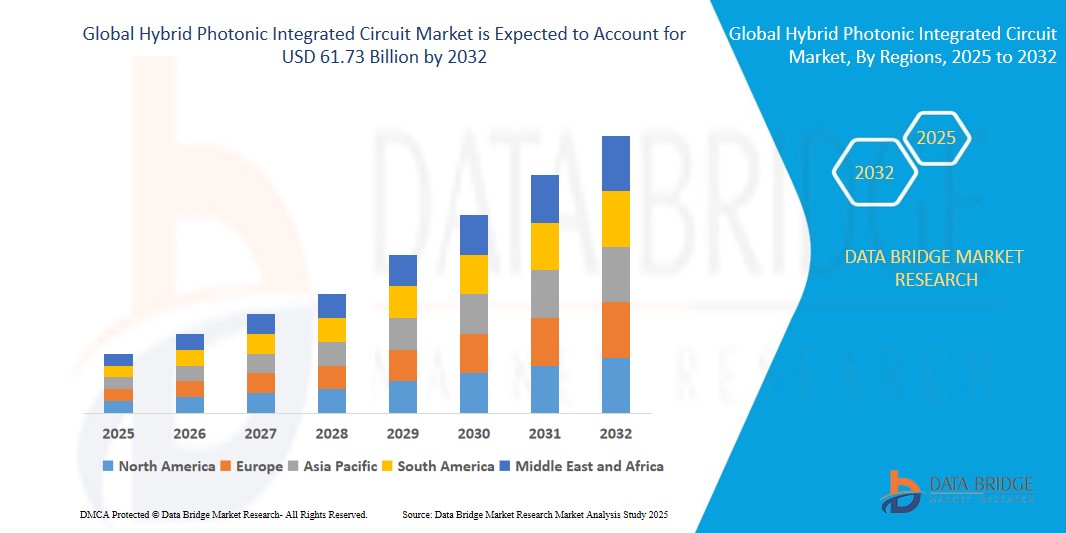
- The Global Hybrid Photonic Integrated Circuit Market size was valued at USD 12.67 billion in 2024 and is expected to reach USD 61.73 billion by 2032, at a CAGR of 21.8% during the forecast period.
- This growth is driven by surging demand for high-speed data transmission, widespread adoption of 5G and AI-driven technologies, and increasing investments in energy-efficient photonic solutions for telecommunications and data centers.
Hybrid Photonic Integrated Circuit Market Analysis
- Hybrid PICs integrate photonic and electronic components on a single chip, leveraging materials like silicon photonics and III-V compounds to deliver high performance, scalability, and cost-effectiveness in applications such as optical communications, sensing, and biomedical imaging.
- The market is propelled by the global rollout of 5G networks, growing data center infrastructure, and a shift toward sustainable, low-power photonic technologies to meet escalating data traffic demands.
- Asia-Pacific holds a significant market share due to its advanced semiconductor manufacturing, high adoption of PICs in telecommunications, and presence of key players like TSMC and Huawei.
- Asia-Pacific is expected to register the fastest growth, fueled by rapid 5G deployment, increasing AI and cloud computing investments, and government initiatives to boost semiconductor production.
- The Silicon-on-Insulator segment is projected to account for a significant market share of approximately 35.07% in 2025, driven by its cost-effectiveness and compatibility with existing CMOS fabrication processes.
Report Scope and Hybrid Photonic Integrated Circuit Market Segmentation
|
Attributes |
Waterproofing Membrane Key Market Insights |
|
Segments Covered |
|
|
Countries Covered |
North America
Europe
Asia-Pacific
Middle East and Africa
South America
|
|
Key Market Players |
|
|
Market Opportunities |
|
|
Value Added Data Infosets |
In addition to the insights on market scenarios such as market value, growth rate, segmentation, geographical coverage, and major players, the market reports curated by the Data Bridge Market Research also include import export analysis, production capacity overview, production consumption analysis, price trend analysis, climate change scenario, supply chain analysis, value chain analysis, raw material/consumables overview, vendor selection criteria, PESTLE Analysis, Porter Analysis, and regulatory framework. |
Hybrid Photonic Integrated Circuit Market Trends
“Focus on High-Speed Connectivity and Energy Efficiency”
- The global demand for high-bandwidth communication, driven by 5G, AI, and cloud computing, is accelerating the adoption of hybrid PICs, which offer low-latency data transmission and reduced power consumption.
- Government initiatives, such as the U.S. CHIPS Act (2022) and China’s USD 150 billion semiconductor investment (2020–2030), are boosting photonic chip production to support next-generation networks.
- For instance, in March 2024, Broadcom launched Bailly, a 51.2-Tbps co-packaged optics Ethernet switch using silicon photonics, achieving 70% lower power consumption for AI data centers.
- With government involvement and interest in making and maintaining a sustainable environment and making our earth a greener place, wastewater treatment is one of the focuses to achieve this task.
Hybrid Photonic Integrated Circuit Market Dynamics
Driver
“Global Expansion of 5G and Data Center Infrastructure”
- The rapid deployment of 5G networks and the exponential growth of data centers worldwide are key drivers for the hybrid PIC market.
- These circuits enable high-speed optical communication, critical for handling global data traffic projected to reach 175 zettabytes by 2025.
- For instance, in November 2024, the European Commission invested USD 142 million in photonic semiconductor production in the Netherlands, supporting 5G and AI infrastructure.
- The increasing adoption of AI and machine learning in data centers further fuels demand for hybrid PICs, which offer compact, efficient solutions for optical interconnects.
Opportunity
“Growing Demand for Eco-Friendly and Advanced Materials in Hybrid PICs”
- Rising global emphasis on sustainability is driving innovation in eco-friendly materials like silicon-on-insulator and low-power PIC designs, aligning with net-zero goals.
- The development of advanced materials, such as indium phosphide for high-performance lasers
- For instance, in February 2025, STMicroelectronics collaborated with Amazon Web Services to develop an energy-efficient photonics chip for AI data centers, reducing carbon footprints.
- The presents opportunities for market players to attract investment and expand applications in sensing and biomedical fields.
Restraint/Challenge
“High Manufacturing Costs and Supply Chain Constraints”
- The production of hybrid PICs involves complex processes and costly materials like III-V compounds, leading to high initial investment and barriers for smaller players.
- Global supply chain vulnerabilities, particularly for raw materials like indium phosphide, expose the market to risks from geopolitical tensions and shortages.
- For instance, in 2024, disruptions in semiconductor supply chains impacted PIC production, increasing costs and delaying deployments in telecommunications.
Hybrid Photonic Integrated Circuit Market Scope
The global hybrid photonic integrated circuit market is segmented into four notable segments based on raw material, type, usage, and end-use.
|
Segmentation |
Sub-Segmentation |
|
By Raw Material |
|
|
By Type |
|
|
By Usage |
|
|
By End-Use |
|
In 2025, the Silicon-on-Insulator Segment is Projected to Dominate the Raw Material Segment
The Silicon-on-Insulator segment is expected to hold a market share of approximately 35.07% in 2025, driven by its cost-effectiveness, compatibility with CMOS processes, and scalability for telecommunications and data center applications.
The Transceivers Segment is Expected to Account for the Largest Share During the Forecast Period in the Type Market
In 2025, the transceivers segment is projected to account for a market share of 31.23%, driven by growing demand for high-speed optical interconnects in 5G networks and AI-driven data centers.
“Asia-Pacific Holds the Largest Share in the Hybrid Photonic Integrated Circuit Market”
- Asia-Pacific dominates the market due to its advanced semiconductor ecosystem, high adoption of hybrid PICs in telecommunications, and presence of leading vendors like TSMC and Huawei.
- The region holds a significant share, driven by robust demand for PICs in 5G infrastructure, extensive R&D in silicon photonics, and government-backed semiconductor initiatives.
- Asia-Pacific benefits from advancements in cost-effective and high-performance PIC technologies, such as silicon-on-insulator, enhancing efficiency in data centers and telecom networks.
“Asia-Pacific is Projected to Register the Highest CAGR in the Hybrid Photonic Integrated Circuit Market”
- Asia-Pacific’s growth is driven by rapid 5G deployment, increasing investments in AI and cloud computing, and government support for semiconductor manufacturing.
- The region is projected to exhibit the highest CAGR due to its expanding telecommunications infrastructure and strategic investments in photonic chip production.
- The focus on energy efficiency and high-speed connectivity in IT and telecom sectors further accelerates market growth
Hybrid Photonic Integrated Circuit Market Share
The market competitive landscape provides details by competitor. Details included are company overview, company financials, revenue generated, market potential, investment in research and development, new market initiatives, global presence, production sites and facilities, production capacities, company strengths and weaknesses, product launch, product width and breadth, application dominance. The above data points provided are only related to the companies' focus related to market.
The Major Market Leaders Operating in the Market Are:
- Intel Corporation (U.S.)
- Infinera Corporation (U.S.)
- Nokia (Finland)
- Broadcom Inc. (U.S.)
- Cisco Systems, Inc. (U.S.)
- Lumentum Holdings Inc. (U.S.)
- NeoPhotonics Corporation (U.S.)
- Coherent Corp. (II-VI Incorporated) (U.S.)
- STMicroelectronics N.V. (Switzerland)
- TSMC (Taiwan)
- Huawei Technologies Co., Ltd. (China)
- OpenLight (U.S.)
Latest Developments in Europe Waterproofing Membrane Market
- In June 2024, Nokia acquired Infinera for USD 2.3 billion to enhance its optical networks portfolio, leveraging Infinera’s expertise in silicon photonics and hybrid PICs for AI and 5G applications (Source: Reuters).
- In March 2024, Broadcom launched Bailly, a 51.2-Tbps co-packaged optics Ethernet switch using silicon photonics, reducing power consumption by 70% for AI data centers (Source: Broadcom Press Release).
- In February 2025, STMicroelectronics partnered with Amazon Web Services to develop a photonics chip for AI data centers, emphasizing energy efficiency and high-speed processing (Source: STMicroelectronics Press Release).
- In November 2024, TSMC announced a USD 1 billion investment in photonic chip fabrication to support 5G and AI infrastructure, expanding its Taiwan facilities (Source: Nikkei Asia).
- In October 2023, OpenLight partnered with TSMC to offer integrated photonics design services, enhancing hybrid PIC development on indium phosphide and silicon platforms (Source: OpenLight Press Release).

- Interactive Data Analysis Dashboard
- Company Analysis Dashboard for high growth potential opportunities
- Research Analyst Access for customization & queries
- Competitor Analysis with Interactive dashboard
- Latest News, Updates & Trend analysis
- Harness the Power of Benchmark Analysis for Comprehensive Competitor Tracking
Global Hybrid Photonic Integrated Circuit Market, Supply Chain Analysis and Ecosystem Framework
To support market growth and help clients navigate the impact of geopolitical shifts, DBMR has integrated in-depth supply chain analysis into its Global Hybrid Photonic Integrated Circuit Market research reports. This addition empowers clients to respond effectively to global changes affecting their industries. The supply chain analysis section includes detailed insights such as Global Hybrid Photonic Integrated Circuit Market consumption and production by country, price trend analysis, the impact of tariffs and geopolitical developments, and import and export trends by country and HSN code. It also highlights major suppliers with data on production capacity and company profiles, as well as key importers and exporters. In addition to research, DBMR offers specialized supply chain consulting services backed by over a decade of experience, providing solutions like supplier discovery, supplier risk assessment, price trend analysis, impact evaluation of inflation and trade route changes, and comprehensive market trend analysis.
Data collection and base year analysis are done using data collection modules with large sample sizes. The stage includes obtaining market information or related data through various sources and strategies. It includes examining and planning all the data acquired from the past in advance. It likewise envelops the examination of information inconsistencies seen across different information sources. The market data is analysed and estimated using market statistical and coherent models. Also, market share analysis and key trend analysis are the major success factors in the market report. To know more, please request an analyst call or drop down your inquiry.
The key research methodology used by DBMR research team is data triangulation which involves data mining, analysis of the impact of data variables on the market and primary (industry expert) validation. Data models include Vendor Positioning Grid, Market Time Line Analysis, Market Overview and Guide, Company Positioning Grid, Patent Analysis, Pricing Analysis, Company Market Share Analysis, Standards of Measurement, Global versus Regional and Vendor Share Analysis. To know more about the research methodology, drop in an inquiry to speak to our industry experts.
Data Bridge Market Research is a leader in advanced formative research. We take pride in servicing our existing and new customers with data and analysis that match and suits their goal. The report can be customized to include price trend analysis of target brands understanding the market for additional countries (ask for the list of countries), clinical trial results data, literature review, refurbished market and product base analysis. Market analysis of target competitors can be analyzed from technology-based analysis to market portfolio strategies. We can add as many competitors that you require data about in the format and data style you are looking for. Our team of analysts can also provide you data in crude raw excel files pivot tables (Fact book) or can assist you in creating presentations from the data sets available in the report.













