


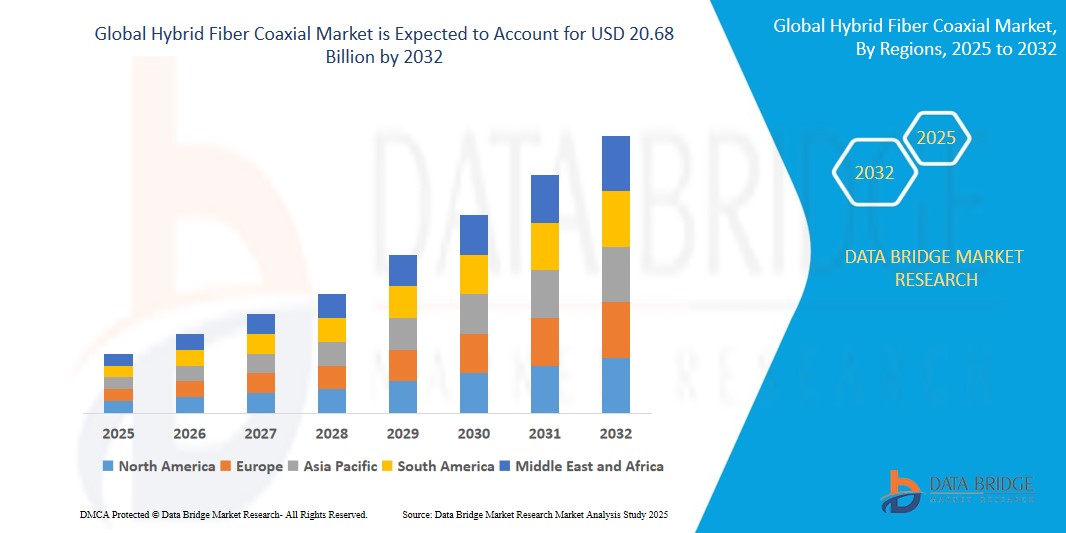
Global Hybrid Fiber Coaxial Market Size
- The Global Hybrid Fiber Coaxial Market size was valued at USD 11.9 billion in 2024 and is expected to reach USD 20.68 billion by 2032, at a CAGR of 8.2% during the forecast period.
- This growth is driven by Increasing consumer need for high-speed internet has pushed operators like Comcast and Charter Communications to upgrade their HFC networks. In 2023, Comcast announced its plan to roll out DOCSIS 4.0, promising gigabit speeds over HFC.
Global Hybrid Fiber Coaxial Market Analysis
-
Rising demand for precise current and voltage measurement in semiconductor R&D is propelling SMU adoption. For example, Keysight Technologies expanded its precision measurement portfolio in 2023 to support semiconductor test applications.
-
HFC provides a balance between performance and cost, allowing telecom companies to upgrade existing infrastructure instead of full fiber deployment. Altice USA, for instance, continued leveraging HFC for rural expansion in 2022.
- North America holds a significant market share due to Cost-Effective Network Expansion.
- Asia-Pacific is expected to register the fastest growth, fuelled by Rising Demand for High-Speed Broadband.
- The DOCSIS 3.0 & Below segment is projected to account for a significant market share of approximately 68.1% in 2025, driven by growth in Video-On-Demand and OTT Services.
Report Scope and Global Hybrid Fiber Coaxial Market Segmentation
|
Attributes |
Global Hybrid Fiber Coaxial Market Key Market Insights |
|
Segments Covered |
|
|
Countries Covered |
North America
Europe
Asia-Pacific
Middle East and Africa
South America
|
|
Key Market Players |
|
|
Market Opportunities |
|
|
Value Added Data Infosets |
In addition to the insights on market scenarios such as market value, growth rate, segmentation, geographical coverage, and major players, the market reports curated by the Data Bridge Market Research also include import export analysis, production capacity overview, production consumption analysis, price trend analysis, climate change scenario, supply chain analysis, value chain analysis, raw material/consumables overview, vendor selection criteria, PESTLE Analysis, Porter Analysis, and regulatory framework. |
Global Hybrid Fiber Coaxial Market Trends
“AI and Machine Learning Integration”
- AI and machine learning technologies are being incorporated into HFC networks to optimize data traffic management, enhance customer experience, and improve network efficiency. These technologies enable predictive maintenance and real-time optimization of energy production.
- HFC networks are increasingly being integrated into smart grid infrastructures, facilitating bidirectional communication and enhancing overall energy efficiency. This integration supports better grid management and contributes to the reliability of energy systems.
- In February 2023, Cisco announced its exit from the HFC networking hardware market to focus on its core technologies, including the Converged Cable Access Platform (CCAP) and Cable Modem Termination Systems (CMTS).
- HFC networks can support 5G small cell backhaul where fiber isn’t feasible. Nokia tested hybrid backhaul with HFC in India in 2023.
Global Hybrid Fiber Coaxial Market Dynamics
Driver
“Increasing Demand for High-Speed Internet”
- The proliferation of digital services, online education, remote work, and streaming platforms is driving the demand for high-speed and reliable internet connectivity, propelling the growth of HFC networks.
- The deployment of advanced technologies such as DOCSIS 3.1 and DOCSIS 4.0 is enhancing the capacity and efficiency of HFC networks, supporting the delivery of gigabit-speed internet services.
- For instance, In August 2022, Corning expanded its optical cable manufacturing capabilities through a long-term partnership with AT&T, aiming to meet the growing demand for fiber internet services in the U.S.
- Countries in Latin America, Africa, and Southeast Asia are rapidly urbanizing. In 2024, Claro Brazil announced new HFC rollouts to meet growing urban demand.
Opportunity
“Expansion in Emerging Markets”
- Rapid urbanization and increasing internet penetration in regions like Asia-Pacific present significant opportunities for the expansion of HFC networks. Countries such as China, Japan, India, and South Korea are investing heavily in HFC infrastructure to improve digital connectivity.
- The convergence of HFC networks with 5G infrastructure is enabling enhanced connectivity and supporting the increased data traffic generated by 5G applications, creating new avenues for market growth.
- For instance, In February 2023, Nokia introduced the Beacon 10, its first gateway supporting Wi-Fi 6E, capable of delivering 10Gbps Wi-Fi speeds, enhancing mesh networking capabilities.
- Streaming services have increased data consumption. Providers like Vodafone upgraded HFC networks in Europe to meet this growing demand in 2023.
Restraint/Challenge
“High Implementation Costs”
- The initial investment required for deploying and upgrading HFC networks, including the installation of fiber-optic cables and integration with existing coaxial networks, can be substantial, posing a barrier to adoption.
- The HFC market is subject to a complex framework of regulations governing spectrum allocation, data privacy, and network security. Navigating these regulatory challenges requires robust compliance strategies and investments in cybersecurity.
- For instance, Regulations in the EU and Asia Pacific increasingly favor full-fiber rollout, affecting HFC investments. Deutsche Telekom in 2023 faced regulatory pressure to shift to fiber in Germany.
- Telecom giants like AT&T and Verizon are shifting investments toward full fiber due to lower latency and future scalability, slowing HFC adoption in urban centres.
Global Hybrid Fiber Coaxial Market Scope
The market is segmented based on Technology, Component, Application.
|
Segmentation |
Sub-Segmentation |
|
By Technology |
|
|
By Component |
|
|
By Application |
|
In 2025, 9CMTS/CCAP segment is projected to dominate the Component segment
The 9CMTS/CCAP segment is expected to hold a market share of approximately 39.3% in 2025, driven by Cost-Effective Network Expansion.
The Digital TV segment is expected to account for the largest share during the forecast period in the Devices market
In 2025, the Digital TV segment is projected to account for a market share of 29.8%, driven by Growth in Video-On-Demand and OTT Services.
“North America Holds the Largest Share in the Global Hybrid Fiber Coaxial Market”
-
North America dominates the market due to Increasing consumer need for high-speed internet has pushed operators like Comcast and Charter Communications to upgrade their HFC networks. In 2023, Comcast announced its plan to roll out DOCSIS 4.0, promising gigabit speeds over HFC.
- The U.S. holds a significant share, driven by Smart City and IoT Initiatives.
- The development of DOCSIS 3.1 and 4.0 boosts HFC efficiency and speed. ARRIS (now part of CommScope) played a pivotal role in deploying DOCSIS 3.1-enabled modems across markets in 2023.
“North America is Projected to Register the Highest CAGR in the Global Hybrid Fiber Coaxial Market”
-
North America’s growth is driven by Growth of IoT and Smart Devices.
- U.S. is projected to exhibit the highest CAGR due to Growth of Semiconductor Industry.
- Bandwidth-heavy applications are driving HFC upgrades in suburban areas. Rogers Communications in Canada began HFC enhancement projects in 2024 to support AR-capable services.
Global Hybrid Fiber Coaxial Market Share
The market competitive landscape provides details by competitor. Details included are company overview, company financials, revenue generated, market potential, investment in research and development, new market initiatives, global presence, production sites and facilities, production capacities, company strengths and weaknesses, product launch, product width and breadth, application dominance. The above data points provided are only related to the companies' focus related to market.
The Major Market Leaders Operating in the Market Are:
- Cisco Systems
- Corning Incorporated
- Ciena Corporation
- Comcast
- CommScope
- Teleste Corporation
- Telstra
- PCT International Inc.
- ASSIA
- Skyworks Solutions Inc.
- Vodafone Group
- CableLabs
- HELUKABEL
- ADTRAN
- KATHREIN SE
- Comba Telecom Systems Holdings Ltd.
- Singtel Optus Pty Limited
- Cyient
- Broadspectrum Pty Ltd.
Latest Developments in Global Hybrid Fiber Coaxial Market
- In August 2022, Corning expanded its optical cable manufacturing capabilities through a long-term partnership with AT&T, aiming to meet the growing demand for fiber internet services in the U.S.
- In February 2023, Nokia introduced the Beacon 10, its first gateway supporting Wi-Fi 6E, capable of delivering 10Gbps Wi-Fi speeds, enhancing mesh networking capabilities.
- In January 2023, Orange Belgium and Telenet extended their commercial wholesale agreements by 15 years, allowing customers access to their respective FTTH and HFC networks, aiming to boost competition and consumer benefits in the Belgian telecom market.
- In September 2022, entered the SMU market with the launch of the GSM-20H10 precision DC SMU, aiming to leverage its technological advantages and extensive experience in power measurement applications.

- Interactive Data Analysis Dashboard
- Company Analysis Dashboard for high growth potential opportunities
- Research Analyst Access for customization & queries
- Competitor Analysis with Interactive dashboard
- Latest News, Updates & Trend analysis
- Harness the Power of Benchmark Analysis for Comprehensive Competitor Tracking
Global Hybrid Fiber Coaxial Market, Supply Chain Analysis and Ecosystem Framework
To support market growth and help clients navigate the impact of geopolitical shifts, DBMR has integrated in-depth supply chain analysis into its Global Hybrid Fiber Coaxial Market research reports. This addition empowers clients to respond effectively to global changes affecting their industries. The supply chain analysis section includes detailed insights such as Global Hybrid Fiber Coaxial Market consumption and production by country, price trend analysis, the impact of tariffs and geopolitical developments, and import and export trends by country and HSN code. It also highlights major suppliers with data on production capacity and company profiles, as well as key importers and exporters. In addition to research, DBMR offers specialized supply chain consulting services backed by over a decade of experience, providing solutions like supplier discovery, supplier risk assessment, price trend analysis, impact evaluation of inflation and trade route changes, and comprehensive market trend analysis.
Data collection and base year analysis are done using data collection modules with large sample sizes. The stage includes obtaining market information or related data through various sources and strategies. It includes examining and planning all the data acquired from the past in advance. It likewise envelops the examination of information inconsistencies seen across different information sources. The market data is analysed and estimated using market statistical and coherent models. Also, market share analysis and key trend analysis are the major success factors in the market report. To know more, please request an analyst call or drop down your inquiry.
The key research methodology used by DBMR research team is data triangulation which involves data mining, analysis of the impact of data variables on the market and primary (industry expert) validation. Data models include Vendor Positioning Grid, Market Time Line Analysis, Market Overview and Guide, Company Positioning Grid, Patent Analysis, Pricing Analysis, Company Market Share Analysis, Standards of Measurement, Global versus Regional and Vendor Share Analysis. To know more about the research methodology, drop in an inquiry to speak to our industry experts.
Data Bridge Market Research is a leader in advanced formative research. We take pride in servicing our existing and new customers with data and analysis that match and suits their goal. The report can be customized to include price trend analysis of target brands understanding the market for additional countries (ask for the list of countries), clinical trial results data, literature review, refurbished market and product base analysis. Market analysis of target competitors can be analyzed from technology-based analysis to market portfolio strategies. We can add as many competitors that you require data about in the format and data style you are looking for. Our team of analysts can also provide you data in crude raw excel files pivot tables (Fact book) or can assist you in creating presentations from the data sets available in the report.













