Global High Strength Steel Market
Market Size in USD Billion
CAGR :
% 
 USD
39.82 Billion
USD
57.70 Billion
2024
2032
USD
39.82 Billion
USD
57.70 Billion
2024
2032
 Forecast Period Forecast Period |
2025 –2032 |
 Market Size (Base Year) Market Size (Base Year) |
USD 39.82 Billion |
 Market Size (Forecast Year) Market Size (Forecast Year) |
USD 57.70 Billion |
 CAGR CAGR |
% |
| Major Markets Players |
|
Global High Strength Steel Market Size
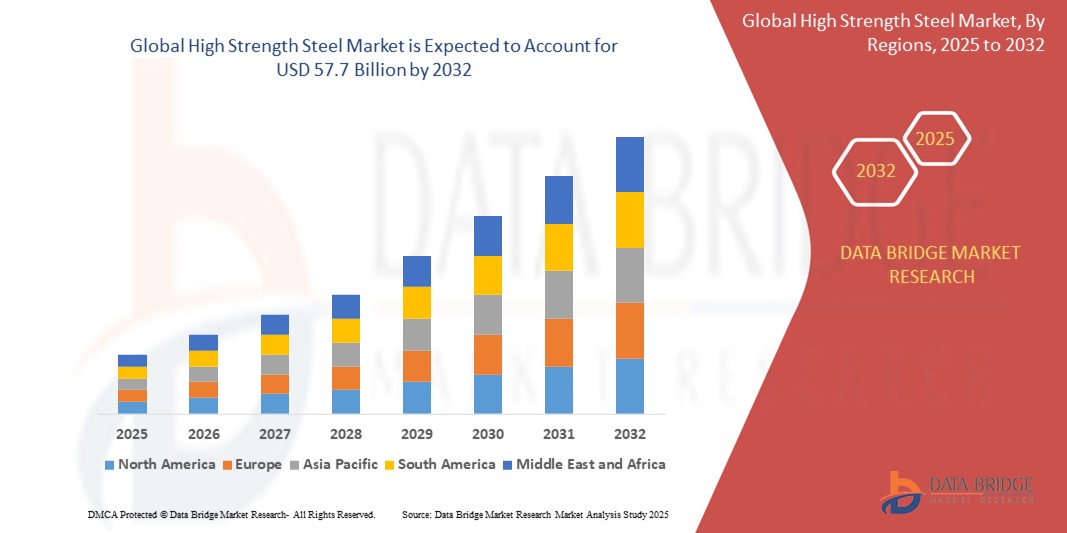
- The Global High Strength Steel Market size was valued at USD 39.82 billion in 2024 and is expected to reach USD 57.7 billion by 2032, at a CAGR of 6.8% during the forecast period
- The market growth is largely fueled by the increasing consumption of high strength steels in the automotive and construction industries. This is driven by the need to improve fuel efficiency and safety in vehicles through lightweighting, and to ensure high strength and improved safety features in buildings and infrastructure
- Furthermore, rising global urbanization and infrastructure development projects are establishing high strength steel as a vital material for modern construction of high-rise buildings, bridges, and other large structures. These converging factors are accelerating the uptake of high strength steel solutions, thereby significantly boosting the industry's growth
Global High Strength Steel Market Analysis
- High strength steel (HSS), characterized by its enhanced mechanical properties, including high yield and tensile strength, is an increasingly vital material component across modern industrial sectors, particularly in automotive and construction, due to its ability to enable lightweighting, improve safety, and enhance structural integrity
- The escalating demand for high strength steel is primarily fueled by stringent regulations on vehicle emissions and safety, driving the need for lighter yet stronger automotive components, coupled with rapid global urbanization and infrastructure development requiring durable and efficient construction materials
- Asia-Pacific dominates the global high strength steel market, accounting for the largest revenue share of approximately 48.9% in 2024, attributed to rapid industrialization, urbanization, and significant infrastructure growth in countries like China, India, Japan, and South Korea. This region benefits from a robust manufacturing base and substantial consumption of HSS in its flourishing automotive and construction industries
- Asia-Pacific is also expected to be the fastest-growing region in the high strength steel market during the forecast period. This growth is driven by continued strong economic development, increasing investments in new infrastructure projects, and the expanding automotive sector, particularly with the rising production of electric vehicles, which heavily utilize HSS for lightweighting
- The Automotive segment dominates the high strength steel market with the largest revenue share of approximately 82.3% in 2024, owing to its wide range of uses in vehicle bodies, chassis, and safety components. This dominance is driven by the critical need to reduce vehicle weight for improved fuel efficiency and lower emissions, while simultaneously enhancing crashworthiness and passenger safety
Report Scope and Global High Strength Steel Market Segmentation
|
Attributes |
Global High Strength Steel Market Key Market Insights |
|
Segments Covered |
|
|
Countries Covered |
North America
Europe
Asia-Pacific
Middle East and Africa
South America
|
|
Key Market Players |
|
|
Market Opportunities |
|
|
Value Added Data Infosets |
In addition to the insights on market scenarios such as market value, growth rate, segmentation, geographical coverage, and major players, the market reports curated by the Data Bridge Market Research also include import export analysis, production capacity overview, production consumption analysis, price trend analysis, climate change scenario, supply chain analysis, value chain analysis, raw material/consumables overview, vendor selection criteria, PESTLE Analysis, Porter Analysis, and regulatory framework. |
Global High Strength Steel Market Trends
"Digitalization and Industry 4.0 Integration for Optimized Production"
- A significant and accelerating trend in the global high strength steel market is the deepening integration of digitalization, Industry 4.0 technologies, and advanced analytics into steel manufacturing processes. This fusion of technologies is profoundly transforming steel production, enhancing efficiency, product quality, and sustainability
- For instance, steel manufacturers are increasingly deploying Industrial Internet of Things (IoT) sensors on furnaces, rolling mills, and other critical equipment to gather real-time data on temperature, pressure, chemical composition, and energy consumption. This allows for immediate adjustments to optimize production, reduce waste, and improve yield quality
- Artificial intelligence (AI) and machine learning (ML) integration in steel production enables features such as predictive maintenance, anticipating equipment failures to minimize downtime and costs. AI systems can also process data from visual inspections and sensors to detect surface defects or structural irregularities in real-time, ensuring higher product quality and reducing rework
- The seamless integration of these digital technologies, including digital twins (virtual replicas of physical assets), facilitates centralized control and optimization across the entire production line. This creates a "smart" ecosystem that adapts quickly to changes, optimizes energy use, and streamlines supply chains from raw material sourcing to finished product delivery
- This trend towards more intelligent, automated, and interconnected steel manufacturing systems is fundamentally reshaping industry expectations for efficiency, quality, and environmental performance. Consequently, companies are investing heavily in R&D to adopt Industry 4.0 solutions, focusing on data-driven decision-making, robotic automation, and advanced process control
- The demand for high strength steel produced with these advanced, digitalized methods is growing rapidly across end-use industries like automotive and construction, as consumers and industries increasingly prioritize both material performance and the sustainability credentials of their suppliers
Global High Strength Steel Market Dynamics
Driver
"Increasing Demand from Automotive Lightweighting and Stringent Safety Regulations"
- The increasing prevalence of global regulations aimed at improving fuel efficiency and reducing emissions, coupled with rising consumer and regulatory demands for enhanced vehicle safety, is a significant driver for the heightened demand for high strength steel in the automotive industry. High strength steel (HSS) enables lightweighting of vehicles without compromising structural integrity or safety.
- For instance, in 2024, vehicle manufacturers are increasingly incorporating Advanced High Strength Steels (AHSS) into vehicle bodies, chassis, and safety components, as highlighted by a focus on reducing overall vehicle weight by 35-40% compared to traditional steel. Such widespread adoption by leading automotive companies is expected to drive significant growth in the high strength steel market during the forecast period.
- As consumers become more aware of the benefits associated with lighter, safer vehicles, including improved fuel economy and enhanced crashworthiness, they are increasingly seeking vehicles that utilize these advanced materials.
- Furthermore, the rising global production of electric vehicles (EVs) is making high strength steel an integral component of battery casings and structural elements due to its strength-to-weight ratio. HSS products offer seamless integration into modern vehicle designs and provide superior performance in absorbing crash energy.
- The convenience of readily available HSS grades that meet stringent safety standards, coupled with continuous innovation in steel manufacturing processes (like hot stamping), are key factors propelling the adoption of high strength steel in the automotive sector. The trend towards sustainable and resource-efficient manufacturing further contributes to market growth.
Restraint/Challenge
"High Production Costs and Complex Manufacturing Processes"
- Concerns surrounding the relatively higher initial production costs of some high strength steel grades, coupled with the need for specialized and complex manufacturing and forming techniques, pose a significant challenge to broader market penetration
- For instance, advanced high strength steel (AHSS) often requires specialized forming, welding, and heat treatment processes compared to conventional steel. This complexity can lead to increased manufacturing costs and may necessitate significant capital investment in new equipment or training for manufacturers. High-profile reports on the difficulties in forming complex shapes or issues with batch-to-batch inconsistency have made some manufacturers hesitant to fully transition to these new materials
- Addressing these challenges through continuous innovation in metallurgy, production technologies, and processing techniques (such as improved hot stamping methods and roll forming) is crucial for building manufacturer confidence and reducing overall cost
- Companies are actively investing in R&D to develop more cost-effective production methods and improve the formability and weldability of high strength steel. Additionally, while the long-term benefits (like weight savings and improved performance) can offset the initial investment, the perceived higher upfront cost compared to traditional steel can be a barrier for price-sensitive industries or smaller manufacturers, particularly in developing regions
- Overcoming these challenges through enhanced product development, technological advancements to streamline manufacturing, and clearer demonstration of the long-term economic and performance benefits will be vital for sustained market growth
Global High Strength Steel Market Scope
The market is segmented on the basis application, product type, technology, magnification type, end user
- By Grade
On the basis of grade, the high strength steel market is segmented into High Strength Low Alloy, Dual Phase, Transformation Induced Plasticity, Bake Hardenable, Rephosphorised steel, and Interstitial Free. The High Strength Low Alloy (HSLA) segment dominates the largest market revenue share of 36.3% in 2024, driven by its superior mechanical properties, including higher toughness, ductility, high formability, weldability, and excellent corrosion resistance compared to ordinary carbon steels. HSLA steels are widely adopted in automotive and construction sectors due to their versatility and cost-efficiency
The Dual Phase (DP) segment is anticipated to witness the fastest growth rate of 8.0% from 2025 to 2032, fueled by its increasing utilization in vehicle body components such as hoods, doors, and rails. Dual Phase steels offer an excellent balance of high strength and formability, making them ideal for lightweighting initiatives and enhancing crash safety in the automotive industry
- By Product Type
On the basis of product type, the high strength steel market is segmented into Cold Rolled, Hot Rolled, Metallic Coated, and Direct Rolled. The Hot Rolled segment holds a significant share due to its extensive applications in structural components across various industries, offering cost-effectiveness and ease of production. These product types are crucial in shaping the properties and applications of high strength steel, catering to diverse industrial requirements
- By End User
On the basis of end user, the high strength steel market is segmented into Automotive, Construction, Heavy Machinery, Ship Building, Aerospace, Energy & Power, Packaging, and Consumer Goods. The Automotive segment accounted for the largest market revenue share of 82.3% in 2024, driven by the critical need for lightweighting, improved fuel efficiency, and enhanced safety features in modern vehicles. High strength steel is essential for manufacturing vehicle bodies, chassis, and safety components that meet stringent regulatory standards
The Construction segment is expected to witness the fastest CAGR of 10.1% from 2025 to 2032, fueled by rapid urbanization, increasing infrastructure development projects, and the growing demand for durable and sustainable building materials globally. High strength steel is vital for developing high-rise buildings, bridges, and other large structures due to its superior strength-to-weight ratio
Global High Strength Steel Market Regional Analysis
- Asia-Pacific dominates the global high strength steel market with the largest revenue share of approximately 48.9% in 2024, driven by rapid industrialization, extensive urbanization, and significant infrastructure development across its major economies
- The region's consumers and industries highly value the performance benefits of high strength steel, including its ability to enable lightweighting in vehicles and provide superior structural integrity in construction
- This widespread adoption is further supported by robust manufacturing capabilities, increasing investments in the automotive and construction sectors, and growing focus on sustainable and efficient material solutions, establishing high strength steel as a critical component for regional growth
China High Strength Steel Market Insight
The China high strength steel market captured a substantial revenue share within Asia-Pacific, fueled by the country's booming automotive industry, aggressive infrastructure development, and continuous urbanization. Manufacturers are increasingly prioritizing the use of HSS for lightweighting vehicles to meet emission standards and for constructing resilient, high-rise buildings. The growing preference for advanced materials, combined with robust government initiatives promoting smart cities and sustainable development, further propels the high strength steel industry. Moreover, China's position as a global manufacturing hub significantly contributes to the market's expansion
North America High Strength Steel Market Insight
The North America high strength steel market is projected to expand at a substantial CAGR throughout the forecast period, primarily driven by stringent automotive fuel efficiency and safety regulations, coupled with ongoing investments in infrastructure upgrades. The increasing demand for lightweight vehicles, including electric vehicles (EVs), is fostering the adoption of HSS. North American consumers are also drawn to the enhanced safety and performance these materials offer in various applications. The region is experiencing significant growth across automotive, construction, and heavy machinery sectors, with HSS being incorporated into both new designs and retrofitting projects
U.S. High Strength Steel Market Insight
The U.S. high strength steel market is anticipated to grow at a noteworthy CAGR during the forecast period, driven by the escalating trend of automotive lightweighting and a desire for heightened safety and performance in vehicles and infrastructure. Additionally, concerns regarding structural integrity and durability are encouraging engineers and manufacturers to choose high strength steel solutions. The U.S.'s embrace of advanced manufacturing technologies, alongside its robust automotive and construction industries, is expected to continue to stimulate market growth
Europe High Strength Steel Market Insight
The Europe high strength steel market is expected to expand at a considerable CAGR during the forecast period, fueled by increasing awareness of material efficiency and the demand for technologically advanced, eco-conscious solutions. Europe’s well-developed industrial infrastructure, combined with its emphasis on innovation and sustainability, promotes the adoption of high strength steel, particularly in automotive manufacturing, renewable energy infrastructure, and advanced construction projects. The integration of HSS with advanced engineering solutions is also becoming increasingly prevalent, with a strong preference for durable, high-performance materials aligning with local industry expectations
Germany High Strength Steel Market Insight
The Germany high strength steel market is anticipated to grow at a noteworthy CAGR during the forecast period, driven by its strong automotive manufacturing base, stringent safety and environmental regulations, and a focus on engineering excellence. German automakers are leading the charge in utilizing HSS for vehicle lightweighting and improved crash performance. Additionally, the country's emphasis on sustainable construction practices and high-quality infrastructure projects fuels the demand for advanced steel grades. Germany's robust R&D landscape and its commitment to Industry 4.0 in steel production are expected to continue to stimulate market growth
The Major Market Leaders Operating in the Market Are:
- POSCO (South Korea)
- ArcelorMittal S.A. (Luxembourg)
- Nippon Steel & Sumitomo Metal Corporation (Japan)
- HBIS Group (China)
- HYUNDAI STEEL (South Korea)
- AK Steel Corporation (United States)
- Voestalpine AG (Austria)
- SSAB AB (Sweden)
- Angang Steel Company Limited (China)
- Shanghai Baosteel Chemical Co., Ltd. (A Subsidiary of Baosteel Co., Ltd.) (China)
- Shougang Group (China)
- Thyssenkrupp AG (Germany)
- Shandong Iron and Steel Group Co., Ltd. (China)
- Benxi Steel Group (China)
- JFE Steel Corporation (Japan)
- United States Steel Corporation (United States)
- SAIL (Steel Authority of India Limited) (India)
- JSW Steel Limited (India)
- Tata Steel (India)
- NUCOR Corporation (United States)
Latest Developments in the Global High Strength Steel Market
- In February 2025, ArcelorMittal announced the development of a new generation of ultra-high-strength steel (UHSS) grades under its Fortiform and Usibor product lines, aimed at reducing vehicle weight by up to 15% without compromising safety, in response to increasing demand from electric vehicle (EV) manufacturers in Europe and North America.
- In January 2025, POSCO (South Korea) unveiled its Giga Steel solution for next-generation automotive applications, which achieves tensile strength exceeding 1,000 MPa with enhanced formability, allowing automakers to meet both crash safety standards and lightweight design targets for EVs.
- In November 2024, Nippon Steel Corporation (Japan) partnered with Toyota to co-develop advanced high strength steel (AHSS) grades for use in EV frames and battery enclosures, integrating thermal and corrosion resistance with structural integrity for improved energy efficiency.
- In October 2024, SSAB (Sweden) expanded its Green Steel initiative with the launch of fossil-free high strength steel variants using HYBRIT technology, which replaces coal with hydrogen in the steel-making process, marking a significant step toward sustainability in the heavy machinery and construction sectors.
SKU-
Get online access to the report on the World's First Market Intelligence Cloud
- Interactive Data Analysis Dashboard
- Company Analysis Dashboard for high growth potential opportunities
- Research Analyst Access for customization & queries
- Competitor Analysis with Interactive dashboard
- Latest News, Updates & Trend analysis
- Harness the Power of Benchmark Analysis for Comprehensive Competitor Tracking
Global High Strength Steel Market, Supply Chain Analysis and Ecosystem Framework
To support market growth and help clients navigate the impact of geopolitical shifts, DBMR has integrated in-depth supply chain analysis into its Global High Strength Steel Market research reports. This addition empowers clients to respond effectively to global changes affecting their industries. The supply chain analysis section includes detailed insights such as Global High Strength Steel Market consumption and production by country, price trend analysis, the impact of tariffs and geopolitical developments, and import and export trends by country and HSN code. It also highlights major suppliers with data on production capacity and company profiles, as well as key importers and exporters. In addition to research, DBMR offers specialized supply chain consulting services backed by over a decade of experience, providing solutions like supplier discovery, supplier risk assessment, price trend analysis, impact evaluation of inflation and trade route changes, and comprehensive market trend analysis.
Research Methodology
Data collection and base year analysis are done using data collection modules with large sample sizes. The stage includes obtaining market information or related data through various sources and strategies. It includes examining and planning all the data acquired from the past in advance. It likewise envelops the examination of information inconsistencies seen across different information sources. The market data is analysed and estimated using market statistical and coherent models. Also, market share analysis and key trend analysis are the major success factors in the market report. To know more, please request an analyst call or drop down your inquiry.
The key research methodology used by DBMR research team is data triangulation which involves data mining, analysis of the impact of data variables on the market and primary (industry expert) validation. Data models include Vendor Positioning Grid, Market Time Line Analysis, Market Overview and Guide, Company Positioning Grid, Patent Analysis, Pricing Analysis, Company Market Share Analysis, Standards of Measurement, Global versus Regional and Vendor Share Analysis. To know more about the research methodology, drop in an inquiry to speak to our industry experts.
Customization Available
Data Bridge Market Research is a leader in advanced formative research. We take pride in servicing our existing and new customers with data and analysis that match and suits their goal. The report can be customized to include price trend analysis of target brands understanding the market for additional countries (ask for the list of countries), clinical trial results data, literature review, refurbished market and product base analysis. Market analysis of target competitors can be analyzed from technology-based analysis to market portfolio strategies. We can add as many competitors that you require data about in the format and data style you are looking for. Our team of analysts can also provide you data in crude raw excel files pivot tables (Fact book) or can assist you in creating presentations from the data sets available in the report.