


What is the Hemostasis and Tissue Sealing Agents Market Size and Overview?
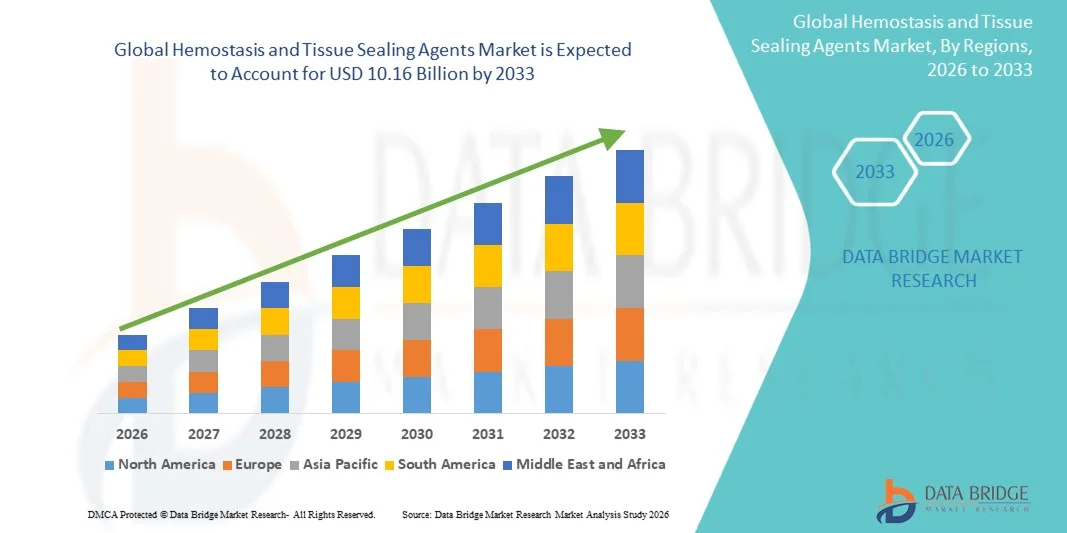
- As per Data Bridge Market Research Analysis the global hemostasis and tissue sealing agents market size was valued at USD 5.77 billion in 2025 and is expected to reach USD 10.16 billion by 2033, at a CAGR of 7.33% during the forecast period
- The market growth is largely fueled by the increasing volume of surgical procedures, along with continuous technological advancements in hemostasis and tissue sealing products, leading to improved clinical outcomes and greater adoption across hospitals, ambulatory surgical centers, and specialty clinics
- Furthermore, rising demand for effective bleeding control, shorter procedure times, and minimally invasive surgical solutions is establishing hemostasis and tissue sealing agents as essential tools in modern surgical practice. These converging factors are accelerating the uptake of Hemostasis and Tissue Sealing Agents solutions, thereby significantly boosting the industry’s growth
Market Size & Forecast
- Global Market Value (2025): USD 5.77 billion
- Expected Market Value (2033): USD 10.16 billion
- Forecast CAGR (2026–2033): 7.33%
- Leading Region in 2025: North America
- Fastest Growing Region: Asia-Pacific
Hemostasis and Tissue Sealing Agents Market Analysis
- Hemostasis and tissue sealing agents, used to control bleeding and seal tissues during surgical and interventional procedures, are increasingly vital components of modern healthcare due to their ability to reduce blood loss, shorten procedure times, and improve patient outcomes across hospitals and ambulatory surgical centers
- The escalating demand for hemostasis and tissue sealing agents is primarily fueled by the rising volume of surgical procedures, growing adoption of minimally invasive techniques, increasing prevalence of chronic diseases, and the need for effective and reliable bleeding control solutions
- North America dominated the hemostasis and tissue sealing agents market with the largest revenue share of approximately 36.5% in 2025, supported by advanced healthcare infrastructure, high surgical procedure volumes, favorable reimbursement policies, and a strong presence of leading medical device manufacturers, with the U.S. contributing the majority of regional revenue
- Asia-Pacific is expected to be the fastest-growing region in the hemostasis and tissue sealing agents market during the forecast period, driven by expanding healthcare infrastructure, rising surgical volumes, increasing healthcare expenditure, and growing adoption of advanced surgical technologies in countries such as China and India
- The Topical Hemostats segment dominated the market, accounting for approximately 58.4% of the global revenue share in 2025, driven by their widespread use across a broad range of surgical procedures.
Report Scope and Hemostasis and Tissue Sealing Agents Market Segmentation
|
Attributes |
Hemostasis and Tissue Sealing Agents Key Market Insights |
|
Segments Covered |
|
|
Countries Covered |
North America
Europe
Asia-Pacific
Middle East and Africa
South America
|
|
Key Market Players |
|
|
Market Opportunities |
|
|
Value Added Data Infosets |
In addition to the insights on market scenarios such as market value, growth rate, segmentation, geographical coverage, and major players, the market reports curated by the Data Bridge Market Research also include in-depth expert analysis, patient epidemiology, pipeline analysis, pricing analysis, and regulatory framework. |
What is the Key Trend in the Hemostasis and Tissue Sealing Agents Market ?
“Advancements in Surgical Techniques and Preference for Minimally Invasive Procedures”
- A significant and accelerating trend in the global hemostasis and tissue sealing agents market is the growing adoption of minimally invasive and advanced surgical procedures, which require rapid, effective, and reliable bleeding control solutions. As surgical techniques evolve, there is increasing demand for hemostatic agents and tissue sealants that offer faster action, improved precision, and reduced operative time
- For instance, in March 2023, Johnson & Johnson’s Ethicon launched its advanced fibrin sealant system in Europe, designed to provide rapid hemostasis during laparoscopic and robotic-assisted surgeries, helping surgeons control bleeding efficiently in minimally invasive procedures
- The rising use of laparoscopic, robotic-assisted, and endoscopic surgeries across specialties such as cardiovascular, orthopedic, neurological, and general surgery is driving demand for advanced hemostasis products that can perform effectively in confined surgical fields
- Technological advancements in biocompatible materials, including collagen-based, fibrin-based, gelatin-based, and synthetic polymer sealants, are enhancing product efficacy and safety. These innovations improve tissue adhesion, promote faster wound healing, and reduce postoperative complications such as infection and re-bleeding
- In addition, the shift toward outpatient and same-day surgical procedures is encouraging the adoption of fast-acting hemostatic solutions that support quicker recovery times and shorter hospital stays. This trend is reshaping clinical preferences and influencing purchasing decisions among hospitals and ambulatory surgical centers
- Overall, the continuous evolution of surgical practices and emphasis on improved patient outcomes are reinforcing the role of hemostasis and tissue sealing agents as essential tools in modern surgical care
Hemostasis and Tissue Sealing Agents Market Dynamics
Driver
“Rising Surgical Volume and Growing Burden of Chronic Diseases”
- The increasing number of surgical procedures worldwide, driven by the rising prevalence of chronic diseases such as cardiovascular disorders, cancer, diabetes, and orthopedic conditions, is a major driver of the Hemostasis and Tissue Sealing Agents market
- These conditions often require complex surgical interventions where effective bleeding management is critical
- For instance, in January 2024, Baxter International expanded its hemostatic product portfolio in North America to support growing demand for cardiac and orthopedic surgeries, highlighting how rising surgical volumes are directly influencing product adoption
- In addition, improvements in healthcare infrastructure, expanding access to surgical care in emerging economies, and increased healthcare spending are supporting market growth. Hospitals and surgical centers are increasingly adopting advanced hemostasis products to improve procedural efficiency, reduce transfusion requirements, and enhance patient safety
- The emphasis on reducing surgical complications, minimizing blood loss, and lowering overall treatment costs is driving clinicians to prefer hemostatic agents and sealants over conventional methods. These factors collectively position rising surgical demand as a key growth catalyst for the market
Restraint/Challenge
“High Product Costs and Risk of Adverse Reactions”
- One of the major challenges facing the hemostasis and tissue sealing agents market is the high cost of advanced products, particularly biologic and combination-based sealants. These products can significantly increase procedural costs, limiting their adoption in cost-sensitive healthcare settings and low- and middle-income regions
- For instance, in September 2022, Medtronic reported that limited adoption of its synthetic sealants in Southeast Asian hospitals was due to high pricing compared to traditional hemostats, demonstrating how cost remains a key barrier to market growth
- In addition, concerns regarding potential adverse reactions, such as immunogenic responses, infection risk, or delayed healing—particularly with animal- or human-derived products—pose challenges to wider clinical acceptance. Strict regulatory requirements and the need for extensive clinical validation can also delay product approvals and market entry
- Variability in product performance depending on surgical type, patient condition, and application technique further complicates adoption. Surgeons often require specialized training to ensure proper use, which can act as a barrier in resource-limited settings
- Addressing these challenges through cost-effective product development, improved safety profiles, and enhanced clinician education will be essential for sustained market growth. Ongoing research into synthetic and next-generation bioengineered sealants is expected to help mitigate these limitations over time
Hemostasis and Tissue Sealing Agents Market Scope
The market is segmented on the basis of product type, material type, application, and end users.
• By Product Type
On the basis of product type, the Global Hemostasis and Tissue Sealing Agents market is segmented into Topical Hemostats and Adhesive and Tissue Sealants. The Topical Hemostats segment dominated the market, accounting for approximately 58.4% of the global revenue share in 2025, driven by their widespread use across a broad range of surgical procedures. Topical hemostats are extensively adopted in general surgery, orthopedic surgery, cardiovascular surgery, and trauma care due to their rapid bleeding control and ease of application. Hospitals prefer topical hemostats for their effectiveness in controlling mild to moderate bleeding without complex preparation. Their compatibility with both open and minimally invasive surgeries further supports strong adoption. Increasing surgical volumes globally significantly contribute to segment dominance. The availability of multiple formats such as sponges, powders, and matrices enhances clinical flexibility. Strong physician familiarity and long-standing clinical usage reinforce preference. Favorable reimbursement policies in developed markets support revenue growth. Continuous product improvements enhance efficacy and safety. Rising demand in emergency and trauma care settings further strengthens dominance. The segment benefits from cost-effectiveness compared to advanced sealants. High procedural frequency ensures consistent revenue generation.
The Adhesive and Tissue Sealants segment is expected to witness the fastest growth, registering a CAGR of 17.9% from 2026 to 2033, driven by increasing adoption in advanced and minimally invasive surgeries. Tissue sealants provide superior wound closure and leakage prevention, particularly in cardiovascular, neurological, and laparoscopic procedures. Rising preference for sutureless and minimally invasive techniques accelerates demand. Sealants reduce surgery time and postoperative complications, improving patient outcomes. Growing use in complex surgeries enhances market penetration. Advancements in bio-based and synthetic sealant formulations support expansion. Increasing focus on reducing blood loss and infection risk boosts adoption. Expanding applications in robotic-assisted surgeries further drive growth. Higher adoption in developed healthcare systems supports CAGR acceleration. Clinical evidence supporting improved healing outcomes strengthens demand. Growing surgeon awareness fuels market uptake. Expanding product pipelines from key players accelerate innovation. Increased investment in surgical care infrastructure sustains rapid growth.
• By Material Type
On the basis of material type, the market is segmented into Collagen-Based, Oxidized Regenerated Cellulose (ORC) Based, Gelatin-Based, Polysaccharide-Based, and Others. The Collagen-Based segment dominated the market, holding a revenue share of 34.6% in 2025, due to its superior biocompatibility and strong hemostatic properties. Collagen-based agents promote platelet aggregation and rapid clot formation, making them highly effective in surgical bleeding control. These materials are widely used in cardiovascular, orthopedic, and general surgeries. Strong absorption capability enhances clinical efficiency. High safety profile supports repeated use. Hospitals favor collagen-based products due to predictable performance. Increasing surgical procedures globally strengthen dominance. Established clinical guidelines support collagen usage. Favorable physician preference contributes to high adoption. Strong presence of leading manufacturers ensures product availability. Regulatory approvals across major markets support expansion. Reduced risk of adverse reactions enhances trust. Consistent demand ensures steady revenue contribution.
The Polysaccharide-Based segment is anticipated to grow at the fastest CAGR of 18.6% from 2026 to 2033, driven by advancements in plant-based and synthetic formulations. These materials offer rapid absorption and minimal tissue reaction. Growing preference for biodegradable and bioresorbable materials supports adoption. Increasing use in minimally invasive procedures accelerates growth. Polysaccharide agents reduce postoperative inflammation and complications. Expanding clinical applications enhance utilization. Rising focus on patient safety drives demand. Cost-effectiveness compared to collagen-based agents supports adoption in emerging markets. Growing R&D investments fuel innovation. Surgeons increasingly adopt polysaccharide agents for versatility. Expanding regulatory approvals boost commercial availability. Increasing outpatient surgical procedures support growth. Technological improvements sustain high CAGR.
• By Application
On the basis of application, the market is segmented into General Surgery, Minimally Invasive Surgery, and Others. The General Surgery segment dominated the market, capturing 49.2% of the revenue share in 2025, due to the high volume of surgical procedures performed globally. Hemostasis and tissue sealing agents are routinely used in abdominal, gastrointestinal, and trauma surgeries. Increasing prevalence of chronic diseases drives surgical demand. General surgery procedures often involve significant bleeding risks, necessitating hemostatic solutions. Hospitals rely heavily on these agents for bleeding control. Broad applicability supports dominance. Growing aging population increases surgical interventions. Improved surgical access in developing regions strengthens demand. High adoption across emergency surgeries supports revenue. Surgeon familiarity enhances usage rates. Favorable clinical outcomes reinforce adoption. Continuous procedural demand ensures steady growth. Strong reimbursement coverage supports utilization.
The Minimally Invasive Surgery segment is projected to register the fastest CAGR of 19.3% from 2026 to 2033, driven by the global shift toward less invasive procedures. Minimally invasive surgeries require precise bleeding control, increasing reliance on advanced sealing agents. Reduced hospital stays and faster recovery drive preference. Increasing adoption of laparoscopic and robotic surgeries accelerates growth. Tissue sealants enhance procedural efficiency. Rising patient preference for minimally invasive treatments supports expansion. Growing surgeon expertise fuels adoption. Technological innovations improve product compatibility. Expanding surgical centers enhance access. Favorable outcomes drive repeat usage. Increased healthcare spending supports growth. Strong pipeline of minimally invasive devices sustains demand. Rapid expansion in developed and emerging markets drives CAGR.
• By End Users
On the basis of end users, the market is segmented into Hospitals, Ambulatory Surgical Centers, Home Care Settings, and Others. The Hospitals segment dominated the market, accounting for 62.1% of revenue share in 2025, due to high surgical volumes and advanced infrastructure. Hospitals handle complex and high-risk surgeries requiring effective bleeding control. Availability of skilled surgeons supports usage. Strong procurement capabilities ensure consistent supply. Hospitals prefer advanced hemostatic agents for safety. Rising inpatient admissions support dominance. Increasing trauma and emergency cases boost demand. Favorable reimbursement supports adoption. Continuous surgical workflow sustains consumption. Presence of specialized departments enhances usage. Technological integration supports product utilization. Growing hospital expansions increase capacity. Dominant purchasing power ensures leadership.
The Ambulatory Surgical Centers segment is expected to grow at the fastest CAGR of 20.1% from 2026 to 2033, driven by the shift toward outpatient surgeries. ASCs offer cost-effective and efficient surgical care. Increasing minimally invasive procedures boost adoption. Shorter patient stays increase procedure turnover. Growing preference for same-day surgeries supports growth. Expanding ASC networks fuel demand. Lower operational costs attract patients and providers. Rising insurance coverage supports utilization. Technological advancements improve surgical outcomes. Surgeons increasingly prefer ASCs for select procedures. Increasing patient convenience drives volumes. Regulatory support enhances expansion. Strong growth momentum sustains high CAGR.
Hemostasis and Tissue Sealing Agents Market Regional Analysis
- North America dominated the hemostasis and tissue sealing agents market with the largest revenue share of approximately 36.5% in 2025, supported by advanced healthcare infrastructure, high surgical procedure volumes, favorable reimbursement policies, and a strong presence of leading medical device manufacturers, with the U.S. contributing the majority of regional revenue
- Consumers in the region highly value advanced surgical technologies, reliable hemostatic solutions, and efficient tissue sealing products for use in cardiovascular, orthopedic, and general surgeries
- This widespread adoption is further supported by high healthcare spending, a technologically advanced hospital network, and a growing emphasis on patient safety and minimally invasive procedures, establishing hemostasis and tissue sealing agents as a preferred solution for surgical care
U.S. Hemostasis and Tissue Sealing Agents Market Insight
The U.S. hemostasis and tissue sealing agents market captured the largest revenue share of 81% in 2025 within North America, fueled by high surgical volumes, advanced hospital infrastructure, and the adoption of minimally invasive procedures. Consumers and healthcare providers are increasingly prioritizing efficient bleeding management, reduced operative complications, and faster recovery times. The growing preference for clinically validated, high-quality hemostatic agents and tissue sealants further propels the Hemostasis and Tissue Sealing Agents industry. Moreover, the increasing integration of advanced surgical techniques and technologies, such as robotic-assisted and laparoscopic procedures, is significantly contributing to the market's expansion.
Europe Hemostasis and Tissue Sealing Agents Market Insight
The Europe hemostasis and tissue sealing agents market is projected to expand at a substantial CAGR throughout the forecast period, primarily driven by growing surgical volumes, stringent patient safety regulations, and adoption of minimally invasive surgeries. The increase in hospital procedures, coupled with the demand for reliable hemostasis products, is fostering adoption. European healthcare providers are also drawn to the efficacy, safety, and improved patient outcomes these agents offer. The region is experiencing significant growth across cardiovascular, orthopedic, and general surgery applications, with tissue sealants being incorporated into both new hospitals and surgical center upgrades.
U.K. Hemostasis and Tissue Sealing Agents Market Insight
The U.K. hemostasis and tissue sealing agents market is anticipated to grow at a noteworthy CAGR during the forecast period, driven by the rising number of surgical procedures, growing adoption of minimally invasive techniques, and increasing hospital infrastructure investment. Additionally, the emphasis on patient safety and reduced intraoperative blood loss is encouraging both hospitals and surgical centers to choose advanced hemostasis and tissue sealing agents. The U.K.’s focus on high-quality surgical outcomes, clinical efficiency, and modern operating rooms is expected to continue to stimulate market growth.
Germany Hemostasis and Tissue Sealing Agents Market Insight
The Germany hemostasis and tissue sealing agents market is expected to expand at a considerable CAGR during the forecast period, fueled by increasing awareness of advanced surgical techniques, strong hospital infrastructure, and emphasis on patient safety. Germany’s well-developed healthcare system, combined with its focus on innovation and quality care, promotes the adoption of hemostasis and tissue sealing agents, particularly in cardiovascular and orthopedic surgeries. The integration of next-generation sealants with minimally invasive procedures is also becoming increasingly prevalent, with a strong preference for reliable, high-performance products aligning with local clinical expectations.
Asia-Pacific Hemostasis and Tissue Sealing Agents Market Insight
The Asia-Pacific hemostasis and tissue sealing agents market is poised to grow at the fastest CAGR during the forecast period, driven by expanding healthcare infrastructure, rising surgical volumes, increasing healthcare expenditure, and growing adoption of advanced surgical technologies in countries such as China and India. Furthermore, as APAC emerges as a manufacturing hub for hemostasis and tissue sealing agent components and systems, the availability and accessibility of high-quality products are expanding to a wider healthcare base.
Japan Hemostasis and Tissue Sealing Agents Market Insight
The Japan hemostasis and tissue sealing agents market is gaining momentum due to the country’s advanced healthcare infrastructure, aging population, and high surgical procedure volumes. The Japanese market places a significant emphasis on patient safety, clinical efficacy, and rapid recovery, and the adoption of advanced hemostasis and tissue sealing agents is driven by the increasing number of minimally invasive and high-precision surgeries. Moreover, Japan's focus on technologically advanced surgical solutions and hospital modernization is likely to spur demand for high-performance tissue sealants in both public and private healthcare facilities.
China Hemostasis and Tissue Sealing Agents Market Insight
The China hemostasis and tissue sealing agents market accounted for the largest revenue share in Asia-Pacific in 2025, attributed to the country’s expanding middle class, rising surgical volumes, and strong domestic manufacturing capabilities. China stands as one of the largest markets for advanced surgical technologies, and hemostasis and tissue sealing agents are becoming increasingly prevalent in cardiovascular, orthopedic, and general surgery procedures. The push towards hospital modernization, government healthcare initiatives, and availability of high-quality domestic products are key factors propelling the market in China.
Which are the Top Companies in Hemostasis and Tissue Sealing Agents Market ?
The Hemostasis and Tissue Sealing Agents industry is primarily led by well-established companies, including:
- Baxter International (U.S.)
- Johnson & Johnson (U.S.)
- Medtronic (Ireland)
- BD (U.S.)
- CryoLife (U.S.)
- Stryker (U.S.)
- Smith & Nephew (U.K.)
- Confluent Surgical (U.S.)
- Haemonetics (U.S.)
- Baxter BioScience (U.S.)
- Cook Medical (U.S.)
- Integra LifeSciences (U.S.)
- Takeda Pharmaceutical (Japan)
- LivaNova (Italy)
- C.R. Bard (U.S.)
- Terumo Corporation (Japan)
- Johnson & Johnson Ethicon (U.S.)
- Beijing Beite Medical (China)
- Shanghai RAAS Blood Products (China)
- Hemostasis Technologies (U.S.)
Latest Developments in Global Hemostasis and Tissue Sealing Agents Market
- In June 2021, Ethicon, a division of Johnson & Johnson MedTech, launched the ENSEAL X1 Straight Jaw Tissue Sealer, an advanced bipolar energy device that provides stronger sealing and more efficient tissue capture compared to previous technologies, designed to improve surgical outcomes in tissue sealing applications
- In December 2021, BD (Becton, Dickinson and Company) completed the acquisition of Tissuemed Ltd., a UK‑based developer of self‑adhesive surgical sealant films such as TissuePatch, expanding BD’s portfolio in the surgical sealants space and enhancing its position in the global hemostasis and tissue sealing agents market
- In January 2023, Medcura, Inc. announced that the U.S. Food and Drug Administration (FDA) granted its LifeGel Absorbable Surgical Hemostat a Breakthrough Device Designation, recognizing it as a novel and differentiated hemostatic agent for use in surgical procedures, which accelerates regulatory review and clinical adoption
- In July 2023, Baxter International Inc. launched PERCLOT Absorbable Hemostatic Powder in the United States, a ready‑to‑use passive hemostatic powder designed to control mild surgical bleeding, enhancing the company’s surgical hemostatic product offerings
- In July 2023, Advanced Medical Solutions Group plc introduced Surgiflo, a next‑generation hemostatic patch aimed at controlling bleeding in a range of surgical operations, with initial launches in select European regions — marking a strategic expansion of advanced topical hemostatic technologies
- In September 2023, B. Braun Melsungen AG entered into a strategic collaboration with a prominent medical technology firm to develop and commercialize next‑generation hemostatic medicines intended for less invasive operations — a move that broadens product pipelines and supports innovation in tissue sealing agents
- In November 2023, Johnson & Johnson’s MedTech division, Ethicon, received European CE mark approval for its ETHIZIA Hemostatic Sealing Patch, the first matrix designed to be active on both sides and adaptable to open and minimally invasive surgeries, underscoring expanded regulatory acceptance in the global market
- In November 2023, Ethicon’s ETHIZIA Hemostatic Sealing Patch was formally introduced into key European markets, adding a high‑performance hemostatic patch option that can control bleeding more rapidly and reliably in complex surgical cases compared to conventional patches
- In February 2023, Ethicon introduced Surgicel FLO in the United States, a hemostatic patch designed to control general oozing and bleeding during laparoscopic and open surgical procedures, reflecting continued expansion of topical hemostat offerings
- In May 2025, Baxter International secured a multi‑year contract to supply surgical hemostatic products to a leading national health system, reinforcing its role in the global operating room setting and highlighting sustained institutional demand

- Interactive Data Analysis Dashboard
- Company Analysis Dashboard for high growth potential opportunities
- Research Analyst Access for customization & queries
- Competitor Analysis with Interactive dashboard
- Latest News, Updates & Trend analysis
- Harness the Power of Benchmark Analysis for Comprehensive Competitor Tracking
Data collection and base year analysis are done using data collection modules with large sample sizes. The stage includes obtaining market information or related data through various sources and strategies. It includes examining and planning all the data acquired from the past in advance. It likewise envelops the examination of information inconsistencies seen across different information sources. The market data is analysed and estimated using market statistical and coherent models. Also, market share analysis and key trend analysis are the major success factors in the market report. To know more, please request an analyst call or drop down your inquiry.
The key research methodology used by DBMR research team is data triangulation which involves data mining, analysis of the impact of data variables on the market and primary (industry expert) validation. Data models include Vendor Positioning Grid, Market Time Line Analysis, Market Overview and Guide, Company Positioning Grid, Patent Analysis, Pricing Analysis, Company Market Share Analysis, Standards of Measurement, Global versus Regional and Vendor Share Analysis. To know more about the research methodology, drop in an inquiry to speak to our industry experts.
Data Bridge Market Research is a leader in advanced formative research. We take pride in servicing our existing and new customers with data and analysis that match and suits their goal. The report can be customized to include price trend analysis of target brands understanding the market for additional countries (ask for the list of countries), clinical trial results data, literature review, refurbished market and product base analysis. Market analysis of target competitors can be analyzed from technology-based analysis to market portfolio strategies. We can add as many competitors that you require data about in the format and data style you are looking for. Our team of analysts can also provide you data in crude raw excel files pivot tables (Fact book) or can assist you in creating presentations from the data sets available in the report.













