Global Heart Pump Device Market
Market Size in USD Billion
CAGR :
% 
 USD
3.33 Billion
USD
14.67 Billion
2025
2033
USD
3.33 Billion
USD
14.67 Billion
2025
2033
 Forecast Period Forecast Period |
2026 - 2033 |
 Market Size (Base Year) Market Size (Base Year) |
USD 3.33 Billion |
 Market Size (Forecast Year) Market Size (Forecast Year) |
USD 14.67 Billion |
 CAGR CAGR |
% |
| Major Markets Players |
|
Heart Pump Devices Market Size
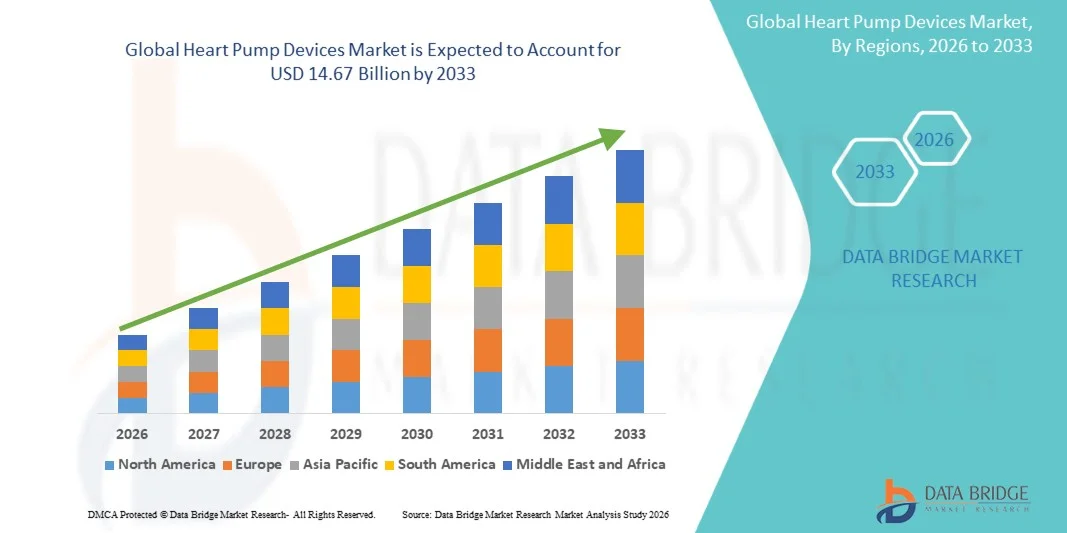
- The global heart pump devices market size was valued at USD 3.33 billion in 2025 and is expected to reach USD 14.67 billion by 2033, at a CAGR of 20.37% during the forecast period
- The market growth is largely fueled by the increasing prevalence of cardiovascular diseases, rising adoption of advanced mechanical circulatory support devices, and continuous technological advancements in ventricular assist devices (VADs) and total artificial hearts, leading to improved patient outcomes and broader clinical applications across healthcare settings
- Furthermore, growing demand for minimally invasive treatment options, increasing awareness regarding early cardiac intervention, and expanding healthcare infrastructure in emerging economies are establishing heart pump devices as a critical component in modern cardiac care. These converging factors are accelerating the uptake of heart pump technologies, thereby significantly boosting the industry's growth
Heart Pump Devices Market Analysis
- Heart pump devices, including ventricular assist devices (VADs), intra-aortic balloon pumps (IABPs), and total artificial hearts (TAH), are increasingly vital components of advanced cardiac care, providing mechanical circulatory support for patients with severe heart failure in both hospital and specialized care settings due to their ability to improve survival outcomes, stabilize hemodynamics, and support patients awaiting transplantation or long-term therapy
- The escalating demand for heart pump devices is primarily fueled by the rising global prevalence of cardiovascular diseases, growing geriatric population, increasing incidence of advanced heart failure, and a rising preference for technologically advanced and life-sustaining treatment options
- North America dominated the heart pump devices market with the largest revenue share of 41.5% in 2025, characterized by advanced healthcare infrastructure, high healthcare expenditure, and strong presence of leading manufacturers, with the U.S. witnessing substantial adoption of ventricular assist devices and artificial heart systems supported by favorable reimbursement frameworks and continuous innovation
- Asia-Pacific is expected to be the fastest growing region in the heart pump devices market during the forecast period due to expanding healthcare infrastructure, increasing awareness regarding advanced cardiac therapies, and rising investments in healthcare across emerging economies such as China and India
- Ventricular Assist Devices (VADs) segment dominated the heart pump devices market with a market share of 57.8% in 2025, driven by their widespread clinical adoption, effectiveness in managing end-stage heart failure, and increasing utilization across bridge-to-transplant (BTT) and destination therapy (DT) applications
Report Scope and Heart Pump Devices Market Segmentation
|
Attributes |
Heart Pump Devices Key Market Insights |
|
Segments Covered |
|
|
Countries Covered |
North America
Europe
Asia-Pacific
Middle East and Africa
South America
|
|
Key Market Players |
|
|
Market Opportunities |
|
|
Value Added Data Infosets |
In addition to the insights on market scenarios such as market value, growth rate, segmentation, geographical coverage, and major players, the market reports curated by the Data Bridge Market Research also include in-depth expert analysis, patient epidemiology, pipeline analysis, pricing analysis, and regulatory framework |
Heart Pump Devices Market Trends
“Advancements in Minimally Invasive and Implantable Cardiac Support Systems”
- A significant and accelerating trend in the global heart pump devices market is the rapid advancement of minimally invasive and fully implantable cardiac support systems, including ventricular assist devices (VADs) and total artificial hearts. This evolution of technologies is significantly enhancing patient outcomes and long-term disease management
- For instance, Abbott’s HeartMate 3 LVAD has demonstrated improved hemocompatibility and reduced adverse events, allowing patients to live longer with fewer complications. Similarly, SynCardia’s Total Artificial Heart is being increasingly adopted for patients awaiting heart transplantation, offering life-saving circulatory support
- Technological innovation in heart pump devices enables features such as improved biocompatible materials, enhanced pump durability, and better energy efficiency for long-term use. For instance, next-generation devices incorporate magnetic levitation technology to reduce wear and blood damage while ensuring stable blood flow. Furthermore, advancements in portability and battery life offer patients greater mobility and improved quality of life
- The seamless integration of heart pump devices with remote patient monitoring systems and digital health platforms facilitates continuous tracking of patient health and device performance. Through connected healthcare solutions, clinicians can monitor device parameters and patient vitals in real time, enabling proactive intervention and reducing hospitalization rates
- This trend towards more advanced, reliable, and patient-friendly cardiac support systems is fundamentally reshaping treatment approaches for end-stage heart failure. Consequently, companies such as Medtronic are developing next-generation implantable heart pump devices with improved safety profiles and long-term support capabilities
- The demand for heart pump devices that offer enhanced durability, reduced complications, and improved patient mobility is growing rapidly across global healthcare systems, as providers increasingly prioritize effective and long-term cardiac care solutions
- Growing clinical research and trials focused on expanding indications for heart pump devices, including earlier-stage heart failure treatment, are further shaping future adoption trends
Heart Pump Devices Market Dynamics
Driver
“Rising Burden of Cardiovascular Diseases and Increasing Adoption of Advanced Therapies”
- The increasing global prevalence of cardiovascular diseases and the growing adoption of advanced mechanical circulatory support therapies are significant drivers for the heightened demand for heart pump devices
- For instance, in June 2024, Abbott announced expanded clinical data supporting the long-term use of its HeartMate 3 device in advanced heart failure patients. Such strategies by key companies are expected to drive the heart pump devices market growth in the forecast period
- As the incidence of heart failure continues to rise due to aging populations and lifestyle-related risk factors, heart pump devices provide critical life-sustaining support, offering improved survival rates and bridging patients to transplantation or long-term therapy
- Furthermore, the increasing awareness among healthcare providers regarding early intervention and the availability of technologically advanced treatment options are making heart pump devices an integral component of modern cardiac care pathways
- The growing preference for minimally invasive procedures, improved reimbursement frameworks, and advancements in device reliability are key factors propelling the adoption of heart pump devices across hospitals and specialized cardiac centers. The expansion of clinical indications and improved patient outcomes further contribute to market growth
- Rising investments in healthcare infrastructure and cardiac care centers across emerging economies are further accelerating the adoption of advanced heart pump technologies
- Increasing collaborations between medical device manufacturers and research institutions are fostering innovation and speeding up the development of next-generation heart pump devices
Restraint/Challenge
“High Cost, Surgical Risks, and Stringent Regulatory Requirements”
- Concerns surrounding the high cost of heart pump devices and the complexity of implantation procedures pose significant challenges to broader market adoption. As these devices require specialized surgical expertise and post-operative care, accessibility remains limited in certain regions
- For instance, high procedural costs and limited reimbursement coverage in developing economies have made some patients hesitant or unable to opt for advanced heart pump therapies
- Addressing these challenges through cost optimization, improved surgical techniques, and expanded reimbursement policies is crucial for wider adoption. Companies such as Abbott and Medtronic are focusing on enhancing device efficiency and clinical outcomes to justify the cost-benefit value. In addition, stringent regulatory approval processes and the need for extensive clinical trials can delay product commercialization and market entry
- While technological advancements continue to improve safety and performance, concerns regarding complications such as infection, thrombosis, and device malfunction can still hinder adoption among patients and healthcare providers
- Overcoming these challenges through continuous innovation, better clinical evidence, and improved healthcare infrastructure will be vital for sustained market growth
- Limited availability of skilled cardiac surgeons and specialized centers for implantation procedures remains a critical barrier in several low- and middle-income regions
- Ethical considerations and patient eligibility constraints, particularly for long-term implantable devices, may restrict broader adoption despite technological advancements
Heart Pump Devices Market Scope
The market is segmented on the basis of product, type, and therapy.
- By Product
On the basis of product, the heart pump devices market is segmented into ventricular assist devices (VADs), intra-aortic balloon pumps (IABPs), and total artificial heart (TAH). The ventricular assist devices (VADs) segment dominated the market with the largest market revenue share of 57.8% in 2025, driven by their extensive clinical adoption in managing advanced heart failure and their versatility in supporting both short-term and long-term cardiac assistance. VADs are widely used in bridge-to-transplant (BTT) and destination therapy (DT) applications, making them a preferred choice among clinicians. Their continuous technological advancements, such as improved durability and reduced complication rates, further strengthen their dominance. In addition, increasing awareness and favorable reimbursement policies in developed regions contribute to higher adoption rates. The growing number of heart failure patients globally also supports the sustained demand for VADs, reinforcing their leading position in the market.
The total artificial heart (TAH) segment is anticipated to witness the fastest growth rate during the forecast period, fueled by increasing demand for complete heart replacement solutions in end-stage heart failure patients who are ineligible for transplantation. TAH devices provide full circulatory support, addressing both left and right ventricular failure, which enhances their clinical significance. Advancements in design, portability, and patient compatibility are further driving adoption. Increasing clinical trials and regulatory approvals are expanding the availability of TAH systems globally. Moreover, the rising shortage of donor hearts is pushing the demand for artificial heart technologies. These factors collectively position TAH as a rapidly growing segment in the market.
- By Type
On the basis of type, the heart pump devices market is segmented into implantable heart pump devices and extracorporeal heart pump devices. The implantable heart pump devices segment dominated the market with the largest revenue share in 2025, driven by their ability to provide long-term circulatory support and improved quality of life for patients with chronic heart failure. These devices are increasingly used in destination therapy and bridge-to-transplant applications due to their reliability and continuous operation. Technological advancements such as compact designs and improved biocompatibility have enhanced their clinical outcomes. In addition, growing patient preference for long-term solutions and reduced hospital dependency further supports their dominance. The availability of reimbursement in developed regions also contributes significantly to the adoption of implantable devices.
The extracorporeal heart pump devices segment is expected to witness the fastest growth rate during the forecast period, driven by their critical role in short-term cardiac support, especially in emergency and intensive care settings. These devices are widely used during cardiac surgeries and in cases of acute heart failure where immediate intervention is required. Their ease of deployment and ability to stabilize patients quickly make them essential in critical care environments. Increasing number of cardiac procedures and hospital admissions for acute cardiac conditions are boosting demand. Furthermore, advancements in portable extracorporeal systems are expanding their usability across healthcare facilities. This growing clinical reliance is expected to accelerate segment growth.
- By Therapy
On the basis of therapy, the heart pump devices market is segmented into bridge-to-transplant (BTT), bridge-to-candidacy (BTC), destination therapy (DT), and other therapies. The bridge-to-transplant (BTT) segment dominated the market with the largest revenue share in 2025, driven by the increasing use of heart pump devices to sustain patients awaiting heart transplantation. BTT therapy plays a critical role in improving survival rates and stabilizing patients until a suitable donor heart becomes available. The rising incidence of end-stage heart failure and limited donor availability are key factors supporting this segment’s dominance. In addition, strong clinical evidence supporting the effectiveness of BTT therapy enhances its adoption. Favorable reimbursement frameworks in developed regions further contribute to its widespread use. The growing number of transplant procedures globally also reinforces the segment’s leading position.
The destination therapy (DT) segment is anticipated to witness the fastest growth rate during the forecast period, fueled by the increasing number of patients who are not eligible for heart transplantation. DT provides long-term support for such patients, significantly improving their quality of life and survival outcomes. Technological advancements in implantable devices have made DT more viable and effective as a permanent treatment option. Rising geriatric population and increasing prevalence of chronic heart diseases are further driving demand. In addition, growing acceptance among clinicians and patients is accelerating adoption. These factors collectively position destination therapy as the fastest growing segment in the market.
Heart Pump Devices Market Regional Analysis
- North America dominated the heart pump devices market with the largest revenue share of 41.5% in 2025, characterized by advanced healthcare infrastructure, high healthcare expenditure, and strong presence of leading manufacturers
- Healthcare providers in the region highly value the clinical effectiveness, technological advancements, and long-term reliability offered by heart pump devices in managing severe cardiac conditions and improving patient survival outcomes
- This widespread adoption is further supported by advanced healthcare infrastructure, favorable reimbursement policies, high healthcare spending, and the strong presence of leading medical device manufacturers, establishing heart pump devices as a critical solution for both acute and chronic cardiac care settings
U.S. Heart Pump Devices Market Insight
The U.S. heart pump devices market captured the largest revenue share of 80% in 2025 within North America, fueled by the high prevalence of cardiovascular diseases and the strong adoption of advanced mechanical circulatory support systems. Healthcare providers are increasingly prioritizing improved patient outcomes through technologically advanced ventricular assist devices and artificial heart systems. The growing preference for minimally invasive procedures, combined with robust demand for long-term cardiac support solutions and integration with remote monitoring technologies, further propels the market. Moreover, favorable reimbursement policies and continuous innovation by leading companies are significantly contributing to the market's expansion.
Europe Heart Pump Devices Market Insight
The Europe heart pump devices market is projected to expand at a substantial CAGR throughout the forecast period, primarily driven by increasing incidence of heart failure and the rising need for advanced cardiac care solutions in hospitals and specialized centers. The growth in aging population, coupled with demand for technologically advanced treatment options, is fostering the adoption of heart pump devices. European healthcare systems are also focused on improving patient outcomes and reducing hospital stays through efficient cardiac support technologies. The region is experiencing steady growth across transplant centers and critical care units, with heart pump devices being incorporated into both acute and long-term treatment protocols.
U.K. Heart Pump Devices Market Insight
The U.K. heart pump devices market is anticipated to grow at a noteworthy CAGR during the forecast period, driven by the increasing burden of cardiovascular diseases and the demand for advanced and reliable cardiac support systems. In addition, the need for improved survival rates and quality of life is encouraging healthcare providers to adopt ventricular assist devices and artificial heart technologies. The country’s well-established healthcare system, alongside growing awareness regarding early cardiac intervention, is expected to continue to stimulate market growth.
Germany Heart Pump Devices Market Insight
The Germany heart pump devices market is expected to expand at a considerable CAGR during the forecast period, fueled by rising demand for technologically advanced and high-quality cardiac care solutions. Germany’s strong healthcare infrastructure, combined with its emphasis on medical innovation and precision engineering, promotes the adoption of heart pump devices, particularly in specialized cardiac centers. The integration of advanced monitoring systems with implantable devices is also becoming increasingly prevalent, with a strong preference for reliable and efficient treatment solutions aligning with clinical requirements.
Asia-Pacific Heart Pump Devices Market Insight
The Asia-Pacific heart pump devices market is poised to grow at the fastest CAGR of 22% during the forecast period of 2026 to 2033, driven by increasing prevalence of cardiovascular diseases, improving healthcare infrastructure, and rising healthcare expenditure in countries such as China, Japan, and India. The region's growing focus on advanced cardiac care, supported by government initiatives and expanding access to healthcare services, is driving the adoption of heart pump devices. Furthermore, as APAC strengthens its position in medical device manufacturing, the availability and affordability of cardiac support devices are expanding across a broader patient population.
Japan Heart Pump Devices Market Insight
The Japan heart pump devices market is gaining momentum due to the country’s advanced healthcare system, aging population, and increasing demand for effective cardiac care solutions. The Japanese market places significant emphasis on innovation and quality, and the adoption of heart pump devices is driven by the rising number of heart failure cases and advanced treatment protocols. The integration of heart pump devices with monitoring technologies and hospital systems is fueling growth. Moreover, Japan's aging population is likely to spur demand for long-term and reliable cardiac support solutions in both clinical and home care settings.
India Heart Pump Devices Market Insight
The India heart pump devices market accounted for the largest market revenue share in Asia Pacific in 2025, attributed to the country’s large patient pool, rising incidence of cardiovascular diseases, and improving access to advanced healthcare services. India stands as one of the fastest-growing markets for cardiac care technologies, and heart pump devices are becoming increasingly utilized in tertiary care hospitals and specialized cardiac centers. The push towards healthcare modernization and the availability of cost-effective treatment options, alongside growing investments in healthcare infrastructure, are key factors propelling the market in India.
Heart Pump Devices Market Share
The Heart Pump Devices industry is primarily led by well-established companies, including:
- Abbott (U.S.)
- Medtronic (Ireland)
- Abiomed, Inc. (U.S.)
- Berlin Heart GmbH (Germany)
- Jarvik Heart, Inc. (U.S.)
- SynCardia Systems, LLC (U.S.)
- BiVACOR Inc. (U.S.)
- CARMAT (France)
- CorWave SA (France)
- LivaNova PLC (U.K.)
- Terumo Corporation (Japan)
- Getinge AB (Sweden)
- Teleflex Incorporated (U.S.)
- Edwards Lifesciences Corporation (U.S.)
- Boston Scientific Corporation (U.S.)
- Fresenius Medical Care AG & Co. KGaA (Germany)
- Calon Cardio-Technology Ltd. (U.K.)
- Evaheart, Inc. (Japan)
- CardiacAssist, Inc. (U.S.)
- FineHeart SA (France)
What are the Recent Developments in Global Heart Pump Devices Market?
- In April 2025, the U.S. Food and Drug Administration (FDA) announced that Abbott had removed its HeartMate Mobile Power Unit, used with HeartMate II and HeartMate 3 heart pump systems, due to risks of sudden power loss linked to electrical component issues. This action highlights increasing regulatory scrutiny and the importance of device safety and reliability in life-sustaining heart pump technologies, prompting manufacturers to enhance quality control and post-market surveillance
- In January 2025, Abbott’s fully implantable heart pump system received Breakthrough Device Designation from the FDA, marking a major advancement in next-generation cardiac support technologies. This development reflects the industry’s shift toward fully implantable systems designed to eliminate external driveline components, thereby reducing infection risks and improving patient mobility and long-term outcomes
- In April 2024, Abbott (Thoratec Corp.) initiated a recall of HeartMate II and HeartMate 3 ventricular assist devices due to potential outflow graft obstruction caused by long-term material buildup. This recall underscores the ongoing challenges related to long-term device durability and patient safety, encouraging further innovation in device design and monitoring systems within the heart pump devices market
- In March 2024, Abbott issued a recall for its HeartMate Touch communication system, which is used alongside ventricular assist devices to monitor patient cardiovascular status during procedures. The recall reflects the critical importance of software reliability and real-time monitoring accuracy in heart pump ecosystems, as these systems play a vital role in ensuring safe device operation in clinical settings
- In August 2022, Abbott announced new long-term clinical data from the MOMENTUM 3 trial demonstrating that its HeartMate 3 heart pump can extend patient survival beyond five years in advanced heart failure cases. This milestone represents a significant breakthrough in mechanical circulatory support, reinforcing the role of heart pump devices as a viable long-term therapy and strengthening their adoption in destination therapy applications
SKU-
Get online access to the report on the World's First Market Intelligence Cloud

- Interactive Data Analysis Dashboard
- Company Analysis Dashboard for high growth potential opportunities
- Research Analyst Access for customization & queries
- Competitor Analysis with Interactive dashboard
- Latest News, Updates & Trend analysis
- Harness the Power of Benchmark Analysis for Comprehensive Competitor Tracking
Research Methodology
Data collection and base year analysis are done using data collection modules with large sample sizes. The stage includes obtaining market information or related data through various sources and strategies. It includes examining and planning all the data acquired from the past in advance. It likewise envelops the examination of information inconsistencies seen across different information sources. The market data is analysed and estimated using market statistical and coherent models. Also, market share analysis and key trend analysis are the major success factors in the market report. To know more, please request an analyst call or drop down your inquiry.
The key research methodology used by DBMR research team is data triangulation which involves data mining, analysis of the impact of data variables on the market and primary (industry expert) validation. Data models include Vendor Positioning Grid, Market Time Line Analysis, Market Overview and Guide, Company Positioning Grid, Patent Analysis, Pricing Analysis, Company Market Share Analysis, Standards of Measurement, Global versus Regional and Vendor Share Analysis. To know more about the research methodology, drop in an inquiry to speak to our industry experts.
Customization Available
Data Bridge Market Research is a leader in advanced formative research. We take pride in servicing our existing and new customers with data and analysis that match and suits their goal. The report can be customized to include price trend analysis of target brands understanding the market for additional countries (ask for the list of countries), clinical trial results data, literature review, refurbished market and product base analysis. Market analysis of target competitors can be analyzed from technology-based analysis to market portfolio strategies. We can add as many competitors that you require data about in the format and data style you are looking for. Our team of analysts can also provide you data in crude raw excel files pivot tables (Fact book) or can assist you in creating presentations from the data sets available in the report.