Global Health Ingredients Market
Market Size in USD Billion
CAGR :
% 
 USD
121.39 Billion
USD
200.91 Billion
2025
2033
USD
121.39 Billion
USD
200.91 Billion
2025
2033
 Forecast Period Forecast Period |
2026 –2033 |
 Market Size (Base Year) Market Size (Base Year) |
USD 121.39 Billion |
 Market Size (Forecast Year) Market Size (Forecast Year) |
USD 200.91 Billion |
 CAGR CAGR |
% |
| Major Markets Players |
|
What is the Global Health Ingredients Market Size and Growth Rate?
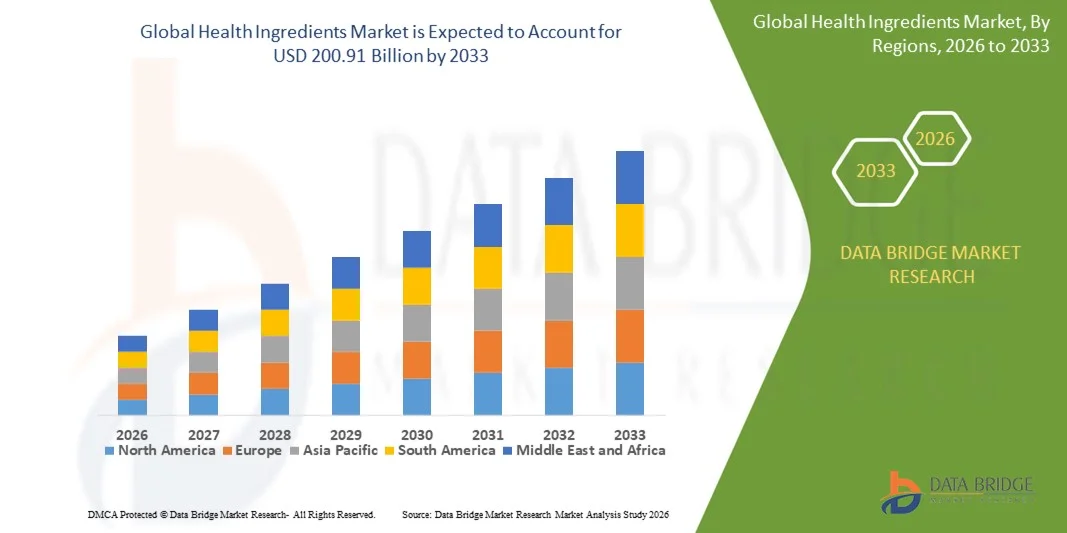
- The global health ingredients market size was valued at USD 121.39 Billion in 2025 and is expected to reach USD 200.91 Billion by 2033, at a CAGR of 6.50% during the forecast period
- The increase in consumer’s preference towards a healthy diet value as it consists nutritional content which is major factor contributing for growth in market
- The prevalence of non-communicable chronic disease, musculoskeletal conditions and increasing health care costs is estimated to contribute to heightening of the health ingredients market
What are the Major Takeaways of Health Ingredients Market?
- The issues regarding the pricing in some under-developed regions and the lack of awareness in developing economies about prebiotics, probiotics and other health ingredients is expected to hinder the growth of the health ingredients market
- Moreover, the introduction of new health Ingredients and the plant-based health ingredients and the surge in vegan population are anticipated to further generate new opportunities for the market. The adherence to stringent food safety regulations might be a major challenge for the market
- In North America, the health ingredients market dominated with a 37.58% revenue share in 2025, driven by strong growth in functional foods, dietary supplements, and nutraceutical innovations across the U.S. and Canada
- In Asia-Pacific, the Health Ingredients market is projected to register the fastest CAGR of 9.14% from 2026 to 2033, supported by rapid population growth, rising health awareness, and expanding functional food and beverage markets across China, Japan, India, South Korea, and Southeast Asia
- The Vitamins segment dominated the market with a 28.5% share in 2025, driven by increasing consumer focus on immunity, general wellness, and preventive healthcare
Report Scope and Health Ingredients Market Segmentation
|
Attributes |
Health Ingredients Key Market Insights |
|
Segments Covered |
|
|
Countries Covered |
North America
Europe
Asia-Pacific
Middle East and Africa
South America
|
|
Key Market Players |
|
|
Market Opportunities |
|
|
Value Added Data Infosets |
In addition to the insights on market scenarios such as market value, growth rate, segmentation, geographical coverage, and major players, the market reports curated by the Data Bridge Market Research also include in-depth expert analysis, pricing analysis, brand share analysis, consumer survey, demography analysis, supply chain analysis, value chain analysis, raw material/consumables overview, vendor selection criteria, PESTLE Analysis, Porter Analysis, and regulatory framework. |
What is the Key Trend in the Health Ingredients Market?
Rising Demand for Clean Label, Functional, and Plant-Based Ingredients
- The Health Ingredients market is witnessing strong adoption of plant-based proteins, probiotics, and bioactive compounds, driven by growing consumer interest in wellness, immunity, and preventive healthcare
- Manufacturers are introducing multi-functional ingredients, combining nutritional benefits, digestive support, and bioavailability to enhance food, beverage, and supplement formulations
- Growing demand for clean label, natural, and non-GMO ingredients is driving usage across functional foods, dietary supplements, and nutraceuticals
- For instance, companies such as ADM, DuPont, BASF, Cargill, and Ingredion have expanded portfolios with prebiotic fibers, plant proteins, and immune-support ingredients, enabling brands to meet consumer demands
- Increasing focus on personalized nutrition, gut health, and immunity-boosting formulations is accelerating adoption of specialized health ingredients in both retail and clinical nutrition applications
- As consumer awareness of nutrition and wellness grows, Health Ingredients will remain vital for product innovation, formulation enhancement, and functional food development
What are the Key Drivers of Health Ingredients Market?
- Rising consumer preference for functional foods, dietary supplements, and fortified beverages is driving demand for proteins, fibers, vitamins, minerals, and probiotic
- For instance, in 2025, leading companies such as ADM, DSM, DuPont expanded product lines with plant-based proteins, prebiotics, and immunity-boosting ingredients, strengthening portfolios for diverse applications
- Growing adoption of personalized nutrition, sports nutrition, and immune-support products is boosting demand across North America, Europe, and Asia-Pacific
- Advancements in encapsulation, extraction, fermentation, and formulation technologies have strengthened efficacy, stability, and bioavailability of health ingredients
- Rising awareness about gut health, mental wellness, and metabolic support is creating demand for multi-functional, high-purity ingredients
- Supported by steady investments in nutraceutical R&D, ingredient innovation, and clean-label solutions, the Health Ingredients market is expected to witness strong long-term growth
Which Factor is Challenging the Growth of the Health Ingredients Market?
- High costs associated with premium, bioactive, and specialty health ingredients restrict adoption among small and mid-sized food and supplement manufacturers
- For instance, during 2024–2025, fluctuations in raw material prices, agricultural supply shortages, and regulatory compliance costs increased manufacturing expenses for several global suppliers
- Complexity in formulating stable, bioavailable, and sensory-acceptable ingredients increases the need for skilled food scientists and R&D investment
- Limited awareness in emerging markets regarding functional benefits, dosage, and safety of novel ingredients slows adoption
- Competition from synthetic substitutes, generic ingredients, and private-label products creates pricing pressure and reduces product differentiation
- To address these challenges, companies are focusing on cost-optimized extraction, formulation innovations, clean-label solutions, and global distribution partnerships to increase adoption of Health Ingredients across functional foods, beverages, and supplements
How is the Health Ingredients Market Segmented?
The market is segmented on the basis of type, source, function, applications, and end user.
- By Type
On the basis of type, the health ingredients market is segmented into Vitamins, Minerals, Prebiotics, Nutritional Lipids, Functional Carbohydrates, Omega PUFA, Plant and Fruit Extracts, Enzymes, Probiotic Starter Cultures, Proteins, and Botanical Extracts. The Vitamins segment dominated the market with a 28.5% share in 2025, driven by increasing consumer focus on immunity, general wellness, and preventive healthcare. Vitamins are widely used across dietary supplements, fortified foods, and functional beverages due to their proven efficacy, regulatory support, and familiarity among consumers.
The Probiotic Starter Cultures segment is expected to grow at the fastest CAGR from 2026 to 2033, fueled by rising awareness of gut health, microbiome support, and digestive wellness. The growth is further supported by increasing incorporation of probiotics in beverages, dairy products, and clinical nutrition. Innovations in encapsulation, stability, and multi-strain formulations are accelerating adoption in both retail and clinical applications, ensuring that type-specific functional ingredients remain key drivers of market expansion.
- By Source
On the basis of source, the market is segmented into Plant, Animal, Microbial, and Synthetic. The Plant-based segment dominated the market with a 33.2% share in 2025, supported by growing consumer preference for clean-label, natural, and vegan ingredients. Plant-derived health ingredients such as proteins, fibers, antioxidants, and botanical extracts are increasingly integrated into foods, beverages, and nutraceuticals due to sustainability and ethical considerations.
The Microbial segment is expected to grow at the fastest CAGR from 2026 to 2033, driven by rising adoption of probiotics, fermented ingredients, enzymes, and functional cultures in dietary supplements and dairy products. Advancements in microbial cultivation, fermentation technology, and strain optimization are enabling scalable production of functional ingredients with higher efficacy and stability, catering to global demand for gut health, immunity, and personalized nutrition solutions.
- By Function
On the basis of function, the health ingredients market is segmented into Weight Management, Immunity Enhancement, Gut Health Management, Joint Health Management, Heart/Cardiovascular Health Management, Eye Health Management, and Brain Health Management. The Immunity Enhancement segment dominated the market with a 29.4% share in 2025, fueled by rising consumer health awareness, pandemics, and lifestyle-related immunity challenges. Vitamins, minerals, antioxidants, and herbal extracts are widely incorporated in functional foods, beverages, and supplements targeting immune support.
The Gut Health Management segment is projected to grow at the fastest CAGR from 2026 to 2033, driven by increasing consumption of probiotics, prebiotics, and dietary fibers. Technological advances in ingredient bioavailability, synergistic formulations, and clinical efficacy are promoting adoption across dairy, beverages, and nutraceutical products, creating long-term growth opportunities for functional ingredient manufacturers globally.
- By Application
On the basis of application, the health ingredients market is segmented into Bakery, Candy, Snacks, Milk Beverages, Fruit Juice, and Other. The Milk Beverages segment dominated the market with a 31.7% share in 2025, supported by high consumer penetration, functional dairy innovation, and fortification trends with vitamins, proteins, and probiotics. Dairy products provide a convenient delivery vehicle for health ingredients while maintaining taste and consumer acceptability.
The Fruit Juice segment is expected to grow at the fastest CAGR from 2026 to 2033, driven by rising demand for fortified beverages, functional juices with plant extracts, and clean-label formulations targeting immunity, energy, and wellness. Innovations in stability, flavor retention, and natural fortification methods are accelerating adoption, especially in health-conscious markets across North America, Europe, and Asia-Pacific.
- By End User
On the basis of end user, the health ingredients market is segmented into Food, Beverages, Pharmaceuticals, Animal Feed, and Personal Care. The Food segment dominated the market with a 38.6% share in 2025, supported by widespread incorporation of vitamins, minerals, proteins, and prebiotics in fortified foods, snacks, and bakery products. Consumers increasingly prefer nutrient-dense foods to address lifestyle-related health concerns.
The Beverages segment is expected to grow at the fastest CAGR from 2026 to 2033, fueled by rising demand for functional drinks, fortified juices, sports beverages, and probiotic drinks. Innovation in ingredient solubility, taste masking, and shelf stability is further driving penetration in retail and commercial beverage segments globally, ensuring beverages remain a major growth driver for Health Ingredients manufacturers.
Which Region Holds the Largest Share of the Health Ingredients Market?
- In North America, the health ingredients market dominated with a 37.58% revenue share in 2025, driven by strong growth in functional foods, dietary supplements, and nutraceutical innovations across the U.S. and Canada. Rising consumer focus on immunity, gut health, weight management, and plant-based nutrition continues to fuel demand for vitamins, minerals, probiotics, omega fatty acids, and botanical extracts. The region benefits from advanced R&D facilities, high regulatory compliance, and widespread consumer awareness, reinforcing its market leadership
- Leading companies in North America are expanding their product portfolios with fortified foods, plant-based proteins, and clean-label functional ingredients, strengthening technological and product innovation advantages. Continuous investment in ingredient research, functional beverage development, and high-quality manufacturing capabilities supports sustained market expansion
- High concentration of industry expertise, strong supply chains, and government-backed initiatives promoting health and wellness further reinforce North America’s leadership position in Health Ingredients
U.S. Health Ingredients Market Insight
In the U.S., the largest contributor in North America, rising adoption of fortified foods, functional beverages, and nutraceutical supplements drives growth. Increasing demand for immunity boosters, digestive health solutions, and plant-based ingredients fuels market expansion. Advanced retail and e-commerce channels, coupled with strong consumer awareness of clean-label and sustainable products, support adoption. Continuous innovation in bioactive ingredients, vitamins, minerals, and probiotics strengthens the U.S. market.
Canada Health Ingredients Market Insight
In Canada, significant growth is driven by rising health awareness and increasing consumption of fortified foods and functional beverages. Expansion of dietary supplement markets, growing interest in plant-based proteins, probiotics, and omega-3 fatty acids, and government-backed nutrition programs support market adoption. Canadian R&D investments in natural and sustainable health ingredients further boost market penetration.
Asia-Pacific Health Ingredients Market
In Asia-Pacific, the Health Ingredients market is projected to register the fastest CAGR of 9.14% from 2026 to 2033, supported by rapid population growth, rising health awareness, and expanding functional food and beverage markets across China, Japan, India, South Korea, and Southeast Asia. Increasing adoption of immunity-boosting supplements, digestive health products, and plant-based nutrition drives demand for vitamins, minerals, probiotics, omega fatty acids, and botanical extracts. Investments in R&D, fortified foods, and nutraceutical production further accelerate growth. Manufacturers are launching functional beverages, fortified dairy products, and clean-label health ingredients tailored to local dietary habits, strengthening regional adoption. Rising disposable incomes, urbanization, and government-backed nutrition initiatives support long-term market growth.
China Health Ingredients Market Insight
In China, growth is fueled by large-scale government initiatives promoting functional foods and health supplements. Increasing adoption of fortified beverages, plant-based proteins, probiotics, and herbal extracts drives demand. Local manufacturing capabilities, competitive pricing, and rapid expansion of nutraceutical production enhance domestic and export market adoption.
Japan Health Ingredients Market Insight
In Japan, steady growth is supported by advanced functional food industries, high health awareness, and innovation in nutraceutical formulations. Increasing adoption of immunity, digestive, and cardiovascular health supplements drives demand for vitamins, minerals, and probiotics. Regulatory support for health claims and focus on premium, high-quality ingredients reinforce market stability.
India Health Ingredients Market Insight
In India, rising health awareness, government-backed initiatives, and growing disposable incomes are fueling market growth. Demand for fortified foods, functional beverages, plant-based nutrition, and immunity-boosting supplements supports adoption. Expansion of e-commerce, retail, and nutraceutical startups further accelerates market penetration.
South Korea Health Ingredients Market Insight
In South Korea, strong demand for functional foods, dietary supplements, and plant-based nutrition supports market expansion. Growth in digestive health, immunity, and beauty-from-within products drives adoption of probiotics, vitamins, and minerals. High-quality manufacturing standards, ingredient innovation, and strong consumer trust support sustained growth.
Which are the Top Companies in Health Ingredients Market?
The health ingredients industry is primarily led by well-established companies, including:
- ADM (U.S.)
- Associated British Foods plc (U.K.)
- DuPont (U.S.)
- BASF SE (Germany)
- Cargill, Incorporated (U.S.)
- Ingredion (U.S.)
- Arla Foods amba (Denmark)
- DSM (Netherlands)
- Tate & Lyle (U.K.)
- Lonza (Switzerland)
- FrieslandCampina Ingredients (Netherlands)
- Glanbia PLC (Ireland)
- Fonterra Co-operative Group (New Zealand)
- Roquette Frères (France)
What are the Recent Developments in Global Health Ingredients Market?
- In August 2022, ADM entered into a strategic partnership with Benson Hill, a food technology company, to scale innovative soy ingredients and meet growing demand for plant-based proteins. In this exclusive North American licensing collaboration, ADM will process and commercialize a portfolio of proprietary ingredients derived from Benson Hill Ultra-High Protein (UHP) soybeans, expanding ADM’s plant-based product offerings across food and beverage markets. This partnership strengthens ADM’s footprint in the plant-based protein sector and enhances its competitive position
- In July 2022, BASF SE announced the expansion of its vitamin A formulation capacities at its Verbund site in Ludwigshafen, increasing production of vitamin A powder in line with higher vitamin A acetate capacities. This expansion is expected to boost revenue and market share in the animal nutrition segment, reinforcing BASF’s leadership in essential nutritional ingredients
- In February 2022, International Flavors & Fragrances Inc. (IFF) agreed to acquire Health Wright Products, LLC, a manufacturer of custom formulations providing encapsulation and packaging for probiotic products. This strategic acquisition enhances IFF’s Health & Biosciences capabilities, integrating probiotic, natural extract, and botanical formulation expertise into its product portfolio, and strengthens its offerings in functional health ingredients
- In November 2021, Kerry launched Emulgold Fibre, a naturally sourced soluble dietary fiber designed for the white bread manufacturing market. Derived from acacia tree resin, the product provides a high concentration of soluble fiber (minimum 85%), expanding Kerry’s portfolio in dietary fibers and reinforcing its position in clean-label and natural food solutions
SKU-
Get online access to the report on the World's First Market Intelligence Cloud
- Interactive Data Analysis Dashboard
- Company Analysis Dashboard for high growth potential opportunities
- Research Analyst Access for customization & queries
- Competitor Analysis with Interactive dashboard
- Latest News, Updates & Trend analysis
- Harness the Power of Benchmark Analysis for Comprehensive Competitor Tracking
Global Health Ingredients Market, Supply Chain Analysis and Ecosystem Framework
To support market growth and help clients navigate the impact of geopolitical shifts, DBMR has integrated in-depth supply chain analysis into its Global Health Ingredients Market research reports. This addition empowers clients to respond effectively to global changes affecting their industries. The supply chain analysis section includes detailed insights such as Global Health Ingredients Market consumption and production by country, price trend analysis, the impact of tariffs and geopolitical developments, and import and export trends by country and HSN code. It also highlights major suppliers with data on production capacity and company profiles, as well as key importers and exporters. In addition to research, DBMR offers specialized supply chain consulting services backed by over a decade of experience, providing solutions like supplier discovery, supplier risk assessment, price trend analysis, impact evaluation of inflation and trade route changes, and comprehensive market trend analysis.
Research Methodology
Data collection and base year analysis are done using data collection modules with large sample sizes. The stage includes obtaining market information or related data through various sources and strategies. It includes examining and planning all the data acquired from the past in advance. It likewise envelops the examination of information inconsistencies seen across different information sources. The market data is analysed and estimated using market statistical and coherent models. Also, market share analysis and key trend analysis are the major success factors in the market report. To know more, please request an analyst call or drop down your inquiry.
The key research methodology used by DBMR research team is data triangulation which involves data mining, analysis of the impact of data variables on the market and primary (industry expert) validation. Data models include Vendor Positioning Grid, Market Time Line Analysis, Market Overview and Guide, Company Positioning Grid, Patent Analysis, Pricing Analysis, Company Market Share Analysis, Standards of Measurement, Global versus Regional and Vendor Share Analysis. To know more about the research methodology, drop in an inquiry to speak to our industry experts.
Customization Available
Data Bridge Market Research is a leader in advanced formative research. We take pride in servicing our existing and new customers with data and analysis that match and suits their goal. The report can be customized to include price trend analysis of target brands understanding the market for additional countries (ask for the list of countries), clinical trial results data, literature review, refurbished market and product base analysis. Market analysis of target competitors can be analyzed from technology-based analysis to market portfolio strategies. We can add as many competitors that you require data about in the format and data style you are looking for. Our team of analysts can also provide you data in crude raw excel files pivot tables (Fact book) or can assist you in creating presentations from the data sets available in the report.