


What is the Global Gas Delivery System for Wafer Fab Equipment Market Size and Growth Rate?
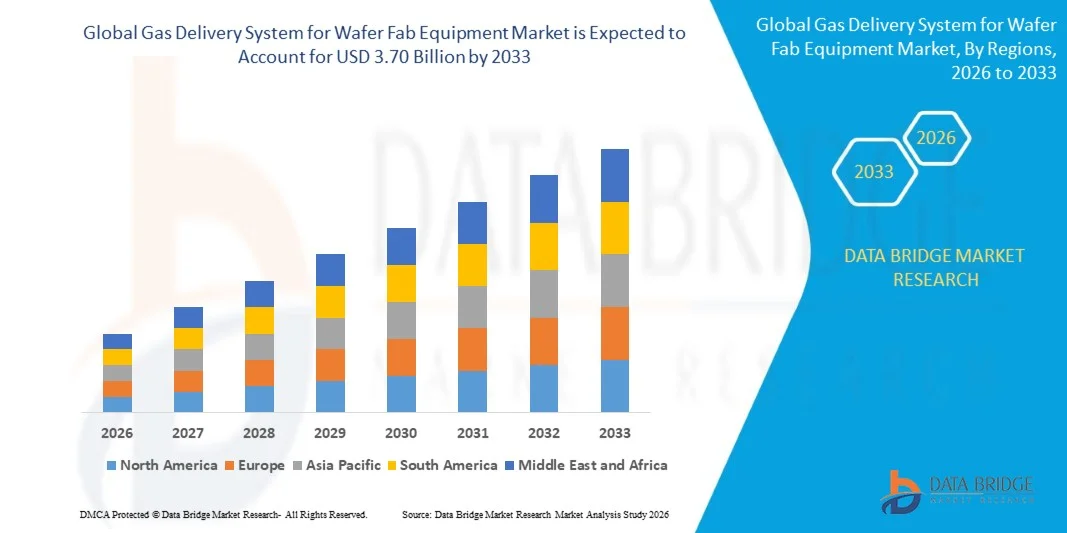
- The global gas delivery system for wafer fab equipment market size was valued at USD 1.90 billion in 2025 and is expected to reach USD 3.70 billion by 2033, at a CAGR of8.80% during the forecast period
- Rising globalization and growing usage of high purity gases will emerge as the major market growth driving factors. Growing need to adopt international measurement standards, surging technological advancements in telecom and semiconductor sector, increasing buildings and construction activities especially in the developing economies, and widespread industrialization will further aggravate the market value
What are the Major Takeaways of Gas Delivery System for Wafer Fab Equipment Market?
- Growing expenditure to undertake research and development proficiencies, surging inspection, measurement and quality control activities in different manufacturing industries, growing demand from consumer electronics industry and growing demand for optimum resource utilization will further carve the way for the growth of the market
- North America dominated the Gas Delivery System for Wafer Fab Equipment market with a 37.05% revenue share in 2025, driven by strong growth in semiconductor fabrication infrastructure, specialty gas supply networks, and expansion of wafer fab equipment manufacturing across the U.S. and Canada
- Asia-Pacific is projected to register the fastest CAGR of 6.99% from 2026 to 2033, driven by rapid semiconductor fab expansion, strong electronics manufacturing ecosystems, and rising investments in advanced nodes across China, Taiwan, Japan, India, and South Korea
- The Atmospheric Gases segment dominated the market with a 41.9% share, owing to its extensive use in wafer fabrication for nitrogen purging, argon-based inert atmospheres, oxygen-assisted processes, and cleanroom gas supply systems
Report Scope and Gas Delivery System for Wafer Fab Equipment Market Segmentation
|
Attributes |
Gas Delivery System for Wafer Fab Equipment Key Market Insights |
|
Segments Covered |
|
|
Countries Covered |
North America
Europe
Asia-Pacific
Middle East and Africa
South America
|
|
Key Market Players |
|
|
Market Opportunities |
|
|
Value Added Data Infosets |
In addition to the insights on market scenarios such as market value, growth rate, segmentation, geographical coverage, and major players, the market reports curated by the Data Bridge Market Research also include in-depth expert analysis, pricing analysis, brand share analysis, consumer survey, demography analysis, supply chain analysis, value chain analysis, raw material/consumables overview, vendor selection criteria, PESTLE Analysis, Porter Analysis, and regulatory framework. |
What is the Key Trend in the Gas Delivery System for Wafer Fab Equipment Market?
“Increasing Shift Toward Smart, High-Purity, and Automated Gas Delivery Systems for Advanced Semiconductor Fabs”
- The Gas Delivery System for Wafer Fab Equipment market is witnessing strong adoption of fully automated, programmable, and high-purity gas handling systems designed to support advanced semiconductor manufacturing nodes such as 5nm, 3nm, and below
- Manufacturers are increasingly introducing smart gas cabinets, automated switchover panels, real-time leak detection systems, and IoT-enabled monitoring solutions to ensure process continuity and contamination control
- Growing demand for ultra-high purity specialty gases such as NF₃, WF₆, NH₃, HCl, and helium is driving the deployment of advanced gas delivery infrastructure across wafer fabrication plants
- For instance, companies such as Linde plc, Air Liquide, Air Products, and Iwatani Corporation are expanding their semiconductor gas delivery capabilities with automated control systems and enhanced purity management solution
- Increasing need for precision gas flow control, safety compliance, and uninterrupted supply in EUV lithography, deposition, and etching processes is accelerating the shift toward intelligent gas delivery systems
- As semiconductor fabrication becomes more complex and node sizes continue to shrink, Gas Delivery Systems for Wafer Fab Equipment will remain vital for yield optimization, process stability, and contamination-free manufacturing
What are the Key Drivers of Gas Delivery System for Wafer Fab Equipment Market?
- Rising expansion of global semiconductor wafer fabrication facilities is significantly increasing demand for advanced gas delivery systems required for front-end manufacturing processes
- For instance, in 2025–2026, increasing investments in AI chip, memory, and logic semiconductor fabs across China, Taiwan, South Korea, India, and the U.S. have strengthened demand for gas cabinets, manifolds, and automated switchover systems
- Growing adoption of AI processors, EV electronics, 5G devices, consumer electronics, and data center chips is boosting demand for semiconductor-grade gas handling solutions globally
- Advancements in real-time flow control, contamination detection, remote monitoring, and automated safety shutoff technologies have improved performance, reliability, and fab efficiency
- Rising use of EUV lithography, 3D NAND, FinFET, and advanced packaging technologies is creating strong demand for high-precision specialty gas delivery systems
- Supported by continuous investments in semiconductor manufacturing infrastructure and advanced wafer fab equipment, the Gas Delivery System for Wafer Fab Equipment market is expected to witness strong long-term growth
Which Factor is Challenging the Growth of the Gas Delivery System for Wafer Fab Equipment Market?
- High costs associated with fully automated, ultra-high purity, and safety-compliant gas delivery systems restrict adoption among smaller fabs and emerging semiconductor manufacturers
- For instance, during 2025–2026, fluctuations in helium, neon, and specialty gas availability, along with supply chain disruptions, increased system deployment and operating costs
- Complexity in handling toxic, corrosive, and high-purity gases such as HCl, WF₆, and NF₃ increases the need for specialized engineering expertise and maintenance
- Limited supply of rare gases and volatility in raw material pricing create challenges for continuous wafer fab operations
- Competition from integrated in-house gas management solutions developed by large semiconductor manufacturers creates pricing pressure for third-party suppliers
- To address these issues, companies are focusing on modular system architecture, gas recycling technologies, predictive maintenance, and smart monitoring platforms to increase global adoption of Gas Delivery Systems for Wafer Fab Equipment
How is the Gas Delivery System for Wafer Fab Equipment Market Segmented?
The market is segmented on the basis of gas type, type, component, and specialty gases type.
• By Gas Type
On the basis of gas type, the Gas Delivery System for Wafer Fab Equipment market is segmented into Atmospheric Gases, Hydrogen, Helium, and Acetylene. The Atmospheric Gases segment dominated the market with a 41.9% share, owing to its extensive use in wafer fabrication for nitrogen purging, argon-based inert atmospheres, oxygen-assisted processes, and cleanroom gas supply systems. These gases are widely adopted due to their lower cost, high-volume consumption, and essential role in semiconductor process stability, making them the backbone of fab gas infrastructure.
The Hydrogen segment is expected to grow at the fastest CAGR from 2026 to 2033, driven by increasing use in annealing, reducing atmospheres, oxidation control, and EUV lithography support systems. Rising investments in advanced-node fabs, AI chip manufacturing, and 3D semiconductor architectures are further accelerating demand for hydrogen-based gas delivery solutions.
• By Type
On the basis of type, the market is segmented into Semi-Automatic Switchover Systems, Fully Automatic Programmable Switchover Systems, and Single Station Systems. The Semi-Automatic Switchover Systems segment dominated the market with a 49.6% share, as it remains the preferred configuration across medium- to large-scale semiconductor fabs requiring uninterrupted gas flow with controlled redundancy. These systems offer reliable gas source switching, improved operational safety, and cost-effective deployment across etching, deposition, and cleaning applications.
The Fully Automatic Programmable Switchover Systems segment is expected to grow at the fastest CAGR from 2026 to 2033, driven by rising demand for smart fabs, Industry 4.0 integration, remote monitoring, and automated leak detection systems. Increasing adoption in next-generation semiconductor plants is strengthening growth prospects.
• By Component
On the basis of component, the Gas Delivery System for Wafer Fab Equipment market is segmented into Gas Cylinders, Manifolds, Gas Cabinets, Switchovers, Protocol Stations, and Changeovers. The Gas Cylinders segment dominated the market with an estimated 32.8% share in 2025, supported by its critical role in storing and supplying ultra-high-purity gases used in wafer fabrication processes. Their widespread deployment across semiconductor fabs and compatibility with multiple specialty gases make them essential infrastructure components.
The Gas Cabinets segment is expected to grow at the fastest CAGR from 2026 to 2033, driven by increasing emphasis on toxic gas containment, safety compliance, automated shutoff mechanisms, and cleanroom integration. Growing use of hazardous specialty gases such as WF6 and HCl is accelerating adoption globally.
• By Specialty Gases Type
On the basis of specialty gases type, the market is segmented into Ammonia (NH3), Hydrogen Chloride (HCL), Tungsten Hexafluoride (WF6), Nitrogen Trifluoride (NF3), Nitrous Oxide (N2O), Disilane (SI2H6), Germane (GEH4), and High Purity Carbon Dioxide (CO2). The Ammonia (NH3) segment dominated the market with an estimated 28.6% share in 2025, driven by its extensive usage in chemical vapor deposition (CVD), nitridation, and compound semiconductor manufacturing. Its critical role in nitride film formation and epitaxial growth supports strong market dominance.
The Tungsten Hexafluoride (WF6) segment is expected to grow at the fastest CAGR from 2026 to 2033, propelled by rising demand for advanced metal deposition, interconnect formation, and next-generation chip architectures. Increasing production of high-performance processors and memory devices is further driving segment growth
Which Region Holds the Largest Share of the Gas Delivery System for Wafer Fab Equipment Market?
- North America dominated the Gas Delivery System for Wafer Fab Equipment market with a 37.05% revenue share in 2025, driven by strong growth in semiconductor fabrication infrastructure, specialty gas supply networks, and expansion of wafer fab equipment manufacturing across the U.S. and Canada. High adoption of ultra-high purity gas cabinets, automated switchover systems, manifolds, and gas monitoring solutions continues to fuel demand across semiconductor foundries, logic chip plants, memory fabs, and advanced packaging facilities
- Leading companies in North America are introducing smart gas delivery platforms with leak detection, automated flow control, remote monitoring, and contamination-free dispensing systems, strengthening the region’s technological advantage. Continuous investment in AI chip production, onshoring of semiconductor fabs, and advanced node manufacturing drives long-term market expansion
- Strong engineering capabilities, established semiconductor ecosystems, and sustained investment in next-generation wafer fabrication facilities further reinforce regional market leadership
U.S. Gas Delivery System for Wafer Fab Equipment Market Insight
The U.S. is the largest contributor in North America, supported by strong semiconductor R&D, expanding domestic fab construction, and extensive use of specialty gas delivery systems across foundries, memory plants, and logic chip manufacturing facilities. Increasing development of AI accelerators, HPC processors, automotive chips, and advanced packaging technologies intensifies demand for gas delivery systems capable of precise flow control, ultra-high purity maintenance, and automated gas switching. Presence of major semiconductor companies, government-backed CHIPS investments, and strong demand for wafer fab infrastructure further drive market growth
Canada Gas Delivery System for Wafer Fab Equipment Market Insight
Canada contributes significantly to regional growth, driven by expanding semiconductor support industries, specialty gas engineering capabilities, and rising investment in electronics manufacturing and research infrastructure. Engineering facilities and industrial labs increasingly utilize gas cabinets, cylinders, and manifold systems for semiconductor process testing and advanced material research. Government-supported innovation programs, skilled workforce availability, and rising investment in clean technology and smart manufacturing strengthen market adoption across the country.
Asia-Pacific Gas Delivery System for Wafer Fab Equipment Market
Asia-Pacific is projected to register the fastest CAGR of 6.99% from 2026 to 2033, driven by rapid semiconductor fab expansion, strong electronics manufacturing ecosystems, and rising investments in advanced nodes across China, Taiwan, Japan, India, and South Korea. High-volume production of AI chips, memory devices, consumer electronics semiconductors, and automotive ICs increases demand for efficient gas delivery systems. Growth in EUV lithography, 3D NAND, advanced packaging, and digital infrastructure continues to accelerate the need for ultra-high purity gas systems across engineering and manufacturing applications
China Gas Delivery System for Wafer Fab Equipment Market Insight
China is the largest contributor to Asia-Pacific due to massive semiconductor investments, world-leading electronics manufacturing capacity, and strong government support for domestic chip production. Rising development of advanced logic fabs, memory production, and AI chip manufacturing drives demand for gas delivery systems with higher automation, contamination control, and specialty gas compatibility. Local manufacturing capabilities and competitive pricing further expand domestic and export market adoption
Japan Gas Delivery System for Wafer Fab Equipment Market Insight
Japan shows steady growth supported by advanced semiconductor materials expertise, precision equipment manufacturing, and continuous modernization of industrial and automotive chip production systems. Strong focus on high-purity gas management and process reliability drives adoption of premium gas delivery solutions. Increasing need for advanced memory devices, robotics chips, and precision control semiconductors reinforces long-term market expansion.
India Gas Delivery System for Wafer Fab Equipment Market Insight
India is emerging as a major growth hub, driven by expanding semiconductor design centres, government-backed fab initiatives, and rising electronics manufacturing investments. Growing demand for embedded chips, telecom semiconductors, EV electronics, and industrial controllers fuels adoption of gas delivery systems in testing and fabrication environments. Increasing R&D investments and digital infrastructure expansion further accelerate market penetration.
South Korea Gas Delivery System for Wafer Fab Equipment Market Insight
South Korea contributes significantly due to strong demand for advanced memory devices, AI processors, 5G chipsets, and high-performance consumer electronics semiconductors. Rapid development of HBM memory, AI servers, and display driver ICs drives adoption of gas delivery systems with high purity standards and automated switching capabilities. Technological innovation, strong manufacturing capacity, and growing digital ecosystems support sustained market growth
Which are the Top Companies in Gas Delivery System for Wafer Fab Equipment Market?
The gas delivery system for wafer fab equipment industry is primarily led by well-established companies, including:
- Linde plc (U.K.)
- Messer SE & Co. KGaA (Germany)
- GCE Group (Sweden)
- CVD Equipment Corporation (U.S.)
- Applied Energy Systems, Inc. (U.S.)
- Indiana Oxygen (U.S.)
- Critical Process Systems Group (U.S.)
- INTEGA GmbH (Germany)
- Powerblanket (U.S.)
- IEEE (U.S.)
- Kelington Group Berhad (Malaysia)
- Critical Systems, Inc. (U.S.)
- Ichor Systems (U.S.)
- MATHESON TRI-GAS, INC. (U.S.)
- Praxair Technology, Inc. (U.S.)
- Air Products Inc. (U.S.)
- Iwatani Corporation (Japan)
- BASF SE (Germany)
- Air Liquide (France)
- Colfax Corporation (U.S.)

- Interactive Data Analysis Dashboard
- Company Analysis Dashboard for high growth potential opportunities
- Research Analyst Access for customization & queries
- Competitor Analysis with Interactive dashboard
- Latest News, Updates & Trend analysis
- Harness the Power of Benchmark Analysis for Comprehensive Competitor Tracking
Global Gas Delivery System For Wafer Fab Equipment Market, Supply Chain Analysis and Ecosystem Framework
To support market growth and help clients navigate the impact of geopolitical shifts, DBMR has integrated in-depth supply chain analysis into its Global Gas Delivery System For Wafer Fab Equipment Market research reports. This addition empowers clients to respond effectively to global changes affecting their industries. The supply chain analysis section includes detailed insights such as Global Gas Delivery System For Wafer Fab Equipment Market consumption and production by country, price trend analysis, the impact of tariffs and geopolitical developments, and import and export trends by country and HSN code. It also highlights major suppliers with data on production capacity and company profiles, as well as key importers and exporters. In addition to research, DBMR offers specialized supply chain consulting services backed by over a decade of experience, providing solutions like supplier discovery, supplier risk assessment, price trend analysis, impact evaluation of inflation and trade route changes, and comprehensive market trend analysis.
Data collection and base year analysis are done using data collection modules with large sample sizes. The stage includes obtaining market information or related data through various sources and strategies. It includes examining and planning all the data acquired from the past in advance. It likewise envelops the examination of information inconsistencies seen across different information sources. The market data is analysed and estimated using market statistical and coherent models. Also, market share analysis and key trend analysis are the major success factors in the market report. To know more, please request an analyst call or drop down your inquiry.
The key research methodology used by DBMR research team is data triangulation which involves data mining, analysis of the impact of data variables on the market and primary (industry expert) validation. Data models include Vendor Positioning Grid, Market Time Line Analysis, Market Overview and Guide, Company Positioning Grid, Patent Analysis, Pricing Analysis, Company Market Share Analysis, Standards of Measurement, Global versus Regional and Vendor Share Analysis. To know more about the research methodology, drop in an inquiry to speak to our industry experts.
Data Bridge Market Research is a leader in advanced formative research. We take pride in servicing our existing and new customers with data and analysis that match and suits their goal. The report can be customized to include price trend analysis of target brands understanding the market for additional countries (ask for the list of countries), clinical trial results data, literature review, refurbished market and product base analysis. Market analysis of target competitors can be analyzed from technology-based analysis to market portfolio strategies. We can add as many competitors that you require data about in the format and data style you are looking for. Our team of analysts can also provide you data in crude raw excel files pivot tables (Fact book) or can assist you in creating presentations from the data sets available in the report.













