Global Frozen Sauces Market
Market Size in USD Billion
CAGR :
% 
 USD
1.88 Billion
USD
3.40 Billion
2025
2033
USD
1.88 Billion
USD
3.40 Billion
2025
2033
 Forecast Period Forecast Period |
2026 –2033 |
 Market Size (Base Year) Market Size (Base Year) |
USD 1.88 Billion |
 Market Size (Forecast Year) Market Size (Forecast Year) |
USD 3.40 Billion |
 CAGR CAGR |
% |
| Major Markets Players |
|
What is the Global Frozen Sauces Market Size and Growth Rate?
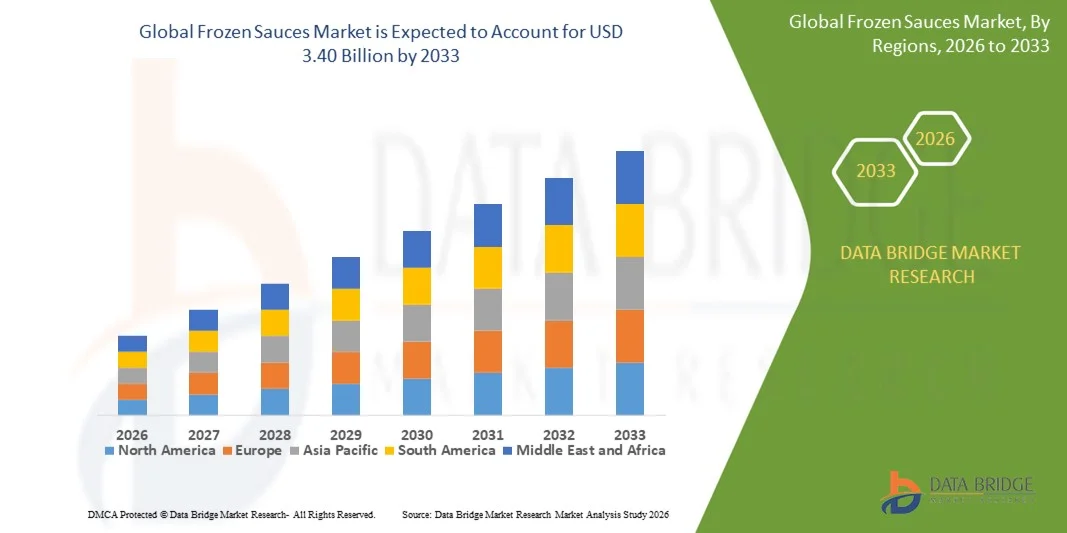
- The global frozen sauces market size was valued at USD 1.88 billion in 2025 and is expected to reach USD 3.40 billion by 2033, at a CAGR of7.70% during the forecast period
- Increase in the popularity of Asian cuisines in the U.S. has increased the demand for different flavours of sauces, dressings, and condiments which acts as the major driver escalating the market growth, also rise in the rapid urbanization, coupled with growing consumer interest in multi-cuisine culture are the major factors driving the frozen sauces market growth
What are the Major Takeaways of Frozen Sauces Market?
- Rise in the research and development activities in the market will further create new opportunities for the frozen sauces market manufacturers
- However, high costs involved in research and development activities are the major factor acting as restraints, and will further challenge the growth of frozen sauces market in the forecast period
- Asia-Pacific dominated the frozen sauces market with an estimated revenue share of around 38.25% in 2025, driven by rising consumption of convenience foods, rapid urbanization, and strong growth of the frozen food industry across China, Japan, India, South Korea, and Southeast Asia
- North America is expected to register the fastest CAGR of 8.25% from 2026 to 2033, driven by rising demand for convenient meal solutions, strong penetration of frozen foods, and increasing consumption of ethnic and premium sauces across the U.S. and Canada
- The Cooking Sauces segment dominated the market with an estimated share of around 62% in 2025, as these products are widely used in home cooking, foodservice outlets, and quick-service restaurants for preparing complete meals with minimal preparation time
Report Scope and Frozen Sauces Market Segmentation
|
Attributes |
Frozen Sauces Key Market Insights |
|
Segments Covered |
|
|
Countries Covered |
North America
Europe
Asia-Pacific
Middle East and Africa
South America
|
|
Key Market Players |
|
|
Market Opportunities |
|
|
Value Added Data Infosets |
In addition to the insights on market scenarios such as market value, growth rate, segmentation, geographical coverage, and major players, the market reports curated by the Data Bridge Market Research also include in-depth expert analysis, pricing analysis, brand share analysis, consumer survey, demography analysis, supply chain analysis, value chain analysis, raw material/consumables overview, vendor selection criteria, PESTLE Analysis, Porter Analysis, and regulatory framework. |
What is the Key Trend in the Frozen Sauces Market?
Increasing Shift Toward Convenient, Clean-Label, and Premium Frozen Sauce Solutions
- The frozen sauces market is witnessing rising adoption of ready-to-use, portion-controlled, and quick-freeze sauces that preserve taste, texture, and nutritional value
- Manufacturers are increasingly focusing on clean-label formulations, reducing artificial preservatives while maintaining extended shelf life through advanced freezing technologies
- Growing demand for convenience foods among working professionals and urban consumers is accelerating the use of frozen sauces in both retail and foodservice channels
- For instance, major food companies are expanding portfolios of ethnic, gourmet, and plant-based frozen sauces to cater to evolving taste preferences
- Rising penetration of QSRs, cloud kitchens, and meal kit services is driving consistent demand for standardized frozen sauce solutions
- As consumers seek convenience without compromising quality, frozen sauces are becoming a preferred alternative to fresh and shelf-stable sauces
What are the Key Drivers of Frozen Sauces Market?
- Rising consumer demand for convenient, time-saving cooking solutions that offer consistent taste and quality
- For instance, in recent years, leading food brands have expanded frozen sauce lines to support restaurant-style meals at home
- Growing popularity of global cuisines, including Asian, Italian, Mexican, and Middle Eastern flavors, is boosting frozen sauce consumption
- Advancements in IQF and blast-freezing technologies enhance product stability, flavor retention, and shelf life
- Increasing adoption of frozen sauces by foodservice operators to reduce preparation time and operational costs
- Supported by growth in frozen food infrastructure and cold-chain logistics, the Frozen Sauces market is expected to witness steady long-term growth
Which Factor is Challenging the Growth of the Frozen Sauces Market?
- High dependence on cold-chain storage and transportation increases logistics and distribution costs
- For instance, fluctuations in energy prices and cold-storage expenses during 2024–2025 impacted profit margins for several frozen food manufacturers
- Consumer perception in some regions that frozen products are less fresh than chilled or homemade alternatives limits adoption
- Regulatory challenges related to food labeling, preservatives, and clean-label compliance increase formulation complexity
- Intense competition from shelf-stable sauces, chilled sauces, and fresh meal kits creates pricing pressure
- To overcome these challenges, companies are investing in clean-label innovation, efficient cold-chain management, and premium positioning to expand global adoption of frozen sauces
How is the Frozen Sauces Market Segmented?
The market is segmented on the basis of product and distribution channel.
- By Product
On the basis of product, the frozen sauces market is segmented into Cooking Sauces and Dips. The Cooking Sauces segment dominated the market with an estimated share of around 62% in 2025, as these products are widely used in home cooking, foodservice outlets, and quick-service restaurants for preparing complete meals with minimal preparation time. Frozen cooking sauces such as pasta sauces, gravies, curry bases, and ethnic sauces offer consistency in flavor, extended shelf life, and ease of use, making them highly preferred by consumers and commercial kitchens. Their ability to retain taste and texture through advanced freezing technologies further supports strong adoption.
The Dips segment is expected to grow at the fastest CAGR from 2026 to 2033, driven by rising demand for frozen cheese dips, salsa, hummus, and specialty dips across snack, party, and casual dining occasions. Growth in convenience snacking, premium appetizers, and foodservice innovation is accelerating demand for frozen dips globally.
- By Distribution Channel
On the basis of distribution channel, the frozen sauces market is segmented into Offline and Online. The Offline segment dominated the market with a share of approximately 70–72% in 2025, supported by strong presence of supermarkets, hypermarkets, convenience stores, and foodservice distributors. Consumers continue to prefer offline channels due to immediate product availability, temperature-controlled storage, and the ability to compare brands and flavors in-store. Established retail freezer infrastructure and strong supplier–retailer relationships further strengthen offline dominance.
The Online segment is projected to register the fastest CAGR from 2026 to 2033, driven by rapid growth of e-commerce grocery platforms, direct-to-consumer food brands, and improved cold-chain logistics. Rising digital adoption, home delivery convenience, and subscription-based frozen food services are significantly boosting online sales of frozen sauces worldwide.
Which Region Holds the Largest Share of the Frozen Sauces Market?
- Asia-Pacific dominated the frozen sauces market with an estimated revenue share of around 38.25% in 2025, driven by rising consumption of convenience foods, rapid urbanization, and strong growth of the frozen food industry across China, Japan, India, South Korea, and Southeast Asia. Increasing participation of working populations, changing dietary habits, and growing preference for ready-to-cook and ready-to-eat meal components are significantly boosting demand for frozen cooking sauces and dips across households and foodservice sectors
- Expanding cold-chain infrastructure, improving freezer penetration, and strong presence of regional food manufacturers offering ethnic and fusion sauces further support market dominance. Rising popularity of Asian cuisines globally also strengthens production and export of frozen sauces from the region
- Government initiatives supporting food processing, along with increasing investments by multinational brands in local manufacturing facilities, reinforce Asia-Pacific’s leadership
China Frozen Sauces Market Insight
China is the largest contributor in Asia-Pacific, supported by a rapidly expanding frozen food sector, large urban population, and growing demand for convenient meal solutions. Rising adoption of Western and pan-Asian cuisines, along with strong retail and foodservice expansion, continues to drive frozen sauce consumption.
Japan Frozen Sauces Market Insight
Japan shows steady growth driven by high demand for premium-quality frozen foods, strong cold-storage infrastructure, and preference for portion-controlled, time-saving meal components. Traditional sauces combined with modern freezing technologies support consistent market demand.
India Frozen Sauces Market Insight
India is emerging as a high-growth market due to increasing urbanization, rising disposable incomes, and rapid expansion of organized retail and QSR chains. Growing acceptance of frozen gravies, curry bases, and international sauces is accelerating adoption.
North America Frozen Sauces Market
North America is expected to register the fastest CAGR of 8.25% from 2026 to 2033, driven by rising demand for convenient meal solutions, strong penetration of frozen foods, and increasing consumption of ethnic and premium sauces across the U.S. and Canada. High demand from quick-service restaurants, busy households, and meal-kit providers, combined with innovation in clean-label, organic, and plant-based frozen sauces, supports rapid market growth. Advanced cold-chain logistics, high freezer ownership, and strong brand presence further accelerate regional expansion
U.S. Frozen Sauces Market Insight
The U.S. leads regional growth due to high consumption of frozen convenience foods, strong foodservice demand, and continuous product innovation. Growing preference for global flavors, premium ingredients, and easy-to-prepare meals is driving sustained market expansion.
Canada Frozen Sauces Market Insight
Canada contributes steadily, supported by increasing demand for frozen ready-to-cook products, expanding multicultural food preferences, and strong retail freezer infrastructure. Rising focus on quality, sustainability, and health-oriented frozen sauces further strengthens market growth.
Which are the Top Companies in Frozen Sauces Market?
The frozen sauces industry is primarily led by well-established companies, including:
- Nestlé (Switzerland)
- The Kraft Heinz Company (U.S.)
- General Mills Inc. (U.S.)
- Mars, Incorporated (U.S.)
- McDonald's (U.S.)
- Conagra Foodservice, Inc. (U.S.)
- The Kroger Co. (U.S.)
- Hormel Foods Corporation (U.S.)
- McCormick & Company, Inc. (U.S.)
- Del Monte Food, Inc. (U.S.)
- Kikkoman Corporation (Japan)
- Tas Gourmet Sauce Co. (Australia)
- CSC Brand L.P. (U.S.)
- Frito-Lay North America, Inc. (U.S.)
- Bolton Group (Italy)
- Edward & Sons Trading Co. (U.S.)
- Ken's Foods, Inc. (U.S.)
- No Limit, LLC. (U.S.)
- Williams Foods (U.S.)
- Stokes Sauces Ltd (U.K.)
- CaJohns Fiery Foods (U.S.)
SKU-
Get online access to the report on the World's First Market Intelligence Cloud
- Interactive Data Analysis Dashboard
- Company Analysis Dashboard for high growth potential opportunities
- Research Analyst Access for customization & queries
- Competitor Analysis with Interactive dashboard
- Latest News, Updates & Trend analysis
- Harness the Power of Benchmark Analysis for Comprehensive Competitor Tracking
Global Frozen Sauces Market, Supply Chain Analysis and Ecosystem Framework
To support market growth and help clients navigate the impact of geopolitical shifts, DBMR has integrated in-depth supply chain analysis into its Global Frozen Sauces Market research reports. This addition empowers clients to respond effectively to global changes affecting their industries. The supply chain analysis section includes detailed insights such as Global Frozen Sauces Market consumption and production by country, price trend analysis, the impact of tariffs and geopolitical developments, and import and export trends by country and HSN code. It also highlights major suppliers with data on production capacity and company profiles, as well as key importers and exporters. In addition to research, DBMR offers specialized supply chain consulting services backed by over a decade of experience, providing solutions like supplier discovery, supplier risk assessment, price trend analysis, impact evaluation of inflation and trade route changes, and comprehensive market trend analysis.
Research Methodology
Data collection and base year analysis are done using data collection modules with large sample sizes. The stage includes obtaining market information or related data through various sources and strategies. It includes examining and planning all the data acquired from the past in advance. It likewise envelops the examination of information inconsistencies seen across different information sources. The market data is analysed and estimated using market statistical and coherent models. Also, market share analysis and key trend analysis are the major success factors in the market report. To know more, please request an analyst call or drop down your inquiry.
The key research methodology used by DBMR research team is data triangulation which involves data mining, analysis of the impact of data variables on the market and primary (industry expert) validation. Data models include Vendor Positioning Grid, Market Time Line Analysis, Market Overview and Guide, Company Positioning Grid, Patent Analysis, Pricing Analysis, Company Market Share Analysis, Standards of Measurement, Global versus Regional and Vendor Share Analysis. To know more about the research methodology, drop in an inquiry to speak to our industry experts.
Customization Available
Data Bridge Market Research is a leader in advanced formative research. We take pride in servicing our existing and new customers with data and analysis that match and suits their goal. The report can be customized to include price trend analysis of target brands understanding the market for additional countries (ask for the list of countries), clinical trial results data, literature review, refurbished market and product base analysis. Market analysis of target competitors can be analyzed from technology-based analysis to market portfolio strategies. We can add as many competitors that you require data about in the format and data style you are looking for. Our team of analysts can also provide you data in crude raw excel files pivot tables (Fact book) or can assist you in creating presentations from the data sets available in the report.