


What is the Flexible Digital Video Cystoscopes Market Size and Growth Rate ?
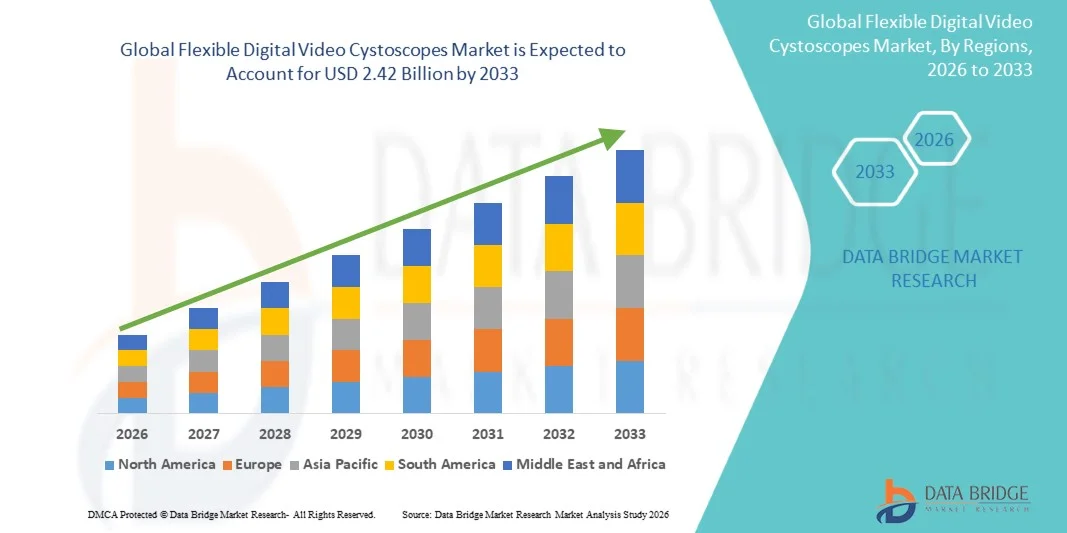
- As per Data Bridge Market Research Analysis the Global flexible digital video cystoscopes market size was valued at USD 1.60 billion in 2025 and is expected to reach USD 2.42 billion by 2033, at a CAGR of 5.35% during the forecast period.
- The market growth is largely fueled by the growing prevalence of urological disorders, the transition to minimally invasive diagnostic and therapeutic urology procedures, and technological advancements in digital endoscopy including high‑definition imaging, flexible scopes and video integration
- Furthermore, rising demand for patient‑friendly, outpatient/ambulatory diagnostic solutions, increasing focus on infection control and investments in healthcare infrastructure in emerging economies are establishing flexible digital video cystoscopes as the preferred solution in urology clinics and hospitals. These converging factors are accelerating the uptake of flexible digital video cystoscope solutions, thereby significantly boosting the industry’s growth
Market Size & Forecast
- Global Market Value (2025): USD 1.60 Billion
- Expected Market Value (2033): USD 2.42 Billion
- Forecast CAGR (2026–2033): 5.35%
Flexible Digital Video Cystoscopes Market Analysis
- Flexible digital video cystoscopes, providing high-definition visualization and electronic imaging for the urinary tract, are increasingly vital tools in modern urology diagnostics and minimally invasive procedures in both hospital and outpatient settings due to their enhanced imaging accuracy, patient comfort, and seamless integration with digital healthcare systems
- The escalating demand for flexible digital video cystoscopes is primarily fueled by the growing prevalence of urological disorders, increasing adoption of minimally invasive procedures, and a rising preference for patient-friendly, outpatient-ready diagnostic tools
- North America dominated the flexible digital video cystoscopes market with the largest revenue share of 38.9% in 2025, characterized by advanced healthcare infrastructure, high adoption of innovative medical technologies, and a strong presence of key industry players, with the U.S. experiencing substantial growth in cystoscope procedures, particularly in ambulatory surgery centers and hospitals, driven by innovations in high-definition imaging, single-use scopes, and AI-assisted diagnostics
- Asia-Pacific is expected to be the fastest growing region in the flexible digital video cystoscopes market during the forecast period due to increasing healthcare investments, rising awareness of urological health, and expanding hospital and clinic networks in urbanized areas
- Reusable Flexible Digital Video Cystoscopies segment dominated the market with a share of 46.7% in 2025, driven by their cost-effectiveness over multiple procedures, established adoption in hospitals, and continuous improvements in sterilization and imaging technologies.
Report Scope and Flexible Digital Video Cystoscopes Market Segmentation
|
Attributes |
Flexible Digital Video Cystoscopes Key Market Insights |
|
Segments Covered |
|
|
Countries Covered |
North America
Europe
Asia-Pacific
Middle East and Africa
South America
|
|
Key Market Players |
|
|
Market Opportunities |
|
|
Value Added Data Infosets |
In addition to the insights on market scenarios such as market value, growth rate, segmentation, geographical coverage, and major players, the market reports curated by the Data Bridge Market Research also include in-depth expert analysis, patient epidemiology, pipeline analysis, pricing analysis, and regulatory framework |
What is the Key Trend in Flexible Digital Video Cystoscopes Market ?
Enhanced Imaging and AI-Assisted Diagnostics
- A significant and accelerating trend in the global flexible digital video cystoscopes market is the integration of high-definition imaging with AI-assisted diagnostic features, improving lesion detection, procedural accuracy, and workflow efficiency
- For instance, the Olympus VISERA ELITE II system incorporates enhanced imaging modes with AI algorithms to assist clinicians in identifying subtle abnormalities during cystoscopy procedures
- AI integration enables features such as automated detection of bladder lesions and pattern recognition for recurrent conditions, providing more accurate diagnostics and predictive insights
- The seamless combination of digital imaging, real-time video capture, and AI-based analytics facilitates centralized data management and enables better patient monitoring and follow-up care
- This trend towards intelligent, image-enhanced cystoscopes is reshaping expectations for urological diagnostics, leading companies such as Boston Scientific to develop AI-enabled cystoscopes with enhanced visualization and predictive analytics capabilities
- The demand for cystoscopes offering enhanced imaging, AI-assisted guidance, and integrated workflow support is growing rapidly across hospitals and outpatient centers, as clinicians prioritize precision, efficiency, and patient safety
- For instance, integration with hospital EMR and PACS systems is increasingly being adopted, allowing seamless data transfer, procedural documentation, and long-term patient record management
- The development of compact, portable cystoscopes is also gaining traction, enabling use in ambulatory surgery centers and remote clinics, expanding access to high-quality urological care
Flexible Digital Video Cystoscopes Market Dynamics
Driver
Rising Prevalence of Urological Disorders and Minimally Invasive Procedures
- The increasing incidence of bladder cancer, urinary tract infections, and other urological conditions, combined with the rising adoption of minimally invasive procedures, is a significant driver for the market
- For instance, in March 2025, Karl Storz introduced advanced flexible cystoscopes for outpatient and hospital procedures, emphasizing improved imaging and patient comfort to support early diagnosis
- As healthcare providers seek more effective and patient-friendly diagnostic tools, flexible digital video cystoscopes offer real-time visualization, better maneuverability, and reduced procedural discomfort compared to rigid scopes
- Furthermore, the growing trend of outpatient urology procedures and the shift towards ambulatory surgery centers are making flexible cystoscopes an essential component of modern urology practices
- Clinicians increasingly prefer tools that provide both diagnostic and treatment capabilities, seamless integration with hospital digital systems, and data management for follow-up care
- The combination of rising urological disorder prevalence, minimally invasive procedure adoption, and technological advancements is propelling the uptake of flexible digital video cystoscopes across healthcare settings
- For instance, rising investments in healthcare infrastructure in emerging markets such as Asia-Pacific are creating new opportunities for the adoption of advanced cystoscopy systems
- The increasing focus on outpatient and telemedicine-enabled urology services is also driving demand for portable and digitally connected flexible cystoscopes that support remote consultation and follow-up
Restraint/Challenge
High Costs and Sterilization Limitations
- The relatively high cost of advanced flexible digital video cystoscopes, along with the expenses for associated accessories and maintenance, poses a significant challenge to market penetration
- For instance, high-end models from brands such as Olympus and Boston Scientific can cost several thousand dollars, which may be prohibitive for smaller clinics or budget-conscious hospitals
- In addition, reusable cystoscopes require stringent sterilization processes, which can be time-consuming and risk cross-contamination if not properly handled, limiting operational efficiency
- Healthcare facilities need to invest in sterilization infrastructure and trained personnel to comply with safety standards, adding to operational costs
- While single-use cystoscopes mitigate some infection risks, their recurring costs can also be higher, particularly in regions with budget constraints
- Overcoming these challenges through cost-effective product design, streamlined sterilization solutions, and awareness of infection control best practices will be critical for sustained market growth
- For instance, variations in regional regulatory standards for medical devices may delay approvals and adoption of new cystoscope models in some countries
- Limited availability of trained urologists and technicians to operate advanced cystoscopes in certain regions can also restrain market growth, particularly in rural or underdeveloped healthcare settings
Flexible Digital Video Cystoscopes Market Scope
The market is segmented on the basis of product type, application, end user, and distribution channel.
- By Product Type
On the basis of product type, the flexible digital video cystoscopes market is segmented into Reusable Flexible Digital Video Cystoscopies and Single-Use Cystoscope. The Reusable Flexible Digital Video Cystoscopes segment dominated the market with a share of 46.7% in 2025, driven by their cost-effectiveness over multiple procedures, established adoption in hospitals, and continuous improvements in sterilization and imaging technologies. Hospitals and clinics prefer reusable scopes for high-volume procedures due to lower per-procedure costs and the ability to integrate advanced imaging features. Continuous innovations in high-definition visualization, AI-assisted detection, and enhanced maneuverability further reinforce the dominance of this segment. For instance, improvements in sterilization protocols and durability of scopes allow safe reuse without compromising patient safety. Reusable scopes are also compatible with a wide range of accessories and treatment tools, making them versatile for diagnostic and interventional urology procedures.
The Accessories segment is anticipated to witness the fastest growth rate from 2026 to 2033, fueled by increasing demand for complementary products such as sheaths, sterilization kits, light sources, and imaging modules. Accessories enhance the efficiency, safety, and accuracy of cystoscopy procedures and are essential for both hospitals and ambulatory surgery centers. Rising investments in upgrading urology infrastructure and the trend toward single-use disposable accessories to mitigate infection risks contribute significantly to the expansion of this subsegment.
- By Application
On the basis of application, the market is segmented into diagnostic and treatment. The Diagnostic segment dominated the market with a revenue share of 55% in 2025, owing to the high prevalence of bladder cancer, urinary tract infections, and other urological disorders that require early and accurate detection. Diagnostic procedures with flexible digital video cystoscopes are preferred for their high-definition imaging, reduced patient discomfort, and real-time visualization, making them integral to modern urology practices. Hospitals and clinics rely heavily on these devices for routine check-ups, follow-ups, and early disease detection, which supports continued revenue dominance. The segment benefits from continuous AI integration, improving lesion detection and overall diagnostic accuracy.
The Treatment segment is expected to witness the fastest CAGR from 2026 to 2033, driven by the growing adoption of minimally invasive therapeutic procedures in urology. Flexible cystoscopes allow for procedures such as biopsy, lesion removal, and stent placement, reducing the need for open surgery. The increasing number of ambulatory surgery centers and outpatient procedures supports growth in this segment. Technological advancements such as AI-assisted treatment guidance, high-definition imaging, and enhanced maneuverability are further boosting adoption. In addition, rising awareness among patients about less invasive treatments fuels the demand for treatment-oriented cystoscopes.
- By End User
On the basis of end user, the market is segmented into hospitals, clinics, ambulatory surgery centres (ASCS), and others. The Hospitals segment dominated the market with the largest revenue share of 60% in 2025, owing to their high patient throughput and the need for advanced diagnostic and treatment equipment. Hospitals are early adopters of cutting-edge cystoscopy technologies, integrating flexible digital video cystoscopes into routine urology workflows. They benefit from the devices’ durability, reusability, and compatibility with multiple applications, supporting both inpatient and outpatient procedures. Hospitals also invest in AI-assisted and digitally integrated systems for enhanced workflow and patient monitoring, strengthening the dominance of this end-user segment.
The Ambulatory Surgery Centres (ASCs) segment is anticipated to witness the fastest growth rate from 2026 to 2033, driven by the rising number of outpatient urology procedures and the trend toward cost-efficient, minimally invasive care. Flexible digital video cystoscopes are increasingly adopted in ASCs due to their portability, efficiency, and reduced need for extensive sterilization infrastructure compared to traditional rigid scopes. The expansion of ASCs in emerging markets and growing demand for outpatient services further contribute to growth. Clinicians in ASCs benefit from improved procedural efficiency, patient comfort, and integration with electronic health records.
- By Distribution Channel
On the basis of distribution channel, the market is segmented into direct tender and retailer. The Direct Tender segment dominated the market with the largest revenue share in 2025, primarily driven by large hospital procurements and government healthcare contracts. Hospitals and major clinics prefer direct tender channels for bulk purchases, service agreements, and long-term maintenance contracts, ensuring reliable supply and technical support. Direct tender agreements often include training, installation, and after-sales services, making it the preferred channel for high-value cystoscopy systems. The reliability and cost-effectiveness of direct procurement in large-scale healthcare settings reinforce its market dominance.
The Retailer segment is expected to witness the fastest growth rate from 2026 to 2033, driven by increasing adoption of flexible digital video cystoscopes in smaller clinics, private practices, and emerging market regions. Retail channels provide easier access to individual units, accessories, and replacement parts, enabling smaller healthcare providers to adopt advanced technology without large upfront investments. Growth in the retail segment is further supported by online medical device marketplaces, simplified procurement processes, and increasing awareness of minimally invasive urology solutions among private healthcare providers.
Flexible Digital Video Cystoscopes Market Regional Analysis
- North America dominated the flexible digital video cystoscopes market with the largest revenue share of 38.9% in 2025, characterized by advanced healthcare infrastructure, high adoption of innovative medical technologies, and a strong presence of key industry players
- Healthcare providers in the region highly value the accuracy, high-definition imaging, and patient-friendly features offered by flexible digital video cystoscopes, supporting widespread use in both hospitals and outpatient settings
- This dominance is further reinforced by rising prevalence of urological disorders, increasing adoption of minimally invasive procedures, and investments in AI-assisted diagnostic tools, establishing flexible digital video cystoscopes as essential devices in modern urology practices
U.S. Flexible Digital Video Cystoscopes Market Insight
The U.S. flexible digital video cystoscopes market captured the largest revenue share of 82% in North America in 2025, fueled by advanced healthcare infrastructure, high prevalence of urological disorders, and rapid adoption of minimally invasive procedures. Hospitals and outpatient centers are increasingly prioritizing high-definition imaging, AI-assisted diagnostics, and patient-friendly cystoscopy solutions. The growing demand for ambulatory surgery procedures, coupled with investments in AI and digital integration, is further propelling market growth. Moreover, the presence of major industry players and continuous innovation in scope design and accessories contributes significantly to the market expansion.
Europe Flexible Digital Video Cystoscopes Market Insight
The Europe flexible digital video cystoscopes market is projected to expand at a substantial CAGR throughout the forecast period, primarily driven by increasing urological disease awareness and adoption of minimally invasive procedures. Advanced healthcare systems, coupled with stringent medical device regulations, are fostering the uptake of flexible cystoscopes in hospitals and clinics. European healthcare providers are drawn to the precision, efficiency, and improved patient outcomes offered by these devices. The market growth is supported across both public and private hospitals, as well as ambulatory surgery centers, emphasizing high-quality diagnostics and treatment capabilities.
U.K. Flexible Digital Video Cystoscopes Market Insight
The U.K. flexible digital video cystoscopes market is anticipated to grow at a noteworthy CAGR during the forecast period, driven by rising demand for minimally invasive urology procedures and high-quality diagnostics. Concerns over early detection and treatment of bladder cancer and urinary tract disorders are encouraging healthcare providers to adopt advanced cystoscopy technologies. The country’s strong healthcare infrastructure, combined with robust hospital and clinic networks, supports continuous market expansion. Integration with hospital digital systems and AI-assisted features is further stimulating adoption across both inpatient and outpatient settings.
Germany Flexible Digital Video Cystoscopes Market Insight
The Germany flexible digital video cystoscopes market is expected to expand at a considerable CAGR during the forecast period, fueled by increasing awareness of urological health, demand for precision diagnostics, and adoption of advanced medical devices. Hospitals and clinics in Germany are adopting flexible digital video cystoscopes to improve procedural efficiency, patient comfort, and treatment outcomes. Strong emphasis on innovation, healthcare quality, and technological integration promotes market growth. The rising focus on outpatient and ambulatory urology procedures further supports adoption of flexible cystoscopes with high-definition imaging and AI-assisted diagnostic features.
Asia-Pacific Flexible Digital Video Cystoscopes Market Insight
The Asia-Pacific flexible digital video cystoscopes market is poised to grow at the fastest CAGR during the forecast period, driven by rising urological disorder prevalence, expanding healthcare infrastructure, and increasing awareness of minimally invasive procedures. Countries such as China, Japan, and India are witnessing higher adoption of digital and AI-enabled cystoscopes in hospitals, clinics, and outpatient centers. Government initiatives promoting advanced medical technologies, along with rising disposable incomes and urbanization, are further propelling market growth. The expansion of hospital networks and ambulatory surgery centers in the region is supporting broader accessibility to flexible cystoscopy solutions.
Japan Flexible Digital Video Cystoscopes Market Insight
The Japan market is gaining momentum due to high technological adoption, emphasis on advanced healthcare, and growing demand for minimally invasive diagnostics and treatments. Hospitals and clinics in Japan prioritize flexible digital video cystoscopes for high-definition imaging, AI-assisted lesion detection, and enhanced patient comfort. Integration with electronic medical records and other hospital systems is facilitating procedural efficiency. The increasing number of outpatient and ambulatory urology procedures, along with the aging population, is further driving demand for easy-to-use, precise cystoscopy solutions in both residential and commercial healthcare facilities.
India Flexible Digital Video Cystoscopes Market Insight
The India flexible digital video cystoscopes market accounted for the largest revenue share in Asia-Pacific in 2025, attributed to rising prevalence of urological disorders, rapid urbanization, and expanding hospital and clinic infrastructure. Flexible digital video cystoscopes are increasingly adopted across hospitals, clinics, and ambulatory surgery centers to improve diagnostic accuracy and patient outcomes. Government initiatives supporting healthcare modernization, the growth of private healthcare providers, and availability of cost-effective cystoscopy solutions are key factors propelling market growth. Increased awareness of minimally invasive procedures and investments in AI-enabled imaging systems further contribute to expanding adoption in India.
Flexible Digital Video Cystoscopes Market Share
The Flexible Digital Video Cystoscopes industry is primarily led by well-established companies, including:
- Boston Scientific Corporation (U.S.)
- Olympus Corporation (Japan)
- PENTAX (Japan)
- KARL STORZ SE & Co. KG (Germany)
- Ambu A/S (Denmark)
- Richard Wolf GmbH (Germany)
- Vision-Sciences Inc. (U.S.)
- Zhuhai Mindhao Medical Co. Ltd (China)
- NeoScope Inc. (U.S.)
- Laborie (Canada)
- Stryker (U.S.)
- Coloplast Group (Denmark)
- Thermo Fisher Scientific Inc. (U.S.)
- Abbott (U.S.)
- Drägerwerk AG & Co. KGaA (Germany)
- F. Hoffmann-La Roche Ltd (Switzerland)
- Endoservice GmbH (Germany)
- Erbe Elektromedizin GmbH (Germany)
- OPTEC ENDOSCOPY SYSTEMS GMBH (Germany)
- Alltion (China)
What are the Recent Developments in Global Flexible Digital Video Cystoscopes Market?
- In September 2025, Olympus Corporation entered into an exclusive global distribution agreement with MacroLux Medical Technology Co., Ltd. to distribute single use urology products, including flexible cystoscopes, ureteroscopes and suction access sheaths. The partnership expands Olympus’s urology portfolio by adding innovative single use technologies, offering physicians both reusable and disposable flexible scopes
- In September 2025, Olympus announced the U.S. launch of the VISERA S OTV S500 Imaging Platform, a versatile video system for ENT and urological applications, compatible with HD flexible cystoscopes. The platform integrates advanced visualization modes, including Narrow Band Imaging™ (NBI™), white light, and an upgradeable stroboscopy mode, enabling enhanced detection and characterization of urological diseases such as non muscle invasive bladder cancer (NMIBC)
- In June 2025, Ambu received expanded FDA 510(k) clearance for the single use flexible cysto nephroscope solution, supporting both cystoscopy and nephroscopy procedures. The clearance acknowledges that single use flexible cysto nephroscopes are now validated for broader applications including lower urinary tract and upper tract (kidney) endoscopy, thus expanding procedural scope
- In October 2023, Ambu A/S announced that the aScope 5 Cysto HD solution received CE mark clearance in Europe and planned U.S. The device is a high definition, single use flexible cystoscope designed to support both diagnostic and therapeutic procedures in urology especially cases requiring superior image quality
- In May 2021, UroViu Corporation announced that the Uro G Cystoscope a flexible, single use cystoscope with a fully deflectable tip received clearance from the U.S. Food & Drug Administration (FDA). This device is designed for endoscopic diagnosis and irrigation in the bladder and urethra, and its design allows usage without the need for complex reprocessing

- Interactive Data Analysis Dashboard
- Company Analysis Dashboard for high growth potential opportunities
- Research Analyst Access for customization & queries
- Competitor Analysis with Interactive dashboard
- Latest News, Updates & Trend analysis
- Harness the Power of Benchmark Analysis for Comprehensive Competitor Tracking
Data collection and base year analysis are done using data collection modules with large sample sizes. The stage includes obtaining market information or related data through various sources and strategies. It includes examining and planning all the data acquired from the past in advance. It likewise envelops the examination of information inconsistencies seen across different information sources. The market data is analysed and estimated using market statistical and coherent models. Also, market share analysis and key trend analysis are the major success factors in the market report. To know more, please request an analyst call or drop down your inquiry.
The key research methodology used by DBMR research team is data triangulation which involves data mining, analysis of the impact of data variables on the market and primary (industry expert) validation. Data models include Vendor Positioning Grid, Market Time Line Analysis, Market Overview and Guide, Company Positioning Grid, Patent Analysis, Pricing Analysis, Company Market Share Analysis, Standards of Measurement, Global versus Regional and Vendor Share Analysis. To know more about the research methodology, drop in an inquiry to speak to our industry experts.
Data Bridge Market Research is a leader in advanced formative research. We take pride in servicing our existing and new customers with data and analysis that match and suits their goal. The report can be customized to include price trend analysis of target brands understanding the market for additional countries (ask for the list of countries), clinical trial results data, literature review, refurbished market and product base analysis. Market analysis of target competitors can be analyzed from technology-based analysis to market portfolio strategies. We can add as many competitors that you require data about in the format and data style you are looking for. Our team of analysts can also provide you data in crude raw excel files pivot tables (Fact book) or can assist you in creating presentations from the data sets available in the report.













