


What is the Fish Protein Market Size and Growth Rate?
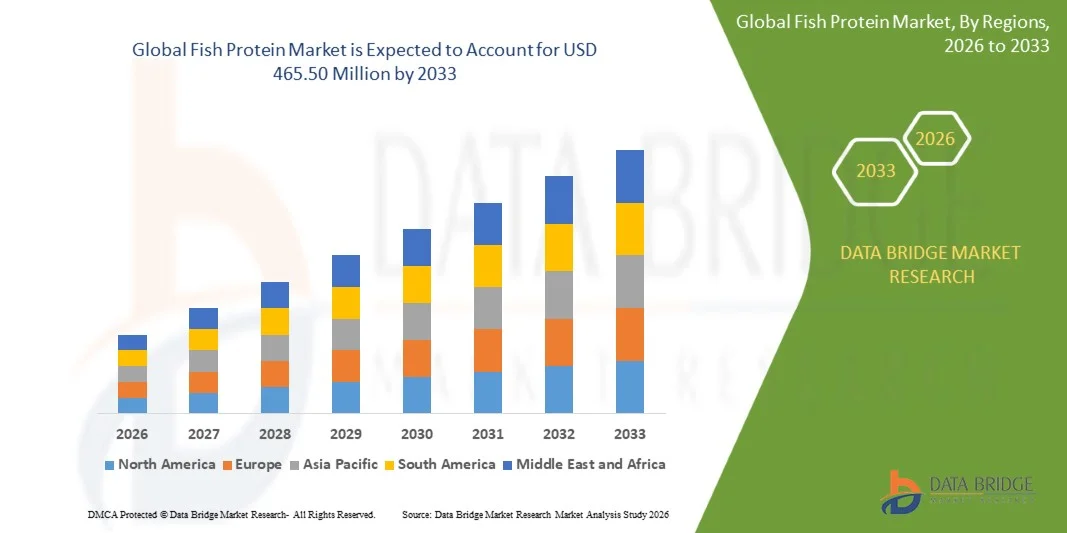
- As per Data Bridge Market Research analysis, the fish protein market was valued at USD 329.85 million in 2025 and is projected to reach USD 465.50 million by 2033, growing at a CAGR of 4.40% from 2026 to 2033.
- The market is experiencing steady growth driven by rising global demand for sustainable, high-quality alternative protein sources, growing consumer interest in marine-derived functional ingredients offering superior amino acid profiles, and increasing utilization of fish processing by-products to reduce seafood industry waste and improve overall value chain sustainability.
- The growing consumer awareness of fish protein’s high digestibility, complete essential amino acid profile, and omega-3 fatty acid co-benefits is compelling food and nutraceutical manufacturers to incorporate fish-derived proteins into an expanding range of products beyond traditional animal feed applications. Fish protein hydrolysate is increasingly complementing conventional fish meal and concentrate products, offering improved solubility and bioavailability for human food and sports nutrition applications.
- The growing global emphasis on circular economy practices within the seafood industry is further reinforcing fish protein market expansion, as manufacturers increasingly view processing by-products as a valuable revenue stream rather than a waste disposal cost, supporting sustained investment in protein recovery infrastructure.
Market Size & Forecast
- Global Market Value (2025): USD 329.85 Million
- Expected Market Value (2033): USD 465.50 Million
- Forecast CAGR (2026–2033): 4.40%
- Leading Region in 2025: Europe
- Fastest Growing Region: Asia-Pacific
What are the Major Takeaways of the Fish Protein Market?
- Europe dominated the global fish protein market with the largest revenue share of 34.72% in 2025, supported by advanced fish processing infrastructure across Norway, Iceland, and Denmark, strong regulatory support for sustainable fisheries by-product utilization, and established fish protein hydrolysate production capabilities for nutraceutical applications.
- Asia-Pacific is expected to be the fastest-growing region at a CAGR of 6.3% from 2026 to 2033, fueled by rapidly expanding aquaculture feed demand, rising consumer interest in marine-derived functional nutrition products, and growing domestic fish processing capacity across China, Japan, and Vietnam.
- The fish protein hydrolysate segment led the market with a 38.64% share in 2025, driven by its superior solubility, bioavailability, and increasing adoption across human nutrition, sports supplement, and specialty animal feed applications.
- The human food & nutraceuticals application segment is the fastest-growing category, projected to register a CAGR of 6.7%, reflecting rising consumer demand for marine-derived protein ingredients in functional foods, dietary supplements, and clinical nutrition products.
- The animal feed application segment dominated the application category with a 54.36% revenue share in 2025, led by continued strong demand for high-quality protein inputs across aquaculture, pet food, and livestock feed formulations.
- The powder form segment accounted for 61.28% of the market share in 2025, preferred for its extended shelf stability, ease of transport and storage, and broad compatibility across food, feed, and supplement manufacturing processes.
- The sports nutrition & dietary supplements application segment is the fastest-growing category, with a CAGR of 7.1%, driven by rising consumer interest in marine-derived protein as a differentiated alternative to conventional whey and plant-based protein supplements.
Report Scope and Fish Protein Market Segmentation
|
Attributes |
Fish Protein Key Market Insights |
|
Segments Covered |
|
|
Countries Covered |
North America
Europe
Asia-Pacific
Middle East and Africa
South America
|
|
Key Market Players |
|
|
Market Opportunities |
|
|
Value Added Data Infosets |
In addition to the insights on market scenarios such as market value, growth rate, segmentation, geographical coverage, and major players, the market reports curated by the Data Bridge Market Research also include in-depth expert analysis, pricing analysis, brand share analysis, consumer survey, demography analysis, supply chain analysis, value chain analysis, raw material/consumables overview, vendor selection criteria, PESTLE Analysis, Porter Analysis, and regulatory framework. |
What is the Key Trend in the Fish Protein Market?
- Fish protein manufacturers are increasingly investing in enzymatic hydrolysis and advanced processing technologies to convert fish-processing side streams into higher-value protein ingredients. The trend is being driven by demand for sustainable marine ingredients with applications across human nutrition, functional foods, nutraceuticals, pet nutrition, and aquaculture.
- For instance, a February 2025 strategic partnership between Hofseth BioCare ASA (HBC) and Symrise AG provides a notable industry example. Under the agreement, Symrise committed a EUR 5 million loan to support HBC's conversion of its Berkak facility in Norway into a state-of-the-art enzymatic hydrolysis plant, with the planned expansion expected to triple HBC's production capacity. The companies also agreed to distribute HBC's marine ingredients through Symrise's global customer network.
- Technology-transfer partnerships between research institutions and seafood companies are also supporting the commercialization of marine protein hydrolysates.
- For instance, in December 2024, ICAR–Central Institute of Fisheries Technology (ICAR-CIFT) signed a Memorandum of Agreement with Siri Aquatic Feeds Pvt. Ltd. for the technology transfer of an enzymatically derived shrimp protein hydrolysate produced from shrimp-shell waste. ICAR-CIFT stated that the technology converts shrimp-shell waste into a higher-value protein hydrolysate, linking enzymatic processing with waste reduction and value addition in the seafood industry.
- Industry–academic collaboration is also expanding the development of protein hydrolysates from underutilized marine resources for food and health applications.
- For instance, in January 2025, the University of the Philippines Visayas (UPV) and Pascual Pharma Corp., through DOST-PCAARRD, were reported to be developing protein hydrolysates from marine fishery species. The project uses low-value and underutilized marine raw materials, including bigeye scad, sardines, bullet tuna, low-fin pomfret, snake mackerel, mollusks, and seaweeds, and had produced chemical\- and food-grade hydrolysates intended for future blended hydrolysate products.
- Companies are simultaneously expanding marine protein hydrolysate applications beyond human nutrition into aquaculture and animal nutrition.
- For instance, in January 2025 Aquaproducts announced PEPTITOM, a shrimp hydrolysate powder, and highlighted collaborations with Scanbio and Maqpro Biotech as part of its marine-protein supply chain. Aquaproducts also operates Marine Biotech Vietnam, a hydrolysate facility focused on producing dry hydrolysate protein powders for Asian feed and pet-food markets. aquaproducts.org
- Overall, the fish protein market is shifting toward higher-value, technology-enabled utilization of marine resources rather than relying primarily on conventional low-value applications. Enzymatic hydrolysis, side-stream valorization, strategic partnerships, technology transfer, and scientific validation are collectively supporting the development of fish protein hydrolysates and related marine ingredients for functional foods, nutraceuticals, sports and consumer health, pet nutrition, and aquaculture.
What are the Key Drivers of the Fish Protein Market?
- The rising global demand for sustainable, high-quality alternative protein sources, driven by growing consumer awareness of the environmental impact of traditional protein production methods, has significantly increased interest in fish protein as a resource-efficient nutritional ingredient.
- For instance, in April 2025, TripleNine Group expanded its fish protein concentrate production capacity to meet rising demand from both animal feed manufacturers and food ingredient customers seeking sustainably sourced marine protein inputs.
- The continued rapid expansion of the global aquaculture industry, requiring increasingly efficient and sustainable protein sources for fish and shrimp feed formulations, is driving sustained demand for fish protein products as key aquafeed ingredients.
- For instance, in December 2024, BioMar Group expanded distribution of its fish protein hydrolysate-enhanced aquafeed formulations to additional customers across Southeast Asia, supporting the region’s rapidly expanding shrimp and fish farming industries.
- The growing consumer shift toward flexitarian and pescatarian dietary patterns, driven by both health and environmental sustainability considerations, is expanding the addressable consumer base for marine-derived protein ingredients across functional food and supplement categories.
- With rising global demand for sustainable protein sources, continued aquaculture industry expansion, and growing consumer interest in marine-derived functional nutrition, fish protein will remain an important ingredient category within the broader global food, feed, and nutraceutical industries.
Which Factors are Challenging the Growth of the Fish Protein Market?
- The fish protein market faces significant exposure to raw material supply volatility, as fish catch volumes for both direct processing and by-product generation can vary substantially due to seasonal fishing patterns, quota regulations, and broader marine ecosystem sustainability considerations.
- These supply fluctuations create unpredictable input availability and pricing for fish protein manufacturers, complicating long-term supply contract planning for downstream food, feed, and nutraceutical customers dependent on consistent product availability.
- For instance, in January 2024, Peru closed its second anchovy fishing season early after approximately 75% of the permitted quota had been caught, following disruptions associated with El Niño conditions and the presence of juvenile fish. The disruption followed the cancellation of Peru's first 2023 anchovy season and illustrates how climate-related changes in marine conditions can affect fish availability and create uncertainty for downstream marine-ingredient supply chains.
- Growing competition from plant-based and alternative protein sources, including pea, soy, and insect protein, is creating a crowded ingredient landscape in which fish protein must continue to differentiate itself through demonstrated nutritional and functional advantages to maintain and grow its market position.
- The characteristic fishy taste and odor associated with many fish protein products continues to limit broader consumer acceptance in mainstream human food and beverage applications, despite ongoing processing improvements. This sensory barrier slows market penetration beyond niche nutraceutical and sports nutrition segments, limiting the pace of category expansion into more mainstream food product categories despite fish protein’s favorable nutritional profile.
How is the Fish Protein Market Segmented?
The fish protein market is segmented on the basis of product type, source, form, application, end user, and distribution channel.
- By Product Type
On the basis of product type, the global fish protein market is segmented into fish protein concentrate, fish protein hydrolysate, fish protein isolate, fish meal, and others. The fish protein hydrolysate segment dominated the market with a 38.64% share in 2025, owing to its superior solubility, bioavailability, and increasing adoption across human nutrition, sports supplement, and specialty animal feed applications. These products remain the preferred choice for manufacturers seeking easily digestible, functionally versatile marine protein ingredients.
The fish protein isolate segment is projected to register the fastest growth at a CAGR of 6.9% from 2026 to 2033, driven by rising demand for the highest-purity marine protein products suited to premium human nutrition and specialty nutraceutical applications requiring minimal non-protein content.
- By Source
On the basis of source, the global fish protein market is segmented into whitefish, salmonids, tuna & other pelagic fish, and fish by-products/processing waste. The fish by-products/processing waste segment led the market with a 42.17% share in 2025, supported by growing industry emphasis on maximizing value recovery from seafood processing operations and reducing overall industry waste generation.
The salmonids segment is expected to experience the fastest growth at a CAGR of 6.4% from 2026 to 2033, driven by the continued rapid expansion of global salmon aquaculture production generating increasing volumes of processing by-products suitable for high-value protein recovery.
- By Form
On the basis of form, the global fish protein market is segmented into powder, liquid, and granules. The powder segment dominated the market with a share of 61.28% in 2025 due to its extended shelf stability, ease of transport and storage, and broad compatibility across food, feed, and supplement manufacturing processes. the widespread preference among manufacturers for powder-form ingredients offering simplified formulation integration continues to reinforce this segment’s leading position.
The liquid segment is expected to witness the fastest CAGR of 5.8% from 2026 to 2033, driven by rising demand for ready-to-use liquid protein hydrolysate products in specialty aquafeed and functional beverage applications where liquid form offers processing and formulation advantages over powder alternatives.
- By Application
On the basis of application, the global fish protein market is segmented into human food & nutraceuticals, animal feed, sports nutrition & dietary supplements, and others. The animal feed segment dominated the market with a share of 54.36% in 2025 due to continued strong demand for high-quality protein inputs across aquaculture, pet food, and livestock feed formulations. the continued global expansion of aquaculture production is reinforcing the dominance of this segment.
The human food & nutraceuticals segment is expected to witness the fastest CAGR of 6.7% from 2026 to 2033, driven by this growth is fueled by rising consumer demand for marine-derived protein ingredients in functional foods, dietary supplements, and clinical nutrition products supporting healthy aging and recovery nutrition.
- By End User
On the basis of end user, the global fish protein market is segmented into food & beverage manufacturers, nutraceutical companies, animal feed manufacturers, and sports nutrition companies. The animal feed manufacturers segment dominated the market with a share of 49.82% in 2025 due to sustained demand for fish protein as a key aquafeed and specialty pet food ingredient supporting animal growth and health outcomes. the widespread integration of fish protein into premium aquafeed formulations is reinforcing this segment’s leading position.
The sports nutrition companies segment is expected to witness the fastest CAGR of 7.1% from 2026 to 2033, driven by rising consumer interest in marine-derived protein as a differentiated alternative to conventional whey and plant-based protein supplements, particularly among consumers seeking dairy-free options.
- By Distribution Channel
On the basis of distribution channel, the global fish protein market is segmented into B2B/direct sales, online retail, and specialty stores. The B2B/direct sales segment dominated the market with a share of 72.64% in 2025 due to the predominantly industrial nature of fish protein procurement by food, feed, and nutraceutical manufacturers requiring bulk ingredient supply agreements. established direct supplier relationships between fish protein producers and industrial customers continue to reinforce this segment’s leading position.
The online retail segment is expected to witness the fastest CAGR of 8.2% from 2026 to 2033, driven by growing direct-to-consumer sales of finished fish protein supplement products through e-commerce platforms targeting health-conscious and sports nutrition consumers.
Which Region Holds the Largest Share of the Fish Protein Market?
- Europe dominated the fish protein market and accounted for the largest revenue share of 34.72% in 2025, supported by advanced fish processing infrastructure across Norway, Iceland, and Denmark, strong regulatory support for sustainable fisheries by-product utilization, and established fish protein hydrolysate production capabilities for nutraceutical applications.
- The region also benefits from a well-developed marine ingredients industry, strong consumer awareness of omega-3 and marine protein health benefits, and continued innovation investment from leading fish protein manufacturers headquartered in the region. Continued focus on sustainable fisheries management continues to strengthen Europe’s leadership position in the global market.
Germany Fish Protein Market Insight
Germany market is expected to witness the growth driven by advanced food technology and a robust pharmaceutical sector. Local demand focuses heavily on high-purity, pharmaceutical-grade isolates used in medical nutrition, functional foods, and cosmetics. Conversely, the aquafeed sector depends significantly on imported marine proteins, creating a shift toward sustainable alternatives like insect-derived and single-cell options. Strict European clean-label standards and strict quality regulations continue to drive innovation across German manufacturing and specialized feed industries.
France Fish Protein Market Insight
France’s fish protein market is evolving alongside demand for high-quality, sustainable, and convenient nutrition. Growth is supported by rising interest in protein-rich diets, seafood consumption, and functional food applications. Fish protein ingredients are increasingly used in sports nutrition, dietary supplements, clinical nutrition, and food products. Sustainability, traceability, and responsible sourcing remain important purchasing factors. Market opportunities are emerging for value-added, clean-label, and environmentally responsible fish protein solutions, while regulatory requirements and raw-material availability continue to influence competitive dynamics.
Asia-Pacific Fish Protein Market Insight
The Asia-Pacific fish protein market is expected to witness rapid growth, driven by rapidly expanding aquaculture feed demand, rising consumer interest in marine-derived functional nutrition products, and growing domestic fish processing capacity across the region. Increasing government support for aquaculture industry modernization and rising consumer health awareness are supporting regional market expansion. Additionally, the growing presence of both international and domestic fish protein manufacturers is accelerating market adoption across the region.
China Fish Protein Market Insight
The China fish protein market is growing rapidly, driven by extensive domestic aquaculture production, rising demand for high-quality aquafeed protein inputs, and growing consumer interest in marine-derived nutraceutical products. Growing adoption of fish protein hydrolysate across both aquafeed and human nutrition applications is significantly boosting market demand. In addition, rising domestic fish processing and protein recovery capabilities are positioning China as one of the fastest-growing markets for fish protein globally.
India Fish Protein Market Insight
India’s fish protein market is expanding with growing demand for affordable, nutritious, and protein-rich food ingredients. Rising seafood consumption, increasing health awareness, sports nutrition trends, and growth in functional foods are supporting market development. Fish protein is gaining applications in dietary supplements, animal nutrition, processed foods, and specialized nutrition products. Opportunities are emerging for value-added, sustainable, and clean-label protein solutions. However, supply-chain infrastructure, processing capabilities, quality standards, and consumer awareness remain important factors shaping market growth.
Which are the Top Companies in Fish Protein Market?
The fish protein industry is primarily led by well-established companies, including:
- TripleNine Group A/S (Denmark)
- Pelagia AS (Norway)
- Austevoll Seafood ASA (Norway)
- Copalis Sea Solutions SAS (France)
- Symrise AG (Diana Food) (Germany)
- Croda International Plc (Incromega) (U.K.)
- GC Rieber Oils AS (Norway)
- Scanbio Marine Group AS (Norway)
- Norsildmel AS (Norway)
- FF Skagen A/S (Denmark)
- Sopropêche Group (France)
- BioMar Group (Denmark)
- Omega Protein Corporation (U.S.)
- Tecnológica de Alimentos S.A. (TASA) (Peru)
- Corpesca S.A. (Chile)
- Nutrimar S.A. (Chile)
- Copeinca ASA (China Fishery Group) (Peru)
- Darling Ingredients Inc. (Rousselot) (U.S.)
- Bioriginal Food & Science Corp. (Canada)
- Marine Ingredients Denmark A/S (Denmark)
What are Latest Developments in Fish Protein Market?
- In September 2025, Pelagia launched a new low-odor fish protein hydrolysate product line specifically formulated for human food and beverage applications, targeting food manufacturers seeking to incorporate marine protein into mainstream functional food products.
- In January 2025, TripleNine Group expanded its fish protein concentrate manufacturing facility in Denmark to increase production capacity and meet rising demand from both aquafeed and human nutrition ingredient customers.
- In November 2025, Symrise expanded its Diana Food marine protein ingredient portfolio with a new fish protein hydrolysate product optimized for sports nutrition applications, featuring improved solubility and neutral taste profile.
- In November 2024, BioMar Group introduced an upgraded fish protein hydrolysate-enhanced aquafeed formulation designed to improve growth performance and immune health in shrimp aquaculture applications.
- In June 2023, Omega Protein Corporation partnered with several nutraceutical companies to conduct field validation of its fish protein hydrolysate ingredients in clinical nutrition applications, demonstrating favorable amino acid bioavailability outcomes compared to conventional protein sources.
- In August 2024, Croda International expanded its Incromega marine ingredient production capacity to meet growing demand from nutraceutical and functional food customers seeking sustainably sourced fish protein and omega-3 co-products.

- Interactive Data Analysis Dashboard
- Company Analysis Dashboard for high growth potential opportunities
- Research Analyst Access for customization & queries
- Competitor Analysis with Interactive dashboard
- Latest News, Updates & Trend analysis
- Harness the Power of Benchmark Analysis for Comprehensive Competitor Tracking
Global Fish Protein Market, Supply Chain Analysis and Ecosystem Framework
To support market growth and help clients navigate the impact of geopolitical shifts, DBMR has integrated in-depth supply chain analysis into its Global Fish Protein Market research reports. This addition empowers clients to respond effectively to global changes affecting their industries. The supply chain analysis section includes detailed insights such as Global Fish Protein Market consumption and production by country, price trend analysis, the impact of tariffs and geopolitical developments, and import and export trends by country and HSN code. It also highlights major suppliers with data on production capacity and company profiles, as well as key importers and exporters. In addition to research, DBMR offers specialized supply chain consulting services backed by over a decade of experience, providing solutions like supplier discovery, supplier risk assessment, price trend analysis, impact evaluation of inflation and trade route changes, and comprehensive market trend analysis.
Data collection and base year analysis are done using data collection modules with large sample sizes. The stage includes obtaining market information or related data through various sources and strategies. It includes examining and planning all the data acquired from the past in advance. It likewise envelops the examination of information inconsistencies seen across different information sources. The market data is analysed and estimated using market statistical and coherent models. Also, market share analysis and key trend analysis are the major success factors in the market report. To know more, please request an analyst call or drop down your inquiry.
The key research methodology used by DBMR research team is data triangulation which involves data mining, analysis of the impact of data variables on the market and primary (industry expert) validation. Data models include Vendor Positioning Grid, Market Time Line Analysis, Market Overview and Guide, Company Positioning Grid, Patent Analysis, Pricing Analysis, Company Market Share Analysis, Standards of Measurement, Global versus Regional and Vendor Share Analysis. To know more about the research methodology, drop in an inquiry to speak to our industry experts.
Data Bridge Market Research is a leader in advanced formative research. We take pride in servicing our existing and new customers with data and analysis that match and suits their goal. The report can be customized to include price trend analysis of target brands understanding the market for additional countries (ask for the list of countries), clinical trial results data, literature review, refurbished market and product base analysis. Market analysis of target competitors can be analyzed from technology-based analysis to market portfolio strategies. We can add as many competitors that you require data about in the format and data style you are looking for. Our team of analysts can also provide you data in crude raw excel files pivot tables (Fact book) or can assist you in creating presentations from the data sets available in the report.













