


Financial Statement Fraud Market Overview
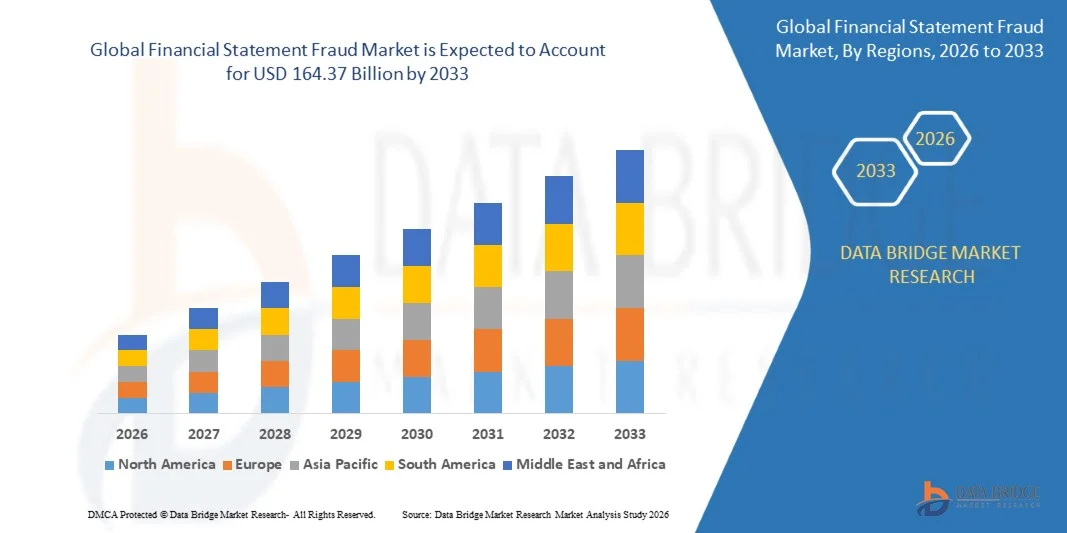
As per Data Bridge Market Research analysis, the financial statement fraud market was valued at USD 41.43 billion in 2025 and is projected to reach USD 164.37 billion by 2033, growing at a CAGR of 18.80% from 2026 to 2033. The market is experiencing consistent growth driven by increasing regulatory scrutiny, rising incidents of financial fraud, growing demand for financial transparency, and the adoption of advanced fraud detection technologies such as artificial intelligence, machine learning, and data analytics.
The increasing complexity of financial reporting, expansion of digital financial transactions, and stricter compliance requirements are compelling enterprises, banking institutions, auditing organizations, and government bodies to adopt advanced financial statement fraud detection solutions. AI-powered fraud analytics, automated auditing platforms, and continuous monitoring systems are replacing traditional manual approaches by enabling early detection of financial irregularities, improving corporate governance, reducing financial risks, and strengthening regulatory compliance
Market Size & Forecast
- Global Market Value (2025): USD 41.43 Billion
- Expected Market Value (2033): USD 164.37 Billion
- Forecast CAGR (2026–2033): 18.80%
- Leading Region in 2025: North America
- Fastest Growing Region: Asia Pacific
Key Market Trends & Insights
- North America dominated the financial statement fraud market with the largest revenue share of 45.7% in 2025, supported by stringent regulatory frameworks, increasing corporate governance requirements, and strong adoption of advanced fraud detection solutions
- The revenue recognition fraud segment led the market with a 38.4% share in 2025, driven by its frequent occurrence across publicly traded companies and large enterprises seeking to meet earnings expectations and investor targets
- Asia-Pacific is expected to be the fastest-growing region, registering a CAGR of 8.0% during the forecast period, fueled by rapid digital transformation, increasing financial transaction volumes, improving regulatory frameworks, and growing adoption of fraud prevention technologies across emerging economies such as China and India
- Financial statement misstatement are the fastest-growing type of fraud, projected to register a CAGR of 8.6%, reflecting the surge in regulatory scrutiny and increasing complexity in corporate financial reporting
- The accounting anomalies segment dominated the warning sign category with a 31.7% revenue share in 2025, led by its role as one of the earliest and most measurable indicators of potential financial statement fraud
- Internal audits accounted for 34.2% of the market, preferred by its critical role in continuously evaluating financial controls, operational processes, and compliance frameworks
- The government segment is the fastest-growing application category, with a CAGR of 8.5%, driven by increasing focus on public sector transparency, accountability, and anti-corruption initiatives
Report Scope and Financial Statement Fraud Market Segmentation
|
Attributes |
Financial Statement Fraud Key Market Insights |
|
Segments Covered |
|
|
Countries Covered |
North America
Europe
Asia-Pacific
Middle East and Africa
South America
|
|
Key Market Players |
|
|
Market Opportunities |
|
|
Value Added Data Infosets |
In addition to the market insights such as market value, growth rate, market segments, geographical coverage, market players, and market scenario, the market report curated by the Data Bridge Market Research team includes in-depth expert analysis, import/export analysis, pricing analysis, production consumption analysis, and pestle analysis. |
Financial Statement Fraud Market Trends
Trend: Growth in AI-Powered Fraud Detection and Predictive Analytics
Organizations are increasingly adopting artificial intelligence (AI), machine learning, and advanced analytics solutions to detect financial statement fraud by identifying abnormal transaction patterns, analyzing large volumes of financial data, and improving audit accuracy. The integration of automated risk assessment, continuous monitoring, and predictive analytics enables auditors and enterprises to move from traditional periodic reviews toward proactive fraud prevention models. Financial institutions, multinational corporations, and regulatory bodies are similarly leveraging AI-driven platforms to strengthen financial transparency, improve compliance processes, and reduce the impact of fraudulent reporting activities. For instance, in July 2024, the Association of Certified Fraud Examiners (ACFE) reported that proactive anti-fraud controls, including proactive data analysis, were associated with reduced fraud losses and shorter fraud duration, highlighting the increasing importance of technology-enabled fraud management solutions.
The growing adoption of AI-based fraud detection technologies is transforming financial statement fraud management by enabling faster identification of irregularities, improving audit efficiency, and strengthening corporate governance practices.
Financial Statement Fraud Market Dynamics
Key Market Driver: Increasing Regulatory Compliance Requirements and Corporate Governance Standards
The increasing implementation of strict financial reporting regulations and corporate governance standards is creating substantial demand for financial statement fraud detection solutions. Regulatory authorities and organizations are focusing on improving transparency, strengthening internal controls, and reducing accounting manipulation risks through advanced auditing and compliance technologies. Enterprises, financial institutions, and auditing firms are adopting automated fraud monitoring platforms to meet evolving regulatory requirements, minimize financial misstatements, and improve investor confidence. The growing complexity of global financial operations further accelerates the need for continuous fraud assessment and advanced forensic accounting capabilities. For instance, in March 2024, the U.S. Securities and Exchange Commission (SEC) announced enforcement actions against multiple entities for violations related to financial reporting, disclosure failures, and accounting-related misconduct, reinforcing the importance of strong internal controls and fraud prevention mechanisms.
Rising regulatory scrutiny and the increasing focus on financial transparency are major factors accelerating the adoption of financial statement fraud detection solutions globally.
Key Restraint/Challenge: High Cost and Complexity of Implementing Advanced Fraud Detection Systems
A significant restraint in the financial statement fraud market is the high investment required for implementing advanced fraud detection platforms. Modern solutions integrate artificial intelligence algorithms, predictive analytics, data management systems, and continuous monitoring capabilities, requiring substantial expenditure on technology infrastructure, software integration, and skilled professionals. Small and medium-sized enterprises often face challenges due to limited budgets, lack of technical expertise, and difficulties in integrating advanced fraud analytics with existing accounting systems. The ongoing requirement for system upgrades, cybersecurity protection, and regulatory adaptation further increases the overall cost of ownership. For instance, in March 2024, the Association of Certified Fraud Examiners (ACFE) released the Occupational Fraud 2024: A Report to the Nations, highlighting that occupational fraud remains a major financial risk for organizations globally. The report found that financial statement fraud represented 5% of reported cases but resulted in a median loss of USD 766,000, emphasizing the need for stronger fraud prevention controls and investment in detection systems.
The high implementation cost and technical complexity of advanced fraud detection solutions remain key barriers, particularly for smaller enterprises seeking adoption of sophisticated fraud management technologies.
Key Market Opportunity: Expansion of Cloud-Based Fraud Detection and Real-Time Monitoring Solutions
The increasing adoption of cloud-based fraud detection platforms presents a significant market opportunity by enabling scalable, cost-effective, and real-time financial monitoring capabilities. Cloud technologies allow organizations to deploy advanced analytics solutions without extensive on-premise infrastructure investments while improving accessibility, data processing speed, and operational efficiency. The integration of cloud computing with AI, machine learning, and automated auditing tools is creating new opportunities for enterprises, financial institutions, and accounting firms to enhance fraud prevention capabilities. For instance, in October 2024, Oracle launched the Oracle Financial Services Crime and Compliance Management Investigation Hub Cloud Service, an AI-powered case management solution designed to help banks investigate financial crime, automate fraud investigations, enhance compliance, and resolve cases up to 70% faster, creating opportunities for broader adoption of cloud-based fraud analytics platforms.
The shift toward cloud-enabled fraud detection platforms is expected to accelerate market growth by improving affordability, scalability, and accessibility of advanced financial statement fraud prevention technologies.
Financial Statement Fraud Market Scope
The financial statement fraud market is segmented on the basis of type of fraud, warning sign, detection method, and application.
- By Type of Fraud
On the basis of type of fraud, the financial statement fraud market is segmented into revenue recognition fraud, expense inflation, asset misappropriation, and financial statement misstatement. The revenue recognition fraud segment dominated the market with an estimated share of 38.4% in 2025, driven by its frequent occurrence across publicly traded companies and large enterprises seeking to meet earnings expectations and investor targets. This type of fraud involves premature, fictitious, or manipulated revenue reporting, making it one of the most scrutinized areas by regulators and auditors. Revenue-related irregularities often have a direct impact on stock prices, shareholder confidence, and corporate valuation. The increasing complexity of global accounting standards and multi-channel revenue streams further elevates the risk of manipulation. Organizations are investing heavily in analytics and monitoring tools to detect unusual revenue patterns. Regulatory enforcement actions continue to keep revenue recognition fraud at the center of fraud prevention efforts.
The financial statement misstatement segment is projected to register the fastest growth at an estimated CAGR of 8.6% from 2026 to 2033, driven by growing regulatory scrutiny and increasing complexity in corporate financial reporting. Misstatements may involve manipulation of assets, liabilities, expenses, revenues, or disclosures to present a misleading financial position. The adoption of digital reporting systems and complex business structures is creating new challenges for auditors and compliance teams. Organizations are increasingly deploying AI-powered solutions to identify inconsistencies and reporting anomalies. Rising cross-border business operations and stricter disclosure requirements are further supporting demand for advanced fraud detection solutions. The segment is expected to benefit from increasing investments in forensic accounting and compliance technologies.
- By Warning Sign
On the basis of warning sign, the financial statement fraud market is segmented into accounting anomalies, consistent sales growth, depreciation methods, weak internal corporate governance, outsized frequency of complex third-party transactions, missing paperwork, and incentivizes fraud. The accounting anomalies segment dominated the market with an estimated share of 31.7% in 2025 due to its role as one of the earliest and most measurable indicators of potential financial statement fraud. Unusual fluctuations in revenues, expenses, margins, or balance sheet items often trigger fraud investigations and audit reviews. Organizations increasingly rely on automated analytics platforms to identify accounting irregularities in real time. The growth of continuous auditing and data-driven compliance programs has strengthened the importance of anomaly detection. Regulatory authorities frequently use anomaly-based assessments during investigations. As financial data volumes continue to expand, accounting anomalies remain the most widely monitored fraud indicator.
The weak internal corporate governance segment is anticipated to witness the fastest growth at an estimated CAGR of 8.8% from 2026 to 2033, driven by increasing recognition of governance failures as a root cause of major financial scandals. Weak oversight structures, inadequate board supervision, and ineffective internal controls significantly increase fraud risk exposure. Investors and regulators are placing greater emphasis on governance quality and transparency. Organizations are expanding governance risk and compliance programs to strengthen accountability. The integration of governance monitoring tools and compliance technologies is accelerating adoption. Growing corporate focus on ESG reporting is also contributing to segment growth.
- By Detection Method
On the basis of detection method, the financial statement fraud market is segmented into horizontal financial statement analysis, vertical financial statement analysis, internal audits, external audits, fraud detection software, and whistleblower reports. The internal audits segment dominated the market with an estimated share of 34.2% in 2025 owing to its critical role in continuously evaluating financial controls, operational processes, and compliance frameworks. Internal audit teams serve as the first line of defense against fraudulent reporting practices. Organizations increasingly conduct risk-based audits to identify irregularities before they escalate into material financial issues. The segment benefits from growing investments in governance, risk, and compliance programs. Internal audits provide continuous oversight and support early fraud identification. Their ability to improve organizational transparency and accountability sustains their dominant market position.
The fraud detection software segment is expected to register the fastest growth at an estimated CAGR of 9.4% from 2026 to 2033, driven by rapid adoption of artificial intelligence, machine learning, and predictive analytics technologies. These platforms can analyze vast volumes of financial data in real time and identify suspicious patterns that may go unnoticed through manual reviews. Organizations are increasingly adopting automated fraud monitoring systems to improve efficiency and reduce compliance risks. The growing complexity of financial transactions is further increasing demand for advanced analytics solutions. Cloud-based deployment models are expanding accessibility across organizations of all sizes. Continuous technological advancements are expected to accelerate market growth significantly.
- By Application
On the basis of application, the financial statement fraud market is segmented into defence, government, banks & financial institutions, and others. The banks & financial institutions segment dominated the market with an estimated share of 42.8% in 2025 due to the high volume of financial transactions, stringent regulatory requirements, and elevated exposure to financial fraud risks. Financial institutions must comply with extensive reporting, auditing, and risk management standards, driving demand for advanced fraud detection solutions. The increasing digitization of banking services has expanded the need for continuous monitoring and compliance management. AI-powered analytics and real-time fraud detection tools are widely adopted across the sector. Regulatory pressure and reputational concerns continue to support investments in fraud prevention technologies. The segment remains the largest adopter of financial statement fraud detection solutions globally.
The government segment is projected to witness the fastest growth at an estimated CAGR of 8.5% from 2026 to 2033, driven by increasing focus on public sector transparency, accountability, and anti-corruption initiatives. Governments are adopting advanced fraud analytics and forensic accounting tools to strengthen oversight of public funds and financial reporting processes. The growing digitalization of government financial systems is creating demand for automated monitoring solutions. Regulatory reforms and public-sector governance programs are further supporting adoption. Investments in compliance infrastructure and audit modernization initiatives are accelerating market growth. The segment is expected to benefit from rising efforts to enhance financial integrity and public trust.
Financial Statement Fraud Market Regional Analysis
North America dominated the financial statement fraud market with the largest revenue share of 45.7% in 2025, supported by stringent regulatory frameworks, increasing corporate governance requirements, and strong adoption of advanced fraud detection solutions. The region benefits from the presence of major financial institutions, regulatory authorities, forensic accounting firms, and technology providers specializing in fraud analytics and compliance solutions. Growing implementation of artificial intelligence, machine learning, and continuous auditing platforms is enhancing fraud detection capabilities across enterprises. Increasing enforcement actions by regulatory agencies and rising investments in governance, risk, and compliance programs are further accelerating market development. The growing focus on financial transparency, investor protection, and prevention of accounting misconduct continues to strengthen North America's leadership position in the global market.
U.S. Financial Statement Fraud Market Insight
The U.S. financial statement fraud market is witnessing strong growth due to increasing regulatory scrutiny, rising adoption of artificial intelligence-driven fraud detection platforms, and growing corporate focus on financial transparency and compliance. The country’s mature financial services sector, extensive public company ecosystem, and advanced regulatory framework are driving demand for fraud analytics, forensic accounting, and continuous auditing solutions. In addition, growing concerns regarding accounting irregularities, earnings manipulation, and financial reporting misconduct are accelerating investments in fraud prevention technologies across enterprises and financial institutions. In fiscal year 2024, the U.S. Securities and Exchange Commission (SEC) filed 583 total enforcement actions and obtained orders for financial remedies totaling approximately USD 8.2 billion, reflecting continued focus on financial reporting integrity and fraud enforcement.
Europe Financial Statement Fraud Market Insight
The Europe financial statement fraud market remains a major contributor to global revenue, driven by stringent financial reporting regulations, increasing corporate governance requirements, and growing adoption of advanced compliance technologies. The widespread implementation of anti-fraud frameworks across banking, insurance, and public sector organizations is supporting market expansion throughout the region. Increasing investments in data analytics, forensic accounting, and regulatory technology solutions, coupled with strict oversight from European regulatory authorities, continue to enhance fraud detection capabilities. The European Union's Corporate Sustainability Reporting Directive (CSRD), which began phased implementation in 2024, has significantly increased reporting and compliance requirements, driving demand for advanced monitoring and verification solutions.
U.K. Financial Statement Fraud Market Insight
The U.K. financial statement fraud market is experiencing steady growth, supported by increasing adoption of digital auditing technologies, rising regulatory oversight, and growing demand for risk management and compliance solutions. Financial institutions, publicly listed companies, and accounting firms are investing in advanced fraud detection systems to improve transparency and reduce reporting risks. Furthermore, integration of artificial intelligence, machine learning, and automated monitoring technologies is improving fraud identification capabilities, positioning the U.K. as a key innovation hub in financial crime prevention. On 25 July 2024, the U.K. Financial Reporting Council (FRC) published its Annual Enforcement Review 2024, summarizing enforcement activity for the year ended 31 March 2024 and highlighting lessons from high-profile audit investigations, including deficiencies in auditor integrity, fraud risk assessment, audit planning, and audit evidence to strengthen confidence in corporate reporting.
Germany Financial Statement Fraud Market Insight
The Germany financial statement fraud market is expanding steadily due to the country’s strong industrial base, advanced financial infrastructure, and increasing focus on corporate governance and compliance management. Enterprises, financial institutions, and auditing firms are increasingly utilizing fraud analytics and forensic accounting tools to strengthen reporting accuracy and internal controls. Continuous advancements in digital auditing technologies, data analytics, and regulatory compliance solutions, along with strong government focus on corporate accountability, are further driving market growth in Germany. Germany continues to implement stricter audit oversight and reporting reforms following major corporate accounting scandals, increasing demand for fraud detection and governance solutions across enterprises.
Asia-Pacific Financial Statement Fraud Market Insight
The Asia-Pacific financial statement fraud market is expected to witness rapid growth, driven by increasing digitalization of financial services, expanding capital markets, and rising investments in compliance infrastructure across countries such as China, India, Japan, and Australia. Growing awareness regarding corporate governance, increasing adoption of fraud analytics platforms, and rising demand for scalable and cost-effective compliance solutions are supporting regional market expansion. In addition, the growing presence of multinational corporations and evolving regulatory frameworks are accelerating adoption of financial statement fraud detection technologies. The Association of Certified Fraud Examiners (ACFE) reported continued growth in anti-fraud investments across Asia-Pacific organizations as businesses strengthen fraud risk management and compliance programs
Japan Financial Statement Fraud Market Insight
The Japan financial statement fraud market is witnessing consistent growth due to rising investments in governance, risk management, and compliance technologies. Financial institutions, corporations, and auditing organizations are increasingly adopting advanced analytics and automated monitoring systems to strengthen financial reporting controls and reduce fraud risks. Moreover, increasing regulatory expectations and the country’s focus on corporate governance reforms are further contributing to market growth. Japan’s Corporate Governance Code continues to encourage stronger board oversight, transparency, and disclosure practices, supporting demand for fraud monitoring and compliance solutions.
China Financial Statement Fraud Market Insight
The China financial statement fraud market is growing rapidly, driven by expanding capital markets, increasing regulatory oversight, and rising government focus on financial transparency and investor protection. Growing adoption of artificial intelligence-based analytics, automated auditing platforms, and compliance monitoring systems across financial institutions and enterprises is significantly boosting market demand. In addition, rising investments in digital finance, increasing scrutiny of listed companies, and rapid technological advancements are positioning China as one of the fastest-growing markets for financial statement fraud detection solutions globally. For instance, the China Securities Regulatory Commission (CSRC) has intensified enforcement actions against financial disclosure violations and accounting fraud among listed companies, strengthening demand for fraud prevention technologies.
Financial Statement Fraud Market Share
The financial statement fraud industry is primarily led by well-established companies, including:
- Oracle (U.S.)
- SAS Institute Inc. (U.S.)
- IBM (U.S.)
- Experian (Ireland)
- LexisNexis Risk Solutions (U.S.)
- Feedzai (Portugal)
- DataVisor, Inc. (U.S.)
- NICE Ltd. (Israel)
- Quantexa Limited (U.K.)
- BAE Systems (U.K.)
- Eastnets (U.A.E.)
- ACI Worldwide, Inc. (U.S.)
- Fiserv, Inc. (U.S.)
- SymphonyAI (U.S.)
- Clari5 (Singapore)
- ThetaRay Ltd. (Israel)
- Cleafy S.p.A. (Italy)
- RS Software (India)
Latest Developments in Financial Statement Fraud Market
- In March 2025, Oracle launched new AI Agents for the Oracle Financial Services Investigation Hub Cloud Service, enabling financial institutions to automate evidence collection, generate AI-driven investigation narratives, recommend investigative actions, and accelerate financial crime investigations. The launch strengthens fraud detection, compliance management, and financial statement fraud investigations through agentic AI capabilities
- In October 2024, Oracle launched the Oracle Financial Services Crime and Compliance Management Investigation Hub Cloud Service, an AI-powered case management solution that helps banks investigate financial crime, automate workflows, eliminate data silos, and resolve investigations up to 70% faster
- In September 2024, NICE Actimize launched its AI-powered Fraud Investigations solution, the industry's first end-to-end fraud investigation platform designed to automate fraud case management, streamline claims processing, generate Suspicious Activity Reports (SARs), and improve investigation efficiency for financial institutions
- In April 2024, NICE Actimize launched IFM 11 (Integrated Fraud Management), the latest version of its AI-driven fraud management platform featuring pervasive AI across fraud detection, investigations, analytics, and operational workflows to help financial institutions combat increasingly sophisticated fraud schemes
- In June 2023, Google Cloud launched Anti Money Laundering AI (AML AI), an artificial intelligence-powered solution designed to help financial institutions detect suspicious financial activities, improve financial crime investigations, and strengthen governance and regulatory compliance. The solution enables organizations to identify two to four times more suspicious activity while significantly reducing false alerts, supporting more effective fraud detection and financial risk management

- Interactive Data Analysis Dashboard
- Company Analysis Dashboard for high growth potential opportunities
- Research Analyst Access for customization & queries
- Competitor Analysis with Interactive dashboard
- Latest News, Updates & Trend analysis
- Harness the Power of Benchmark Analysis for Comprehensive Competitor Tracking
Data collection and base year analysis are done using data collection modules with large sample sizes. The stage includes obtaining market information or related data through various sources and strategies. It includes examining and planning all the data acquired from the past in advance. It likewise envelops the examination of information inconsistencies seen across different information sources. The market data is analysed and estimated using market statistical and coherent models. Also, market share analysis and key trend analysis are the major success factors in the market report. To know more, please request an analyst call or drop down your inquiry.
The key research methodology used by DBMR research team is data triangulation which involves data mining, analysis of the impact of data variables on the market and primary (industry expert) validation. Data models include Vendor Positioning Grid, Market Time Line Analysis, Market Overview and Guide, Company Positioning Grid, Patent Analysis, Pricing Analysis, Company Market Share Analysis, Standards of Measurement, Global versus Regional and Vendor Share Analysis. To know more about the research methodology, drop in an inquiry to speak to our industry experts.
Data Bridge Market Research is a leader in advanced formative research. We take pride in servicing our existing and new customers with data and analysis that match and suits their goal. The report can be customized to include price trend analysis of target brands understanding the market for additional countries (ask for the list of countries), clinical trial results data, literature review, refurbished market and product base analysis. Market analysis of target competitors can be analyzed from technology-based analysis to market portfolio strategies. We can add as many competitors that you require data about in the format and data style you are looking for. Our team of analysts can also provide you data in crude raw excel files pivot tables (Fact book) or can assist you in creating presentations from the data sets available in the report.













