


What is the Feed Palatability Enhancers and Modifiers Market Size and Growth Rate?
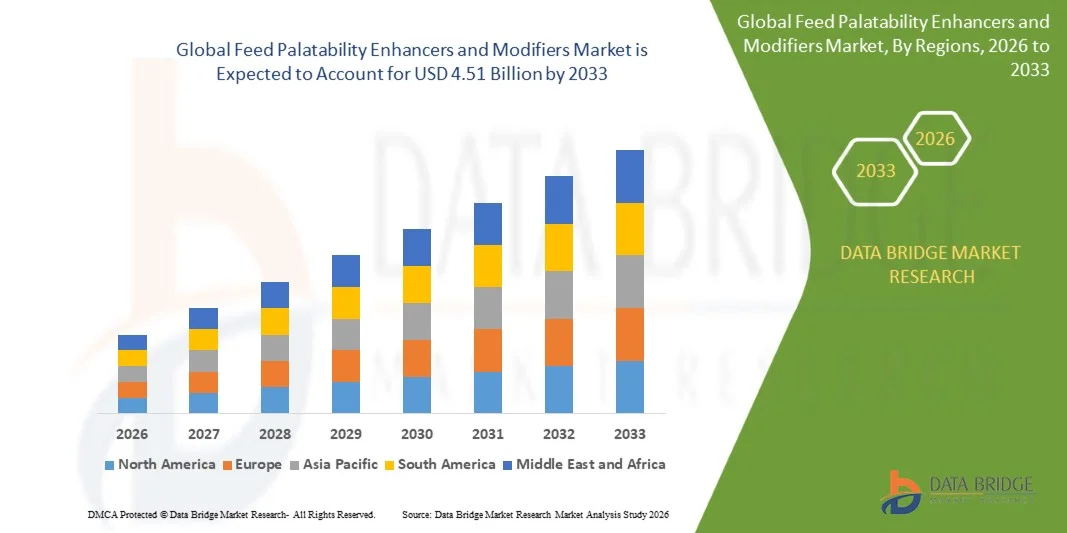
- As per Data Bridge Market Research analysis, the feed palatability enhancers and modifiers market was valued at USD 3.13 billion in 2025 and is projected to reach USD 4.51 billion by 2033, growing at a CAGR of 4.70% from 2026 to 2033.
- The market is experiencing notable growth driven by the increasing demand for high-quality animal feed products that improve livestock nutrition and productivity, rising demand for meat, dairy, and other animal-derived products, and the growing importance of feed quality and appeal.
- Palatability enhancers, including flavors and sweeteners, are incorporated into feed to stimulate animals' appetites, while feed palatability enhancers and modifiers improve the taste, smell, and texture of animal food, supporting better feed intake, enhanced growth, and increased overall feed efficiency. The increasing demand for livestock products, rise in meat consumption, and adoption of modern practices in animal husbandry are further supporting market growth.
Market Size & Forecast
- Global Market Value (2025): USD 3.13 Billion
- Expected Market Value (2033): USD 4.51 Billion
- Forecast CAGR (2026–2033): 4.70%
What are the Major Takeaways of the Feed Palatability Enhancers and Modifiers Market?
- North America dominated the feed palatability enhancers and modifiers market with a 35.9% share in 2025, supported by the region’s strong presence of livestock producers and pet food manufacturers, with the U.S. representing a major contributor to regional demand.
- Asia-Pacific is expected to be the fastest-growing region at a CAGR of 4.19% from 2026 to 2033, fueled by the increase in meat consumption and growing demand for feed additives such as flavors and sweeteners across the region.
- The synthetic segment led the market with a 60.91% share in 2025, driven by its cost-effectiveness, consistency, and ability to provide diverse flavors and taste profiles for animal nutrition and production.
- Natural are the fastest-growing source type, projected to register a CAGR of 6.1%, reflecting the surge in consumer emphasis on natural and eco-friendly products.
- The flavors segment dominated the product category with a 42% revenue share in 2025, led by its ability to improve the taste and aroma of animal food.
- Poultry accounted for 35.33% of the market share in 2025, preferred by large-scale poultry production and increasing demand for poultry meat and eggs.
- The aquaculture segment is the fastest-growing livestock category, with a CAGR of 9.62%, driven by the expanding aquaculture production and increasing seafood consumption.
Report Scope and Feed Palatability Enhancers and Modifiers Market Segmentation
|
Attributes |
Feed Palatability Enhancers and Modifiers Key Market Insights |
|
Segments Covered |
|
|
Countries Covered |
North America
Europe
Asia-Pacific
Middle East and Africa
South America
|
|
Key Market Players |
|
|
Market Opportunities |
|
|
Value Added Data Infosets |
In addition to the insights on market scenarios such as market value, growth rate, segmentation, geographical coverage, and major players, the market reports curated by the Data Bridge Market Research also include in-depth expert analysis, pricing analysis, brand share analysis, consumer survey, demography analysis, supply chain analysis, value chain analysis, raw material/consumables overview, vendor selection criteria, PESTLE Analysis, Porter Analysis, and regulatory framework. |
What is the Key Trend in the Feed Palatability Enhancers and Modifiers Market?
- Natural and specialized palatants are gaining importance as feed manufacturers increasingly focus on improving feed acceptance, sensory characteristics, and species-specific feeding responses across livestock, pets, and aquaculture.
- For instance, in August 2023, a study published in Frontiers in Veterinary Science found that flavor variety could improve feed intake and palatability in nursery pigs, highlighting the growing relevance of sensory-variety strategies in swine nutrition
- Dry pet food is an important application for palatability enhancers because palatants are generally added to dry foods to increase their acceptability to pets, particularly because kibble is considered less palatable than other pet-food formats.
- Aquaculture feed preference assessment is emerging as an important area, particularly as producers seek to evaluate alternative protein and lipid sources without compromising feed palatability or animal acceptance.
- Formulation and processing are also receiving greater attention because extrusion conditions can influence the characteristics, digestibility, and palatability of dry pet foods, creating opportunities to optimize processing alongside palatant use.
- For instance, in January 2023, the European Food Safety Authority (EFSA) assessed 27 flavoring compounds providing a milky-vanilla flavor for use as sensory feed additives, with tolerance studies conducted in chickens for fattening, piglets, and cattle for fattening
- Species-specific palatability optimization is becoming more relevant as research demonstrates that animals can show clear preferences between diets, requiring manufacturers to evaluate sensory responses rather than relying solely on nutritional composition.
What are the Key Drivers of the Feed Palatability Enhancers and Modifiers Market?
- The increasing demand for highly acceptable animal feed is supporting the use of palatability enhancers that improve feed acceptance and encourage consistent consumption across animal species.
- For instance, in March 2024, a study published in Animal Nutrition found that dietary cinnamaldehyde and carvacrol supplementation improved appetite and performance in nursery pigs, supporting the use of sensory-active feed ingredients to stimulate feed intake
- The growing importance of feed intake, feed utilization, and animal productivity is encouraging nutrition researchers and producers to optimize the sensory characteristics of formulated diets alongside their nutritional composition.
- Palatability enhancers are particularly valuable in formulations where unpleasant tastes or odors can reduce acceptance, including dry pet foods containing different nutritional ingredients and functional components.
- The expansion of alternative protein and lipid sources in animal diets is creating demand for palatability evaluation because changes in ingredient composition can influence animal feeding preferences and acceptance.
- For instance, in March 2024, research published in Frontiers in Physiology demonstrated that gustatory sensations following feed intake are associated with digestive responses in broiler chickens, reinforcing the importance of taste and feed flavor in poultry feeding behavior.
- Advances in animal-based palatability testing and sensory evaluation are enabling manufacturers and researchers to quantify feeding preferences more systematically and use the findings to improve formulations.
Which Factors are Challenging the Growth of the Feed Palatability Enhancers and Modifiers Market?
- Maintaining palatability while changing feed formulations remains challenging because alternative ingredients can alter the sensory characteristics and feeding preferences of animals.
- For instance, in April 2024, an article published in Foods highlighted that sustainable and healthier pet-food formulations face supply constraints for novel ingredients, while ingredient characteristics can substantially influence the palatability of finished products.
- The shift toward alternative protein and lipid sources requires additional palatability evaluation because nutritional suitability does not necessarily guarantee equivalent animal preference or feed acceptance.
- Processing conditions can affect palatability, meaning manufacturers must optimize extrusion and other production parameters while simultaneously maintaining digestibility and desirable physical characteristics.
- Developing formulations that perform consistently across different animal species and individual feeding preferences can increase formulation complexity and the need for species-specific testing.
- For instance, in October 2024, researchers from the University of Arkansas reported that conventional one-bowl and two-bowl palatability tests have limitations, with animal behavior, hunger level, seasonal effects, and other factors potentially affecting test results and complicating reliable palatability assessment
- Aquaculture producers also face the challenge of feed wastage associated with feeding behavior, which can negatively affect feed conversion performance even when diets are suitable from a palatability perspective.
How is the Feed Palatability Enhancers and Modifiers Market Segmented?
The feed palatability enhancers and modifiers market is segmented on the basis of source, product, livestock, and end user.
- By Source
On the basis of source, the feed palatability enhancers and modifiers market is segmented into natural and synthetic. The synthetic segment dominated the market with 60.91% revenue share in 2025, owing to its cost-effectiveness, consistency, and ability to provide diverse flavors and taste profiles for animal nutrition and production. Synthetic palatability enhancers are widely used in commercial feed formulations because they provide consistent sensory characteristics. Their predictable performance is particularly relevant to large-scale livestock and poultry operations. Synthetic ingredients can also be formulated to mask undesirable tastes associated with vitamins, minerals, and other feed components. Their established use and relatively economical production continue to support the segment. However, increasing preference for natural and clean-label ingredients is encouraging manufacturers to develop alternatives.
The natural segment is projected to register the fastest growth at a CAGR of 6.1% from 2026 to 2033, driven by increasing consumer emphasis on natural and eco-friendly products. Natural palatability enhancers can be derived from plant, animal, and other naturally occurring sources. They provide an alternative to traditionally used synthetic additives in animal feed. Growing awareness regarding feed quality and animal nutrition is encouraging manufacturers to develop naturally derived flavors and sweeteners. The segment also benefits from increasing demand for sustainable and clean-label animal nutrition products. Premium pet food and specialty feed applications are creating additional opportunities for natural ingredients.
- By Product
On the basis of product, the market is segmented into flavors, sweeteners, texturants, aroma enhancers, and other products. The flavors segment dominated the product category with 42% market share in 2025, supported by its ability to improve the taste and aroma of animal food. Flavors are incorporated into feed to enhance sensory appeal and encourage animals to consume formulated diets. They can be obtained from natural sources or produced synthetically to provide specific taste profiles. Their applications span livestock, poultry, aquaculture, and pet food formulations. Increasing demand for high-quality animal feed is supporting the incorporation of flavoring ingredients. The broad application of flavors and their role in improving feed acceptance continue to make this the leading product category.
The sweeteners segment is projected to be the fastest-growing product category at a CAGR of 6.5% from 2026 to 2033, driven by their ability to increase intake and weight gain, mask unpleasant flavors, improve feeding behavior and efficiency, and enhance nutrient absorption. Sweeteners include natural and synthetic ingredients that improve the taste profile of animal feed. They can be particularly useful for masking undesirable flavors produced by vitamins, minerals, medications, and other functional ingredients. Improved feed acceptance can support consistent consumption and animal productivity. Increasing emphasis on feed efficiency is encouraging the incorporation of sweetening agents into feed formulations. Growing demand for palatable animal nutrition products is expected to further support this category.
- By Livestock
On the basis of livestock, the market is segmented into ruminants, poultry, swine, aquaculture, pets, and others. The poultry segment dominated the livestock category with 35.33% revenue share in 2025, supported by large-scale poultry production and increasing demand for poultry meat and eggs. Palatability enhancers are incorporated into poultry feed to improve feed acceptance and support consistent consumption. Poultry feed formulations require ingredients that provide appropriate sensory characteristics while maintaining nutritional performance. Flavors and sweeteners are particularly relevant to improving the appeal of formulated diets. The large commercial scale of poultry production creates substantial demand for feed additives. Rising global consumption of poultry products is expected to continue supporting the segment's leading position
The aquaculture segment is projected to witness the fastest growth at 9.62% CAGR during forecast period, supported by expanding aquaculture production and increasing seafood consumption. Palatability is particularly important in aquatic feed because feed acceptance influences consumption and feed utilization. The growing adoption of alternative protein sources in aquaculture diets is also increasing the need for ingredients that maintain feed acceptance. Flavoring and attractant technologies can help encourage feeding behavior among aquatic species. Expansion of commercial fish and shrimp farming is creating additional demand for specialized feed solutions. Increasing emphasis on efficient and sustainable aquaculture production is expected to strengthen demand for palatability enhancers in this segment.
- By End User
On the basis of end user, the market is segmented into livestock, poultry, aquaculture, and pet food. The livestock end-user segment dominated the market with 46.2% in 2025, supported by extensive use of palatability enhancers in commercial animal feed. Livestock feed manufacturers incorporate flavors, sweeteners, texturants, and other modifiers to improve feed acceptance. These ingredients can help mask undesirable tastes associated with vitamins, minerals, medications, and other functional components. Improved palatability can encourage consistent feed consumption and support animal productivity. Increasing global production of meat and dairy products is strengthening demand for efficient animal nutrition solutions. The broad livestock feed base therefore provides a substantial application opportunity for palatability enhancers and modifiers.
The aquaculture segment is projected to witness the fastest growth at 9.9% CAGR during forecast period, with growth supported by increasing aquaculture production, rising seafood consumption, and greater attention to feed efficiency. Aquaculture producers require feeds that provide adequate nutritional value while maintaining strong acceptance among fish and other aquatic species. Palatability enhancers can improve feed attraction and consumption and help address sensory limitations associated with alternative ingredients. The growing use of novel protein and lipid sources is increasing the importance of palatability optimization in aquaculture formulations. Expansion of intensive fish and shrimp farming is further supporting demand for specialized feed additives.
Which Region Holds the Largest Share of the Feed Palatability Enhancers and Modifiers Market?
- North America dominated the feed palatability enhancers and modifiers market with a 35.9% share in 2025, supported by the region’s strong presence of livestock producers and pet food manufacturers, with the U.S. representing a major contributor to regional demand.
- The region also benefits from high livestock production, established animal feed industries, and increasing demand for high-quality animal nutrition products. The North American market is further supported by growing adoption of flavoring agents, sweeteners, and aroma enhancers across poultry, ruminants, swine, aquaculture, and pet applications. The U.S. market benefits from a well-established feed manufacturing base and strong demand for products that improve feed intake and nutritional consumption.
U.S. Feed Palatability Enhancers and Modifiers Market Insight
The U.S. feed palatability enhancers and modifiers market is witnessing strong growth due to its large livestock, poultry, and pet food industries and increasing emphasis on animal nutrition and feed quality. The country is one of the leading consumers of feed palatability products, supported by advances in animal nutrition and food technology. In addition, the U.S. poultry industry expanded significantly, with broiler production increasing 17.3% between 2015 and 2024, strengthening demand for efficient and highly acceptable feed formulations. Growing emphasis on reducing feed waste, improving feed utilization, and maintaining animal productivity is further supporting the use of flavors, sweeteners, and other palatability modifiers. The country’s established feed manufacturing infrastructure and substantial livestock production base continue to provide a strong foundation for market expansion
Asia-Pacific Feed Palatability Enhancers and Modifiers Market Insight
The Asia-Pacific feed palatability enhancers and modifiers market is expected to witness rapid growth, driven by increasing meat consumption, expanding livestock and aquaculture industries, and rising demand for feed additives across China, India, and Japan. China, India, and Japan represent important markets because of their large animal-production bases and growing demand for animal protein. Increasing adoption of flavors, sweeteners, and other feed additives is supporting feed quality and animal-feed acceptance. Expansion of commercial livestock production and aquaculture is further creating opportunities for specialized palatability solutions.
Japan Feed Palatability Enhancers and Modifiers Market Insight
The Japan feed palatability enhancers and modifiers market is witnessing consistent growth due to established livestock production, increasing attention to animal nutrition, and gradual adoption of technology-supported farming practices. Japan’s agricultural system is increasingly incorporating smart livestock technologies to improve efficiency, animal welfare, and environmental sustainability. Research examining Japanese small-farm systems found that technology adoption is influenced by digital literacy, implementation support, and observable impacts on animal health and productivity, supporting continued modernization of livestock production. The country also maintains a substantial domestic feed-crop base, with Japan recording 1.026 million hectares of feed-crop cultivation area in the 2022 crop year. Increasing focus on productivity and feed efficiency is supporting demand for specialized feed ingredients.
China Feed Palatability Enhancers and Modifiers Market Insight
The China feed palatability enhancers and modifiers market is growing rapidly, driven by the country’s large livestock industry, high meat consumption, and increasing focus on feed efficiency and alternative feed ingredients. The country’s large swine sector is particularly important for feed-additive demand, while increasing efforts to develop locally sourced feed ingredients are changing feed formulations. In April 2026, Reuters reported that fermented feed had reached approximately 8% of China’s industrial feed, reflecting the industry’s increasing experimentation with alternative feed formulations. Such formulation changes can increase the importance of palatability solutions that maintain animal acceptance and feed intake
U.K. Feed Palatability Enhancers and Modifiers Market Insight
The U.K. feed palatability enhancers and modifiers market is experiencing steady growth, supported by a substantial animal-feed industry and increasing feed requirements across cattle, poultry, sheep, and pig production. In 2024, total animal-feed purchases reached 30.6 million tonnes, increasing 1.6% from 2023, while compound feed production increased 4.4%. Cattle compound-feed purchases increased 5.7%, sheep feed increased 11%, and poultry feed increased 1.6%, demonstrating continued demand across major livestock categories. The U.K. government also reported that animal feed remained the largest item of agricultural expenditure, with a value of approximately USD 9.55 billion in 2024. This substantial feed consumption base supports continued demand for ingredients that improve feed acceptance, intake, and formulation performance.
Germany Feed Palatability Enhancers and Modifiers Market Insight
The Germany feed palatability enhancers and modifiers market is expanding steadily due to its strong livestock production base, established animal-feed industry, and increasing focus on efficient and sustainable animal nutrition. Germany produced approximately 6.9 million tonnes of meat in 2024, representing a 1.4% increase from 2023 and the first annual increase in meat production since 2016. The country also processed approximately 48.7 million pigs, cattle, sheep, goats, and horses and 693.3 million poultry birds in commercial slaughterhouses during 2024. This large livestock and poultry production base creates substantial underlying demand for compound feed and specialized feed ingredients. Increasing emphasis on animal productivity, feed efficiency, and high-quality animal products is supporting the adoption of functional feed additives, including palatability-enhancing ingredients
Which are the Top Companies in Feed Palatability Enhancers and Modifiers Market?
The feed palatability enhancers and modifiers industry is primarily led by well-established companies, including:
- Kemin Industries, Inc. (U.S.)
- ADM (U.S.)
- BASF SE (Germany)
- Alltech (U.S.)
- ADISSEO (France)
- Novus International, Inc. (U.S.)
- Lucta, S.A. (Spain)
- Phibro Animal Health Corporation (U.S.)
- Palital Feed Additives B.V. (Netherlands)
- Impextraco NV (Belgium)
- Orffa International Holding B.V. (Netherlands)
- Jefo Nutrition Inc. (Canada)
- EW Nutrition GmbH (Germany)
- Perstorp Holding AB (Sweden)
- ADDCON GmbH (Germany)
- Animine (France)
- MIAVIT GmbH (Germany)
- Lesaffre (France)
- Azelis Group NV (Belgium)
- Evonik Industries AG (Germany)
What are Latest Developments in Feed Palatability Enhancers and Modifiers Market?
- In January 2025, Petfood Processing reported that palatant suppliers were developing more customized solutions to address changing pet-food formulations, ingredient availability, and individual animal preferences. Industry suppliers including Kemin and Symrise Pet Food were reported to be working on customized palatants, new delivery methods, sustainable ingredients, and application technologies. The development demonstrates a shift from standardized palatants toward more targeted solutions designed around specific formulations and animal preferences.
- In October 2025, Kemin introduced new technical findings around PALIVATE WP.65 Dry in wet cat food, evaluating how palatant application interacts with retorting conditions to influence palatability. The company tested a turkey-and-giblet loaf containing 1% PALIVATE™ WP.65 Dry across different processing temperatures and times using a panel of 30 cats. The work showed that processing conditions can significantly influence sensory acceptance and demonstrated the development of palatant solutions specifically adapted to wet-food manufacturing.
- In July 2025, Kemin detailed its PALIVATE palatability solution for pet food, including the use of liquid and powder palatants to improve aroma, flavor, and feed acceptance. Kemin reported that liquid palatants are generally applied at 1%–4%, while powder palatants are applied at 0.5%–3%, with different application approaches used for dog and cat foods. The development demonstrates continued innovation in palatant delivery and formulation according to species-specific sensory requirements.
- In December 2024, Kemin highlighted its P Series plant-based palatants as a response to increasing use of alternative ingredients in pet food. The company explained that plant-based palatants can help maintain or improve palatability in formulations containing alternative proteins and can provide advantages related to animal-disease restrictions, export requirements, and conventional, vegetarian, or limited-ingredient product claims. This development reflects innovation toward more flexible and sustainable palatant solutions.
- In March 2023, Adisseo introduced its palatability solutions Krave AP and Delistart for swine nutrition, targeting feed intake and acceptance during critical production stages. Krave AP was developed for sows to improve feed palatability and support optimal feed intake during lactation, while Delistart combines flavorings, appetizing substances, and sweeteners for young piglets. The development highlights the increasing use of specialized flavor and sweetener combinations to address feed-intake challenges in young animals and breeding sows.

- Interactive Data Analysis Dashboard
- Company Analysis Dashboard for high growth potential opportunities
- Research Analyst Access for customization & queries
- Competitor Analysis with Interactive dashboard
- Latest News, Updates & Trend analysis
- Harness the Power of Benchmark Analysis for Comprehensive Competitor Tracking
Global Feed Palatability Enhancers And Modifiers Market, Supply Chain Analysis and Ecosystem Framework
To support market growth and help clients navigate the impact of geopolitical shifts, DBMR has integrated in-depth supply chain analysis into its Global Feed Palatability Enhancers And Modifiers Market research reports. This addition empowers clients to respond effectively to global changes affecting their industries. The supply chain analysis section includes detailed insights such as Global Feed Palatability Enhancers And Modifiers Market consumption and production by country, price trend analysis, the impact of tariffs and geopolitical developments, and import and export trends by country and HSN code. It also highlights major suppliers with data on production capacity and company profiles, as well as key importers and exporters. In addition to research, DBMR offers specialized supply chain consulting services backed by over a decade of experience, providing solutions like supplier discovery, supplier risk assessment, price trend analysis, impact evaluation of inflation and trade route changes, and comprehensive market trend analysis.
Data collection and base year analysis are done using data collection modules with large sample sizes. The stage includes obtaining market information or related data through various sources and strategies. It includes examining and planning all the data acquired from the past in advance. It likewise envelops the examination of information inconsistencies seen across different information sources. The market data is analysed and estimated using market statistical and coherent models. Also, market share analysis and key trend analysis are the major success factors in the market report. To know more, please request an analyst call or drop down your inquiry.
The key research methodology used by DBMR research team is data triangulation which involves data mining, analysis of the impact of data variables on the market and primary (industry expert) validation. Data models include Vendor Positioning Grid, Market Time Line Analysis, Market Overview and Guide, Company Positioning Grid, Patent Analysis, Pricing Analysis, Company Market Share Analysis, Standards of Measurement, Global versus Regional and Vendor Share Analysis. To know more about the research methodology, drop in an inquiry to speak to our industry experts.
Data Bridge Market Research is a leader in advanced formative research. We take pride in servicing our existing and new customers with data and analysis that match and suits their goal. The report can be customized to include price trend analysis of target brands understanding the market for additional countries (ask for the list of countries), clinical trial results data, literature review, refurbished market and product base analysis. Market analysis of target competitors can be analyzed from technology-based analysis to market portfolio strategies. We can add as many competitors that you require data about in the format and data style you are looking for. Our team of analysts can also provide you data in crude raw excel files pivot tables (Fact book) or can assist you in creating presentations from the data sets available in the report.













