


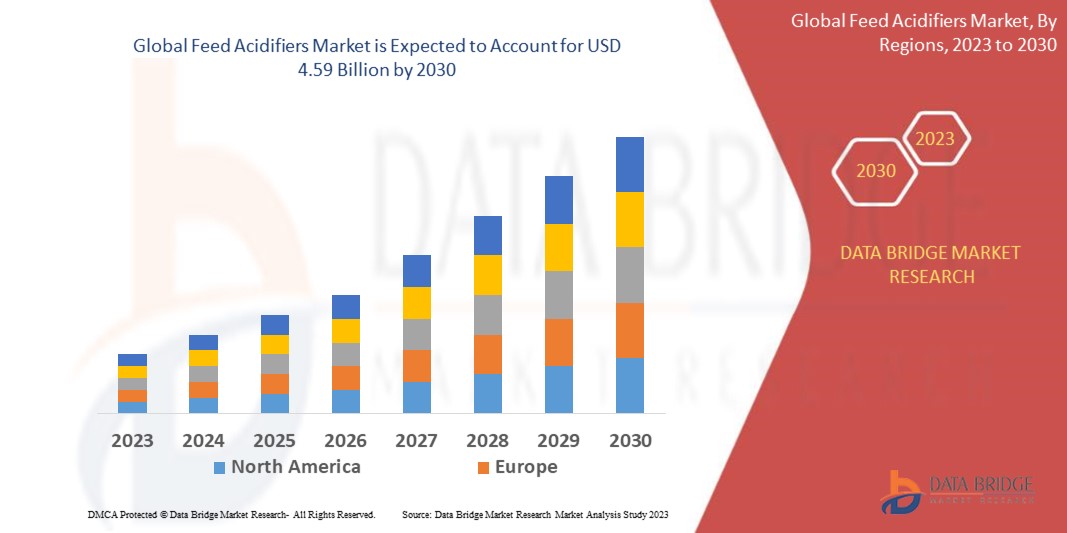
Feed Acidifiers Market Analysis and Size
The global feed acidifiers market is growing demand for animal protein is expected to drive market growth. Additionally, government regulations and restrictions on antibiotic growth are expected to drive market growth.
Data Bridge Market Research analyses that the global feed acidifiers market which was USD 2.86 billion in 2022, would rocket up to USD 4.59 billion by 2030, and is expected to undergo a CAGR of 6.1% during the forecast period of 2023 to 2030. “Propionic acid” dominates the type segment of the global feed acidifiers market and helps curb bacterial growth in molds. Hence, it can also be used as a preservative in animal feed. In addition to the insights on market scenarios such as market value, growth rate, segmentation, geographical coverage, and major players, the market reports curated by the Data Bridge Market Research also include in-depth expert analysis, geographically represented company-wise production and capacity, network layouts of distributors and partners, detailed and updated price trend analysis and deficit analysis of supply chain and demand.
Feed Acidifiers Market Scope and Segmentation
|
Report Metric |
Details |
|
Forecast Period |
2023 to 2030 |
|
Base Year |
2022 |
|
Historic Years |
2021 (Customizable to 2015-2020) |
|
Quantitative Units |
Revenue in USD Billion, Volumes in Tons, Pricing in USD |
|
Segments Covered |
Type (Propionic Acid, Formic Acid, Lactic Acid, Citric Acid, Sorbic Acid, Malic Acid, Others), Form (Dry, Liquid), Compound (Blended, Single), Livestock (Poultry, Swine, Ruminants, Aquaculture, Others) |
|
Countries Covered |
U.S., Canada and Mexico in North America, Germany, France, U.K., Netherlands, Switzerland, Belgium, Russia, Italy, Spain, Turkey, Rest of Europe in Europe, China, Japan, India, South Korea, Singapore, Malaysia, Australia, Thailand, Indonesia, Philippines, Rest of Asia-Pacific, Saudi Arabia, U.A.E, South Africa, Egypt, Israel, Rest of Middle East and Africa, Brazil, Argentina and Rest of South America. |
|
Market Players Covered |
BASF SE (Germany), Novus International, Inc. (USA), Perstorp Holding AB (Sweden), Kemin Industries, Inc. (USA), Nutrex NV/SA (Belgium), Impextraco NV (Belgium), ADDCON Group GmbH (Germany), Biomin Holding GmbH (Austria), Pancosma SA (Switzerland), Anpario plc (United Kingdom), Acidifiers International Group Ltd. (United Kingdom), Jefo Nutrition Inc. (Canada), Impextraco Asia Pacific Sdn. Bhd. (Malaysia) |
|
Market Opportunities |
|
Market Definition
Feed acidifiers are additives added to feed to promote livestock's gut health by modulating the gut microbiota. Acidifiers used in the preparation of feed have bacteriostatic and bactericidal properties, which aid in maintaining the growth of microbes in the gastrointestinal tract. Animal feed Acidifiers are again the organic acids incorporated with the feed for nutritional or preservative benefits. This acidifier help to control microbial growth, inhibit pathogenic bacteria, reduction of feed buffer capacity, and also improve nutrient digestibility. Acidifiers are also found to enhance congestion and microbiological balance in the alimentary and digestive tracts of livestock. The global feed acidifiers market is driven by significant growth in the livestock feed industry and growing demand for livestock products, including milk, eggs, meat, and wool, amongst others.
Global Feed Acidifiers Market Dynamics
Drivers
- Growing demand for animal protein
The increasing global population and changing dietary preferences have led to rising demand for animal protein, driving the need for improved animal nutrition and health through feed additives like acidifiers.
- Rising focus on animal health and welfare
Acidifiers are known to improve gut health, enhance feed digestibility, and support animal growth and performance. Increasing awareness of animal health and welfare among producers is driving the adoption of feed acidifiers.
Opportunities
- Expansion in the aquaculture industry
The aquaculture sector is witnessing significant growth due to the increasing demand for seafood. Acidifiers can be used to enhance feed efficiency and disease resistance in aquaculture, presenting opportunities for market growth.
- Development of innovative acidifier formulations
Ongoing research and development efforts are focused on developing advanced acidifier formulations that provide better efficacy, stability, and targeted delivery, which can create opportunities for market expansion.
Restraints/Challenges
- Lack of awareness and understanding
The adoption of feed acidifiers may be hindered by a lack of awareness and understanding among producers, particularly in developing regions. Educating and promoting the benefits of acidifiers will be essential to overcome this restraint.
- Fluctuating raw material prices
The prices of raw materials used in the production of feed acidifiers, such as organic acids, can be volatile. Fluctuations in raw material prices can impact the cost of production and potentially affect market stability.
Recent Development
-
On November 21, 2022 ADM announced the release of two SUCRAM products, which are in-feed sweetening solutions for cattle species. Pancosma, SUCRAM M'I Sweet, and SUCRAM Specifeek are sweeteners created by ADM's worldwide feed additives business to increase the palatability of feed for young animals, particularly weanling pigs. Palatants and sweeteners are effective nutrition solutions for increasing feed intake and increasing producer efficiencies while also improving animal health and well-being. As a result, the company's product line has grown.
Global Feed Acidifiers Market Scope
The global feed acidifiers market is segmented on the basis of type, form, compound, and Livestock. The growth amongst these segments will help you analyze meagre growth segments in the industries and provide the users with a valuable market overview and market insights to help them make strategic decisions for identifying core market applications.
Type
- Propionic Acid
- Formic Acid
- Lactic Acid
- Citric Acid
- Sorbic Acid
- Malic Acid
- Others
Form
- Dry
- Liquid
Compound
- Blended
- Single
Livestock
- Poultry
- Swine
- Ruminants
- Aquaculture
- Others
Global Feed Acidifiers Market Regional Analysis/Insights
The global feed acidifiers market is analysed and market size insights and trends are provided by country, type, price range, and application, as referenced above.
The countries covered in the global ammonia market report are U.S., Canada and Mexico in North America, Germany, France, U.K., Netherlands, Switzerland, Belgium, Russia, Italy, Spain, Turkey, Rest of Europe in Europe, China, Japan, India, South Korea, Singapore, Malaysia, Australia, Thailand, Indonesia, Philippines, Rest of Asia-Pacific, Saudi Arabia, U.A.E, South Africa, Egypt, Israel, Rest of Middle East and Africa, Brazil, Argentina and Rest of South America.
Asia-Pacific dominates the feed acidifiers market due to increasing demand for livestock feed with rich nutrients, increasing awareness regarding the health benefits associated with meat, and rising demand for hygienic products globally.
The country section of the report also provides individual market impacting factors and changes in regulation in the market domestically that impacts the current and future trends of the market. Data points like down-stream and upstream value chain analysis, technical trends, and porter's five forces analysis, case studies are some of the pointers used to forecast the market scenario for individual countries. Also, the presence and availability of global brands and their challenges faced due to large or scarce competition from local and domestic brands, the impact of domestic tariffs, and trade routes are considered while providing forecast analysis of the country data.
Competitive Landscape and Global Feed Acidifiers Market Share Analysis
The feed acidifiers market competitive landscape provides details by competitors. Details included are company overview, company financials, revenue generated, market potential, investment in research and development, new market initiatives, global presence, production sites and facilities, production capacities, company strengths and weaknesses, product launch, product width, and breadth, application dominance. The above data points provided are only related to the companies' focus related to the feed acidifiers market.
Some of the major players operating in the global feed acidifiers market are:
- BASF SE (Germany)
- Novus International, Inc. (USA)
- Perstorp Holding AB (Sweden)
- Kemin Industries, Inc. (USA)
- Nutrex NV/SA (Belgium)
- Impextraco NV (Belgium)
- ADDCON Group GmbH (Germany)
- Biomin Holding GmbH (Austria)
- Pancosma SA (Switzerland)
- Anpario plc (United Kingdom)
- Acidifiers International Group Ltd. (United Kingdom)
- Jefo Nutrition Inc. (Canada)
- Impextraco Asia Pacific Sdn. Bhd. (Malaysia)

- Interactive Data Analysis Dashboard
- Company Analysis Dashboard for high growth potential opportunities
- Research Analyst Access for customization & queries
- Competitor Analysis with Interactive dashboard
- Latest News, Updates & Trend analysis
- Harness the Power of Benchmark Analysis for Comprehensive Competitor Tracking
Table of Content
1 INTRODUCTION
1.1 OBJECTIVES OF THE STUDY
1.2 MARKET DEFINITION
1.3 OVERVIEW OF GLOBAL FEED ACIDIFIERS MARKET
1.4 CURRENCY AND PRICING
1.5 LIMITATION
1.6 MARKETS COVERED
2 MARKET SEGMENTATION
2.1 KEY TAKEAWAYS
2.2 ARRIVING AT THE GLOBAL FEED ACIDIFIERS MARKET SIZE
2.2.1 VENDOR POSITIONING GRID
2.2.2 TECHNOLOGY LIFE LINE CURVE
2.2.3 MARKET GUIDE
2.2.4 COMPANY POSITIONING GRID
2.2.5 COMAPANY MARKET SHARE ANALYSIS
2.2.6 MULTIVARIATE MODELLING
2.2.7 DEMAND AND SUPPLY-SIDE VARIABLES
2.2.8 CONSUMPTION TREND OF END PRODUCTS
2.2.9 TOP TO BOTTOM ANALYSIS
2.2.10 STANDARDS OF MEASUREMENT
2.2.11 VENDOR SHARE ANALYSIS
2.2.12 DATA POINTS FROM KEY PRIMARY INTERVIEWS
2.2.13 DATA POINTS FROM KEY SECONDARY DATABASES
2.3 GLOBAL FEED ACIDIFIERS MARKET: RESEARCH SNAPSHOT
2.4 ASSUMPTIONS
3 MARKET OVERVIEW
3.1 DRIVERS
3.2 RESTRAINTS
3.3 OPPORTUNITIES
3.4 CHALLENGES
4 EXECUTIVE SUMMARY
5 PREMIUM INSIGHTS
5.1 VALUE CHAIN ANALYSIS
5.2 SUPPLY CHAIN ANALYSIS
5.3 PORTER’S FIVE FORCES ANALYSIS
5.3.1 BARGAINING POWER OF SUPPLIERS
5.3.2 BARGAINING POWER OF BUYERS/CONSUMERS
5.3.3 THREAT OF NEW ENTRANTS
5.3.4 THREAT OF SUBSTITUTE PRODUCTS
5.3.5 INTENSITY OF COMPETITIVE RIVALRY
5.4 GROWTH STRATEGIES ADOPTED BY KEY MARKET PLAYERS
5.5 OVERVIEW ON TECHNOLOGICAL INNOVATIONS
5.6 INDUSTRY TRENDS AND FUTURE PERSPECTIVE
5.7 FACTORS INFLUENCING PURCHASING DECISION OF END-USERS
6 REGULATORY FRAMEWORK AND GUIDELINES
7 IMPACT OF ECONOMIC SLOW DOWN ON MARKET
7.1 IMPACT ON PRICE
7.2 IMPACT ON SUPPLY CHAIN
7.3 IMPACT ON SHIPMENT
7.4 IMPACT ON COMPANY’S STRATEGIC DECISIONS
8 PRICING ANALYSIS
9 GLOBAL FEED ACIDIFIERS MARKET, BY PRODUCT TYPE, 2022-2031 (USD MILLION) (KILO TONS)
9.1 OVERVIEW
9.2 PROPIONIC ACID
9.3 FUMARIC ACID
9.4 LACTIC ACID
9.5 TARTARIC ACID
9.6 BUTYRIC ACID
9.7 ACETIC ACID
9.8 FORMIC ACID
9.9 CITRIC ACID
9.1 SORBIC ACID
9.11 BENZOIC ACID
9.12 MALIC ACID
9.13 OTHERS
10 GLOBAL FEED ACIDIFIERS MARKET, BY FORM, 2022-2031 (USD MILLION)
10.1 OVERVIEW
10.2 LIQUID
10.3 DRY
10.3.1 DRY, BY TYPE
10.3.1.1. CUBES
10.3.1.2. POWDER
10.3.1.3. FLAKES
10.3.1.4. PELLET
10.3.1.5. OTHERS
11 GLOBAL FEED ACIDIFIERS MARKET, BY CATEGORY, 2022-2031 (USD MILLION)
11.1 OVERVIEW
11.2 CONVENTIONAL
11.3 ORGANIC
12 GLOBAL FEED ACIDIFIERS MARKET, BY COMPOUND, 2022-2031 (USD MILLION)
12.1 OVERVIEW
12.2 SINGLE
12.3 BLENDED
13 GLOBAL FEED ACIDIFIERS MARKET, BY LIFECYCLE, 2022-2031 (USD MILLION)
13.1 OVERVIEW
13.2 GROWER FEED
13.2.1 GROWER FEED, BY PRODUCT TYPE
13.2.1.1. PROPIONIC ACID
13.2.1.2. FUMARIC ACID
13.2.1.3. LACTIC ACID
13.2.1.4. TARTARIC ACID
13.2.1.5. BUTYRIC ACID
13.2.1.6. ACETIC ACID
13.2.1.7. FORMIC ACID
13.2.1.8. CITRIC ACID
13.2.1.9. SORBIC ACID
13.2.1.10. BENZOIC ACID
13.2.1.11. MALIC ACID
13.2.1.12. OTHERS
13.3 FINISHER FEED
13.3.1 FINISHER FEED, BY PRODUCT TYPE
13.3.1.1. PROPIONIC ACID
13.3.1.2. FUMARIC ACID
13.3.1.3. LACTIC ACID
13.3.1.4. TARTARIC ACID
13.3.1.5. BUTYRIC ACID
13.3.1.6. ACETIC ACID
13.3.1.7. FORMIC ACID
13.3.1.8. CITRIC ACID
13.3.1.9. SORBIC ACID
13.3.1.10. BENZOIC ACID
13.3.1.11. MALIC ACID
13.3.1.12. OTHERS
13.4 STARTER FEED
13.4.1 STARTER FEED, BY PRODUCT TYPE
13.4.1.1. PROPIONIC ACID
13.4.1.2. FUMARIC ACID
13.4.1.3. LACTIC ACID
13.4.1.4. TARTARIC ACID
13.4.1.5. BUTYRIC ACID
13.4.1.6. ACETIC ACID
13.4.1.7. FORMIC ACID
13.4.1.8. CITRIC ACID
13.4.1.9. SORBIC ACID
13.4.1.10. BENZOIC ACID
13.4.1.11. MALIC ACID
13.4.1.12. OTHERS
13.5 BROODER FEED
13.5.1 BROODER FEED, BY PRODUCT TYPE
13.5.1.1. PROPIONIC ACID
13.5.1.2. FUMARIC ACID
13.5.1.3. LACTIC ACID
13.5.1.4. TARTARIC ACID
13.5.1.5. BUTYRIC ACID
13.5.1.6. ACETIC ACID
13.5.1.7. FORMIC ACID
13.5.1.8. CITRIC ACID
13.5.1.9. SORBIC ACID
13.5.1.10. BENZOIC ACID
13.5.1.11. MALIC ACID
13.5.1.12. OTHERS
14 GLOBAL FEED ACIDIFIERS MARKET, BY FUNCTION, 2022-2031 (USD MILLION)
14.1 OVERVIEW
14.2 DIGESTIVE HEALTH
14.3 IMMUNE HEALTH
14.4 RESPIRATORY HEALTH
14.5 HYDRATION
14.6 WEIGHT GAIN
14.7 BONE AND MUSCLE HEALTH
14.8 OTHERS
15 GLOBAL FEED ACIDIFIERS MARKET, BY LIVESTOCKS, 2022-2031 (USD MILLION)
15.1 OVERVIEW
15.2 POULTRY
15.2.1 POULTRY, BY TYPE
15.2.1.1. CHICKEN
15.2.1.1.1. BROILERS
15.2.1.1.2. LAYERS
15.2.1.2. TURKEY
15.2.1.3. GEESE
15.2.1.4. DUCKS
15.2.1.5. GUINEA FOWL
15.2.1.6. QUAIL
15.2.1.7. OTHERS
15.2.2 POULTRY, BY PRODUCT TYPE
15.2.2.1. PROPIONIC ACID
15.2.2.2. FUMARIC ACID
15.2.2.3. LACTIC ACID
15.2.2.4. TARTARIC ACID
15.2.2.5. BUTYRIC ACID
15.2.2.6. ACETIC ACID
15.2.2.7. FORMIC ACID
15.2.2.8. CITRIC ACID
15.2.2.9. SORBIC ACID
15.2.2.10. BENZOIC ACID
15.2.2.11. MALIC ACID
15.2.2.12. OTHERS
15.3 RUMINANTS
15.3.1 RUMINANTS, BY TYPE
15.3.1.1. CALVES
15.3.1.2. DAIRY CATLE
15.3.1.3. BEEF CATLE
15.3.1.4. OTHERS
15.3.2 RUMINANTS, BY PRODUCT TYPE
15.3.2.1. PROPIONIC ACID
15.3.2.2. FUMARIC ACID
15.3.2.3. LACTIC ACID
15.3.2.4. TARTARIC ACID
15.3.2.5. BUTYRIC ACID
15.3.2.6. ACETIC ACID
15.3.2.7. FORMIC ACID
15.3.2.8. CITRIC ACID
15.3.2.9. SORBIC ACID
15.3.2.10. BENZOIC ACID
15.3.2.11. MALIC ACID
15.3.2.12. OTHERS
15.4 SWINE
15.4.1 SWINE, BY TYPE
15.4.1.1. STARTER
15.4.1.2. GROWER
15.4.1.3. SOW
15.4.2 SWINE, BY PRODUCT TYPE
15.4.2.1. PROPIONIC ACID
15.4.2.2. FUMARIC ACID
15.4.2.3. LACTIC ACID
15.4.2.4. TARTARIC ACID
15.4.2.5. BUTYRIC ACID
15.4.2.6. ACETIC ACID
15.4.2.7. FORMIC ACID
15.4.2.8. CITRIC ACID
15.4.2.9. SORBIC ACID
15.4.2.10. BENZOIC ACID
15.4.2.11. MALIC ACID
15.4.2.12. OTHERS
15.5 PETS
15.5.1 PETS, BY TYPE
15.5.1.1. CATS
15.5.1.2. DOGS
15.5.1.3. RABBITS
15.5.1.4. OTHERS
15.5.2 PETS, BY PRODUCT TYPE
15.5.2.1. PROPIONIC ACID
15.5.2.2. FUMARIC ACID
15.5.2.3. LACTIC ACID
15.5.2.4. TARTARIC ACID
15.5.2.5. BUTYRIC ACID
15.5.2.6. ACETIC ACID
15.5.2.7. FORMIC ACID
15.5.2.8. CITRIC ACID
15.5.2.9. SORBIC ACID
15.5.2.10. BENZOIC ACID
15.5.2.11. MALIC ACID
15.5.2.12. OTHERS
15.6 AQUACULTURE
15.6.1 AQUACULTURE, BY TYPE
15.6.1.1. FISH
15.6.1.1.1. HERRING
15.6.1.1.2. MAHI-MAHI
15.6.1.1.3. COD
15.6.1.1.4. SALMON
15.6.1.1.5. TILAPIA
15.6.1.1.6. SEA BASS
15.6.1.1.7. TROUTS
15.6.1.1.8. CATFISH
15.6.1.1.9. MILKFISH
15.6.1.1.10. STURGEON
15.6.1.1.11. TURBOT
15.6.1.1.12. CARPS
15.6.1.1.13. GROUPER
15.6.1.1.14. BARRAMUNDI
15.6.1.1.15. EEL
15.6.1.1.16. SEA BREAM
15.6.1.1.17. KINGFISH
15.6.1.1.18. MEAGRE
15.6.1.1.19. SOLE
15.6.1.1.20. ROCKFISH
15.6.1.1.21. PIKE PERCH
15.6.1.1.22. OTHERS
15.6.1.2. CRUSTACEANS
15.6.1.2.1. CRABS
15.6.1.2.2. KRILL
15.6.1.2.3. LOBSTERS
15.6.1.2.4. CRAYFISH
15.6.1.2.5. SHRIMPS
15.6.1.2.6. PRAWNS
15.6.1.2.7. OTHERS
15.6.1.3. MOLLUSKS
15.6.1.3.1. GASTOPODS
15.6.1.3.2. SCALLOPS
15.6.1.3.3. OYSTERS
15.6.1.3.4. MUSSELS
15.6.1.3.5. OTHERS
15.6.2 AQUACULTURE, BY PRODUCT TYPE
15.6.2.1. PROPIONIC ACID
15.6.2.2. FUMARIC ACID
15.6.2.3. LACTIC ACID
15.6.2.4. TARTARIC ACID
15.6.2.5. BUTYRIC ACID
15.6.2.6. ACETIC ACID
15.6.2.7. FORMIC ACID
15.6.2.8. CITRIC ACID
15.6.2.9. SORBIC ACID
15.6.2.10. BENZOIC ACID
15.6.2.11. MALIC ACID
15.6.2.12. OTHERS
15.7 EQUINE
15.7.1 EQUINE, BY PRODUCT TYPE
15.7.1.1. PROPIONIC ACID
15.7.1.2. FUMARIC ACID
15.7.1.3. LACTIC ACID
15.7.1.4. TARTARIC ACID
15.7.1.5. BUTYRIC ACID
15.7.1.6. ACETIC ACID
15.7.1.7. FORMIC ACID
15.7.1.8. CITRIC ACID
15.7.1.9. SORBIC ACID
15.7.1.10. BENZOIC ACID
15.7.1.11. MALIC ACID
15.7.1.12. OTHERS
15.8 OTHERS
16 GLOBAL FEED ACIDIFIERS MARKET, BY END USER, 2022-2031 (USD MILLION)
16.1 OVERVIEW
16.2 FEED MANUFACTURERS
16.3 CONTRACT MANUFACTURERS
16.4 LIVESTOCK PRODUCERS
16.5 FARMERS
16.6 OTHERS
17 GLOBAL FEED ACIDIFIERS MARKET, BY GEOGRAPHY, 2022-2031 (USD MILLION) (KILO TONS)
17.1 GLOBAL FEED ACIDIFIERS MARKET, (ALL SEGMENTATION PROVIDED ABOVE IS REPRESENTED IN THIS CHAPTER BY COUNTRY)
17.2 NORTH AMERICA
17.2.1 U.S.
17.2.2 CANADA
17.2.3 MEXICO
17.3 EUROPE
17.3.1 GERMANY
17.3.2 U.K.
17.3.3 ITALY
17.3.4 FRANCE
17.3.5 SPAIN
17.3.6 SWITZERLAND
17.3.7 NETHERLANDS
17.3.8 BELGIUM
17.3.9 RUSSIA
17.3.10 DENMARK
17.3.11 SWEDEN
17.3.12 POLAND
17.3.13 TURKEY
17.3.14 REST OF EUROPE
17.4 ASIA-PACIFIC
17.4.1 JAPAN
17.4.2 CHINA
17.4.3 SOUTH KOREA
17.4.4 INDIA
17.4.5 AUSTRALIA
17.4.6 SINGAPORE
17.4.7 THAILAND
17.4.8 INDONESIA
17.4.9 MALAYSIA
17.4.10 PHILIPPINES
17.4.11 NEW ZEALAND
17.4.12 VIETNAM
17.4.13 REST OF ASIA-PACIFIC
17.5 SOUTH AMERICA
17.5.1 BRAZIL
17.5.2 ARGENTINA
17.5.3 REST OF SOUTH AMERICA
17.6 MIDDLE EAST AND AFRICA
17.6.1 SOUTH AFRICA
17.6.2 UAE
17.6.3 SAUDI ARABIA
17.6.4 OMAN
17.6.5 QATAR
17.6.6 KUWAIT
17.6.7 REST OF MIDDLE EAST AND AFRICA
18 GLOBAL FEED ACIDIFIERS MARKET, COMPANY LANDSCAPE
18.1 COMPANY SHARE ANALYSIS: GLOBAL
18.2 COMPANY SHARE ANALYSIS: NORTH AMERICA
18.3 COMPANY SHARE ANALYSIS: EUROPE
18.4 COMPANY SHARE ANALYSIS: ASIA-PACIFIC
18.5 COMPANY SHARE ANALYSIS: MIDDLE EAST AND AFRICA
18.6 MERGERS & ACQUISITIONS
18.7 NEW PRODUCT DEVELOPMENT & APPROVALS
18.8 EXPANSIONS & PARTNERSHIP
18.9 REGULATORY CHANGES
19 GLOBAL FEED ACIDIFIERS MARKET, SWOT & DBMR ANALYSIS
20 GLOBAL FEED ACIDIFIERS MARKET, COMPANY PROFILE
20.1 VALOR CHEMICAL CO.,LTD
20.1.1 COMPANY OVERVIEW
20.1.2 REVENUE ANALYSIS
20.1.3 PRODUCT PORTFOLIO
20.1.4 RECENT DEVELOPMENTS
20.2 NOVUS INTERNATIONAL
20.2.1 COMPANY OVERVIEW
20.2.2 REVENUE ANALYSIS
20.2.3 PRODUCT PORTFOLIO
20.2.4 RECENT DEVELOPMENTS
20.3 BASF SE
20.3.1 COMPANY OVERVIEW
20.3.2 REVENUE ANALYSIS
20.3.3 PRODUCT PORTFOLIO
20.3.4 RECENT DEVELOPMENTS
20.4 YARA
20.4.1 COMPANY OVERVIEW
20.4.2 REVENUE ANALYSIS
20.4.3 PRODUCT PORTFOLIO
20.4.4 RECENT DEVELOPMENTS
20.5 KEMIN INDUSTRIES, INC.
20.5.1 COMPANY OVERVIEW
20.5.2 REVENUE ANALYSIS
20.5.3 PRODUCT PORTFOLIO
20.5.4 RECENT DEVELOPMENTS
20.6 DSM
20.6.1 COMPANY OVERVIEW
20.6.2 REVENUE ANALYSIS
20.6.3 PRODUCT PORTFOLIO
20.6.4 RECENT DEVELOPMENTS
20.7 CORBION
20.7.1 COMPANY OVERVIEW
20.7.2 REVENUE ANALYSIS
20.7.3 PRODUCT PORTFOLIO
20.7.4 RECENT DEVELOPMENTS
20.8 BARENTZ (PESTELL NUTRITION)
20.8.1 COMPANY OVERVIEW
20.8.2 REVENUE ANALYSIS
20.8.3 PRODUCT PORTFOLIO
20.8.4 RECENT DEVELOPMENTS
20.9 IMPEXTRACO NV
20.9.1 COMPANY OVERVIEW
20.9.2 REVENUE ANALYSIS
20.9.3 PRODUCT PORTFOLIO
20.9.4 RECENT DEVELOPMENTS
20.1 PERSTORP
20.10.1 COMPANY OVERVIEW
20.10.2 REVENUE ANALYSIS
20.10.3 PRODUCT PORTFOLIO
20.10.4 RECENT DEVELOPMENTS
20.11 PANCOSMA
20.11.1 COMPANY OVERVIEW
20.11.2 REVENUE ANALYSIS
20.11.3 PRODUCT PORTFOLIO
20.11.4 RECENT DEVELOPMENTS
20.12 JEFO
20.12.1 COMPANY OVERVIEW
20.12.2 REVENUE ANALYSIS
20.12.3 PRODUCT PORTFOLIO
20.12.4 RECENT DEVELOPMENTS
20.13 NUTREX
20.13.1 COMPANY OVERVIEW
20.13.2 REVENUE ANALYSIS
20.13.3 PRODUCT PORTFOLIO
20.13.4 RECENT DEVELOPMENTS
20.14 ADDCON GROUP GMBH
20.14.1 COMPANY OVERVIEW
20.14.2 REVENUE ANALYSIS
20.14.3 PRODUCT PORTFOLIO
20.14.4 RECENT DEVELOPMENTS
20.15 PETERLABS HOLDINGS BERHAD
20.15.1 COMPANY OVERVIEW
20.15.2 REVENUE ANALYSIS
20.15.3 PRODUCT PORTFOLIO
20.15.4 RECENT DEVELOPMENTS
20.16 VETLINE (A DIVISION OF SIMFA LABS PVT LTD )
20.16.1 COMPANY OVERVIEW
20.16.2 REVENUE ANALYSIS
20.16.3 PRODUCT PORTFOLIO
20.16.4 RECENT DEVELOPMENTS
20.17 TEX BIOSCIENCES
20.17.1 COMPANY OVERVIEW
20.17.2 REVENUE ANALYSIS
20.17.3 PRODUCT PORTFOLIO
20.17.4 RECENT DEVELOPMENTS
20.18 AJINOMOTO HEALTH & NUTRITION NORTH AMERICA, INC.
20.18.1 COMPANY OVERVIEW
20.18.2 REVENUE ANALYSIS
20.18.3 PRODUCT PORTFOLIO
20.18.4 RECENT DEVELOPMENTS
20.19 AUSEN CHEMICAL GROUP CO., LIMITED
20.19.1 COMPANY OVERVIEW
20.19.2 REVENUE ANALYSIS
20.19.3 PRODUCT PORTFOLIO
20.19.4 RECENT DEVELOPMENTS
20.2 VETSFARMA LTD
20.20.1 COMPANY OVERVIEW
20.20.2 REVENUE ANALYSIS
20.20.3 PRODUCT PORTFOLIO
20.20.4 RECENT DEVELOPMENTS
20.21 NOREL S.A
20.21.1 COMPANY OVERVIEW
20.21.2 REVENUE ANALYSIS
20.21.3 PRODUCT PORTFOLIO
20.21.4 RECENT DEVELOPMENTS
NOTE: THE COMPANIES PROFILED IS NOT EXHAUSTIVE LIST AND IS AS PER OUR PREVIOUS CLIENT REQUIREMENT. WE PROFILE MORE THAN 100 COMPANIES IN OUR STUDY AND HENCE THE LIST OF COMPANIES CAN BE MODIFIED OR REPLACED ON REQUEST
21 RELATED REPORTS
22 QUESTIONNAIRE
23 ABOUT DATA BRIDGE MARKET RESEARCH

Global Feed Acidifiers Market, Supply Chain Analysis and Ecosystem Framework
To support market growth and help clients navigate the impact of geopolitical shifts, DBMR has integrated in-depth supply chain analysis into its Global Feed Acidifiers Market research reports. This addition empowers clients to respond effectively to global changes affecting their industries. The supply chain analysis section includes detailed insights such as Global Feed Acidifiers Market consumption and production by country, price trend analysis, the impact of tariffs and geopolitical developments, and import and export trends by country and HSN code. It also highlights major suppliers with data on production capacity and company profiles, as well as key importers and exporters. In addition to research, DBMR offers specialized supply chain consulting services backed by over a decade of experience, providing solutions like supplier discovery, supplier risk assessment, price trend analysis, impact evaluation of inflation and trade route changes, and comprehensive market trend analysis.
Data collection and base year analysis are done using data collection modules with large sample sizes. The stage includes obtaining market information or related data through various sources and strategies. It includes examining and planning all the data acquired from the past in advance. It likewise envelops the examination of information inconsistencies seen across different information sources. The market data is analysed and estimated using market statistical and coherent models. Also, market share analysis and key trend analysis are the major success factors in the market report. To know more, please request an analyst call or drop down your inquiry.
The key research methodology used by DBMR research team is data triangulation which involves data mining, analysis of the impact of data variables on the market and primary (industry expert) validation. Data models include Vendor Positioning Grid, Market Time Line Analysis, Market Overview and Guide, Company Positioning Grid, Patent Analysis, Pricing Analysis, Company Market Share Analysis, Standards of Measurement, Global versus Regional and Vendor Share Analysis. To know more about the research methodology, drop in an inquiry to speak to our industry experts.
Data Bridge Market Research is a leader in advanced formative research. We take pride in servicing our existing and new customers with data and analysis that match and suits their goal. The report can be customized to include price trend analysis of target brands understanding the market for additional countries (ask for the list of countries), clinical trial results data, literature review, refurbished market and product base analysis. Market analysis of target competitors can be analyzed from technology-based analysis to market portfolio strategies. We can add as many competitors that you require data about in the format and data style you are looking for. Our team of analysts can also provide you data in crude raw excel files pivot tables (Fact book) or can assist you in creating presentations from the data sets available in the report.













