


Fat Powder Market Overview
The Fat Powder Market was valued at USD 3.13 billion in 2025 and is projected to reach USD 4.65 billion by 2033, growing at a CAGR of 5.10% from 2026 to 2033. The Fat Powder Market is experiencing consistent growth driven by rising demand for functional food ingredients, increasing adoption of fat powder in bakery, confectionery, dairy, and nutritional applications, and growing preference for convenient and shelf-stable food products. The expanding food processing industry, changing consumer lifestyles, and rising demand for clean-label and high-quality ingredient solutions are encouraging manufacturers to adopt fat powder as an efficient alternative to liquid fats.
The increasing demand for longer shelf-life ingredients, cost-effective food formulations, and improved texture and flavor enhancement is compelling food manufacturers to incorporate fat powder across various applications. Fat powders provide advantages such as easy handling, storage stability, improved dispersion, and enhanced product consistency, making them suitable for processed foods, beverages, infant nutrition, and animal feed applications. Advancements in spray-drying technologies, increasing investments in food ingredient innovation, and growing consumption of processed and convenience foods across developed and emerging markets are further supporting market expansion.
Key Market Trends & Insights
- North America dominated the Fat Powder Market with the largest revenue share of 34.2% in 2025, supported by strong demand from food and beverage manufacturers, increasing consumption of processed and convenience foods, and the presence of major dairy ingredient and specialty nutrition companies. The region’s well-established food processing industry, rising demand for functional ingredients, and growing adoption of fat powders in bakery, confectionery, dairy alternatives, and ready-to-eat products are strengthening market growth.
- The B2B segment dominated the market with a 72.5% share in 2025, supported by high-volume procurement from food manufacturers, industrial processors, and commercial food service companies.
- Asia-Pacific is expected to be the fastest-growing region at a CAGR of 7.5% from 2026 to 2033, fueled by rising disposable incomes, expanding food processing industries, increasing demand for convenience foods, and growing adoption of powdered ingredients across China, India, Japan, and Southeast Asian markets. Rapid urbanization and increasing consumption of bakery, dairy, and nutritional products are further accelerating regional demand.
- The high-fat segment dominated the product type category with a 61.4% revenue share in 2025, driven by its extensive usage in applications requiring improved flavor, mouthfeel, texture, and energy content. High-fat powders are widely preferred by food manufacturers for bakery mixes, creamers, nutritional formulations, and confectionery applications due to their superior functional performance and stability.
Market Size & Forecast
- Global Market Value (2025): USD 3.13 Billion
- Expected Market Value (2033): USD 4.65 Billion
- Forecast CAGR (2026–2033): 5.10%
- Leading Region in 2025: North America
- Fastest Growing Region: Asia-Pacific
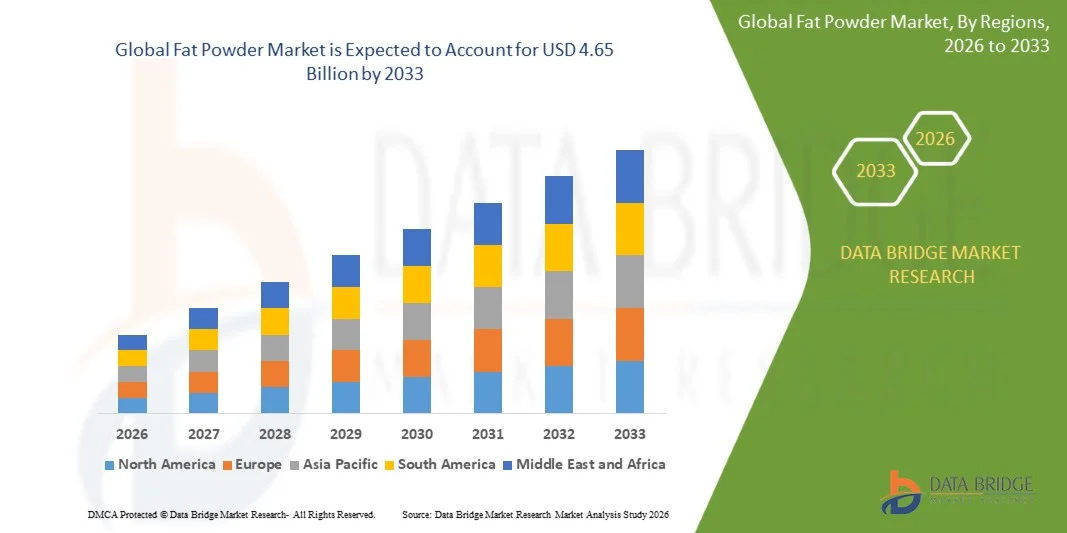
Report Scope and Fat Powder Market Segmentation
|
Attributes |
Fat Powder Key Market Insights |
|
Segments Covered |
|
|
Countries Covered |
North America · U.S. · Canada · Mexico Europe · Germany · France · U.K. · Netherlands · Switzerland · Belgium · Russia · Italy · Spain · Turkey · Rest of Europe Asia-Pacific · China · Japan · India · South Korea · Singapore · Malaysia · Australia · Thailand · Indonesia · Philippines · Rest of Asia-Pacific Middle East and Africa · Saudi Arabia · U.A.E. · South Africa · Egypt · Israel · Rest of Middle East and Africa South America · Brazil · Argentina · Rest of South America |
|
Key Market Players |
• Kerry Group (Ireland) |
|
Market Opportunities |
· Growing Demand for Clean-Label and Functional Food Ingredients · Expansion of Processed Food, Bakery, and Dairy Industries in Emerging Market · Advancements in Fat Powder Formulation and Sustainable Ingredient Development |
|
Value Added Data Infosets |
In addition to the insights on market scenarios such as market value, growth rate, segmentation, geographical coverage, and major players, the market reports curated by the Data Bridge Market Research also include in-depth expert analysis, geographically represented company-wise production and capacity, network layouts of distributors and partners, detailed and updated price trend analysis and deficit analysis of supply chain and demand. |
Fat Powder Market Trends
Trend: Rising Demand for Functional and Specialty Fat Powders in Food Processing Applications
The Fat Powder Market is witnessing increasing adoption across bakery, confectionery, dairy, beverage, and nutritional food applications due to its ability to improve texture, stability, flavor, and shelf life. Food manufacturers are increasingly replacing liquid fats and oils with powdered fat ingredients to enhance processing efficiency, simplify storage, and improve product consistency. The growing popularity of convenience foods, ready-to-mix beverages, and functional nutrition products is accelerating demand for high-performance fat powders. Manufacturers are focusing on developing fat powders derived from sources such as soybean oil, canola oil, coconut oil, palm oil, and sunflower oil to meet diverse application requirements. For instance, companies such as Kerry Group, Cargill, and Koninklijke DSM have expanded their ingredient portfolios with specialty fat solutions targeting bakery, dairy alternatives, and nutritional applications. The increasing demand for clean-label, plant-based, and sustainable fat ingredients is also encouraging innovation in fat powder formulations. The rising consumption of processed foods in emerging markets, particularly across Asia-Pacific, is creating new opportunities for fat powder suppliers. Growing bakery and confectionery industries in countries such as China and India are driving the adoption of powdered fat ingredients for industrial food production.
Fat Powder Market Dynamics
Key Market Driver: Growing Adoption of Fat Powders in Convenience Foods and Processed Food Manufacturing
The increasing demand for convenience foods and processed food products is a major driver of the Fat Powder Market. Food manufacturers are adopting fat powders as functional ingredients due to their longer shelf life, ease of transportation, improved handling properties, and consistent performance compared with traditional liquid fats. Fat powders are widely used in bakery mixes, instant beverages, soup formulations, nutritional supplements, and confectionery products to provide desirable mouthfeel, creaminess, and energy content. According to industry trends, the global packaged food sector continues to expand due to changing lifestyles, urbanization, and increasing demand for ready-to-consume food products, creating strong growth opportunities for fat powder applications. For instance, Nestlé and other global food manufacturers continue to invest in reformulating products with improved nutritional profiles and functional ingredients, supporting demand for specialized fat-based ingredients. In addition, the expansion of industrial bakery and dairy processing industries is increasing the requirement for stable powdered fat solutions.
Key Restraint/Challenge: Fluctuating Raw Material Prices and Health Concerns Associated with Certain Fat Sources
A significant challenge in the Fat Powder Market is the volatility in raw material prices, particularly for vegetable oils such as palm oil, soybean oil, and coconut oil. Changes in agricultural output, climate conditions, supply chain disruptions, and geopolitical factors can influence production costs and impact manufacturer margins. In addition, growing consumer awareness regarding saturated fats, trans fats, and healthier dietary choices is creating pressure on manufacturers to develop improved fat powder formulations. Regulatory initiatives and changing nutritional preferences are encouraging companies to reduce unhealthy fat components and introduce alternatives with improved nutritional profiles. For instance, increasing demand for sustainable palm oil sourcing has encouraged companies across the food industry to adopt certified sustainable ingredients and improve supply chain transparency. These factors create challenges but also encourage innovation toward healthier and cleaner fat powder solutions.
Key Market Opportunity: Development of Plant-Based, Clean-Label, and Functional Fat Powder Solutions
The growing demand for plant-based and functional food ingredients presents a significant opportunity for the Fat Powder market. Consumers are increasingly seeking products with improved nutritional value, natural ingredients, and sustainable sourcing, encouraging manufacturers to develop advanced fat powders using alternative oil sources such as coconut oil, sunflower oil, and canola oil. The expansion of plant-based food and beverage categories is creating new applications for fat powders in dairy alternatives, vegan creamers, nutritional beverages, and specialty bakery products. Companies are investing in advanced spray-drying technologies and formulation techniques to improve solubility, stability, and sensory performance. For instance, Cargill and ADM continue developing plant-based ingredient solutions to support growing demand for sustainable and functional food products. Furthermore, increasing adoption of fat powders in sports nutrition, meal replacement products, and fortified foods is opening additional growth opportunities. The integration of advanced processing technologies, sustainable sourcing practices, and customized ingredient solutions is expected to strengthen market expansion across developed and emerging markets during the forecast period.
Fat Powder Market Scope
The Fat Powder market is segmented on the basis of Source, Product Type, End-Use, Sales Channel, and Packaging Format.
- By Source
On the basis of source, the Fat Powder Market is segmented into soybean oil, canola oil, coconut oil, palm oil, and sunflower oil. The palm oil segment dominated the market with a 32.6% share in 2025, owing to its widespread availability, cost-effectiveness, and strong functional properties in food processing applications. Palm oil-based fat powders are extensively used across bakery, confectionery, dairy, beverage, and processed food industries due to their excellent stability, emulsification characteristics, and ability to enhance texture and mouthfeel. The segment benefits from established global production networks and consistent supply availability, making it a preferred choice among industrial food manufacturers. Increasing demand for convenience foods and ready-to-use food ingredients is further supporting the adoption of palm oil-based fat powders. In addition, manufacturers prefer palm-derived fat powders because of their longer shelf life, easy handling, and transportation advantages compared with liquid fat ingredients. Rising investments in food processing infrastructure across emerging economies are also contributing to segment expansion. However, sustainability concerns related to palm oil production are encouraging companies to adopt certified sustainable sourcing practices and improved production methods. Continuous innovation in palm oil formulations and blended fat solutions is expected to maintain its leading position during the forecast period.
The coconut oil segment is expected to witness the fastest growth at a CAGR of 7.9% from 2026 to 2033, driven by increasing consumer preference for plant-based, clean-label, and natural food ingredients. Coconut oil-based fat powders are gaining popularity in dairy alternatives, vegan food products, nutritional beverages, bakery items, and functional food formulations due to their unique flavor profile and nutritional characteristics. The rising demand for lactose-free and plant-based products is encouraging food manufacturers to incorporate coconut-derived ingredients into innovative formulations. Growing health awareness and consumer preference for minimally processed ingredients are further supporting segment growth. In addition, coconut oil fat powders provide improved stability, solubility, and convenience compared with conventional liquid oils. The expansion of premium food categories and specialty nutrition products is creating new opportunities for coconut-based fat powder applications. Increasing adoption among food service providers and retail consumers is also contributing to market growth. Furthermore, advancements in spray-drying and encapsulation technologies are improving the quality and performance of coconut oil-based fat powders. These factors are expected to accelerate segment growth through 2033.
- By Product Type
On the basis of product type, the Fat Powder Market is segmented into High-fat and low-fat. The high-fat segment dominated the market with a 61.4% share in 2025, supported by extensive usage across bakery, confectionery, dairy products, nutritional supplements, and beverage applications. High-fat powders are preferred by manufacturers due to their ability to deliver rich flavor, creamy texture, improved mouthfeel, and higher energy content. The segment is widely adopted in industrial food processing where consistent performance and product quality are critical. Increasing consumption of processed foods, ready-to-mix beverages, and premium food products is strengthening demand for high-fat powder ingredients. These products also provide advantages such as longer shelf life, easier storage, and improved transportation efficiency compared with liquid fats. Food manufacturers are increasingly using high-fat powders to optimize production processes and improve formulation stability. Growing demand from bakery and confectionery industries is further supporting market expansion. In addition, high-fat powders are widely used in applications requiring enhanced sensory characteristics and nutritional density. The segment continues to benefit from increasing investments in food manufacturing capacity globally. Rising demand for convenience foods and indulgent food products is expected to sustain the dominance of high-fat powders during the forecast period.
The low-fat segment is projected to register the fastest growth at a CAGR of 7.8% from 2026 to 2033, driven by rising consumer focus on healthier diets and reduced-fat food formulations. Increasing awareness regarding balanced nutrition and healthier lifestyles is encouraging manufacturers to develop low-fat alternatives without compromising taste and functionality. The segment is gaining traction in health-focused food products, weight-management formulations, and functional beverages. Food companies are increasingly reformulating products to meet changing consumer preferences and nutritional requirements. Growing demand for clean-label and wellness-oriented foods is creating new opportunities for low-fat powder applications. In addition, regulatory initiatives promoting healthier food choices are supporting the adoption of reduced-fat ingredients. Advancements in food processing technologies are enabling manufacturers to maintain texture, flavor, and performance in low-fat formulations. Rising demand for healthier bakery products, beverages, and dairy alternatives is further driving segment expansion. The increasing popularity of fitness and nutrition-focused products is also contributing to growth. These factors are expected to support the rapid expansion of the low-fat segment during 2026–2033.
- By End-Use
On the basis of end-use, the Fat Powder Market is segmented into industrial, food service provider, and retail. The industrial segment dominated the market with a 45.7% share in 2025, owing to extensive utilization of fat powders in large-scale food manufacturing operations. Industrial food producers widely use fat powders in bakery products, confectionery items, dairy formulations, beverage mixes, and processed foods due to their stability and functional advantages. The segment benefits from increasing demand for packaged foods, ready-to-eat products, and convenience food solutions globally. Fat powders provide manufacturers with improved storage efficiency, reduced transportation costs, and consistent product quality. The growing expansion of food processing industries across emerging markets is further strengthening industrial adoption. Manufacturers prefer powdered fat ingredients because they simplify handling and improve production efficiency. Rising investments in automated food manufacturing facilities are also supporting segment growth. In addition, industrial users benefit from customized fat powder formulations designed for specific applications. Increasing demand from bakery and confectionery manufacturers is contributing significantly to market expansion. The continuous growth of global processed food consumption is expected to maintain the industrial segment’s leading position.
The food service provider segment is expected to witness the fastest growth at a CAGR of 7.3% from 2026 to 2033, driven by increasing demand from restaurants, cafés, bakeries, catering companies, and quick-service food chains. Food service operators are adopting fat powders due to their convenience, longer shelf life, and ease of preparation. Expansion of organized food service industries in developing regions is creating new opportunities for market growth. The rising popularity of bakery products, beverages, and ready-to-prepare food items is increasing consumption among commercial food providers. Fat powders help food service businesses maintain consistent quality while reducing storage and handling challenges. Growing urbanization and changing consumer lifestyles are encouraging expansion of restaurants and food outlets. Increasing demand for efficient ingredient solutions is further supporting adoption. In addition, food service providers are focusing on cost optimization and operational efficiency, increasing preference for powdered ingredients. The growth of online food delivery and commercial kitchens is also contributing to segment expansion. These trends are expected to drive strong growth in the food service provider segment.
- By Sales Channel
On the basis of sales channel, the Fat Powder Market is segmented into B2B and B2C. The B2B segment dominated the market with a 72.5% share in 2025, supported by high-volume procurement from food manufacturers, industrial processors, and commercial food service companies. B2B channels are preferred due to bulk purchasing advantages, reliable supply agreements, and customized ingredient solutions. Large-scale manufacturers depend on B2B suppliers for consistent quality and uninterrupted ingredient availability. The segment benefits from increasing demand for processed foods and expansion of food production facilities worldwide. Food companies prefer direct sourcing relationships to improve cost efficiency and maintain supply chain reliability. In addition, B2B suppliers provide specialized fat powder formulations based on specific industrial requirements. Growing investments in food manufacturing infrastructure are strengthening the role of B2B distribution channels. The segment continues to benefit from long-term partnerships between ingredient producers and food companies. Increasing demand for functional food ingredients is further supporting B2B market growth. The dominance of industrial applications is expected to maintain B2B leadership throughout the forecast period.
The B2C segment is expected to grow at a CAGR of 6.9% from 2026 to 2033, driven by increasing availability of packaged fat powder products through retail stores and online platforms. Rising consumer interest in home baking, convenient cooking solutions, and specialty ingredients is supporting direct consumer adoption. Growth of e-commerce platforms is improving accessibility of fat powder products for household users. Manufacturers are introducing smaller packaging formats to target individual consumers. Increasing awareness about ingredient convenience and longer shelf life is encouraging retail purchases. The expansion of online grocery platforms is further accelerating B2C sales. Consumers are increasingly seeking easy-to-use food ingredients for home preparation. Growing adoption of premium and specialty food products is creating new opportunities for retail channels. These factors are expected to support steady B2C growth during the forecast period.
- By Packaging Format
On the basis of packaging format, the Fat Powder Market is segmented into pouches & sachets, carton packs, tins, and bulk packaging. The bulk packaging segment dominated the market with a 48.9% share in 2025, owing to strong demand from industrial manufacturers and large-scale food service providers. Bulk packaging is preferred because of cost efficiency, simplified handling, and suitability for high-volume applications. Food processing companies widely use bulk packaging for continuous production operations. The segment benefits from increasing industrial consumption of fat powders across bakery, dairy, and confectionery industries. Bulk formats help reduce packaging costs and improve transportation efficiency. Large manufacturers prefer these solutions due to their ability to support long-term storage and supply chain management. Growing expansion of food processing facilities is strengthening demand for bulk packaging. The segment also benefits from increasing B2B procurement activities globally. Improved packaging technologies are enhancing product protection and shelf stability. These advantages are expected to maintain the dominance of bulk packaging through the forecast period.
The pouches & sachets segment is projected to register the fastest growth at a CAGR of 7.6% from 2026 to 2033, driven by increasing demand for convenient, portable, and consumer-friendly packaging solutions. Pouches and sachets are gaining popularity due to ease of use, portion control, and suitability for retail applications. Growing adoption of online grocery platforms and direct-to-consumer sales is supporting segment expansion. Consumers increasingly prefer smaller packaging formats for household applications and convenience. Manufacturers are focusing on attractive and functional packaging designs to improve product accessibility. Rising demand for ready-to-use food ingredients is further encouraging adoption of sachet-based formats. The segment is also benefiting from increased penetration of premium and specialty fat powder products. Improved barrier packaging technologies are enhancing shelf life and product quality. These factors are expected to accelerate growth of pouches and sachets during 2026–2033.
Fat Powder Market Regional Analysis
North America dominated the Fat Powder Market with the largest revenue share of 34.2% in 2025, supported by strong demand from food and beverage manufacturers, increasing consumption of processed and convenience foods, and the presence of major dairy ingredient and specialty nutrition companies. The region benefits from a well-established food processing industry, rising demand for functional ingredients, and growing adoption of fat powders across bakery, confectionery, dairy alternatives, nutritional products, and ready-to-eat food applications. Increasing consumer preference for shelf-stable, convenient, and high-quality food ingredients is further supporting market growth across the region.
U.S. Fat Powder Market Insight
The U.S. fat powder market is witnessing steady growth due to rising demand for functional food ingredients, increasing consumption of processed foods, and strong adoption of fat powders across bakery, dairy, confectionery, and nutritional product applications. The country’s advanced food manufacturing sector, presence of leading ingredient suppliers, and growing focus on product innovation are driving market expansion. In addition, increasing demand for clean-label, high-performance, and convenient food formulations is encouraging manufacturers to incorporate fat powders into various food products.
Europe Fat Powder Market Insight
The Europe fat powder market remains a significant contributor to global revenue, driven by strong demand for processed foods, advanced food manufacturing capabilities, and increasing adoption of specialty ingredients. The region’s focus on food quality, nutritional enhancement, and sustainable ingredient solutions is supporting the use of fat powders across bakery, dairy, confectionery, and food service applications. Growing innovation in plant-based and functional food products is further creating opportunities for market growth across European countries.
U.K. Fat Powder Market Insight
The U.K. fat powder market is experiencing consistent growth, supported by increasing demand for convenient food products, expanding bakery and confectionery industries, and rising adoption of powdered ingredients in food manufacturing. Food producers are increasingly utilizing fat powders due to their longer shelf life, easy handling, and ability to improve product texture and stability. Growing consumer demand for nutritional and ready-to-eat food products is further contributing to market development.
Germany Fat Powder Market Insight
The Germany fat powder market is expanding steadily due to the country’s strong food processing industry, advanced dairy sector, and increasing demand for functional food ingredients. Manufacturers are adopting fat powders in bakery, dairy, confectionery, and specialty nutrition applications to improve product consistency and processing efficiency. Continuous innovation in food formulations, along with growing interest in sustainable and high-quality ingredients, is supporting market growth in Germany.
Asia-Pacific Fat Powder Market Insight
The Asia-Pacific fat powder market is expected to be the fastest-growing region at a CAGR of 7.5% from 2026 to 2033, fueled by rising disposable incomes, expanding food processing industries, increasing demand for convenience foods, and growing adoption of powdered ingredients across China, India, Japan, and Southeast Asian markets. Rapid urbanization, changing dietary preferences, and increasing consumption of bakery, dairy, nutritional, and ready-to-eat products are accelerating regional demand. Growing investments in food manufacturing infrastructure and rising awareness of functional ingredients are further supporting market expansion.
Japan Fat Powder Market Insight
The Japan fat powder market is witnessing steady growth due to increasing demand for high-quality food ingredients, expanding applications in nutritional products, and rising consumption of processed and convenience foods. Food manufacturers are increasingly adopting fat powders to enhance product quality, stability, and texture across bakery, dairy, and confectionery applications. The country’s focus on food innovation, advanced processing technologies, and premium ingredient solutions is further contributing to market growth.
China Fat Powder Market Insight
The China fat powder market is growing rapidly, driven by expanding food processing industries, rising consumer demand for convenience foods, and increasing adoption of powdered ingredients across bakery, dairy, confectionery, and nutritional applications. Rapid urbanization, rising disposable incomes, and changing consumption patterns are encouraging manufacturers to adopt fat powders as efficient and stable food ingredients. In addition, increasing investments in food manufacturing capabilities and growing demand for functional and processed food products are positioning China as a key growth market for Fat Powder globally.
Fat Powder Market Share
The Fat Powder industry is primarily led by well-established companies, including:
- Kerry Group (Ireland)
- Archer Daniels Midland Company (ADM) (U.S.)
- Cargill (U.S.)
- Koninklijke DSM (Netherlands)
- Fonterra Co-operative Group (New Zealand)
- Glanbia plc (Ireland)
- Müller Group (Germany)
- Lactalis Group (France)
- Nestlé S.A. (Switzerland)
- Ingredion Incorporated (U.S.)
- Bunge Global (U.S.)
- AAK AB (Sweden)
- Fuji Oil Holdings Inc. (Japan)
- IFF (U.S.)
- Royal FrieslandCampina N.V. (Netherlands)
- Kanegrade Limited (United Kingdom)
- MGP Ingredients (U.S.)
- Allied Pinnacle (Australia)
- Azelis (Belgium)
- Döhler Group (Germany)
- Tirlán (Ireland)
- Sime Darby Oils (Malaysia)
- Wilmar International (Singapore)
- Fuji Oil Co., Ltd. (Japan)
- Batory Foods (U.S.)
Latest Developments in Fat Powder Market
- In April 2024, Spherical Insights & Consulting published a market analysis highlighting the growth of the global powdered fats market, driven by increasing demand for functional food ingredients, bakery applications, dairy products, and convenience foods. The report emphasized the rising adoption of fat powders due to their improved shelf stability, easy handling, and expanding applications across food and beverage manufacturing
- In July 2024, Fonterra Co-operative Group announced a collaboration with Nourish Ingredients to develop innovative food products using advanced fat technologies. The partnership focused on combining dairy expertise with next-generation fat solutions to enhance taste, aroma, and mouthfeel, supporting innovation in specialty fat ingredients and future food applications
- In August 2024, Fonterra Co-operative Group announced an investment to expand its functional ingredient production capabilities at its Studholme site in New Zealand. The expansion was aimed at increasing production capacity for value-added dairy ingredients used in nutrition, food, and beverage applications, supporting the growing demand for specialized powdered ingredients
- In November 2024, Fonterra Co-operative Group launched its Anchor Easy Bakery cream product in China to strengthen its foodservice portfolio and address rising demand from bakery manufacturers. The launch supported the increasing adoption of dairy-based fat ingredients and specialty formulations across bakery and foodservice applications in the Asia-Pacific region
- In March 2023, Kerry Group expanded its portfolio of specialty nutrition and food ingredient solutions, including fat-based ingredient applications, to support growing demand from food manufacturers seeking improved texture, flavor, and functional performance in bakery, beverage, and nutritional products
- In May 2025, leading fat powder manufacturers continued introducing advanced formulations, including high-fat powders, low-fat powders, and customized fat ingredients designed for bakery, confectionery, dairy alternatives, and nutritional applications. These developments reflected the growing focus on improving ingredient stability, processing efficiency, and product quality across the global food industry

- Interactive Data Analysis Dashboard
- Company Analysis Dashboard for high growth potential opportunities
- Research Analyst Access for customization & queries
- Competitor Analysis with Interactive dashboard
- Latest News, Updates & Trend analysis
- Harness the Power of Benchmark Analysis for Comprehensive Competitor Tracking
Global Fat Powder Market, Supply Chain Analysis and Ecosystem Framework
To support market growth and help clients navigate the impact of geopolitical shifts, DBMR has integrated in-depth supply chain analysis into its Global Fat Powder Market research reports. This addition empowers clients to respond effectively to global changes affecting their industries. The supply chain analysis section includes detailed insights such as Global Fat Powder Market consumption and production by country, price trend analysis, the impact of tariffs and geopolitical developments, and import and export trends by country and HSN code. It also highlights major suppliers with data on production capacity and company profiles, as well as key importers and exporters. In addition to research, DBMR offers specialized supply chain consulting services backed by over a decade of experience, providing solutions like supplier discovery, supplier risk assessment, price trend analysis, impact evaluation of inflation and trade route changes, and comprehensive market trend analysis.
Data collection and base year analysis are done using data collection modules with large sample sizes. The stage includes obtaining market information or related data through various sources and strategies. It includes examining and planning all the data acquired from the past in advance. It likewise envelops the examination of information inconsistencies seen across different information sources. The market data is analysed and estimated using market statistical and coherent models. Also, market share analysis and key trend analysis are the major success factors in the market report. To know more, please request an analyst call or drop down your inquiry.
The key research methodology used by DBMR research team is data triangulation which involves data mining, analysis of the impact of data variables on the market and primary (industry expert) validation. Data models include Vendor Positioning Grid, Market Time Line Analysis, Market Overview and Guide, Company Positioning Grid, Patent Analysis, Pricing Analysis, Company Market Share Analysis, Standards of Measurement, Global versus Regional and Vendor Share Analysis. To know more about the research methodology, drop in an inquiry to speak to our industry experts.
Data Bridge Market Research is a leader in advanced formative research. We take pride in servicing our existing and new customers with data and analysis that match and suits their goal. The report can be customized to include price trend analysis of target brands understanding the market for additional countries (ask for the list of countries), clinical trial results data, literature review, refurbished market and product base analysis. Market analysis of target competitors can be analyzed from technology-based analysis to market portfolio strategies. We can add as many competitors that you require data about in the format and data style you are looking for. Our team of analysts can also provide you data in crude raw excel files pivot tables (Fact book) or can assist you in creating presentations from the data sets available in the report.













