


Extracorporeal Membrane Oxygenation Machine Market Size
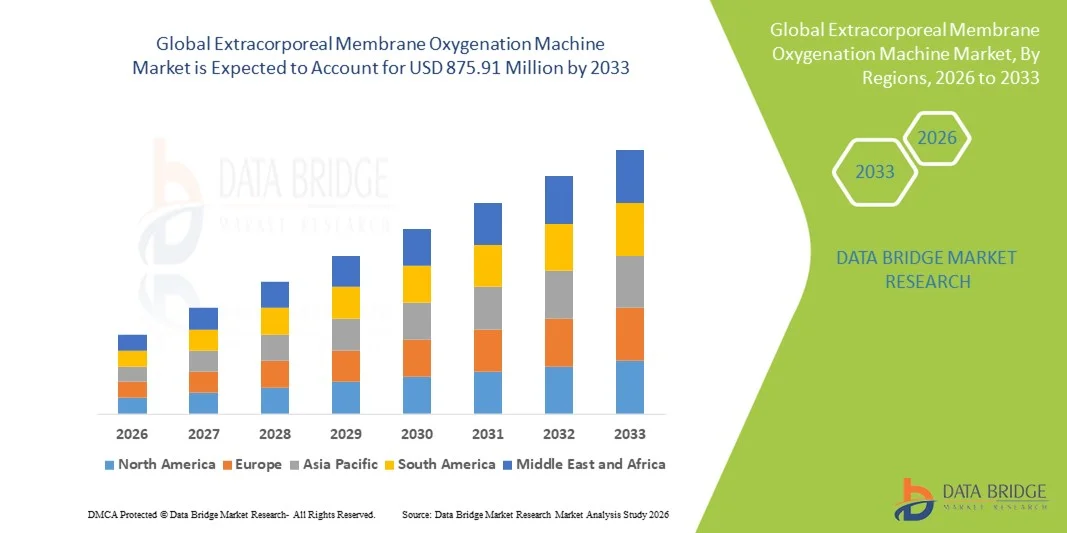
- The global extracorporeal membrane oxygenation machine market size was valued at USD 608.90 million in 2025 and is expected to reach USD 875.91 million by 2033, at a CAGR of 4.65% during the forecast period
- The market growth is largely fueled by the increasing prevalence of cardiovascular and respiratory conditions, rising adoption of advanced life‑support technologies in critical care settings, and continuous technological innovations in ECMO systems that improve efficiency, portability, and patient outcomes
- Furthermore, growing geriatric populations prone to severe heart and lung diseases, expanding critical care infrastructure worldwide, and heightened awareness among healthcare professionals about the clinical benefits of ECMO solutions are driving broader adoption, establishing ECMO machines as essential support systems in hospitals and specialty clinics
Extracorporeal Membrane Oxygenation Machine Market Analysis
- Extracorporeal membrane oxygenation machines, providing advanced life-support for patients with severe cardiac and respiratory failure, are becoming essential in modern critical care units across hospitals and specialty clinics due to their ability to sustain oxygenation and circulation when conventional treatments are insufficient
- The rising demand for Extracorporeal Membrane Oxygenation Machines is primarily fueled by the increasing prevalence of cardiovascular and respiratory diseases, growing adoption of advanced life-support technologies, and continuous technological innovations that enhance portability, efficiency, and patient outcomes
- North America dominated the extracorporeal membrane oxygenation machine market with the largest revenue share of 38.7% in 2025, driven by advanced healthcare infrastructure, high healthcare expenditure, early adoption of innovative critical care technologies, and a strong presence of key industry players, particularly in the U.S., where ECMO usage is increasing in specialized cardiac and respiratory care units
- Asia-Pacific is expected to be the fastest-growing region in the extracorporeal membrane oxygenation machine market during the forecast period due to expanding critical care infrastructure, increasing incidence of respiratory and cardiac diseases, and rising awareness among healthcare providers about the clinical benefits of ECMO therapy
- Adult segment dominated the extracorporeal membrane oxygenation machine market with a share of 45.8% in 2025, driven by the high prevalence of severe cardiac and pulmonary conditions among adult patients and the widespread adoption of ECMO systems in adult intensive care units
Report Scope and Extracorporeal Membrane Oxygenation Machine Market Segmentation
|
Attributes |
Extracorporeal Membrane Oxygenation Machine Key Market Insights |
|
Segments Covered |
|
|
Countries Covered |
North America
Europe
Asia-Pacific
Middle East and Africa
South America
|
|
Key Market Players |
|
|
Market Opportunities |
|
|
Value Added Data Infosets |
In addition to the insights on market scenarios such as market value, growth rate, segmentation, geographical coverage, and major players, the market reports curated by the Data Bridge Market Research also include in-depth expert analysis, patient epidemiology, pipeline analysis, pricing analysis, and regulatory framework |
Extracorporeal Membrane Oxygenation Machine Market Trends
Advanced Portability and AI-Enabled Monitoring
- A significant and accelerating trend in the global extracorporeal membrane oxygenation (ECMO) machine market is the development of portable ECMO devices with AI-enabled patient monitoring, enhancing rapid deployment and real-time clinical decision-making in intensive care units and emergency settings
- For instance, the CardioHelp System integrates AI-driven monitoring to track vital parameters continuously, alerting clinicians to changes in patient status and optimizing pump settings for safer and more efficient therapy
- AI integration in ECMO machines enables predictive analytics to identify potential complications, adjust oxygenation and flow parameters automatically, and improve patient outcomes; for instance, some Maquet ROTAFLOW models leverage AI algorithms to optimize perfusion and reduce adverse events during therapy
- The incorporation of portable ECMO systems and AI-driven dashboards allows healthcare providers to deploy life-support quickly in ambulances, field hospitals, or remote areas, providing flexibility and enhanced patient management
- This trend towards intelligent, portable, and responsive ECMO systems is reshaping expectations for critical care support, prompting companies such as LivaNova to develop AI-integrated ECMO machines capable of automated monitoring, alarm management, and enhanced portability
- The demand for ECMO machines with advanced monitoring and portable capabilities is rising across hospitals, specialty clinics, and emergency care settings, as clinicians increasingly prioritize rapid, reliable, and data-driven patient support
- Growing research collaborations and pilot programs for wearable and transportable ECMO devices are expanding clinical applications beyond traditional ICUs, creating opportunities for home-based or mobile critical care interventions
Extracorporeal Membrane Oxygenation Machine Market Dynamics
Driver
Rising Incidence of Cardiovascular and Respiratory Diseases
- The increasing prevalence of severe cardiac and respiratory conditions, coupled with growing adoption of advanced life-support systems, is a significant driver for the heightened demand for extracorporeal membrane oxygenation machines
- For instance, in March 2025, Getinge announced enhancements to the CardioHelp ECMO system, introducing AI-based monitoring for improved management of critically ill patients, strengthening its position in hospitals worldwide
- As healthcare providers seek solutions for patients with acute heart or lung failure, ECMO machines offer lifesaving support beyond conventional ventilation or circulatory assistance, providing a compelling upgrade for intensive care units
- Furthermore, the expansion of critical care infrastructure, including ICU beds and specialized cardiac and respiratory care units, is making ECMO machines an essential tool for hospitals managing high-risk patient populations
- The increasing awareness among clinicians about ECMO therapy benefits, coupled with governmental and private healthcare investments in advanced critical care technologies, is driving wider adoption across both adult and pediatric patient populations
- The growing demand for ECMO therapy, supported by training programs, clinical guidelines, and improved device usability, continues to propel the Extracorporeal Membrane Oxygenation Machine market in developed and emerging regions
- Rising incidences of pandemics and respiratory emergencies, such as severe influenza or COVID-19-related complications, have accelerated the adoption of ECMO machines in hospitals worldwide
- Increasing collaborations between ECMO device manufacturers and research institutions for device optimization and clinical outcome studies are boosting clinician confidence and market demand globally
Restraint/Challenge
High Cost and Regulatory Complexity
- The relatively high acquisition and maintenance cost of extracorporeal membrane oxygenation machines poses a significant challenge to broader market adoption, especially in price-sensitive or developing regions
- For instance, the HeartMate ECMO systems require substantial upfront investment and ongoing consumable expenses, limiting accessibility for smaller hospitals or clinics with constrained budgets
- Strict regulatory requirements and approvals for medical devices, including ECMO machines, create barriers to market entry, lengthening product launch timelines and increasing compliance costs for manufacturers
- In addition, concerns about clinical complications, including bleeding, infection, and thrombosis during ECMO therapy, necessitate specialized training and continuous monitoring, which can restrict rapid adoption in facilities lacking skilled personnel
- While technological advancements are reducing device complexity, the perception of high risk and operational challenges can still hinder adoption, particularly in hospitals with limited intensive care experience
- Overcoming these challenges through cost-effective portable solutions, regulatory streamlining, and clinician training programs is crucial for sustained growth of the Extracorporeal Membrane Oxygenation Machine market globally
- Limited reimbursement policies and high insurance coverage barriers in certain countries further constrain ECMO adoption, especially for smaller or mid-tier healthcare facilities
- Supply chain challenges for critical ECMO components, including oxygenators and pumps, can delay installations and maintenance, affecting the pace of market expansion in some regions
Extracorporeal Membrane Oxygenation Machine Market Scope
The market is segmented on the basis of component, modality, application, patient group, and end user.
- By Component
On the basis of component, the extracorporeal membrane oxygenation machine market is segmented into pumps, oxygenators, controllers, cannula, and accessories. The oxygenators segment dominated the market in 2025 with the largest revenue share, driven by their critical role in oxygenating blood and removing carbon dioxide during ECMO therapy. Hospitals and specialized care units prioritize high-performance oxygenators to ensure optimal patient outcomes, especially for severe respiratory or cardiac cases. The demand for oxygenators is further fueled by technological innovations such as improved biocompatible coatings and reduced hemolysis risk, enhancing clinical efficacy and safety. Oxygenators’ compatibility with various ECMO configurations and patient groups also supports their widespread adoption. Manufacturers continue to invest in research and development to produce oxygenators with longer lifespan and higher efficiency, which strengthens their dominant market position. In addition, increasing use in both adult and pediatric ICUs reinforces the oxygenator segment as the backbone of ECMO machine functionality.
The pumps segment is expected to witness the fastest growth rate during the forecast period, driven by rising demand for portable and compact ECMO systems. Advanced centrifugal and rotary pumps offer precise blood flow control, making them suitable for both adult and neonatal patients. The need for mobility in emergency care, transport, and field hospitals is accelerating pump adoption. Innovations such as reduced priming volume and low blood trauma pumps are enhancing patient safety and clinical confidence. Hospitals are increasingly integrating pumps with AI-enabled monitoring systems for real-time performance adjustments. Furthermore, the growth is supported by expanding ECMO therapy applications and rising clinician awareness of pump efficiency and reliability.
- By Modality
On the basis of modality, the market is segmented into veno-arterial (VA), veno-venous (VV), and arterio-venous (AV). The veno-venous (VV) segment dominated the market in 2025 due to its primary use in respiratory support for patients with severe lung failure. VV ECMO machines are extensively employed in ICUs for acute respiratory distress syndrome (ARDS) and other respiratory conditions. Their clinical preference is supported by reduced cardiac strain compared to VA ECMO, enhancing safety for patients. VV ECMO’s adoption is further reinforced by technological improvements in cannula design and flow management. Hospitals prioritize VV ECMO for adult and pediatric patients requiring respiratory assistance. The segment benefits from increasing prevalence of lung-related emergencies and COVID-19-related respiratory complications. VV modality’s compatibility with portable and AI-enabled ECMO systems also supports its market leadership.
The veno-arterial (VA) segment is expected to witness the fastest growth during the forecast period, primarily driven by its use in cardiac support for patients with severe heart failure or during extracorporeal cardiopulmonary resuscitation (ECPR). VA ECMO is increasingly adopted in emergency and cardiac ICUs, particularly in hospitals with advanced cardiac care infrastructure. Integration with real-time monitoring and AI-assisted flow regulation enhances its clinical effectiveness. The growing incidence of cardiovascular diseases and post-surgical cardiac complications fuels demand. VA ECMO’s application in adult and pediatric patients requiring circulatory support contributes to its rapid adoption. The trend toward mobile and transportable ECMO systems further accelerates VA modality growth.
- By Application
On the basis of application, the market is segmented into respiratory, cardiac, and extracorporeal cardiopulmonary resuscitation (ECPR). The respiratory segment dominated the market in 2025, accounting for the largest revenue share due to the high prevalence of ARDS, severe pneumonia, and respiratory failure cases. Hospitals utilize ECMO machines extensively to manage critically ill patients requiring prolonged respiratory support. Technological enhancements such as AI-assisted oxygenation and low hemolysis systems improve outcomes, supporting segment dominance. Pediatric and adult patients with severe lung conditions drive consistent demand. The respiratory segment also benefits from rising awareness of ECMO therapy in tertiary care hospitals and ICU centers. Moreover, pandemic-related respiratory emergencies have reinforced its market significance.
The ECPR segment is expected to witness the fastest growth during the forecast period, driven by rising adoption of ECMO during cardiac arrest and critical resuscitation scenarios. Hospitals are increasingly deploying ECPR-enabled ECMO machines to improve survival rates for patients with refractory cardiac arrest. Integration with AI monitoring systems allows clinicians to adjust perfusion and oxygenation rapidly during emergencies. Technological improvements and specialized training programs for healthcare providers further enhance ECPR adoption. The growing availability of portable ECMO systems for emergency and in-hospital cardiac events accelerates segment growth. Rising investment in advanced critical care infrastructure in developed and emerging regions supports the rapid uptake of ECPR applications.
- By Patient Group
On the basis of patient group, the market is segmented into infant, pediatric, and adult. The adult segment dominated the market in 2025 with the largest revenue share of 45.8% due to the high prevalence of severe cardiac and respiratory diseases among adults. ECMO machines for adults are widely used in critical care units, cardiac surgery, and respiratory ICUs. Technological advancements, including AI-assisted monitoring and modular systems, enhance the safety and efficiency of adult ECMO therapy. Hospitals prioritize adult ECMO due to higher patient volumes and demand for critical support. The segment is further driven by increasing incidences of chronic heart failure, ARDS, and COVID-19-related complications. Adult patient ECMO therapy remains central to clinical research and innovation, reinforcing its market leadership.
The pediatric segment is expected to witness the fastest growth during the forecast period, fueled by rising congenital heart defects and pediatric respiratory emergencies. Pediatric ECMO machines are increasingly integrated with neonatal and pediatric ICU units to provide specialized life-support. Innovations such as low-flow pumps, reduced priming volumes, and AI-assisted monitoring improve safety for young patients. Hospitals are adopting pediatric ECMO to enhance survival rates in critical cases. Awareness programs and specialized training for healthcare providers contribute to segment growth. The focus on early intervention in pediatric cardiac and respiratory conditions further accelerates adoption.
- By End User
On the basis of end user, the market is segmented into hospitals, home care settings, ambulatory centers, and others. The hospitals segment dominated the market in 2025, driven by the extensive presence of ICUs, specialized cardiac and respiratory care units, and skilled personnel. Hospitals invest heavily in ECMO machines for adult, pediatric, and neonatal patients requiring life-support in critical care scenarios. Technological advancements, AI integration, and comprehensive maintenance support strengthen hospitals’ reliance on ECMO therapy. The segment benefits from rising incidences of respiratory and cardiovascular diseases, government support, and healthcare investments. Hospitals’ capability to manage complex ECMO procedures ensures their dominance. In addition, hospitals remain central to ECMO clinical trials and research, further boosting adoption.
The home care and ambulatory segment is expected to witness the fastest growth during the forecast period, driven by increasing demand for portable ECMO machines for patient transport and long-term care outside traditional ICUs. Advancements in compact, user-friendly ECMO systems allow critical patients to receive monitored support in home or outpatient settings. Integration with remote monitoring platforms and AI-enabled alerts enhances safety and usability. Rising awareness among caregivers and healthcare providers promotes adoption. The segment is also supported by healthcare policies encouraging home-based patient care to reduce hospital congestion. Growing investments in mobile and telehealth ECMO applications accelerate the expansion of this end-user segment.
Extracorporeal Membrane Oxygenation Machine Market Regional Analysis
- North America dominated the extracorporeal membrane oxygenation machine market with the largest revenue share of 38.7% in 2025, driven by advanced healthcare infrastructure, high healthcare expenditure, early adoption of innovative critical care technologies, and a strong presence of key industry players
- Hospitals and specialized ICUs in the region increasingly adopt ECMO machines to manage critically ill adult, pediatric, and neonatal patients, leveraging advanced AI-enabled monitoring, portable systems, and integration with digital health platforms
- This widespread adoption is further supported by the presence of key ECMO manufacturers, strong clinical expertise, ongoing research and development, and rising awareness among healthcare professionals about ECMO therapy benefits, establishing ECMO machines as a standard critical care solution across hospitals and specialty clinics
U.S. Extracorporeal Membrane Oxygenation Machine Market Insight
The U.S. ECMO machine market captured the largest revenue share of 82% in 2025 within North America, fueled by advanced critical care infrastructure and rising prevalence of cardiovascular and respiratory conditions. Hospitals are increasingly adopting AI-enabled and portable ECMO systems to manage adult, pediatric, and neonatal patients in ICUs. The growing emphasis on patient survival rates, combined with demand for real-time monitoring and telehealth integration, further propels the ECMO machine market. In addition, the rising number of cardiac surgeries, respiratory emergencies, and ECMO clinical trials in the U.S. is driving market expansion. Government initiatives supporting critical care investments and training programs for clinicians also contribute to steady growth.
Europe Extracorporeal Membrane Oxygenation Machine Market Insight
The Europe ECMO machine market is projected to expand at a significant CAGR throughout the forecast period, primarily driven by increasing incidence of respiratory and cardiac conditions and the expansion of advanced ICU facilities. Growing awareness among healthcare professionals about ECMO therapy benefits and the presence of key ECMO manufacturers strengthen adoption. European hospitals are incorporating ECMO machines into both adult and pediatric critical care units to improve patient outcomes. In addition, the integration of ECMO systems with AI-enabled monitoring and electronic health records facilitates precise clinical management. Government healthcare support and rising funding for advanced life-support infrastructure also fuel market growth.
U.K. Extracorporeal Membrane Oxygenation Machine Market Insight
The U.K. ECMO machine market is anticipated to grow at a noteworthy CAGR during the forecast period, driven by rising cardiovascular and respiratory emergencies and the increasing adoption of portable and AI-assisted ECMO systems. Hospitals and specialized ICUs are focusing on improving survival rates for adult and pediatric patients using ECMO therapy. In addition, government initiatives to strengthen critical care infrastructure and ongoing clinical research on ECMO outcomes further encourage adoption. The availability of training programs for healthcare providers and the integration of ECMO systems with hospital telemetry networks are supporting market expansion. Growing awareness of ECMO benefits among private and public hospitals continues to propel the market forward.
Germany Extracorporeal Membrane Oxygenation Machine Market Insight
The Germany ECMO machine market is expected to expand at a considerable CAGR during the forecast period, fueled by increasing awareness of advanced life-support technologies and the growing need for improved critical care facilities. Hospitals are prioritizing AI-enabled ECMO systems with portable and efficient designs for adult, pediatric, and neonatal patients. Germany’s well-developed healthcare infrastructure, emphasis on research, and government funding for ICU expansion promote market adoption. Integration of ECMO machines with hospital monitoring and digital health platforms enhances operational efficiency. In addition, rising cardiovascular and respiratory disease prevalence supports consistent demand. Sustainability-focused hospitals are also adopting energy-efficient and low-blood trauma ECMO systems, reinforcing market growth.
Asia-Pacific Extracorporeal Membrane Oxygenation Machine Market Insight
The Asia-Pacific ECMO machine market is poised to grow at the fastest CAGR of 25% during the forecast period of 2026 to 2033, driven by expanding ICU infrastructure, increasing prevalence of cardiac and respiratory diseases, and rising healthcare investments in countries such as China, Japan, and India. The region’s growing inclination toward advanced life-support systems, supported by government healthcare initiatives and medical training programs, is driving adoption. In addition, increasing awareness among clinicians, rising hospital bed capacity, and the introduction of portable ECMO systems are accelerating market penetration. The expansion of local manufacturing and distribution of ECMO components is also improving affordability and accessibility, widening the patient base across APAC.
Japan Extracorporeal Membrane Oxygenation Machine Market Insight
The Japan ECMO machine market is gaining momentum due to advanced ICU facilities, a technologically advanced healthcare ecosystem, and rising demand for life-support solutions. Hospitals are increasingly deploying ECMO machines for adult, pediatric, and neonatal patients with critical cardiac and respiratory conditions. Integration with AI-driven monitoring and telemetry platforms enables real-time patient data analysis, improving clinical outcomes. In addition, Japan’s aging population is driving demand for safer, easier-to-use ECMO systems, particularly in hospitals and specialty clinics. Government funding for ICU enhancement and ongoing ECMO research programs further propel market growth.
India Extracorporeal Membrane Oxygenation Machine Market Insight
The India ECMO machine market accounted for the largest market revenue share in Asia-Pacific in 2025, attributed to expanding ICU infrastructure, increasing prevalence of respiratory and cardiac conditions, and rising healthcare investments. Hospitals are adopting AI-enabled, portable ECMO systems to improve survival rates among critically ill adult and pediatric patients. The push toward smart hospitals, government initiatives supporting advanced life-support technologies, and the growing presence of domestic ECMO manufacturers are key factors propelling the market. In addition, increasing awareness among clinicians and patients about ECMO therapy benefits supports adoption across both urban and tier-2 hospital centers. Rising availability of cost-effective ECMO solutions further strengthens market expansion in India.
Extracorporeal Membrane Oxygenation Machine Market Share
The Extracorporeal Membrane Oxygenation Machine industry is primarily led by well-established companies, including:
- Getinge AB (Sweden)
- Medtronic (Ireland)
- LivaNova PLC (U.K.)
- Terumo Corporation (Japan)
- Fresenius Medical Care (Germany)
- EUROSETS S.r.l. (Italy)
- NIPRO Corporation (Japan)
- MicroPort Scientific Corporation (China)
- Abiomed, Inc. (U.S.)
- Abbott (U.S.)
- B. Braun SE (Germany)
- Baxter (U.S.)
- ALung Technologies, Inc. (U.S.)
- OriGen Biomedical, Inc. (U.S.)
- Spectrum Medical (U.K.)
- Hemovent N.V. (Belgium)
- Senko Medical Instrument Mfg. Co., Ltd. (Japan)
- Medos Medizintechnik AG (Germany)
- CytoSorbents Corporation (U.S.)
What are the Recent Developments in Global Extracorporeal Membrane Oxygenation Machine Market?
- In October 2025, Medtronic formally launched the VitalFlow™ Extracorporeal Membrane Oxygenation system across European markets at the European Association for Cardio‑Thoracic Surgery (EACTS) Annual Meeting, advancing critical care support and expanding its global ECMO footprint
- In July 2025, Medtronic’s VitalFlow ECMO system received CE Mark approval in Europe, enabling its broader commercial distribution across European healthcare systems and reinforcing the company’s expansion of advanced ECMO technologies to support critically ill patients outside the U.S. market
- In September 2024, Medtronic launched its new VitalFlow™ Extracorporeal Membrane Oxygenation (ECMO) system, a configurable one‑system ECMO solution designed to simplify ICU workflows and support clinicians with an intuitive interface and real‑time data integration, marking a significant product innovation in extracorporeal life support following Medtronic’s acquisition of MC3 Cardiopulmonary
- In September 2023, Rocket Medical launched Revive‑I, its next‑generation ECMO system aimed at improving usability and patient care efficiency in extracorporeal life support, reflecting increased innovation activity within the global ECMO device landscape
- In April 2023, Abbott received two additional U.S. Food and Drug Administration (FDA) clearances for its CentriMag Blood Pump used with the CentriMag™ ECMO System, allowing clinicians to use the device for longer‑term extracorporeal membrane oxygenation support in adults, enhancing flexibility and treatment options in critical care settings

- Interactive Data Analysis Dashboard
- Company Analysis Dashboard for high growth potential opportunities
- Research Analyst Access for customization & queries
- Competitor Analysis with Interactive dashboard
- Latest News, Updates & Trend analysis
- Harness the Power of Benchmark Analysis for Comprehensive Competitor Tracking
Data collection and base year analysis are done using data collection modules with large sample sizes. The stage includes obtaining market information or related data through various sources and strategies. It includes examining and planning all the data acquired from the past in advance. It likewise envelops the examination of information inconsistencies seen across different information sources. The market data is analysed and estimated using market statistical and coherent models. Also, market share analysis and key trend analysis are the major success factors in the market report. To know more, please request an analyst call or drop down your inquiry.
The key research methodology used by DBMR research team is data triangulation which involves data mining, analysis of the impact of data variables on the market and primary (industry expert) validation. Data models include Vendor Positioning Grid, Market Time Line Analysis, Market Overview and Guide, Company Positioning Grid, Patent Analysis, Pricing Analysis, Company Market Share Analysis, Standards of Measurement, Global versus Regional and Vendor Share Analysis. To know more about the research methodology, drop in an inquiry to speak to our industry experts.
Data Bridge Market Research is a leader in advanced formative research. We take pride in servicing our existing and new customers with data and analysis that match and suits their goal. The report can be customized to include price trend analysis of target brands understanding the market for additional countries (ask for the list of countries), clinical trial results data, literature review, refurbished market and product base analysis. Market analysis of target competitors can be analyzed from technology-based analysis to market portfolio strategies. We can add as many competitors that you require data about in the format and data style you are looking for. Our team of analysts can also provide you data in crude raw excel files pivot tables (Fact book) or can assist you in creating presentations from the data sets available in the report.













