Global Erosion Control Blanket Market
Market Size in USD Million
CAGR :
% 
 USD
153.33 Million
USD
201.90 Million
2025
2033
USD
153.33 Million
USD
201.90 Million
2025
2033
 Forecast Period Forecast Period |
2026 –2033 |
 Market Size (Base Year) Market Size (Base Year) |
USD 153.33 Million |
 Market Size (Forecast Year) Market Size (Forecast Year) |
USD 201.90 Million |
 CAGR CAGR |
% |
| Major Markets Players |
|
What is the Global Erosion Control Blanket Market Size and Growth Rate?
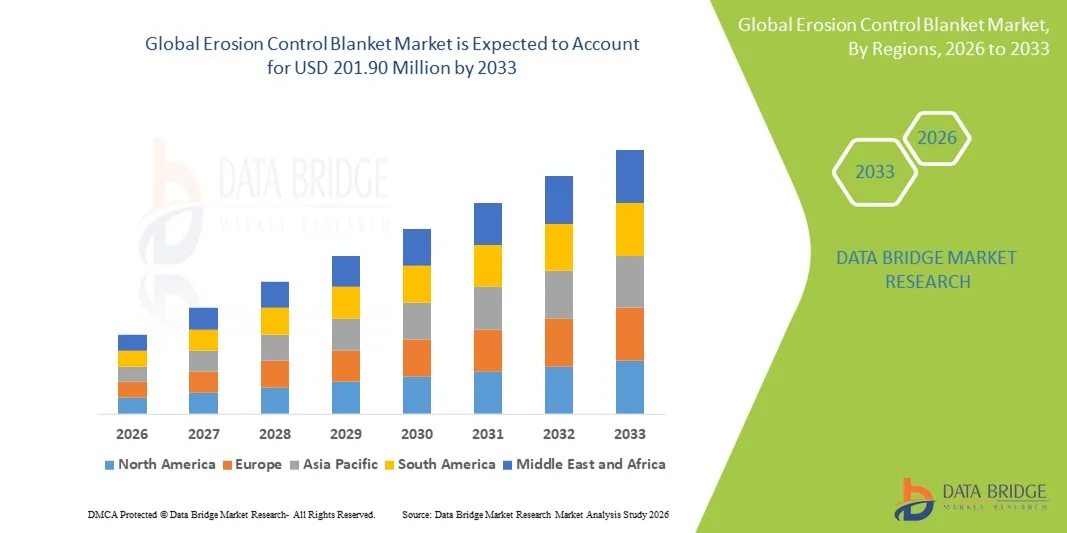
- The global erosion control blanket market size was valued at USD 153.33 million in 2025 and is expected to reach USD 201.90 million by 2033, at a CAGR of3.50% during the forecast period
- Rise in the awareness about erosion issues acts as the major driver escalating the market growth, also rise in the attentiveness to environmental degradation, rise in the deforestation activities and rise in the research and development activities in the market are the major factors among others driving the erosion control blanket market growth
What are the Major Takeaways of Erosion Control Blanket Market?
- Increase in the research and development activities and rise in the demand from emerging economies will further create new opportunities for the erosion control blanket market
- However, rise in the cost of research and development activities acts as the major factor acting as a restraint, and will further challenge the growth of erosion control blanket market
- North America dominated the erosion control blanket market with a 41.36% revenue share in 2025, driven by extensive infrastructure development, large-scale road and highway construction, and strict soil erosion and environmental protection regulations across the U.S. and Canada
- Asia-Pacific is projected to register the fastest CAGR of 9.21% from 2026 to 2033, driven by rapid urbanization, large-scale infrastructure development, and increasing investments in transportation, water management, and construction projects across China, India, Japan, South Korea, and Southeast Asia
- The Natural segment dominated the market with a 44.6% share in 2025, driven by rising environmental regulations, sustainability goals, and strong preference for biodegradable solutions in infrastructure and land restoration projects
Report Scope and Erosion Control Blanket Market Segmentation
|
Attributes |
Erosion Control Blanket Key Market Insights |
|
Segments Covered |
|
|
Countries Covered |
North America
Europe
Asia-Pacific
Middle East and Africa
South America
|
|
Key Market Players |
|
|
Market Opportunities |
|
|
Value Added Data Infosets |
In addition to the insights on market scenarios such as market value, growth rate, segmentation, geographical coverage, and major players, the market reports curated by the Data Bridge Market Research also include in-depth expert analysis, pricing analysis, brand share analysis, consumer survey, demography analysis, supply chain analysis, value chain analysis, raw material/consumables overview, vendor selection criteria, PESTLE Analysis, Porter Analysis, and regulatory framework. |
What is the Key Trend in the Erosion Control Blanket Market?
Growing Shift Toward Biodegradable, High-Performance, and Easy-to-Install Erosion Control Blankets
- The erosion control blanket market is witnessing increasing adoption of biodegradable and natural fiber blankets made from coir, jute, straw, and wood excelsior to meet sustainability and regulatory requirements
- Manufacturers are developing high-strength, lightweight, and hydraulically efficient blankets that provide faster vegetation establishment and improved soil stabilization
- Rising preference for easy-to-install, pre-seeded, and rolled blanket solutions is supporting rapid deployment across construction, mining, roadways, and landscaping projects
- For instance, companies such as Tensar, NAUE, American Excelsior, and Western Excelsior are expanding eco-friendly product portfolios with enhanced durability and performance
- Growing focus on slope protection, riverbank stabilization, and stormwater management is accelerating adoption across infrastructure projects
- As infrastructure expansion and environmental protection gain priority, erosion control blankets will remain critical for long-term soil conservation and land rehabilitation
What are the Key Drivers of Erosion Control Blanket Market?
- Rising demand for effective soil erosion prevention in highway construction, residential development, mining, and infrastructure projects
- For instance, in 2024–2025, large-scale road and rail projects across Europe and Asia-Pacific increased usage of erosion control blankets for slope and embankment stabilization
- Growing enforcement of environmental protection regulations related to sediment control and land restoration is boosting market adoption
- Increasing investments in green infrastructure, flood control, and watershed management are strengthening demand
- Expansion of urbanization and land development activities is increasing soil exposure, driving blanket deployment
- Supported by infrastructure growth and sustainability initiatives, the Erosion Control Blanket market is expected to witness steady long-term expansion
Which Factor is Challenging the Growth of the Erosion Control Blanket Market?
- Higher costs of premium and biodegradable erosion control blankets compared to conventional solutions limit adoption in cost-sensitive projects
- For instance, during 2024–2025, raw material price fluctuations for natural fibers increased production costs for several manufacturers
- Limited awareness regarding proper installation techniques reduces performance effectiveness in some regions
- Competition from alternative erosion control methods such as hydroseeding, geotextiles, and retaining systems creates pricing pressure
- Performance variability based on soil type, slope gradient, and climatic conditions poses adoption challenges
- To overcome these barriers, companies are focusing on cost-optimized designs, installer training programs, and region-specific product innovation to expand global adoption
How is the Erosion Control Blanket Market Segmented?
The market is segmented on the basis of type, material, erosion control period, application, price, and distribution channel.
- By Type
On the basis of type, the erosion control blanket market is segmented into Synthetic, Natural, and Combined. The Natural segment dominated the market with a 44.6% share in 2025, driven by rising environmental regulations, sustainability goals, and strong preference for biodegradable solutions in infrastructure and land restoration projects. Natural blankets made from jute, straw, and coconut fiber support vegetation growth, reduce soil loss, and naturally decompose without leaving residue, making them widely adopted across roadways, riverbanks, and construction sites.
The Combined segment is expected to grow at the fastest CAGR from 2026 to 2033, supported by demand for enhanced durability and extended erosion protection. These blankets combine natural fibers with synthetic netting to improve tensile strength, longevity, and hydraulic performance, making them suitable for high-slope gradients, heavy rainfall zones, and long-term infrastructure applications.
- By Material
Based on material, the market is segmented into Jute, Straw, Coconut Fiber, and Others. The Straw segment held the largest market share of 38.2% in 2025, owing to its low cost, wide availability, and effective short-term erosion control performance. Straw blankets are extensively used in temporary soil stabilization, roadside embankments, and residential landscaping projects.
The Coconut Fiber segment is projected to register the fastest growth during 2026–2033, driven by its superior durability, higher tensile strength, and longer functional life. Coconut fiber blankets are increasingly adopted for slope protection, riverbank reinforcement, and high-moisture environments. Growing infrastructure investment and preference for long-lasting natural materials are accelerating adoption of coconut-based erosion control solutions.
- By Erosion Control Period
On the basis of erosion control period, the market is segmented into Up to 90 Days, 3 Months to 12 Months, 12 Months to 24 Months, and More than 24 Months. The 3 Months to 12 Months segment dominated the market with a 41.3% share in 2025, as it offers an optimal balance between cost, durability, and vegetation establishment for most construction and infrastructure projects.
The More than 24 Months segment is anticipated to grow at the fastest CAGR from 2026 to 2033, supported by rising demand for long-term erosion protection in highways, railways, mining reclamation, and flood control projects. Increased focus on climate resilience and extreme weather protection is boosting adoption of extended-duration erosion control blankets.
- By Application
Based on application, the erosion control blanket market is segmented into Slope Protection, Channel Protection, Culvert Inlets and Outfalls, and Others. The Slope Protection segment accounted for the largest share of 46.9% in 2025, driven by extensive use in road construction, embankments, landfills, and hillside stabilization. Rising infrastructure expansion and urban development significantly increase slope erosion risks, supporting strong demand.
The Channel Protection segment is expected to grow at the fastest CAGR during the forecast period, fueled by increasing investments in stormwater management, drainage systems, and flood mitigation projects. Growing emphasis on waterway protection and sediment control regulations is further strengthening segment growth.
- By Price
On the basis of price, the market is segmented into Low, Medium, and High. The Medium-price segment dominated the market with a 49.1% share in 2025, as it provides an optimal balance between performance, durability, and cost-efficiency. Medium-priced blankets are widely used across commercial construction, transportation infrastructure, and municipal projects.
The High-price segment is projected to grow at the fastest CAGR from 2026 to 2033, driven by increasing adoption of premium, long-lasting, and reinforced erosion control blankets in large-scale infrastructure and environmentally sensitive projects requiring extended protection periods.
- By Distribution Channel
Based on distribution channel, the erosion control blanket market is segmented into Direct and Indirect. The Direct segment dominated the market with a 55.4% share in 2025, supported by bulk procurement by government bodies, infrastructure contractors, and large construction firms seeking cost advantages and customized solutions.
The Indirect segment is expected to grow at the fastest CAGR during 2026–2033, driven by expanding dealer networks, distributor partnerships, and rising adoption among small contractors and landscaping firms. Increased availability through regional suppliers is improving market accessibility and accelerating adoption globally.
Which Region Holds the Largest Share of the Erosion Control Blanket Market?
- North America dominated the erosion control blanket market with a 41.36% revenue share in 2025, driven by extensive infrastructure development, large-scale road and highway construction, and strict soil erosion and environmental protection regulations across the U.S. and Canada. High adoption of erosion control blankets in slope stabilization, highway embankments, riverbank protection, and stormwater management projects continues to fuel market demand. Strong focus on sustainable construction practices and land restoration further supports widespread usage across transportation, mining, and municipal projects
- Leading companies in North America are introducing high-performance erosion control blankets with enhanced tensile strength, biodegradable materials, and extended durability to meet regulatory and project-specific requirements. Continuous investment in infrastructure renewal, climate-resilient construction, and flood mitigation initiatives drives long-term market growth
- Strong contractor networks, advanced construction practices, and consistent government funding for erosion control and land management further reinforce North America’s market leadership
U.S. Erosion Control Blanket Market Insight
The U.S. is the largest contributor in North America, supported by large-scale highway expansion, urban development, and increasing investments in flood control and stormwater management infrastructure. Rising use of erosion control blankets in transportation projects, mining reclamation, pipeline construction, and residential development drives steady demand. Strict environmental compliance standards and emphasis on sustainable construction materials further strengthen market adoption.
Canada Erosion Control Blanket Market Insight
Canada contributes significantly to regional growth, driven by infrastructure modernization, expanding renewable energy projects, and increasing focus on land restoration and erosion prevention. Adoption of erosion control blankets across road construction, riverbank stabilization, and slope protection projects is rising steadily. Government-backed environmental programs and growing awareness of soil conservation practices support market expansion.
Asia-Pacific Erosion Control Blanket Market
Asia-Pacific is projected to register the fastest CAGR of 9.21% from 2026 to 2033, driven by rapid urbanization, large-scale infrastructure development, and increasing investments in transportation, water management, and construction projects across China, India, Japan, South Korea, and Southeast Asia. Growing concerns over soil erosion, flooding, and land degradation are accelerating demand for erosion control solutions. Expansion of road networks, railways, dams, and urban drainage systems significantly increases the need for slope and channel protection measures. Rising adoption of sustainable and biodegradable erosion control materials further supports regional growth.
China Erosion Control Blanket Market Insight
China is the largest contributor to Asia-Pacific, supported by massive infrastructure projects, river management programs, and government-led soil conservation initiatives. High demand for erosion control blankets in highway construction, flood control, and land reclamation projects drives strong market adoption.
Japan Erosion Control Blanket Market Insight
Japan shows steady growth due to frequent exposure to heavy rainfall, landslides, and flooding. Strong emphasis on disaster prevention, slope stabilization, and long-term infrastructure protection drives demand for high-quality erosion control blankets with extended durability.
India Erosion Control Blanket Market Insight
India is emerging as a high-growth market, driven by expanding road construction, riverbank protection projects, and government initiatives such as smart cities and infrastructure development. Rising awareness of soil erosion control and sustainable construction practices further accelerates adoption.
South Korea Erosion Control Blanket Market Insight
South Korea contributes steadily due to infrastructure upgrades, urban expansion, and increased focus on slope protection and environmental conservation. Government investment in flood control, transportation projects, and eco-friendly construction materials supports long-term market growth.
Which are the Top Companies in Erosion Control Blanket Market?
The erosion control blanket industry is primarily led by well-established companies, including:
- Contech Engineered Solutions LLC (Official Website) (U.S.)
- NAUE GmbH & Co. KG (Official Website) (Germany)
- Tensar International Corporation (Official Website) (U.S.)
- Cherokee Manufacturing, Inc. (U.S.)
- Hydroseal LLC (U.S.)
- Hydroseeding Ltd (U.S.)
- L & M Supply Company (U.S.)
- Western Excelsior Corporation (U.S.)
SKU-
Get online access to the report on the World's First Market Intelligence Cloud
- Interactive Data Analysis Dashboard
- Company Analysis Dashboard for high growth potential opportunities
- Research Analyst Access for customization & queries
- Competitor Analysis with Interactive dashboard
- Latest News, Updates & Trend analysis
- Harness the Power of Benchmark Analysis for Comprehensive Competitor Tracking
Research Methodology
Data collection and base year analysis are done using data collection modules with large sample sizes. The stage includes obtaining market information or related data through various sources and strategies. It includes examining and planning all the data acquired from the past in advance. It likewise envelops the examination of information inconsistencies seen across different information sources. The market data is analysed and estimated using market statistical and coherent models. Also, market share analysis and key trend analysis are the major success factors in the market report. To know more, please request an analyst call or drop down your inquiry.
The key research methodology used by DBMR research team is data triangulation which involves data mining, analysis of the impact of data variables on the market and primary (industry expert) validation. Data models include Vendor Positioning Grid, Market Time Line Analysis, Market Overview and Guide, Company Positioning Grid, Patent Analysis, Pricing Analysis, Company Market Share Analysis, Standards of Measurement, Global versus Regional and Vendor Share Analysis. To know more about the research methodology, drop in an inquiry to speak to our industry experts.
Customization Available
Data Bridge Market Research is a leader in advanced formative research. We take pride in servicing our existing and new customers with data and analysis that match and suits their goal. The report can be customized to include price trend analysis of target brands understanding the market for additional countries (ask for the list of countries), clinical trial results data, literature review, refurbished market and product base analysis. Market analysis of target competitors can be analyzed from technology-based analysis to market portfolio strategies. We can add as many competitors that you require data about in the format and data style you are looking for. Our team of analysts can also provide you data in crude raw excel files pivot tables (Fact book) or can assist you in creating presentations from the data sets available in the report.