


What is the Electrical House (E-House) Market Size and Growth Rate?
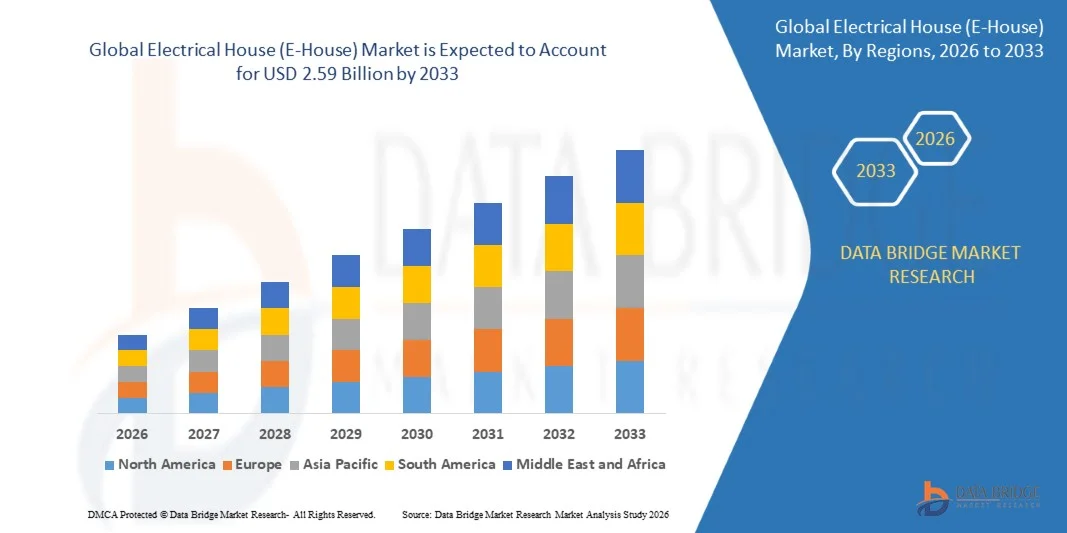
- As per Data Bridge Market Research analysis, the global Electrical House (E-House) market size was valued at USD 1.48 billion in 2025 and is expected to reach USD 2.59 billion by 2033, at a CAGR of 7.25% during the forecast period
- The market growth is largely driven by increasing industrialization, expansion of mining, oil and gas, and metal processing operations, which are creating a rising demand for modular, prefabricated power distribution solutions. The need for rapid deployment, scalable power management, and reliable energy distribution is significantly boosting E-House adoption across multiple sectors
- Furthermore, growing investments in renewable energy, infrastructure projects, and remote industrial sites are establishing Electrical House (E-House) as the preferred solution for efficient and flexible electrical distribution. These converging factors are accelerating the deployment of both fixed and mobile E-Houses, thereby contributing to robust market growth
What are the Major Takeaways of the Electrical House (E-House) Market?
- Electrical House (E-House) are prefabricated, modular electrical enclosures that integrate components such as switchgear, transformers, bus bars, variable frequency drives, power management systems, and HVAC systems. They provide plug-and-play solutions for industrial, utility, and renewable energy applications, enhancing operational efficiency, safety, and reliability
- The escalating demand for Electrical House (E-House) is primarily fueled by the need for compact, pre-assembled electrical systems that reduce on-site construction time, ensure compliance with safety standards, and support energy optimization. In addition, the increasing adoption of digital monitoring, IoT-enabled management, and AI-driven energy systems is further enhancing the value proposition of E-House solutions
- Asia-Pacific dominated the Electrical House (E-House) market with a share of around 35% in 2025, due to rapid industrialization, increasing infrastructure development, and growing investments in mining, oil and gas, and metal processing industries
- North America is expected to be the fastest growing region in the Electrical House (E-House) market during the forecast period due to increasing investments in industrial automation, energy infrastructure modernization, and modular power solutions for mining, oil and gas, and manufacturing industries
- Mobile substation segment dominated the market with a market share of 49% in 2025, due to its high demand in remote industrial sites, mining operations, and project-based deployments where flexible and rapidly deployable power solutions are required. These substations offer easy transportation, quick installation, and reliable performance under challenging environmental conditions, making them essential for temporary or dynamic power distribution needs
Report Scope and Electrical House (E-House) Market Segmentation
|
Attributes |
Electrical House (E-House) Key Market Insights |
|
Segments Covered |
|
|
Countries Covered |
North America
Europe
Asia-Pacific
Middle East and Africa
South America
|
|
Key Market Players |
|
|
Market Opportunities |
|
|
Value Added Data Infosets |
In addition to the market insights such as market value, growth rate, market segments, geographical coverage, market players, and market scenario, the market report curated by the Data Bridge Market Research team includes in-depth expert analysis, import/export analysis, pricing analysis, production consumption analysis, and pestle analysis. |
What is the Key Trend in the Electrical House (E-House) Market?
“Rising Adoption of Modular and Prefabricated Power Solutions”
- A significant trend in the electrical house (E-House) market is the increasing adoption of modular and prefabricated power solutions, driven by the need for rapid deployment, flexible configurations, and compact integration of electrical systems across industrial and utility sectors. This trend is positioning E-Houses as essential solutions for temporary or remote power distribution and control applications
- For instance, Schneider Electric and Siemens supply prefabricated Electrical House (E-House) that are deployed for power substations, industrial automation, and renewable energy integration. These solutions provide faster installation, reduce on-site labor requirements, and ensure standardized safety and control measures
- The trend toward smart grid modernization and renewable energy expansion is encouraging utilities and industrial operators to adopt Electrical House (E-House) for distributed generation, microgrid control, and substation automation. These modular systems allow for scalable power management while reducing on-site construction complexities
- Industrial sectors such as oil & gas, mining, and manufacturing are increasingly using Electrical House (E-House) to centralize power distribution and control systems in hazardous or remote locations. These solutions enhance operational safety, enable easier maintenance, and reduce the need for permanent infrastructure
- Electrical House (E-House) are gaining preference for temporary or rapid-response projects where conventional construction timelines are prohibitive. Deployments in disaster recovery, large-scale events, or construction sites highlight their flexibility and operational efficiency
- The market is witnessing strong interest in integrated Electrical House (E-House) solutions combining power, control, and automation systems, where pre-engineered designs accelerate project timelines and improve system reliability. This adoption is reinforcing the role of E-Houses as a critical enabler of efficient industrial and utility power operations
Electrical House (E-House) Market Dynamics
Driver
“Increasing Industrialization and Infrastructure Development”
- Rising industrialization and large-scale infrastructure projects are driving the demand for Electrical House (E-House), as they provide modular, reliable, and scalable electrical solutions that can be deployed rapidly across diverse sectors. This industrial expansion requires compact and integrated power solutions to manage distributed energy and automation systems efficiently
- For instance, ABB provides preassembled Electrical House (E-House) for infrastructure projects including rail electrification and industrial plants, enabling faster commissioning and consistent performance. These systems reduce the complexity of field assembly and ensure standardized operational protocols
- The growth in renewable energy installations such as solar and wind farms is increasing the need for prefabricated Electrical House (E-House) for inverter stations, switchgear, and control rooms. These solutions simplify deployment in geographically dispersed sites and enhance reliability of power management
- Urbanization and smart city initiatives are creating higher demand for modular electrical solutions in public utilities, transportation, and building management. Electrical House (E-House) offer compact integration for monitoring, metering, and distribution systems
- The continuing global expansion of industrial infrastructure is reinforcing this driver, with E-Houses becoming integral to efficient, flexible, and rapid deployment of electrical power and control systems
Restraint/Challenge
“High Initial Investment and Customization Costs”
- The electrical house market faces challenges due to high initial capital expenditure and the cost of designing customized solutions to meet specific site, environmental, and operational requirements. These financial barriers can limit adoption, particularly for small and medium-scale projects
- For instance, companies such as Eaton and Schneider Electric offer highly customized E-House configurations with integrated power and control systems, where specialized engineering and manufacturing processes increase project costs. Such customization is necessary to meet technical and safety standards but raises the overall investment
- The need for site-specific engineering, transportation logistics, and on-site assembly contributes to higher upfront costs and elongated project planning. This can delay ROI for new deployments
- Maintenance and lifecycle management expenses for specialized components also add to the total cost of ownership. E-Houses require trained personnel to operate and service integrated electrical and automation systems
- The market continues to face constraints related to balancing customization needs with cost-effectiveness, as buyers weigh the benefits of rapid deployment against significant initial investment. These financial and technical challenges collectively act as key barriers to faster adoption of E-House solutions
How is the Electrical House (E-House) Market Segmented?
The market is segmented on the basis of voltage, type, application, and component.
• By Voltage
On the basis of voltage, the Electrical House (E-House) market is segmented into medium voltage electrical house (E-House) and low voltage electrical house (E-House). The medium voltage electrical house segment dominated the largest market revenue share in 2025, driven by its extensive use in heavy industrial operations such as mining, oil and gas, and power distribution where high-capacity power handling is required. Industries prefer medium voltage E-Houses due to their ability to support large-scale equipment, ensure operational reliability, and reduce power losses over long distances. These systems also offer integrated protection and control solutions, making them suitable for complex industrial environments requiring continuous and stable power supply. The increasing investments in infrastructure and energy projects further strengthen the demand for medium voltage solutions across developing and developed regions.
The low voltage electrical house segment is anticipated to witness the fastest growth rate from 2026 to 2033, fueled by rising adoption in commercial facilities, small-scale industries, and renewable energy projects. Low voltage E-Houses are preferred for their cost-effectiveness, compact design, and ease of installation in applications with moderate power requirements. The growing focus on decentralized energy systems and smart grid infrastructure is accelerating their deployment in distributed power networks. Their flexibility and lower maintenance requirements also contribute to increased adoption in urban infrastructure and utility applications.
• By Type
On the basis of type, the Electrical House (E-House) market is segmented into fixed and mobile substation. The mobile substation segment dominated the largest market revenue share of 49% in 2025, driven by its high demand in remote industrial sites, mining operations, and project-based deployments where flexible and rapidly deployable power solutions are required. These substations offer easy transportation, quick installation, and reliable performance under challenging environmental conditions, making them essential for temporary or dynamic power distribution needs. Their modular design and compatibility with various industrial applications further support widespread adoption across regions investing in infrastructure development and energy projects.
The fixed substation segment is expected to witness the fastest CAGR from 2026 to 2033, driven by increasing investments in long-term industrial infrastructure, renewable energy projects, and utility grids requiring stable and permanent power distribution solutions. Fixed substations provide high operational reliability, advanced control systems, and seamless integration with existing electrical networks, making them suitable for large-scale industrial facilities and energy-intensive operations. Growing demand for consistent power supply, enhanced safety standards, and efficient energy management is accelerating the adoption of fixed substations across commercial and industrial sectors.
• By Application
On the basis of application, the Electrical House (E-House) market is segmented into mining industries, oil and gas industry, and metal industry. The oil and gas industry segment dominated the largest market revenue share in 2025, driven by the critical need for reliable and safe power distribution in upstream, midstream, and downstream operations. E-Houses are widely used in offshore platforms, refineries, and processing units where harsh environmental conditions require robust and enclosed electrical systems. These solutions help in minimizing downtime, enhancing operational efficiency, and ensuring compliance with safety standards. The continuous expansion of oil and gas exploration activities further supports the growth of this segment.
The mining industries segment is anticipated to witness the fastest growth rate from 2026 to 2033, fueled by increasing mining activities and the need for efficient power solutions in remote and challenging terrains. E-Houses provide compact and modular power distribution systems that can be easily deployed in mining sites, supporting heavy machinery and automation systems. The rising demand for minerals and metals across various industries is driving investments in mining infrastructure, thereby boosting the adoption of E-Houses. Their ability to withstand harsh environmental conditions and ensure uninterrupted power supply enhances their significance in mining operations.
• By Component
On the basis of component, the Electrical House (E-House) market is segmented into switchgear, transformer, bus bar, variable frequency drive, power management system, heating, ventilation, and air conditioning (HVAC), and other auxiliary systems. The switchgear segment dominated the largest market revenue share in 2025, driven by its critical role in controlling, protecting, and isolating electrical equipment within E-Houses. Switchgear systems ensure operational safety, prevent electrical faults, and enable efficient power distribution across industrial facilities. The increasing emphasis on grid reliability and safety standards is further driving the demand for advanced switchgear solutions. Their integration with digital monitoring systems also enhances performance and reduces operational risks.
The power management system segment is expected to witness the fastest CAGR from 2026 to 2033, driven by the growing need for efficient energy monitoring, optimization, and automation across industrial operations. Power management systems enable real-time data analysis, load balancing, and predictive maintenance, improving overall energy efficiency and reducing operational costs. The rising adoption of smart grid technologies and digital transformation in industrial sectors is accelerating the demand for these systems. Their ability to enhance decision-making and ensure efficient utilization of energy resources contributes significantly to their rapid growth.
Which Region Holds the Largest Share of the Electrical House (E-House) Market?
- Asia-Pacific dominated the Electrical House (E-House) market with the largest revenue share of around 35% in 2025, driven by rapid industrialization, increasing infrastructure development, and growing investments in mining, oil and gas, and metal processing industries
- The region’s cost-effective manufacturing ecosystem, rising adoption of modular power solutions, and expanding renewable energy projects are accelerating market growth
- Favorable government policies, availability of skilled labor, and increasing focus on reliable and scalable power distribution systems are contributing to higher adoption of E-Houses across industrial sectors
China Electrical House (E-House) Market Insight
China held the largest share in the Asia-Pacific Electrical House market in 2025, owing to its strong industrial base, extensive mining and manufacturing operations, and leadership in energy infrastructure projects. The country’s focus on expanding power distribution networks, along with supportive government initiatives for industrial electrification, is driving market demand. In addition, the growing need for modular and pre-fabricated electrical solutions for large-scale projects is further strengthening market expansion.
India Electrical House (E-House) Market Insight
India is witnessing the fastest growth in the Asia-Pacific region, fueled by increasing industrial investments, expansion of mining operations, and rising energy infrastructure development. Government programs such as the National Electric Mobility Mission and industrial corridor initiatives are driving demand for modular E-Houses. In addition, growing adoption of reliable, pre-assembled power solutions in remote project sites and manufacturing hubs is accelerating market penetration.
Europe Electrical House (E-House) Market Insight
The Europe Electrical House market is expanding steadily, supported by stringent safety regulations, high demand for reliable and standardized electrical distribution systems, and investments in sustainable energy and industrial automation. The region emphasizes system efficiency, compliance with environmental standards, and integration with advanced monitoring technologies. Increasing deployment of modular and pre-fabricated E-Houses for energy-intensive industries is further enhancing market growth.
Germany Electrical House (E-House) Market Insight
Germany’s market is driven by its advanced industrial infrastructure, focus on high-precision manufacturing, and commitment to energy-efficient solutions. The country’s established engineering expertise, robust R&D networks, and investments in industrial electrification foster innovation in E-House solutions. Demand is particularly strong in sectors such as automotive, chemicals, and power utilities requiring reliable and scalable electrical distribution systems.
U.K. Electrical House (E-House) Market Insight
The U.K. market is supported by modern industrial facilities, renewable energy projects, and growing adoption of modular and mobile power solutions. Rising focus on industrial automation, energy reliability, and rapid deployment of electrical systems for construction and mining sites is boosting E-House adoption. Collaboration between engineering firms and power solution providers is further strengthening market development.
North America Electrical House (E-House) Market Insight
North America is projected to grow at the fastest CAGR from 2026 to 2033, driven by increasing investments in industrial automation, energy infrastructure modernization, and modular power solutions for mining, oil and gas, and manufacturing industries. Growing demand for pre-fabricated, scalable, and mobile E-Houses for temporary and permanent installations is accelerating adoption. Advanced technology integration, regulatory compliance, and rising reshoring of industrial projects are further supporting market growth.
U.S. Electrical House (E-House) Market Insight
The U.S. accounted for the largest share in the North America market in 2025, underpinned by its extensive industrial base, significant investments in power infrastructure, and growing energy-intensive projects. The country’s focus on modular and mobile power solutions, renewable energy integration, and reliable distribution networks is driving E-House adoption. Presence of leading power solution providers, strong R&D capabilities, and emphasis on operational efficiency further solidify the U.S.’s leading position in the region.
Which are the Top Companies in Electrical House (E-House) Market?
The Electrical House (E-House) industry is primarily led by well-established companies, including:
- iQUORD, S.L. (Spain)
- Electroinnova Instalaciones y Maintenimientos SL (Spain)
- WEG (Brazil)
- TGOOD Global Ltd. (China)
- Matelec Group (Spain)
- AKTIF Group (Turkey)
- PME Power Solutions (India)
- EKOSinergy (Spain)
- Efacec (Portugal)
- Siemens (Germany)
- Atlas Electric, Inc. (U.S.)
- Elgin Power Solutions (U.S.)
- ABB (Switzerland)
- Schneider Electric (France)
- Eaton (Ireland)
- General Electric (U.S.)
- CG (India)
- MEIDENSHA CORPORATION (Japan)
- Powell Industries (U.S.)
What are the Recent Developments in Global Electrical House (E-House) Market?
- In August 2025, Schneider Electric announced a partnership with a leading renewable energy firm to develop integrated E-House solutions tailored for solar energy applications. This collaboration strengthens Schneider Electric’s position in the growing renewable energy segment by offering customized, sustainable power solutions. By addressing the rising demand for clean energy infrastructure, the company enhances its competitive advantage and expands its market relevance in both industrial and renewable energy E-House deployments
- In July 2025, General Electric completed the acquisition of a technology startup specializing in AI-driven energy management systems. This acquisition enables General Electric to integrate advanced AI capabilities into its E-House solutions, significantly improving operational efficiency, energy management, and predictive maintenance. The move positions the company to differentiate its offerings in a market increasingly focused on intelligent, smart, and automated power distribution systems
- In February 2025, Siemens AG announced the expansion of its modular E-House production facility in Frankfurt, Germany. The upgraded facility allows Siemens to accelerate manufacturing of prefabricated medium- and high-voltage E-Houses, enabling rapid deployment for industrial, utility, and renewable energy projects. This strategic investment addresses global demand for flexible, plug-and-play power solutions and reinforces Siemens’ leadership in modular electrical distribution systems
- In 2024, CR Technology Systems introduced a fully mobile E-House platform featuring a containerized design and plug-and-play electrical components. This innovation reduces installation time at oil & gas and mining sites by over 30%, enhancing operational efficiency and project flexibility. The development positions CR Technology Systems as a key provider of rapid-deployment electrical solutions for remote and challenging industrial environments
- In 2023, ABB launched a modular smart E-House solution integrating advanced UPS systems, IoT-enabled monitoring, and energy-efficient HVAC. This solution facilitates rapid deployment for renewable energy and industrial projects, improving energy management, system reliability, and operational sustainability. ABB’s offering strengthens its presence in the modular E-House market and meets growing demand for smart, adaptable power infrastructure globally

- Interactive Data Analysis Dashboard
- Company Analysis Dashboard for high growth potential opportunities
- Research Analyst Access for customization & queries
- Competitor Analysis with Interactive dashboard
- Latest News, Updates & Trend analysis
- Harness the Power of Benchmark Analysis for Comprehensive Competitor Tracking
Data collection and base year analysis are done using data collection modules with large sample sizes. The stage includes obtaining market information or related data through various sources and strategies. It includes examining and planning all the data acquired from the past in advance. It likewise envelops the examination of information inconsistencies seen across different information sources. The market data is analysed and estimated using market statistical and coherent models. Also, market share analysis and key trend analysis are the major success factors in the market report. To know more, please request an analyst call or drop down your inquiry.
The key research methodology used by DBMR research team is data triangulation which involves data mining, analysis of the impact of data variables on the market and primary (industry expert) validation. Data models include Vendor Positioning Grid, Market Time Line Analysis, Market Overview and Guide, Company Positioning Grid, Patent Analysis, Pricing Analysis, Company Market Share Analysis, Standards of Measurement, Global versus Regional and Vendor Share Analysis. To know more about the research methodology, drop in an inquiry to speak to our industry experts.
Data Bridge Market Research is a leader in advanced formative research. We take pride in servicing our existing and new customers with data and analysis that match and suits their goal. The report can be customized to include price trend analysis of target brands understanding the market for additional countries (ask for the list of countries), clinical trial results data, literature review, refurbished market and product base analysis. Market analysis of target competitors can be analyzed from technology-based analysis to market portfolio strategies. We can add as many competitors that you require data about in the format and data style you are looking for. Our team of analysts can also provide you data in crude raw excel files pivot tables (Fact book) or can assist you in creating presentations from the data sets available in the report.













