


What is the Global Distillation Systems Market Size and Growth Rate?
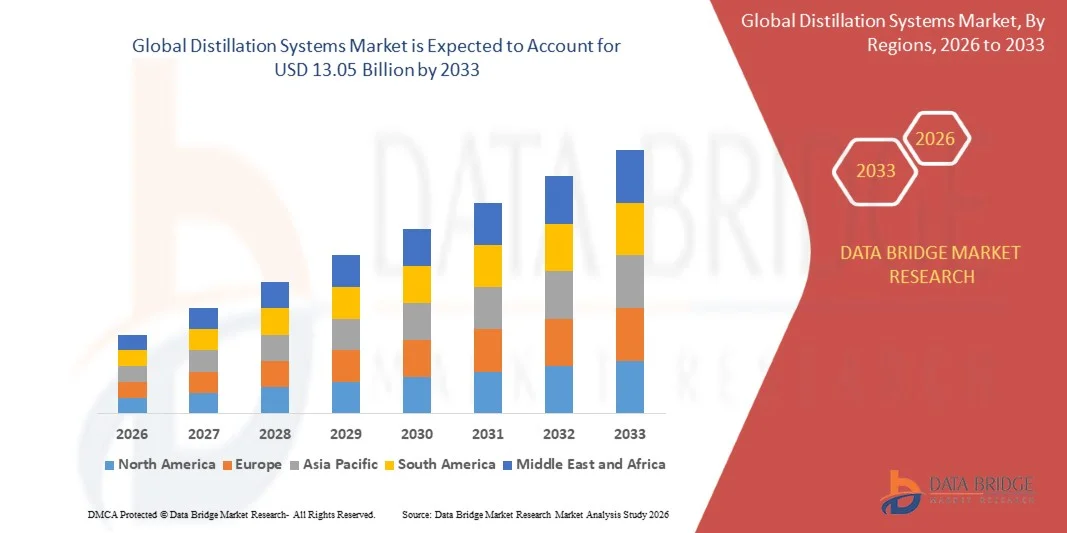
- As per Data Bridge Market Research analysis, the global distillation systems market size was valued at USD 8.76 billion in 2025 and is expected to reach USD 13.05 billion by 2033, at a CAGR of 5.10% during the forecast period
- The development of industrial activities worldwide is the major factor accelerating the growth of the distillation systems market
- Furthermore, need for water distillation alcohol purification, encouragement by numerous governments and stringent laws imposed on emission of wastewater is also expected to drive the growth of the distillation systems market
Market Size & Forecast
- Global Market Value (2025): USD 8.76 billion
- Expected Market Value (2033): USD 13.05 billion
- Forecast CAGR (2026-2033): 5.10%
What are the Major Takeaways of Distillation Systems Market?
- Growth of alternative technologies restrains the distillation systems market, whereas, Stringent regulations will challenge the growth of distillation systems market
- In addition, developing economies, urbanization and developing new towns and cities will create ample opportunities for the distillation systems market
- Asia-Pacific dominated the distillation systems market with a 41.87% revenue share in 2025, driven by rapid industrialization, strong growth in petrochemical refining, pharmaceutical production, water treatment infrastructure, and expanding food & beverage processing industries across China, India, Japan, South Korea, and Southeast Asia
- North America is projected to register the fastest CAGR of 10.74% from 2026 to 2033, driven by rising investments in refinery upgrades, biofuel production, wastewater treatment, and pharmaceutical manufacturing across the U.S. and Canada
- The Plates & Packings segment dominated the market with a 29.8% share in 2025, owing to its critical role in improving vapor-liquid contact efficiency, separation performance, and throughput across industrial distillation columns
Report Scope and Distillation Systems Market Segmentation
|
Attributes |
Distillation Systems Key Market Insights |
|
Segments Covered |
|
|
Countries Covered |
North America
Europe
Asia-Pacific
Middle East and Africa
South America
|
|
Key Market Players |
|
|
Market Opportunities |
|
|
Value Added Data Infosets |
In addition to the insights on market scenarios such as market value, growth rate, segmentation, geographical coverage, and major players, the market reports curated by the Data Bridge Market Research also include in-depth expert analysis, pricing analysis, brand share analysis, consumer survey, demography analysis, supply chain analysis, value chain analysis, raw material/consumables overview, vendor selection criteria, PESTLE Analysis, Porter Analysis, and regulatory framework. |
What is the Key Trend in the Distillation Systems Market?
“Increasing Shift Toward Energy-Efficient, Automated, and Smart Distillation Systems”
- The distillation systems market is witnessing strong adoption of energy-efficient and automated separation technologies designed to support petroleum refining, chemical processing, pharmaceuticals, food & beverage, water treatment, and biofuel production. Rising focus on thermal efficiency and process optimization is significantly driving demand
- Manufacturers are increasingly introducing advanced fractional, vacuum, steam, and multiple-effect distillation systems integrated with IoT-based monitoring, AI-driven predictive maintenance, and automated control systems to improve operational precision and reduce downtime
- Growing demand for cost-efficient, compact, and high-throughput separation systems is driving usage across chemical plants, refineries, pharmaceutical manufacturing units, desalination plants, and industrial wastewater treatment facilities
- For instance, companies such as GEA Group, Sulzer, Alfa Laval, SPX Flow, and Praj Industries are focusing on advanced heat integration, structured packing, and automated column systems to improve energy savings and separation efficiency
- Increasing need for low-energy consumption, reduced emissions, and sustainable process technologies is accelerating the shift toward smart, digitally controlled distillation systems
- As industrial processing becomes more complex and sustainability-focused, distillation systems will remain vital for high-purity separation, solvent recovery, and large-scale industrial purification applications
What are the Key Drivers of Distillation Systems Market?
- Rising demand for efficient separation and purification technologies across petrochemicals, pharmaceuticals, water treatment, and biofuel industries is a major driver of market growth
- For instance, in 2025, leading companies have accelerated investments in automated, energy-saving distillation units to support growing industrial throughput and sustainability targets
- Growing adoption of desalination techniques, industrial solvent recovery, ethanol production, and wastewater treatment systems is significantly boosting market demand across the U.S., Europe, and Asia-Pacific
- Advancements in heat recovery, thermal integration, structured packing, and AI-based process control have strengthened system efficiency, reduced operating costs, and improved reliability
- Rising use of biofuels and green industrial processes is creating strong demand for high-performance distillation systems globally
- Supported by steady investments in industrial modernization, environmental compliance, and process optimization, the Distillation Systems market is expected to witness strong long-term growth
Which Factor is Challenging the Growth of the Distillation Systems Market?
- High costs associated with advanced vacuum, fractional, and automated distillation systems restrict adoption among small and medium-scale manufacturers
- For instance, fluctuations in energy prices, high installation expenses, and rising maintenance costs continue to increase the total cost of ownership for end users
- Complexity in handling high-temperature, high-pressure, and multi-stage separation processes increases the need for skilled operators and technical expertise
- Limited awareness in emerging markets regarding advanced process optimization technologies and smart distillation capabilities slows adoption
- Competition from alternative separation technologies such as membrane filtration, adsorption, and extraction systems create pricing pressure and reduces product differentiation
- To address these issues, companies are focusing on energy-efficient designs, automation, operator training, and hybrid separation solutions to increase global adoption of distillation systems
How is the Distillation Systems Market Segmented?
The market is segmented on the basis of component, technique, type, application, operation, and process.
• By Component
On the basis of component, the distillation systems market is segmented into Column Shells, Plates & Packings, Reboilers & Heaters, Condensers, and Others. The Plates & Packings segment dominated the market with a 29.8% share in 2025, owing to its critical role in improving vapor-liquid contact efficiency, separation performance, and throughput across industrial distillation columns. These components are extensively used in petroleum refining, chemical processing, and pharmaceutical production due to their ability to enhance mass transfer efficiency and reduce energy consumption. Growing adoption of structured packings and advanced tray designs in modern industrial plants is further driving segment dominance.
The Reboilers & Heaters segment is expected to grow at the fastest CAGR from 2026 to 2033, driven by rising demand for energy-efficient heating systems, process optimization, and industrial capacity expansions across refineries and chemical plants.
• By Technique
On the basis of technique, the market is segmented into Fractional, Steam, Vacuum, Multiple Effect, and Others. The Fractional distillation segment dominated the market with a 34.6% share in 2025, supported by its widespread use in petroleum refining, solvent recovery, and chemical separation processes. Fractional distillation offers high separation efficiency for multicomponent mixtures and remains essential across industrial applications.
The Multiple Effect segment is projected to grow at the fastest CAGR from 2026 to 2033, due to increasing demand for low-energy consumption systems in water treatment, food processing, and pharmaceutical industries.
• By Type
On the basis of type, the distillation systems market is segmented into Pot Still and Column Still. The Column Still segment dominated the market with a 63.2% share in 2025, owing to its continuous processing capability, high throughput, and widespread deployment in large-scale industrial operations. Column stills are extensively used in refineries, chemical plants, and beverage production facilities.
The Pot Still segment is expected to grow at the fastest CAGR from 2026 to 2033, driven by increasing demand from premium beverage distillation, specialty chemicals, and small-batch pharmaceutical processing.
• By Application
On the basis of application, the market is segmented into Petroleum & Biorefineries, Water Treatment, Food, Beverages, Pharmaceuticals, Cosmetics, and Chemicals. The Petroleum & Biorefineries segment dominated the market with a 31.9% share in 2025, driven by strong demand for crude oil separation, fuel purification, and biofuel production.
The Pharmaceuticals segment is expected to grow at the fastest CAGR from 2026 to 2033, propelled by rising demand for solvent recovery, active ingredient purification, and high-purity process systems.
• By Operation
On the basis of operation, the market is segmented into Continuous and Batch. The Continuous segment dominated the market with a 68.4% share in 2025, due to its high efficiency, lower operating cost, and suitability for large-scale industrial production.
The Batch segment is projected to grow at the fastest CAGR from 2026 to 2033, supported by increasing use in specialty chemicals, food flavors, and pharmaceutical applications.
• By Process
On the basis of process, the distillation systems market is segmented into Multicomponent and Binary. The Multicomponent segment dominated the market with a 57.7% share in 2025, driven by its extensive use in complex industrial separations involving multiple compounds.
The Binary segment is expected to grow at the fastest CAGR from 2026 to 2033, owing to rising use in laboratory, pharmaceutical, and specialty chemical processes requiring precise separation control.
Which Region Holds the Largest Share of the Distillation Systems Market?
- Asia-Pacific dominated the distillation systems market with a 41.87% revenue share in 2025, driven by rapid industrialization, strong growth in petrochemical refining, pharmaceutical production, water treatment infrastructure, and expanding food & beverage processing industries across China, India, Japan, South Korea, and Southeast Asia. Rising investments in chemical manufacturing, specialty solvents, and industrial separation technologies continue to fuel demand for advanced distillation systems across large-scale processing plants, refineries, and manufacturing facilities
- Leading companies across Asia-Pacific are introducing energy-efficient, automated, and high-throughput distillation columns, condensers, and multi-effect systems, strengthening the region’s technological advantage. Continuous investment in industrial automation, process optimization, and sustainable manufacturing supports long-term market expansion
- High industrial output, strong manufacturing ecosystems, and sustained capital investment in process industries further reinforce regional market leadership
China Distillation Systems Market Insight
China is the largest contributor in Asia-Pacific, supported by strong petrochemical expansion, large-scale chemical processing infrastructure, and extensive deployment of industrial separation equipment across refining, pharmaceutical, and specialty chemical sectors. Increasing production of solvents, fuels, industrial chemicals, and purified water systems intensifies demand for advanced distillation systems with high thermal efficiency and process control capabilities. Presence of major manufacturing clusters and large-scale refinery projects further drives market growth.
India Distillation Systems Market Insight
India contributes significantly to regional growth, driven by expanding pharmaceutical production, rising refinery modernization projects, and growing investments in ethanol, chemicals, and water treatment plants. Distillation systems are increasingly utilized in API manufacturing, beverage processing, and industrial solvent recovery. Government-backed industrial development and strong demand from the process manufacturing sector continue to strengthen market adoption across the country.
Japan Distillation Systems Market Insight
Japan shows steady growth supported by advanced chemical manufacturing, precision industrial processing, and continuous modernization of pharmaceutical and electronics chemical production facilities. Strong focus on process efficiency, product purity, and energy optimization drives adoption of premium distillation technologies. Increasing need for high-purity separation systems and specialty chemicals reinforces long-term market expansion.
North America Distillation Systems Market
North America is projected to register the fastest CAGR of 10.74% from 2026 to 2033, driven by rising investments in refinery upgrades, biofuel production, wastewater treatment, and pharmaceutical manufacturing across the U.S. and Canada. Growing adoption of automated process control systems, energy-efficient column designs, and continuous batch operations is accelerating demand for advanced distillation systems across industrial applications.
U.S. Distillation Systems Market Insight
The U.S. is the largest contributor in North America, supported by strong presence of petroleum refineries, biorefineries, chemical plants, and pharmaceutical manufacturers. Increasing development in sustainable fuel processing, solvent recovery, and industrial purification technologies intensifies demand for high-capacity distillation systems. Presence of advanced engineering companies and high demand for process optimization solutions further drives market growth.
Canada Distillation Systems Market Insight
Canada contributes significantly due to rising investments in energy processing, industrial water treatment, and chemical manufacturing. Growing demand for distillation equipment in oil & gas, specialty chemicals, and beverage processing supports market expansion. Strong industrial infrastructure and increasing focus on sustainable process technologies continue to strengthen regional growth.
Which are the Top Companies in Distillation Systems Market?
The distillation systems industry is primarily led by well-established companies, including:
- GEA Group AG (Germany)
- Pilodist (Germany)
- Larsen & Toubro Ltd. (India)
- Robert Bosch Packaging Technology GmbH (Germany)
- Praj Industries (India)
- Sulzer Ltd. (Switzerland)
- RPM International Inc. (U.S.)
- Pidilite Industries Ltd (India)
- Fosroc (U.K.)
- Chryso SAS (France)
- CAC (China)
- Shandong Wanshan Chemicals (China)
- Sakshi Chem Science (India)
- SPX Flow (U.S.)
- Alfa Laval AB (Sweden)
- GTC Technology US LLC (U.S.)
- Lantec Products Inc. (U.S.)
- FENIX Process Technologies Pvt. Ltd. (India)
- Kevin Enterprises Pvt. Ltd. (India)
- HAT International Ltd. (India)
- Tianjin Univtech Co. Ltd. (China)
- Anton Paar GmbH (Austria)
- Core Laboratories (Netherlands)
What are the Recent Developments in Global Distillation Systems Market?
- In April 2025, PAC, a global leader in analytical instrumentation with more than 5,000 distillation instruments installed worldwide, introduced OptiDist 2, establishing a new benchmark in atmospheric distillation technology. The system offers superior precision, improved operational efficiency, and enhanced reliability through its patented thermosiphon cooling system, advanced safety features, and seamless PACe integration for optimized laboratory performance, thereby strengthening PAC’s leadership in high-performance distillation solutions and supporting future market innovation
- In September 2024, Sulzer launched VoltaSplit, its advanced electrified distillation solution designed to significantly improve energy efficiency while reducing direct CO2 emissions. By replacing conventional steam boilers with electricity-based operations, the system is capable of cutting emissions from distillation units by up to 90%, thereby helping process industries meet sustainability goals, improve compliance, and enhance long-term operational efficiency
- In March 2024, Prospero Equipment Corporation collaborated with Barison Industry to introduce a revolutionary continuous distillation system aimed at improving process consistency and throughput across industrial applications, thereby reinforcing technological advancement and expanding adoption of continuous processing solutions in the distillation systems market

- Interactive Data Analysis Dashboard
- Company Analysis Dashboard for high growth potential opportunities
- Research Analyst Access for customization & queries
- Competitor Analysis with Interactive dashboard
- Latest News, Updates & Trend analysis
- Harness the Power of Benchmark Analysis for Comprehensive Competitor Tracking
Global Distillation Systems Market, Supply Chain Analysis and Ecosystem Framework
To support market growth and help clients navigate the impact of geopolitical shifts, DBMR has integrated in-depth supply chain analysis into its Global Distillation Systems Market research reports. This addition empowers clients to respond effectively to global changes affecting their industries. The supply chain analysis section includes detailed insights such as Global Distillation Systems Market consumption and production by country, price trend analysis, the impact of tariffs and geopolitical developments, and import and export trends by country and HSN code. It also highlights major suppliers with data on production capacity and company profiles, as well as key importers and exporters. In addition to research, DBMR offers specialized supply chain consulting services backed by over a decade of experience, providing solutions like supplier discovery, supplier risk assessment, price trend analysis, impact evaluation of inflation and trade route changes, and comprehensive market trend analysis.
Data collection and base year analysis are done using data collection modules with large sample sizes. The stage includes obtaining market information or related data through various sources and strategies. It includes examining and planning all the data acquired from the past in advance. It likewise envelops the examination of information inconsistencies seen across different information sources. The market data is analysed and estimated using market statistical and coherent models. Also, market share analysis and key trend analysis are the major success factors in the market report. To know more, please request an analyst call or drop down your inquiry.
The key research methodology used by DBMR research team is data triangulation which involves data mining, analysis of the impact of data variables on the market and primary (industry expert) validation. Data models include Vendor Positioning Grid, Market Time Line Analysis, Market Overview and Guide, Company Positioning Grid, Patent Analysis, Pricing Analysis, Company Market Share Analysis, Standards of Measurement, Global versus Regional and Vendor Share Analysis. To know more about the research methodology, drop in an inquiry to speak to our industry experts.
Data Bridge Market Research is a leader in advanced formative research. We take pride in servicing our existing and new customers with data and analysis that match and suits their goal. The report can be customized to include price trend analysis of target brands understanding the market for additional countries (ask for the list of countries), clinical trial results data, literature review, refurbished market and product base analysis. Market analysis of target competitors can be analyzed from technology-based analysis to market portfolio strategies. We can add as many competitors that you require data about in the format and data style you are looking for. Our team of analysts can also provide you data in crude raw excel files pivot tables (Fact book) or can assist you in creating presentations from the data sets available in the report.













