Global Disposable Medical Device Strip Sensors Market
Market Size in USD Billion
CAGR :
% 
 USD
3.50 Billion
USD
6.57 Billion
2025
2033
USD
3.50 Billion
USD
6.57 Billion
2025
2033
 Forecast Period Forecast Period |
2026 –2033 |
 Market Size (Base Year) Market Size (Base Year) |
USD 3.50 Billion |
 Market Size (Forecast Year) Market Size (Forecast Year) |
USD 6.57 Billion |
 CAGR CAGR |
% |
| Major Markets Players |
|
Disposable Medical Device Strip Sensors Market Size
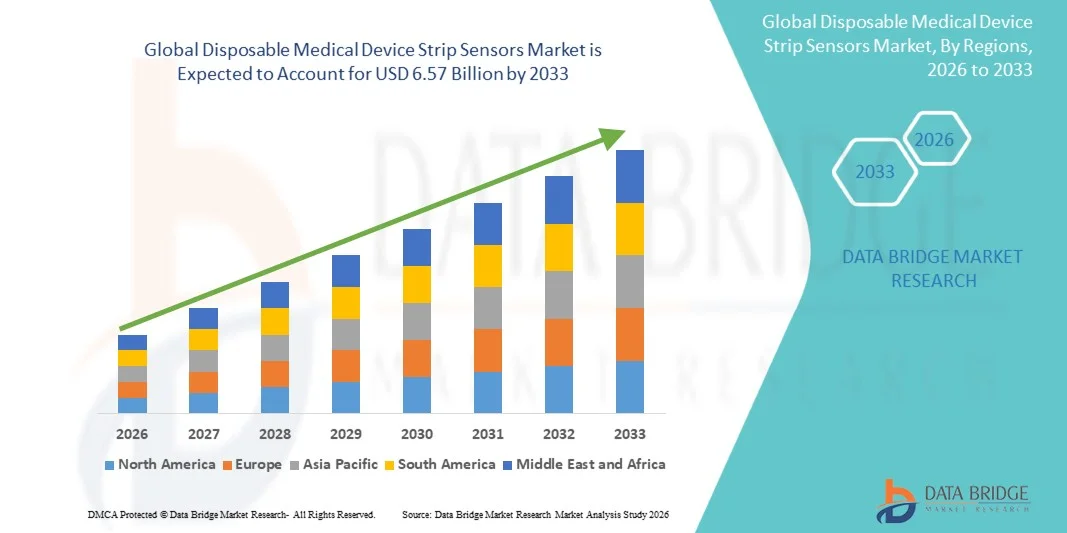
- The global disposable medical device strip sensors market size was valued at USD 3.50 billion in 2025 and is expected to reach USD 6.57 billion by 2033, at a CAGR of 8.21% during the forecast period
- The market growth is largely fueled by the increasing prevalence of chronic diseases such as diabetes, rising adoption of point-of-care diagnostic devices, and continuous technological advancements in disposable biosensor technologies, leading to improved accuracy, faster results, and greater accessibility of home-based health monitoring solutions
- Furthermore, growing patient preference for convenient, single-use diagnostic tools, expanding use of wearable and connected health monitoring devices, and rising demand from hospitals and home-care settings are establishing disposable medical device strip sensors as essential components of modern diagnostic systems. These converging factors are accelerating the uptake of Disposable Medical Device Strip Sensors solutions, thereby significantly boosting the industry’s growth
Disposable Medical Device Strip Sensors Market Analysis
- Disposable medical device strip sensors, widely used in glucose monitoring, pregnancy testing, infectious disease diagnostics, and point-of-care testing, are increasingly vital components of modern healthcare due to their ease of use, rapid results, accuracy, and suitability for both clinical and home-based diagnostic settings
- The escalating demand for disposable medical device strip sensors is primarily fueled by the rising prevalence of chronic diseases such as diabetes, growing adoption of home healthcare and self-monitoring devices, and increasing emphasis on early diagnosis and preventive care through point-of-care testing solutions
- North America dominated the disposable medical device strip sensors market with the largest revenue share of approximately 39.4% in 2025, characterized by high adoption of home diagnostics, advanced healthcare infrastructure, strong reimbursement frameworks, and the presence of leading diagnostic device manufacturers, with the U.S. witnessing substantial growth driven by widespread use of glucose monitoring strips and rapid test kits
- Asia-Pacific is expected to be the fastest-growing region in the disposable medical device strip sensors market during the forecast period, driven by increasing healthcare expenditure, rising incidence of chronic and infectious diseases, expanding access to diagnostic testing, and growing adoption of affordable point-of-care solutions across emerging economies such as China and India
- The diagnostic testing segment accounted for the largest market revenue share of 46.9% in 2025, primarily driven by the high volume usage of disposable sensor strips in routine and emergency diagnostics
Report Scope and Disposable Medical Device Strip Sensors Market Segmentation
|
Attributes |
Disposable Medical Device Strip Sensors Key Market Insights |
|
Segments Covered |
|
|
Countries Covered |
North America
Europe
Asia-Pacific
Middle East and Africa
South America
|
|
Key Market Players |
|
|
Market Opportunities |
|
|
Value Added Data Infosets |
In addition to the insights on market scenarios such as market value, growth rate, segmentation, geographical coverage, and major players, the market reports curated by the Data Bridge Market Research also include in-depth expert analysis, patient epidemiology, pipeline analysis, pricing analysis, and regulatory framework. |
Disposable Medical Device Strip Sensors Market Trends
“Advancements in High-Sensitivity and Rapid-Response Biosensor Technologies”
- A significant and accelerating trend in the global disposable medical device strip sensors market is the development of high-sensitivity biosensor technologies designed to deliver faster and more accurate diagnostic results at the point of care
- Manufacturers are increasingly focusing on electrochemical and optical sensing technologies that enable precise detection of biomarkers in small sample volumes, improving diagnostic reliability in home-care and clinical settings
- For instance, next-generation glucose monitoring strip sensors are being developed with improved enzyme stability and enhanced electrode design to ensure consistent readings even under varying environmental conditions
- The integration of improved reagent coatings and microfluidic channel designs is also enabling quicker sample absorption and shorter test processing times, enhancing user convenience and clinical efficiency
- Furthermore, the rising adoption of disposable strip sensors in decentralized testing environments such as home monitoring, outpatient clinics, and emergency care settings is encouraging continuous product innovation focused on portability and ease of use
- This shift toward rapid, accurate, and easy-to-use disposable diagnostic strips is reshaping diagnostic practices, supporting early disease detection and improved chronic disease management globally
Disposable Medical Device Strip Sensors Market Dynamics
Driver
“Rising Prevalence of Chronic Diseases and Growth in Point-of-Care Testing”
- The increasing global prevalence of chronic conditions such as diabetes, cardiovascular diseases, and infectious diseases is a major driver accelerating demand for disposable medical device strip sensors
- For instance, the growing diabetic population worldwide has significantly increased the use of disposable glucose test strips for routine blood sugar monitoring in both home-care and hospital environments
- The expansion of point-of-care testing (POCT) programs across healthcare systems is further driving demand, as disposable strip sensors enable rapid diagnostic results without the need for centralized laboratory infrastructure
- Increasing awareness of preventive healthcare and self-monitoring practices is also encouraging patients to adopt easy-to-use diagnostic strips for regular health assessment
- In addition, improvements in healthcare accessibility in emerging economies and the expansion of retail pharmacy diagnostic services are supporting steady market growth across diverse patient populations
Restraint/Challenge
“Cost Sensitivity and Accuracy Variability Concerns”
- Cost sensitivity associated with recurring purchases of disposable strip sensors presents a key challenge, particularly for patients requiring frequent daily testing over long periods
- For instance, individuals requiring multiple daily glucose monitoring tests may face substantial long-term expenses, limiting consistent adoption in price-sensitive regions without adequate reimbursement support
- Variability in sensor accuracy due to improper storage conditions, environmental factors, or inconsistent manufacturing quality can also impact test reliability, raising concerns among healthcare providers and patients
- Regulatory requirements for maintaining high accuracy and performance standards further increase compliance costs for manufacturers, influencing pricing structures in competitive markets
- Addressing these challenges through improved manufacturing consistency, expanded reimbursement coverage, and development of cost-efficient high-precision strip technologies will be essential for sustained growth in the Disposable Medical Device Strip Sensors market
Disposable Medical Device Strip Sensors Market Scope
The market is segmented on the basis of product, application, and end user.
• By Product
On the basis of product, the Global Disposable Medical Device Strip Sensors market is segmented into Biosensors, Accelerometers, Pressure Sensors, Temperature Sensors, Image Sensors, and Other Sensors. The biosensors segment dominated the market with a revenue share of 41.6% in 2025, driven by their extensive use in diagnostic testing and point-of-care applications. Disposable biosensor strips are widely used in glucose monitoring, infectious disease detection, and cardiac marker testing due to their high sensitivity, rapid response time, and cost-effectiveness. The increasing prevalence of chronic diseases such as diabetes and cardiovascular disorders has significantly boosted biosensor demand. Widespread adoption of home-based diagnostics and self-monitoring devices further strengthens segment dominance. Technological advancements enabling higher accuracy and miniaturization of biosensor strips also contribute to growth. Favorable regulatory approvals for disposable diagnostic devices support large-scale adoption. Hospitals and diagnostic labs continue to prefer biosensor strips due to reduced cross-contamination risks. Growing emphasis on early disease detection fuels consistent usage volumes. Increasing healthcare expenditure in emerging economies further supports demand. Strong manufacturing scalability and established supply chains enhance availability. Continuous innovation in electrochemical and enzymatic biosensors sustains replacement demand. As diagnostics remain a core healthcare priority, biosensors are expected to maintain their leading position.
The pressure sensors segment is expected to witness the fastest growth, registering a CAGR of 9.8% from 2026 to 2033, driven by rising adoption in patient monitoring and therapeutic applications. Disposable pressure sensor strips are increasingly used in respiratory monitoring, wound care, and minimally invasive procedures. Growth in intensive care admissions and post-operative monitoring requirements significantly fuels demand. Technological improvements enabling high-precision, flexible, and low-cost disposable pressure sensors support rapid adoption. Increasing use in wearable and remote patient monitoring devices further accelerates growth. Hospitals are increasingly adopting disposable pressure sensors to reduce infection risks associated with reusable devices. Expansion of home healthcare and telemedicine services also contributes to rising demand. Growing awareness of pressure injury prevention in hospitalized patients supports clinical adoption. Favorable reimbursement policies for monitoring devices enhance market penetration. Manufacturers’ focus on integrating pressure sensors with digital health platforms further drives innovation. Rising aging population globally increases monitoring needs. These factors collectively position pressure sensors as the fastest-growing product segment.
• By Application
On the basis of application, the Disposable Medical Device Strip Sensors market is segmented into Diagnostic Testing, Patient Monitoring, Therapeutics, and Imaging. The diagnostic testing segment accounted for the largest market revenue share of 46.9% in 2025, primarily driven by the high volume usage of disposable sensor strips in routine and emergency diagnostics. Diagnostic strip sensors are widely used for glucose testing, infectious disease screening, pregnancy tests, and cardiac biomarker detection. Increasing demand for rapid, point-of-care diagnostic solutions significantly boosts segment dominance. The growing burden of chronic and infectious diseases globally drives frequent testing needs. Expansion of decentralized healthcare and home-based diagnostics further supports demand. Disposable diagnostic strips reduce contamination risks and eliminate the need for sterilization, making them highly preferred. Technological advancements improving test accuracy and turnaround time strengthen adoption. Government initiatives promoting early diagnosis and preventive healthcare also support growth. Rising healthcare awareness among patients encourages self-testing practices. Strong adoption across hospitals, clinics, and diagnostic centers ensures consistent demand. Continuous product innovation and regulatory approvals sustain market leadership. Diagnostic testing is expected to remain the dominant application throughout the forecast period.
The patient monitoring segment is projected to grow at the fastest rate, with a CAGR of 10.2% from 2026 to 2033, driven by the increasing shift toward continuous and remote patient monitoring. Disposable sensor strips are increasingly used for monitoring vital parameters such as temperature, pressure, and biochemical markers. Growing adoption of wearable medical devices and telehealth solutions significantly boosts demand. Rising geriatric population and increasing prevalence of chronic conditions necessitate long-term monitoring solutions. Hospitals are increasingly adopting disposable monitoring sensors to minimize hospital-acquired infections. Technological advancements enabling wireless data transmission and real-time analytics further enhance adoption. Expansion of home healthcare services also supports market growth. Favorable reimbursement for remote monitoring services in developed markets accelerates uptake. Increasing ICU admissions and post-operative monitoring needs strengthen demand. Integration of monitoring sensors with digital health platforms improves clinical outcomes. Growing investments in smart healthcare infrastructure further drive expansion. These factors collectively position patient monitoring as the fastest-growing application segment.
• By End User
On the basis of end user, the Disposable Medical Device Strip Sensors market is segmented into Hospitals and Clinics, Diagnostic Centers, and Ambulatory Surgical Centers. Hospitals and clinics dominated the market with a revenue share of 55.4% in 2025, driven by their high patient inflow and extensive use of disposable sensor strips across diagnostics and monitoring applications. Hospitals perform a wide range of procedures requiring frequent sensor usage, including emergency diagnostics, chronic disease management, and post-surgical monitoring. Strict infection control protocols encourage the adoption of single-use disposable sensors. Availability of advanced diagnostic and monitoring infrastructure further supports high consumption. Hospitals also benefit from bulk procurement agreements, ensuring steady supply and usage. Growing hospital admissions due to chronic illnesses and aging populations sustain demand. Government investments in hospital infrastructure in emerging economies strengthen market dominance. Increasing adoption of point-of-care testing within hospital settings boosts sensor utilization. Presence of skilled healthcare professionals ensures consistent procedural volumes. Integration of disposable sensors with hospital information systems enhances workflow efficiency. Strong reimbursement coverage for hospital-based diagnostics further supports usage. These factors ensure hospitals and clinics remain the dominant end-user segment.
Ambulatory Surgical Centers (ASCs) are expected to witness the fastest growth, expanding at a CAGR of 9.5% from 2026 to 2033, driven by the rapid shift toward outpatient surgical care. ASCs increasingly use disposable sensor strips for pre-operative diagnostics and intraoperative monitoring. Growth in minimally invasive procedures supports increased sensor adoption. Cost efficiency and shorter patient stays make ASCs attractive alternatives to hospitals. Rising investments in standalone surgical centers expand procedural volumes. Disposable sensors align well with ASC requirements for infection control and rapid turnover. Increasing patient preference for outpatient procedures further drives growth. Favorable reimbursement for outpatient surgeries in developed regions supports expansion. Technological advancements enabling compact diagnostic devices enhance ASC adoption. Growth in orthopedic, ophthalmic, and cosmetic surgeries contributes to demand. Expansion of private healthcare providers establishing ASCs accelerates market penetration. These combined factors position ASCs as the fastest-growing end-user segment.
Disposable Medical Device Strip Sensors Market Regional Analysis
- North America dominated the disposable medical device strip sensors market with the largest revenue share of approximately 39.4% in 2025
- Characterized by high adoption of home diagnostics, advanced healthcare infrastructure, strong reimbursement frameworks, and the presence of leading diagnostic device manufacturers
- The region’s strong focus on chronic disease management, particularly diabetes monitoring, along with the widespread availability of retail and home-based testing solutions, continues to drive significant demand for disposable strip sensors across healthcare and home-care settings.
U.S. Disposable Medical Device Strip Sensors Market Insight
The U.S. disposable medical device strip sensors market captured the largest revenue share within North America in 2025, driven by the widespread use of glucose monitoring strips, infectious disease rapid test strips, and other point-of-care diagnostic sensors. Increasing healthcare spending, strong insurance coverage for chronic disease testing, and rising patient adoption of home-based monitoring technologies are further accelerating market expansion. Additionally, the presence of major diagnostic device manufacturers and continuous technological advancements in biosensor accuracy and usability are supporting sustained growth in the country.
Europe Disposable Medical Device Strip Sensors Market Insight
The Europe disposable medical device strip sensors market is projected to expand at a substantial CAGR throughout the forecast period, primarily driven by increasing adoption of point-of-care testing, expanding chronic disease screening programs, and strong regulatory emphasis on early disease detection. The region’s well-established healthcare systems and growing focus on preventive healthcare practices are encouraging hospitals, clinics, and home-care providers to utilize disposable diagnostic strip sensors for rapid testing applications.
U.K. Disposable Medical Device Strip Sensors Market Insight
The U.K. disposable medical device strip sensors market is anticipated to grow at a noteworthy CAGR during the forecast period, driven by expanding diagnostic screening initiatives, increasing prevalence of diabetes and cardiovascular conditions, and rising adoption of home-based diagnostic testing solutions. Government-supported healthcare programs promoting routine disease monitoring are further strengthening market demand.
Germany Disposable Medical Device Strip Sensors Market Insight
The Germany disposable medical device strip sensors market is expected to expand at a considerable CAGR during the forecast period, fueled by the country’s advanced healthcare infrastructure, growing aging population, and increasing utilization of point-of-care diagnostic technologies across hospitals and outpatient care facilities. Strong regulatory standards supporting accurate diagnostic testing and high healthcare spending are also contributing to sustained market growth.
Asia-Pacific Disposable Medical Device Strip Sensors Market Insight
The Asia-Pacific disposable medical device strip sensors market is expected to be the fastest-growing region during the forecast period, driven by increasing healthcare expenditure, rising incidence of chronic and infectious diseases, expanding access to diagnostic testing, and growing adoption of affordable point-of-care solutions across emerging economies such as China and India. Rapid expansion of healthcare infrastructure and rising awareness regarding early disease detection are significantly accelerating regional demand.
Japan Disposable Medical Device Strip Sensors Market Insight
The Japan disposable medical device strip sensors market is gaining momentum due to the country’s aging population, strong emphasis on preventive healthcare, and high adoption of home-based disease monitoring solutions. Increasing demand for reliable glucose monitoring and rapid diagnostic testing is supporting steady market growth.
China Disposable Medical Device Strip Sensors Market Insight
The China disposable medical device strip sensors market accounted for the largest market revenue share in Asia-Pacific in 2025, attributed to expanding healthcare coverage, growing prevalence of chronic diseases, increasing domestic production of diagnostic devices, and strong government initiatives promoting affordable point-of-care testing solutions across urban and rural healthcare systems.
Disposable Medical Device Strip Sensors Market Share
The Disposable Medical Device Strip Sensors industry is primarily led by well-established companies, including:
- Abbott (U.S.)
- F. Hoffmann-La Roche Ltd. (Switzerland)
- Siemens Healthineers (Germany)
- Medtronic plc (Ireland)
- GE HealthCare (U.S.)
- Honeywell International Inc. (U.S.)
- TE Connectivity Ltd. (Switzerland)
- NXP Semiconductors N.V. (Netherlands)
- STMicroelectronics N.V. (Switzerland)
- Texas Instruments Incorporated (U.S.)
- Analog Devices, Inc. (U.S.)
- Sensirion AG (Switzerland)
- Amphenol Corporation (U.S.)
- Omron Corporation (Japan)
- Panasonic Holdings Corporation (Japan)
- Smiths Medical (U.S.)
- Nova Biomedical (U.S.)
- Dexcom, Inc. (U.S.)
- Ascensia Diabetes Care (Switzerland)
- ARKRAY, Inc. (Japan)
Latest Developments in Global Disposable Medical Device Strip Sensors Market
- In May 2022, Abbott Laboratories, a leading global healthcare company, announced that the FreeStyle Libre 3 continuous glucose monitoring (CGM) sensor received U.S. FDA clearance. The next-generation disposable glucose sensor was designed to be the smallest and thinnest CGM sensor, capable of delivering real-time glucose readings directly to a smartphone every minute. The system also integrates with digital platforms such as LibreView and LibreLinkUp to enable remote patient monitoring and caregiver connectivity. This development strengthened Abbott’s leadership in biosensor-based disposable glucose monitoring technologies and accelerated the global adoption of advanced sensor-based diabetes management solutions
- In December 2022, Dexcom, a leading manufacturer of continuous glucose monitoring systems, received U.S. FDA clearance for its Dexcom G7 CGM system, a next-generation wearable disposable glucose biosensor integrating the sensor and transmitter into a single compact device. The system was designed to deliver faster warm-up times, improved accuracy, and simplified insertion procedures, supporting enhanced patient convenience and expanding the adoption of disposable glucose sensor technologies across diabetes care settings
- In April 2024, Senseonics Holdings, in partnership with Ascensia Diabetes Care, announced that the Eversense 365 continuous glucose monitoring system received U.S. FDA approval, becoming the first CGM system offering up to one year of continuous glucose monitoring with implantable sensor technology supported by disposable wearable transmitters. The approval represented a significant advancement in long-duration glucose sensing technologies, highlighting ongoing innovation in advanced implantable and disposable sensor ecosystems for diabetes monitoring
- In November 2025, Abbott Laboratories issued a global medical device correction for certain FreeStyle Libre 3 and Libre 3 Plus disposable glucose sensors after identifying potential risks of inaccurate low glucose readings linked to a specific production line. The company replaced affected sensors and implemented manufacturing corrections while continuing production, underscoring the importance of quality assurance and post-market surveillance in disposable biosensor manufacturing
SKU-
Get online access to the report on the World's First Market Intelligence Cloud
- Interactive Data Analysis Dashboard
- Company Analysis Dashboard for high growth potential opportunities
- Research Analyst Access for customization & queries
- Competitor Analysis with Interactive dashboard
- Latest News, Updates & Trend analysis
- Harness the Power of Benchmark Analysis for Comprehensive Competitor Tracking
Research Methodology
Data collection and base year analysis are done using data collection modules with large sample sizes. The stage includes obtaining market information or related data through various sources and strategies. It includes examining and planning all the data acquired from the past in advance. It likewise envelops the examination of information inconsistencies seen across different information sources. The market data is analysed and estimated using market statistical and coherent models. Also, market share analysis and key trend analysis are the major success factors in the market report. To know more, please request an analyst call or drop down your inquiry.
The key research methodology used by DBMR research team is data triangulation which involves data mining, analysis of the impact of data variables on the market and primary (industry expert) validation. Data models include Vendor Positioning Grid, Market Time Line Analysis, Market Overview and Guide, Company Positioning Grid, Patent Analysis, Pricing Analysis, Company Market Share Analysis, Standards of Measurement, Global versus Regional and Vendor Share Analysis. To know more about the research methodology, drop in an inquiry to speak to our industry experts.
Customization Available
Data Bridge Market Research is a leader in advanced formative research. We take pride in servicing our existing and new customers with data and analysis that match and suits their goal. The report can be customized to include price trend analysis of target brands understanding the market for additional countries (ask for the list of countries), clinical trial results data, literature review, refurbished market and product base analysis. Market analysis of target competitors can be analyzed from technology-based analysis to market portfolio strategies. We can add as many competitors that you require data about in the format and data style you are looking for. Our team of analysts can also provide you data in crude raw excel files pivot tables (Fact book) or can assist you in creating presentations from the data sets available in the report.