Global Dimethyl Ether Market
Market Size in USD Billion
CAGR :
% 
 USD
7.37 Billion
USD
23.12 Billion
2025
2033
USD
7.37 Billion
USD
23.12 Billion
2025
2033
 Forecast Period Forecast Period |
2026 - 2033 |
 Market Size (Base Year) Market Size (Base Year) |
USD 7.37 Billion |
 Market Size (Forecast Year) Market Size (Forecast Year) |
USD 23.12 Billion |
 CAGR CAGR |
% |
| Major Markets Players |
|
Dimethyl Ether Market Size
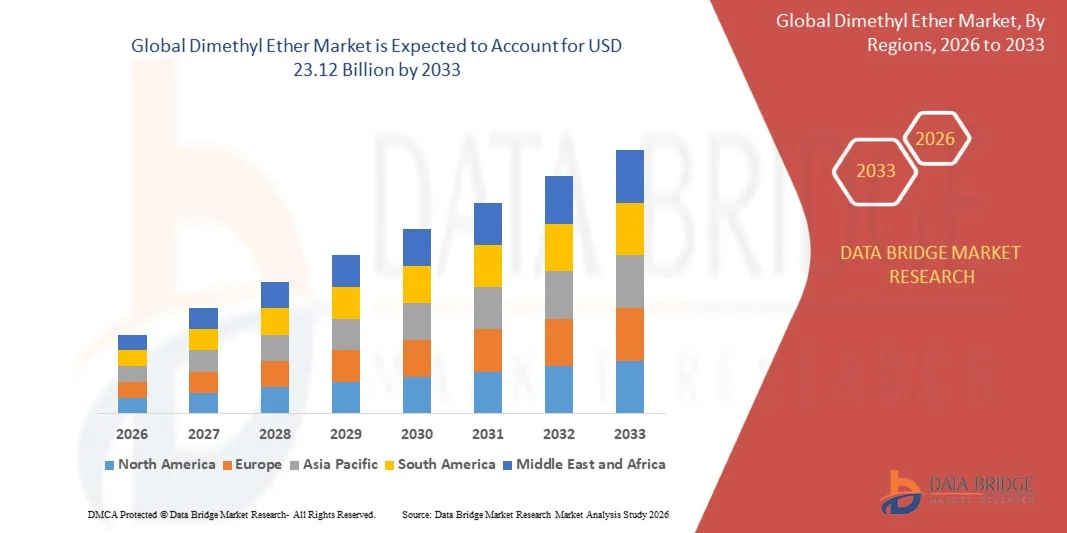
- The global dimethyl ether market size was valued at USD 7.37 billion in 2025 and is expected to reach USD 23.12 billion by 2033, at a CAGR of 15.40% during the forecast period
- The market growth is largely fuelled by the increasing demand for clean and alternative fuels, particularly in transportation and power generation
- Rising environmental regulations and government initiatives promoting low-emission fuels are accelerating adoption
Dimethyl Ether Market Analysis
- Dimethyl ether is gaining traction as a sustainable alternative to conventional fossil fuels due to its low carbon and particulate emissions
- Technological advancements in production processes, such as methanol-to-dimethyl ether (MTD) synthesis, are improving cost-efficiency and scalability
- North America dominated the dimethyl ether market with the largest revenue share of 38.75% in 2025, driven by high adoption of alternative fuels in transportation and industrial applications, along with strong government initiatives promoting low-emission energy solutions
- The Asia-Pacific region is expected to witness the highest growth rate in the global dimethyl ether market, driven by rapid industrialization, expanding transportation and energy sectors, government support for low-emission fuels, and growing investments in renewable and alternative energy infrastructure
- The Methanol segment held the largest market revenue share in 2025, driven by the well-established methanol-to-dimethyl ether (MTD) production process, high availability of methanol feedstock, and cost-effectiveness compared to other raw materials. Methanol-based dimethyl ether is widely used across transportation and industrial fuel applications, making it the preferred choice for large-scale production
Report Scope and Dimethyl Ether Market Segmentation
|
Attributes |
Dimethyl Ether Key Market Insights |
|
Segments Covered |
|
|
Countries Covered |
North America
Europe
Asia-Pacific
Middle East and Africa
South America
|
|
Key Market Players |
• China Energy Holdings Limited (China) |
|
Market Opportunities |
• Expansion Into Renewable Dimethyl Ether Production |
|
Value Added Data Infosets |
In addition to the insights on market scenarios such as market value, growth rate, segmentation, geographical coverage, and major players, the market reports curated by the Data Bridge Market Research also include import export analysis, production capacity overview, production consumption analysis, price trend analysis, climate change scenario, supply chain analysis, value chain analysis, raw material/consumables overview, vendor selection criteria, PESTLE Analysis, Porter Analysis, and regulatory framework. |
Dimethyl Ether Market Trends
“Rising Demand for Clean and Alternative Fuels”
• The growing focus on reducing carbon emissions and improving air quality is significantly shaping the dimethyl ether market, as governments, industries, and consumers increasingly prefer cleaner fuel alternatives to conventional diesel and LPG. Dimethyl ether is gaining traction due to its low sulfur content, high cetane number, and versatility across transportation and power generation applications. This trend strengthens its adoption across automotive, industrial, and energy sectors, encouraging manufacturers to expand production capacities and distribution networks
• Increasing environmental regulations and policies promoting low-emission fuels have accelerated the demand for dimethyl ether in countries pursuing net-zero and sustainable energy targets. Governments and regulatory authorities are incentivizing research, production, and adoption of alternative fuels, prompting collaborations between chemical producers, automotive companies, and energy providers to enhance infrastructure and ensure supply reliability
• Sustainability and energy efficiency trends are influencing investment decisions, with companies focusing on eco-friendly production processes, feedstock optimization, and lifecycle carbon reduction. These factors are helping manufacturers differentiate their offerings in a competitive market while also driving partnerships for research and development of innovative applications, such as in fuel cells and hybrid systems
• For instance, in 2024, ChemChina
(China) and Mitsubishi Chemical
(Japan) expanded their dimethyl ether production facilities to cater to growing demand in transportation and industrial fuel applications. These expansions were introduced in response to rising global preference for low-emission fuels, with distribution across industrial, commercial, and government energy projects
• While demand for dimethyl ether is growing, sustained market expansion depends on continuous technological advancements, cost-effective production methods, and infrastructure development to support widespread adoption. Manufacturers are also focusing on improving feedstock utilization, scaling production, and developing new applications to balance cost, efficiency, and environmental compliance for broader market penetration
Dimethyl Ether Market Dynamics
Driver
“Rising Focus on Clean and Alternative Fuels”
• Growing global initiatives to reduce greenhouse gas emissions and transition to low-carbon fuels is a major driver for the dimethyl ether market. Manufacturers and energy providers are increasingly investing in dimethyl ether production as a sustainable substitute for diesel and LPG, supporting emission reduction goals and energy diversification
• Expanding applications in transportation, power generation, and industrial energy are influencing market growth. Dimethyl ether offers advantages such as higher combustion efficiency, lower particulate emissions, and chemical versatility, enabling adoption across multiple sectors while aligning with environmental targets
• Companies are actively promoting dimethyl ether-based solutions through strategic partnerships, R&D investment, and infrastructure development. These efforts are supported by growing policy support and funding for alternative fuels, encouraging collaborations between energy companies, automotive manufacturers, and chemical producers
• For instance, in 2023, China National Offshore Oil Corporation (CNOOC) (China) and SK Gas (South Korea) reported increased utilization of dimethyl ether in industrial and transportation applications. This expansion followed regulatory incentives, rising adoption of low-emission fuels, and growing awareness of environmental sustainability, driving product differentiation and infrastructure investments
• Although rising demand for clean fuels supports growth, wider adoption depends on cost optimization, availability of feedstock, and scalable production processes. Investment in technology, efficient supply chains, and alternative feedstock utilization will be critical for meeting global demand and maintaining competitive advantage
Restraint/Challenge
“High Production Costs and Limited Infrastructure Compared to Conventional Fuels”
• The relatively higher production cost of dimethyl ether compared to conventional diesel and LPG remains a key challenge, limiting adoption among cost-sensitive industries. Higher feedstock costs, complex synthesis processes, and infrastructure requirements contribute to elevated pricing and slower uptake
• Market awareness and infrastructure for dimethyl ether remain limited in several regions, particularly in developing economies where fossil fuels dominate energy consumption. Lack of refueling stations, storage facilities, and transport networks restricts adoption and delays market penetration
• Supply chain and distribution challenges also impact market growth, as dimethyl ether requires specialized storage and handling due to its gaseous nature at ambient conditions. Logistical complexities and safety regulations increase operational costs, prompting companies to invest in infrastructure upgrades
• For instance, in 2024, distributors in India and Southeast Asia supplying dimethyl ether for industrial and transportation applications reported slower uptake due to higher production costs, limited refueling infrastructure, and regional policy constraints. These factors also led some energy providers to delay large-scale adoption, affecting market visibility and growth
• Overcoming these challenges will require cost-efficient production technologies, development of storage and distribution networks, and government incentives for infrastructure expansion. Collaboration with energy providers, automotive manufacturers, and regulatory bodies can help unlock the long-term growth potential of the global dimethyl ether market. Furthermore, developing alternative feedstock solutions and promoting environmental benefits will be essential for broader adoption
Dimethyl Ether Market Scope
The market is segmented on the basis of raw material, application, and end user.
• By Raw Material
On the basis of raw material, the dimethyl ether market is segmented into Coal, Methanol, Natural Gas, and Bio-Based Feedstock. The Methanol segment held the largest market revenue share in 2025, driven by the well-established methanol-to-dimethyl ether (MTD) production process, high availability of methanol feedstock, and cost-effectiveness compared to other raw materials. Methanol-based dimethyl ether is widely used across transportation and industrial fuel applications, making it the preferred choice for large-scale production.
The Bio-Based Feedstock segment is expected to witness the fastest growth rate from 2026 to 2033, fueled by the increasing demand for renewable and sustainable fuels. Bio-based dimethyl ether is gaining traction due to its low carbon footprint and alignment with global environmental regulations, making it a preferred option for eco-conscious energy applications.
• By Application
On the basis of application, the market is segmented into Aerosol Propellant, LPG Blending, Transportation Fuel, and Others. The Transportation Fuel segment held the largest market revenue share in 2025, supported by growing adoption in diesel engines, public transport fleets, and industrial vehicles as a clean and efficient alternative to conventional fuels.
The LPG Blending segment is expected to witness the fastest growth from 2026 to 2033, driven by increasing initiatives to reduce emissions from household and industrial LPG use. Blending dimethyl ether with LPG enhances fuel efficiency while lowering sulfur and particulate emissions, accelerating adoption in emerging economies.
• By End User
On the basis of end user, the market is segmented into Construction, Automobile, Pesticides, Textiles, Food Ingredients, and Others. The Automobile segment held the largest market revenue share in 2025, owing to the rising incorporation of dimethyl ether in diesel engines and hybrid fuel systems, supported by government policies promoting low-emission vehicles.
The Pesticides segment is expected to witness the fastest growth rate from 2026 to 2033, driven by increasing use of dimethyl ether as a propellant in eco-friendly agricultural formulations. Its non-toxic and low-emission characteristics make it suitable for safe pesticide application, expanding its adoption in sustainable farming practices.
Dimethyl Ether Market Regional Analysis
• North America dominated the dimethyl ether market with the largest revenue share of 38.75% in 2025, driven by high adoption of alternative fuels in transportation and industrial applications, along with strong government initiatives promoting low-emission energy solutions
• Industries and consumers in the region increasingly value dimethyl ether for its clean-burning properties, high energy efficiency, and versatility as a fuel and chemical intermediate
• This widespread adoption is further supported by well-established fuel infrastructure, strong regulatory support, and growing environmental awareness, positioning dimethyl ether as a preferred low-emission alternative across automotive, industrial, and energy sectors
U.S. Dimethyl Ether Market Insight
The U.S. dimethyl ether market captured the largest revenue share in 2025 within North America, fueled by increasing use of clean fuels in transportation and industrial power generation. The rising demand for low-sulfur, high-cetane fuels and government incentives for emission reduction are accelerating adoption. Furthermore, investments in production facilities and distribution networks, along with growing consumer and industrial awareness, continue to propel market growth.
Europe Dimethyl Ether Market Insight
The Europe dimethyl ether market is expected to witness the fastest growth rate from 2026 to 2033, primarily driven by stringent environmental regulations, carbon reduction targets, and the rising shift toward sustainable energy sources. Increasing urbanization and adoption of cleaner fuels in transportation and industrial sectors are fostering market expansion. European countries are also investing in infrastructure and research for large-scale production and utilization of dimethyl ether.
U.K. Dimethyl Ether Market Insight
The U.K. dimethyl ether market is expected to witness the fastest growth rate from 2026 to 2033, driven by the growing focus on reducing transportation and industrial emissions. Government policies promoting renewable fuels, alongside increasing investments in alternative fuel infrastructure, are encouraging the adoption of dimethyl ether. Rising awareness of environmental sustainability among industries and consumers further supports market expansion.
Germany Dimethyl Ether Market Insight
The Germany dimethyl ether market is expected to witness the fastest growth rate from 2026 to 2033, fueled by strong emphasis on environmental sustainability, energy efficiency, and adoption of low-emission fuels in industrial and transportation applications. Germany’s technological advancement and regulatory support promote the integration of dimethyl ether into power generation and fleet management solutions.
Asia-Pacific Dimethyl Ether Market Insight
The Asia-Pacific dimethyl ether market is expected to witness the fastest growth rate from 2026 to 2033, driven by rapid industrialization, increasing energy demand, and government initiatives supporting clean fuel adoption in countries such as China, Japan, and India. Rising urbanization and investments in alternative energy infrastructure are boosting the use of dimethyl ether as a transportation and industrial fuel.
Japan Dimethyl Ether Market Insight
The Japan dimethyl ether market is expected to witness the fastest growth rate from 2026 to 2033 due to the country’s focus on sustainable energy, technological advancements, and demand for high-efficiency, low-emission fuels. Adoption is supported by the integration of dimethyl ether in industrial energy systems and public transportation fleets, alongside policies promoting renewable fuel usage.
China Dimethyl Ether Market Insight
The China dimethyl ether market accounted for the largest market revenue share in Asia Pacific in 2025, attributed to rapid industrial growth, urbanization, and high adoption of alternative fuels. Government initiatives for clean energy, expanding industrial applications, and strong domestic production capabilities are key factors driving market growth. Dimethyl ether is increasingly used in transportation, power generation, and LPG blending, contributing to the country’s leadership in the regional market.
Dimethyl Ether Market Share
The Dimethyl Ether industry is primarily led by well-established companies, including:
• China Energy Holdings Limited (China)
• Mitsubishi Electric Corporation (Japan)
• Jiuneng Inc (China)
• Akzo Nobel N.V. (Netherlands)
• The Chemours Company (U.S.)
• Shell (Netherlands / U.K.)
• Ferrostaal GmbH (Germany)
• Grillo (Germany)
• Jiutai Energy (China)
• Oberon Fuels (U.S.)
• ZPCIR (China)
• TOTAL Energies (France)
• Praxair Technology, Inc (U.S.)
Latest Developments in Global Dimethyl Ether Market
- In October 2025, China National Petroleum Corporation (China) announced plans to develop a new dimethyl ether production facility in Xinjiang, aiming to significantly increase production capacity. The facility will integrate advanced production technologies to ensure high efficiency and low emissions. This initiative aligns with China’s broader energy transition goals and reinforces the company’s strategic focus on cleaner fuels. By expanding domestic production, the company is also positioned to meet rising international demand, strengthening its leadership in the global DME market and supporting regional industrial growth
- In September 2025, AkzoNobel (Netherlands) entered into a strategic partnership with a renewable energy firm to produce bio-based dimethyl ether products. The collaboration will focus on developing sustainable production methods and introducing eco-friendly DME variants to the market. This initiative enhances the company’s sustainability profile and diversifies its product portfolio. It also allows AkzoNobel to leverage renewable resources, reduce environmental impact, and strengthen its competitive position in the growing market for green fuels
- In August 2025, BASF (Germany) launched a new production facility to boost dimethyl ether output by 30%. The plant will incorporate advanced emission-minimizing technologies and optimized production processes. This expansion addresses rising demand for clean energy solutions in industrial and transportation sectors. It also reinforces BASF’s strategic commitment to sustainable innovation and positions the company to capitalize on emerging opportunities in the global DME market
- In January 2021, Mitsubishi Gas Chemical Company, Mitsubishi Corporation, and Mitsubishi Heavy Industries Engineering (Japan) partnered with the National Gas Company of Trinidad and Tobago and Massy Holdings to establish Caribbean Gas Chemical Limited in Trinidad and Tobago. The joint venture initiated commercial operations for a methanol and dimethyl ether plant to support regional industrial development. This project contributes to energy diversification, creates local employment opportunities, and strengthens the supply of cleaner fuels in the Caribbean, supporting sustainable growth in transportation and energy sectors
- In March 2023, DCC plc (U.K.) collaborated with Oberon Fuels (U.S.) to improve the design, construction, and operation of renewable dimethyl ether plants across Europe. The feasibility study highlighted strong demand for sustainable LPG alternatives, prompting the companies to optimize plant performance and scalability. This partnership supports Europe’s transition toward low-emission fuels, enhances the availability of renewable DME, and encourages adoption across residential, commercial, and industrial applications
SKU-
Get online access to the report on the World's First Market Intelligence Cloud

- Interactive Data Analysis Dashboard
- Company Analysis Dashboard for high growth potential opportunities
- Research Analyst Access for customization & queries
- Competitor Analysis with Interactive dashboard
- Latest News, Updates & Trend analysis
- Harness the Power of Benchmark Analysis for Comprehensive Competitor Tracking
Global Dimethyl Ether Market, Supply Chain Analysis and Ecosystem Framework
To support market growth and help clients navigate the impact of geopolitical shifts, DBMR has integrated in-depth supply chain analysis into its Global Dimethyl Ether Market research reports. This addition empowers clients to respond effectively to global changes affecting their industries. The supply chain analysis section includes detailed insights such as Global Dimethyl Ether Market consumption and production by country, price trend analysis, the impact of tariffs and geopolitical developments, and import and export trends by country and HSN code. It also highlights major suppliers with data on production capacity and company profiles, as well as key importers and exporters. In addition to research, DBMR offers specialized supply chain consulting services backed by over a decade of experience, providing solutions like supplier discovery, supplier risk assessment, price trend analysis, impact evaluation of inflation and trade route changes, and comprehensive market trend analysis.
Research Methodology
Data collection and base year analysis are done using data collection modules with large sample sizes. The stage includes obtaining market information or related data through various sources and strategies. It includes examining and planning all the data acquired from the past in advance. It likewise envelops the examination of information inconsistencies seen across different information sources. The market data is analysed and estimated using market statistical and coherent models. Also, market share analysis and key trend analysis are the major success factors in the market report. To know more, please request an analyst call or drop down your inquiry.
The key research methodology used by DBMR research team is data triangulation which involves data mining, analysis of the impact of data variables on the market and primary (industry expert) validation. Data models include Vendor Positioning Grid, Market Time Line Analysis, Market Overview and Guide, Company Positioning Grid, Patent Analysis, Pricing Analysis, Company Market Share Analysis, Standards of Measurement, Global versus Regional and Vendor Share Analysis. To know more about the research methodology, drop in an inquiry to speak to our industry experts.
Customization Available
Data Bridge Market Research is a leader in advanced formative research. We take pride in servicing our existing and new customers with data and analysis that match and suits their goal. The report can be customized to include price trend analysis of target brands understanding the market for additional countries (ask for the list of countries), clinical trial results data, literature review, refurbished market and product base analysis. Market analysis of target competitors can be analyzed from technology-based analysis to market portfolio strategies. We can add as many competitors that you require data about in the format and data style you are looking for. Our team of analysts can also provide you data in crude raw excel files pivot tables (Fact book) or can assist you in creating presentations from the data sets available in the report.