Global Digital Inverter Market
Market Size in USD Billion
CAGR :
% 
 USD
8.88 Billion
USD
15.38 Billion
2025
2033
USD
8.88 Billion
USD
15.38 Billion
2025
2033
 Forecast Period Forecast Period |
2026 –2033 |
 Market Size (Base Year) Market Size (Base Year) |
USD 8.88 Billion |
 Market Size (Forecast Year) Market Size (Forecast Year) |
USD 15.38 Billion |
 CAGR CAGR |
% |
| Major Markets Players |
|
What is the Global Digital Inverter Market Size and Growth Rate?
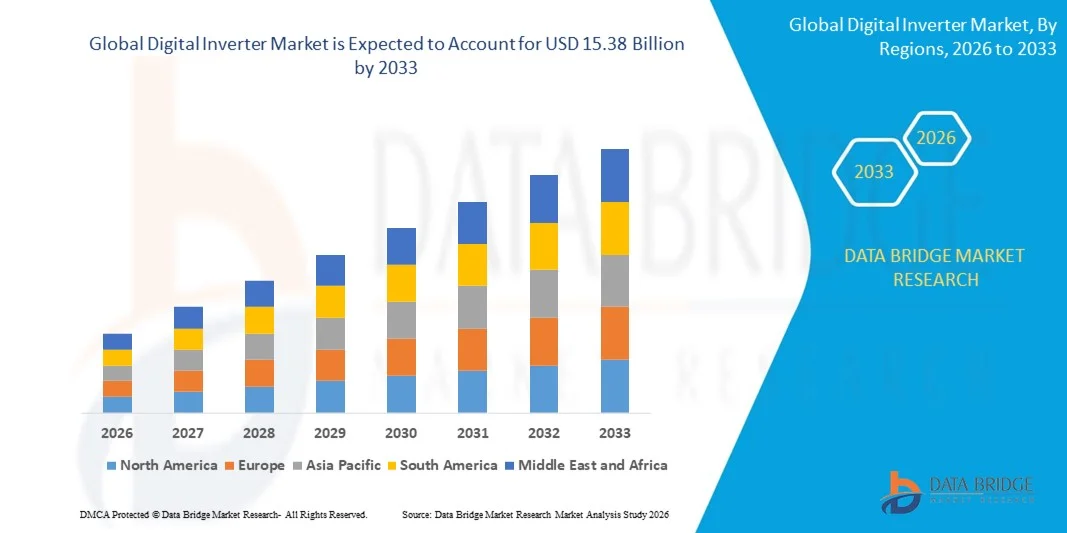
- The global digital inverter market size was valued at USD 8.88 billion in 2025 and is expected to reach USD 15.38 billion by 2033, at a CAGR of7.10% during the forecast period
- Rising rapid technological development in the energy utilization is a crucial factor accelerating the market growth, also increasing need for the durability of the products, increasing limitations of the conventional products such as disruptive noises, abrupt start, and others, increasing demand from both the commercial and industrial sectors, increasing significant capital inflows in renewable energy sector and rising reliability and safety and increased output and cost-efficiency are the major factors among others boosting the digital inverter market
What are the Major Takeaways of Digital Inverter Market?
- Increasing technological advancements and modernization in the market, rising research and development in the market and rising demand from the emerging markets used will further create new opportunities for digital inverter market
- However, rising lack of awareness about such a superior product on account of their lesser availability in the market is also negatively impacting sales which acts as a vital factor among others restraining the market growth, and will further challenge the digital inverter market
- North America dominated the digital inverter market with an estimated 42.25% revenue share in 2025, driven by strong adoption of advanced power electronics, rapid expansion of renewable energy projects, and high penetration of digitally controlled inverters across the U.S. and Canada
- Asia-Pacific is projected to register the fastest CAGR of 8.69% from 2026 to 2033, fueled by rapid expansion of renewable energy capacity, large-scale solar manufacturing, and increasing electrification across China, India, Japan, South Korea, and Southeast Asia
- The Solutions segment dominated the market with a 68.4% revenue share in 2025, driven by rising demand for high-density racks, cable-optimized structures, tool-less designs, PDUs, and mounting accessories essential for modern data centre buildouts
Report Scope and Digital Inverter Market Segmentation
|
Attributes |
Digital Inverter Key Market Insights |
|
Segments Covered |
|
|
Countries Covered |
North America
Europe
Asia-Pacific
Middle East and Africa
South America
|
|
Key Market Players |
|
|
Market Opportunities |
|
|
Value Added Data Infosets |
In addition to the insights on market scenarios such as market value, growth rate, segmentation, geographical coverage, and major players, the market reports curated by the Data Bridge Market Research also include in-depth expert analysis, pricing analysis, brand share analysis, consumer survey, demography analysis, supply chain analysis, value chain analysis, raw material/consumables overview, vendor selection criteria, PESTLE Analysis, Porter Analysis, and regulatory framework. |
What is the Key Trend in the Digital Inverter Market?
Rapid Transition Toward Smart, Compact, and Digitally Controlled Inverter Systems
- The digital inverters market is witnessing a strong shift toward compact, lightweight, and digitally controlled inverter systems designed for renewable energy, EV charging, industrial automation, and smart appliances
- Manufacturers are increasingly integrating high-speed digital signal processors (DSPs), microcontrollers, and IoT-enabled monitoring to enable precise power control, higher efficiency, and real-time performance optimization
- Growing demand for space-saving, energy-efficient, and software-driven power conversion solutions is accelerating adoption across residential, commercial, and industrial applications
- For instance, companies such as Schneider Electric, SUNGROW, Advanced Energy Industries, and KOSTAL have introduced smart digital inverters with remote monitoring, adaptive control algorithms, and grid-support functionalities
- Increasing focus on fast switching, low harmonic distortion, and improved power quality is driving the transition toward digitally optimized inverter architectures
- As power systems become smarter and more connected, digital inverters are emerging as a core technology for efficient energy conversion and intelligent power management
What are the Key Drivers of Digital Inverter Market?
- Rising demand for energy-efficient power conversion solutions in solar PV systems, EVs, industrial equipment, and consumer electronics is significantly driving market growth
- For instance, in 2024–2025, leading manufacturers upgraded their digital inverter portfolios with higher switching frequencies, advanced control firmware, and enhanced thermal management
- Rapid adoption of renewable energy, electric mobility, data centers, and smart grids across the U.S., Europe, and Asia-Pacific is boosting deployment of advanced digital inverters
- Continuous advancements in semiconductor technologies, including SiC and GaN devices, are improving inverter efficiency, power density, and reliability
- Increasing use of AI-enabled control, predictive maintenance, and real-time diagnostics is further strengthening demand for digitally intelligent inverter solutions
- Supported by growing investments in clean energy infrastructure, electrification, and power electronics R&D, the digital inverters market is expected to witness sustained long-term growth
Which Factor is Challenging the Growth of the Digital Inverter Market?
- High initial costs associated with advanced digital control components, wide-bandgap semiconductors, and sophisticated software integration limit adoption among cost-sensitive users
- For instance, during 2024–2025, volatility in semiconductor pricing and supply chain constraints increased production costs for several inverter manufacturers
- Complexity in digital control design, firmware development, and system integration increases dependency on skilled engineers and specialized expertise
- Limited awareness in emerging markets regarding the long-term efficiency and lifecycle benefits of digital inverters slows adoption
- Competition from conventional analog inverters and low-cost alternatives creates pricing pressure and slows technology transition
- To overcome these challenges, manufacturers are focusing on cost optimization, modular designs, simplified software platforms, and expanded training initiatives to accelerate global adoption of digital inverters
How is the Digital Inverter Market Segmented?
The market is segmented on the basis of type, application, and power source.
- By Type
On the basis of type, the digital inverter market is segmented into Central Inverter, String Inverter, and Micro Inverter. The String Inverter segment dominated the market with an estimated 46.5% share in 2025, owing to its widespread adoption in residential, commercial, and small-to-medium utility-scale solar installations. String inverters offer higher design flexibility, easier installation, lower upfront costs, and improved energy yield compared to central inverters, making them a preferred choice across distributed energy systems. Their compatibility with digital monitoring, remote diagnostics, and smart grid integration further supports strong adoption.
The Micro Inverter segment is expected to grow at the fastest CAGR from 2026 to 2033, driven by rising demand for module-level power optimization, enhanced system reliability, and improved performance in shaded or complex rooftop installations. Increasing adoption of residential solar systems and smart energy solutions is accelerating micro inverter deployment globally.
- By Application
On the basis of application, the digital inverter market is segmented into Utilities, Commercial, and Residential. The Utilities segment dominated the market with a 41.8% share in 2025, supported by large-scale solar farms, grid modernization projects, and growing investments in renewable energy infrastructure. Utility-scale deployments require high-capacity, digitally controlled inverters capable of grid synchronization, voltage regulation, and real-time performance optimization, driving strong demand.
The Residential segment is projected to register the fastest CAGR from 2026 to 2033, fueled by increasing rooftop solar installations, rising electricity costs, government incentives, and growing consumer awareness of clean energy solutions. Advancements in compact digital inverters, smart monitoring apps, and battery integration are further boosting adoption across residential users.
- By Power Source
On the basis of power source, the digital inverter market is segmented into Battery Inverter and Solar Inverter. The Solar Inverter segment held the largest market share of 63.2% in 2025, driven by rapid expansion of solar PV installations across residential, commercial, and utility-scale projects. Digital solar inverters play a critical role in efficient DC-to-AC conversion, grid compliance, and real-time energy management, making them essential components of modern solar systems.
The Battery Inverter segment is expected to grow at the fastest CAGR from 2026 to 2033, supported by rising adoption of energy storage systems, EV charging infrastructure, and backup power solutions. Increasing focus on energy independence, grid resilience, and hybrid solar-plus-storage systems is accelerating demand for advanced digital battery inverters.
Which Region Holds the Largest Share of the Digital Inverter Market?
- North America dominated the digital inverter market with an estimated 42.25% revenue share in 2025, driven by strong adoption of advanced power electronics, rapid expansion of renewable energy projects, and high penetration of digitally controlled inverters across the U.S. and Canada. Widespread deployment of solar PV systems, energy storage solutions, EV charging infrastructure, and smart grids continues to fuel demand for high-efficiency digital inverters across residential, commercial, and utility-scale applications
- Leading manufacturers in North America are focusing on high-efficiency designs, AI-enabled power management, real-time monitoring, and grid-support functionalities, strengthening the region’s technological leadership. Continuous investments in clean energy, grid modernization, and energy storage further support long-term market growth
- Strong regulatory support, high engineering expertise, and a mature renewable energy ecosystem further reinforce North America’s dominant market position
U.S. Digital Inverter Market Insight
The U.S. is the largest contributor in North America, supported by large-scale solar installations, rapid adoption of battery energy storage systems, and strong government incentives for renewable energy. Growing deployment of residential rooftop solar, commercial microgrids, and utility-scale solar farms is accelerating demand for advanced digital inverters with smart monitoring and grid-interactive capabilities. Presence of leading inverter manufacturers and strong R&D investments further drive market expansion.
Canada Digital Inverter Market Insight
Canada contributes significantly to regional growth, driven by increasing solar and wind energy projects, grid modernization initiatives, and rising adoption of energy-efficient power solutions. Supportive government policies, expanding clean energy targets, and growing investments in smart infrastructure strengthen digital inverter adoption across the country.
Asia-Pacific Digital Inverter Market
Asia-Pacific is projected to register the fastest CAGR of 8.69% from 2026 to 2033, fueled by rapid expansion of renewable energy capacity, large-scale solar manufacturing, and increasing electrification across China, India, Japan, South Korea, and Southeast Asia. Rising investments in smart grids, EV infrastructure, and distributed energy systems are significantly boosting demand for cost-efficient and high-performance digital inverters.
China Digital Inverter Market Insight
China leads the Asia-Pacific market due to massive solar and energy storage installations, strong domestic manufacturing capabilities, and government-backed renewable energy initiatives. High-volume production and competitive pricing accelerate adoption in both domestic and export markets.
Japan Digital Inverter Market Insight
Japan shows steady growth supported by advanced power electronics, focus on energy efficiency, and modernization of grid infrastructure. Demand for reliable, high-quality digital inverters is driven by residential solar, storage integration, and smart energy management systems.
India Digital Inverter Market Insight
India is emerging as a high-growth market, driven by ambitious solar targets, rapid rooftop solar adoption, and government-led renewable energy programs. Increasing deployment of hybrid solar-plus-storage systems is accelerating digital inverter demand.
South Korea Digital Inverter Market Insight
South Korea contributes notably due to strong investments in smart grids, energy storage, and EV infrastructure. Advanced manufacturing capabilities and focus on high-efficiency power electronics support sustained growth in the digital inverter market.
Which are the Top Companies in Digital Inverter Market?
The digital inverter industry is primarily led by well-established companies, including:
- Schneider Electric (France)
- KOSTAL Solar Electric GmbH (Germany)
- SUNGROW (China)
- Carrier (U.S.)
- Advanced Energy Industries, Inc. (U.S.)
- Cognito Quam Electrotechnologies Ltd. (India)
- Protonix Fortuner India Private Limited (India)
- Lzen Electronics India Pvt. Ltd. (India)
- Instant Power Engineering (India)
- India Power System (India)
- Solarstate Technologies (India)
- M/S Sherin Enterprises (India)
- Win Min E Power Systems (India)
- Purevolt Products Private Limited (India)
- Power Consilium System (India)
- Narson Enterprises (India)
SKU-
Get online access to the report on the World's First Market Intelligence Cloud
- Interactive Data Analysis Dashboard
- Company Analysis Dashboard for high growth potential opportunities
- Research Analyst Access for customization & queries
- Competitor Analysis with Interactive dashboard
- Latest News, Updates & Trend analysis
- Harness the Power of Benchmark Analysis for Comprehensive Competitor Tracking
Global Digital Inverter Market, Supply Chain Analysis and Ecosystem Framework
To support market growth and help clients navigate the impact of geopolitical shifts, DBMR has integrated in-depth supply chain analysis into its Global Digital Inverter Market research reports. This addition empowers clients to respond effectively to global changes affecting their industries. The supply chain analysis section includes detailed insights such as Global Digital Inverter Market consumption and production by country, price trend analysis, the impact of tariffs and geopolitical developments, and import and export trends by country and HSN code. It also highlights major suppliers with data on production capacity and company profiles, as well as key importers and exporters. In addition to research, DBMR offers specialized supply chain consulting services backed by over a decade of experience, providing solutions like supplier discovery, supplier risk assessment, price trend analysis, impact evaluation of inflation and trade route changes, and comprehensive market trend analysis.
Research Methodology
Data collection and base year analysis are done using data collection modules with large sample sizes. The stage includes obtaining market information or related data through various sources and strategies. It includes examining and planning all the data acquired from the past in advance. It likewise envelops the examination of information inconsistencies seen across different information sources. The market data is analysed and estimated using market statistical and coherent models. Also, market share analysis and key trend analysis are the major success factors in the market report. To know more, please request an analyst call or drop down your inquiry.
The key research methodology used by DBMR research team is data triangulation which involves data mining, analysis of the impact of data variables on the market and primary (industry expert) validation. Data models include Vendor Positioning Grid, Market Time Line Analysis, Market Overview and Guide, Company Positioning Grid, Patent Analysis, Pricing Analysis, Company Market Share Analysis, Standards of Measurement, Global versus Regional and Vendor Share Analysis. To know more about the research methodology, drop in an inquiry to speak to our industry experts.
Customization Available
Data Bridge Market Research is a leader in advanced formative research. We take pride in servicing our existing and new customers with data and analysis that match and suits their goal. The report can be customized to include price trend analysis of target brands understanding the market for additional countries (ask for the list of countries), clinical trial results data, literature review, refurbished market and product base analysis. Market analysis of target competitors can be analyzed from technology-based analysis to market portfolio strategies. We can add as many competitors that you require data about in the format and data style you are looking for. Our team of analysts can also provide you data in crude raw excel files pivot tables (Fact book) or can assist you in creating presentations from the data sets available in the report.