


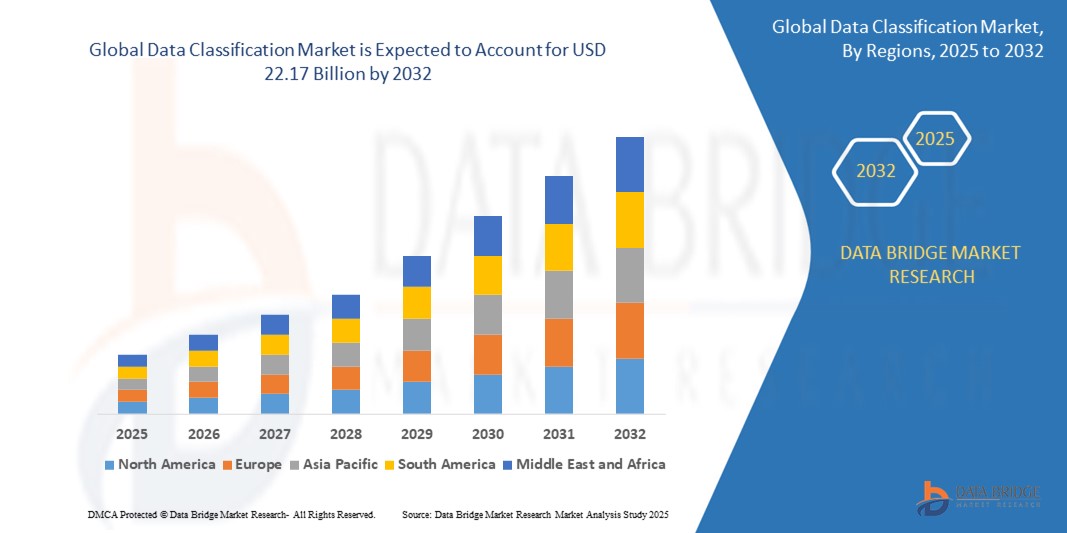
Data Classification Market Size
- The global Data Classification market size was valued at USD 1.44 Billion in 2024 and is expected to reach USD 22.17 Billion by 2032, at a CAGR of 47.8% during the forecast period
- The rise in the concerns regarding cybersecurity and safety, the mandate for adhering to regulatory compliances and the increasing volume of unstructured data with growing business are the major factors driving the data classification market.
Data Classification Market Analysis
- Data Classification refers to a process of categorizing or managing the data into various forms and types. The data is being classified or sorted in the process in accordance with the need of business or personal objective. The main purpose data classification is data management. The enterprise is segmented into private, restricted and public data.
- The rise in the utilization of solution in supporting data management to identify the risk and impact of mishandled data, high demand for classified data as it is convenient to process, safeguard and comply with data security policies and the increasing need for data classification and categorizing data in as public, internal, confidential and private classification accelerate the data classification market growth.
- Asia Pacific is expected to dominate the Data Classification market due rapid digitalization, expanding IT infrastructure, and increasing cyber threats. Government initiatives for data protection and rising awareness among enterprises about regulatory compliance further fuel market growth across sectors like finance, healthcare, and telecommunications.
- North America is anticipated to be the fastest-growing region in the Data Classification market, strict data privacy regulations, such as CCPA and HIPAA, along with a mature cybersecurity ecosystem. High cloud adoption, advanced IT infrastructure, and growing investments in data governance propel demand across industries, especially in finance and healthcare.
- The Solution segment is predicted to hold the largest market share of 62.1% in the Data Classification market during the forecast period. The Karl Fischer titration segment is driving the Data Classification market due to its high precision and reliability in moisture measurement. Its ability to provide accurate results in critical industries like pharmaceuticals, chemicals, and food processing makes it the preferred choice.
Report Scope and Data Classification Market Segmentation
|
Attributes |
Data Classification Key Market Insights |
|
Segments Covered |
|
|
Countries Covered |
North America
Europe
Asia-Pacific
Middle East and Africa
South America
|
|
Key Market Players |
|
|
Market Opportunities |
|
|
Value Added Data Infosets |
In addition to the insights on market scenarios such as market value, growth rate, segmentation, geographical coverage, and major players, the market reports curated by the Data Bridge Market Research also include import export analysis, production capacity overview, production consumption analysis, price trend analysis, climate change scenario, supply chain analysis, value chain analysis, raw material/consumables overview, vendor selection criteria, PESTLE Analysis, Porter Analysis, and regulatory framework. |
Data Classification Market Trends
“Integration of AI and Machine Learning for Automated Data Classification”
- AI and machine learning are being increasingly integrated into data classification solutions to enhance accuracy, automate data tagging, and reduce human error. These technologies enable systems to identify sensitive information across unstructured and structured data with minimal manual intervention.
- Automated data classification using AI improves regulatory compliance, supports real-time threat detection, and optimizes data management strategies. Organizations benefit from streamlined workflows, better data governance, and reduced risk exposure.
- For instance, In February 2025, Microsoft announced enhancements to its Microsoft Purview platform, incorporating AI-driven classification algorithms that automatically detect and label sensitive information, streamlining data protection for enterprise users.
- This trend is fueled by growing volumes of enterprise data, increasing regulatory complexity, and the need for cost-efficient, scalable classification solutions across sectors like finance, healthcare, and government.
Data Classification Market Dynamics
Driver
“Increasing Regulatory Pressure and Compliance Requirements”
- Global regulations like GDPR, HIPAA, and CCPA are accelerating the need for data classification tools. These frameworks mandate strict handling of sensitive information, prompting organizations to adopt technologies that ensure compliance, protect data, and avoid costly legal and financial penalties.
- Enterprises across industries are implementing data classification systems to meet regulatory demands and gain stakeholder trust. These tools help organizations identify and manage sensitive data, ensuring regulatory alignment and enhancing overall data governance practices in today’s complex compliance landscape.
For instance,
- For instance, In March 2025, a leading Canadian financial institution adopted a data classification platform to meet revised PIPEDA standards. This move improved their data visibility and compliance tracking, demonstrating the growing role of classification tools in regulatory readiness.
- The rise in hybrid work and global data exchange increases the need for robust classification systems. These tools support consistent policy enforcement, secure data flows, and regulatory compliance across remote, cloud, and cross-border environments, addressing modern data governance challenges.
Opportunity
“Rising Adoption in Cloud and Hybrid Environments”
- As businesses migrate to cloud and hybrid infrastructures, the need for effective data classification across diverse environments is growing. Classification tools now offer cloud-native integrations that support multi-cloud data governance.
- These solutions help organizations ensure consistent data protection policies across on-premise and cloud storage, facilitating secure collaboration and operational agility.
For instance,
- For instance, In January 2025, Amazon Web Services (AWS) launched a data classification feature within its Macie service, enabling enterprises to identify and manage sensitive data across S3 buckets in real time.
- As cloud computing adoption accelerates, organizations require scalable, cloud-compatible data classification tools to manage sensitive information effectively. These solutions support consistent data governance across cloud environments, driving increased demand and enabling secure, compliant operations in dynamic, distributed IT infrastructures.
Restraint/Challenge
“Complexity of Implementation and Legacy System Integration”
- Integrating modern data classification tools into legacy IT systems poses a significant challenge for organizations. Differences in data formats, infrastructure limitations, and outdated software hinder seamless deployment.
- Implementation complexity often results in longer rollout times, increased costs, and the need for specialized IT expertise.
For instance,
- For instance, In April 2025, a European healthcare provider reported delays in implementing a data classification solution due to incompatibility with its outdated electronic records system, requiring custom integration and additional investment.
- Ensuring continuous integration of data classification tools with existing legacy systems is essential for broader market adoption. Overcoming interoperability challenges will help organizations implement these solutions efficiently, reduce operational disruptions, and maximize the value of their existing IT infrastructure investments.
Data Classification Market Scope
The market is segmented on the basis component, deployment, classification, application and vertical.
|
Segmentation |
Sub-Segmentation |
|
By Component |
|
|
By Deployment |
|
|
By Classification |
|
|
By Application |
|
|
By Vertical |
|
In 2025, the solution is projected to dominate the market with a largest share in by component segment
The solution segment is expected to dominate the Data Classification market, with a market share of 62.2% during the forecast period. The solution component segment of the data classification market is driven by increasing demand for automated tools that enhance data visibility, ensure regulatory compliance, and prevent data breaches. Organizations prioritize robust solutions to manage growing data volumes across cloud and on-premise environments.
The On-Premises is expected to account for the largest share during the forecast period in Data Classification Market
In 2025, the On-Premises segment in the Data Classification market is projected to hold the largest share of approximately 31.10%. The on-premises segment in the data classification market is driven by organizations requiring greater control over sensitive data, especially in highly regulated industries. It offers enhanced security, compliance assurance, and integration with existing infrastructure, making it ideal for data-sensitive enterprises.
Data Classification Market Regional Analysis
“Asia-Pacific Holds the Largest Share in the Data Classification Market”
- Asia-Pacific leads the data classification market, driven by rapid digital transformation, increased adoption of data governance frameworks, and growing regulatory enforcement across sectors in China, India, and Japan.
- China and India are significant contributors due to the explosion of digital services, rising data volumes, and national data protection regulations, such as India’s Digital Personal Data Protection Act.
- Japan’s strong focus on cybersecurity and technological innovation supports the adoption of advanced data classification tools in industries like finance, manufacturing, and healthcare.
- Government initiatives promoting secure data management, digital economy frameworks, and cloud adoption across the region continue to boost demand for scalable and automated data classification solutions.
“North America is Projected to Register the Highest CAGR in the Data Classification Market”
- North America is expected to experience the highest growth in the data classification market due to stringent data privacy laws like CCPA, HIPAA, and evolving federal cybersecurity frameworks.
- The U.S. dominates the region, with tech giants such as Microsoft, IBM, and Google integrating AI-driven data classification into their cloud and enterprise security offerings.
- The rise in cyberattacks and increasing focus on zero-trust architectures are driving businesses to invest in proactive data governance and classification tools.
- Widespread adoption of hybrid cloud, remote work models, and digital workflows in commercial and public sectors is fueling long-term demand for intelligent data classification platforms that enhance data visibility, control, and compliance.
Data Classification Market Share
The market competitive landscape provides details by competitor. Details included are company overview, company financials, revenue generated, market potential, investment in research and development, new market initiatives, global presence, production sites and facilities, production capacities, company strengths and weaknesses, product launch, product width and breadth, application dominance. The above data points provided are only related to the companies' focus related to market.
The Major Market Leaders Operating in the Market Are:
- IBM Corporation
- Amazon Web Services, Inc.
- BOLDON JAMES
- Covata Limited
- DATAGUISE
- Digital Guardian
- Forcepoint
- Clearswift
- GTB Technologies, Inc.
- Informatica
- Innovative Routines International (IRI), Inc.
- Janusnet Pty Limited
- Microsoft
- MinerEye
- Netwrix Corporation
- OpenText Corp.
- PKWARE, Inc.
Latest Developments in Global Data Classification Market
- In July 2024, Microsoft introduced Microsoft Purview Data Governance, a comprehensive tool designed to enhance data governance by providing advanced capabilities for data classification, management, and protection. This initiative aims to support organizations in meeting regulatory compliance requirements and improving data security across diverse environments.
- In January 2024, Varonis expanded its Data Security Posture Management (DSPM) capabilities to support Snowflake, a leading cloud data platform. This initiative enhances data security by offering greater visibility and control over sensitive data, reinforcing the need for advanced data classification in cloud environments.

- Interactive Data Analysis Dashboard
- Company Analysis Dashboard for high growth potential opportunities
- Research Analyst Access for customization & queries
- Competitor Analysis with Interactive dashboard
- Latest News, Updates & Trend analysis
- Harness the Power of Benchmark Analysis for Comprehensive Competitor Tracking
Data collection and base year analysis are done using data collection modules with large sample sizes. The stage includes obtaining market information or related data through various sources and strategies. It includes examining and planning all the data acquired from the past in advance. It likewise envelops the examination of information inconsistencies seen across different information sources. The market data is analysed and estimated using market statistical and coherent models. Also, market share analysis and key trend analysis are the major success factors in the market report. To know more, please request an analyst call or drop down your inquiry.
The key research methodology used by DBMR research team is data triangulation which involves data mining, analysis of the impact of data variables on the market and primary (industry expert) validation. Data models include Vendor Positioning Grid, Market Time Line Analysis, Market Overview and Guide, Company Positioning Grid, Patent Analysis, Pricing Analysis, Company Market Share Analysis, Standards of Measurement, Global versus Regional and Vendor Share Analysis. To know more about the research methodology, drop in an inquiry to speak to our industry experts.
Data Bridge Market Research is a leader in advanced formative research. We take pride in servicing our existing and new customers with data and analysis that match and suits their goal. The report can be customized to include price trend analysis of target brands understanding the market for additional countries (ask for the list of countries), clinical trial results data, literature review, refurbished market and product base analysis. Market analysis of target competitors can be analyzed from technology-based analysis to market portfolio strategies. We can add as many competitors that you require data about in the format and data style you are looking for. Our team of analysts can also provide you data in crude raw excel files pivot tables (Fact book) or can assist you in creating presentations from the data sets available in the report.













