


Crystalline Silicon Solar Cell (C Si) Market Overview
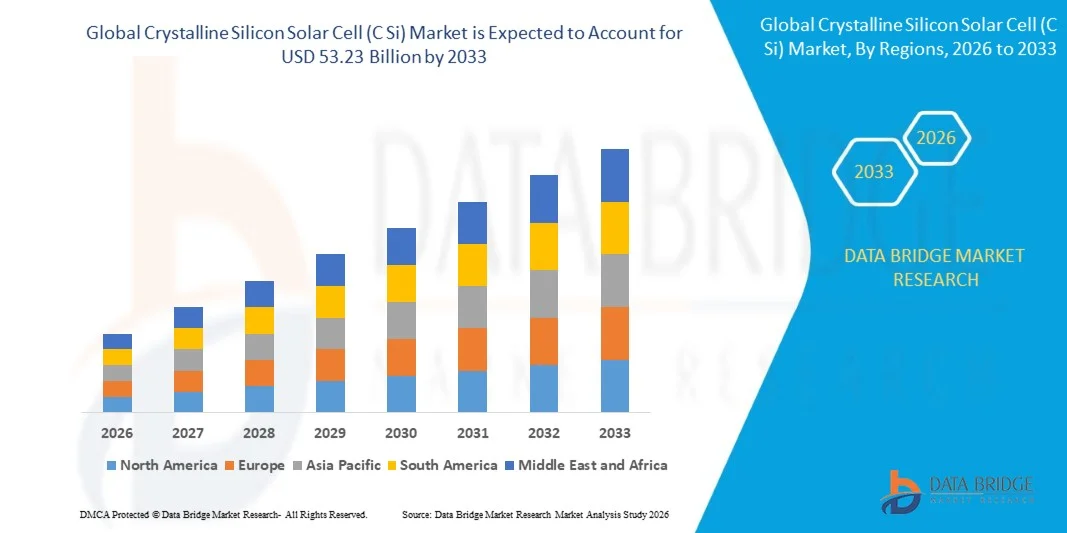
The Crystalline Silicon Solar Cell (C Si) Market was valued at USD 32.41 billion in 2025 and is projected to reach USD 53.23 billion by 2033, growing at a CAGR of 6.40% from 2026 to 2033. The global crystalline silicon solar cell (C-Si) market is experiencing consistent growth driven by rising demand for renewable energy, rapid expansion of solar power installations, and continuous improvements in solar cell efficiency and manufacturing technologies. Governments worldwide are increasingly focusing on clean energy transition and decarbonization goals, which is accelerating the adoption of crystalline silicon-based photovoltaic systems across residential, commercial, and utility-scale projects.
The increasing global electricity demand, combined with supportive policies such as renewable energy targets, tax incentives, and net metering programs, is compelling utilities, industrial users, and households to adopt solar energy solutions. Crystalline silicon solar cells, including monocrystalline and polycrystalline technologies, are widely preferred due to their high efficiency, long lifecycle, and cost-effectiveness compared to alternative photovoltaic technologies.
Key Market Trends & Insights
- North America dominated the global crystalline silicon solar cell (C-Si) market with the largest revenue share of 34.6% in 2025, supported by strong renewable energy investments, favorable government incentives such as tax credits, and rapid expansion of utility-scale solar installations. The region also benefits from strong presence of solar project developers and advanced grid integration infrastructure.
- The mono-crystalline segment dominated the market with a share of 70% in 2025 due to its high efficiency, superior energy conversion rate, and strong adoption in utility-scale and residential solar installations. its efficiency levels of 23% make it the preferred technology for large-scale solar farms and high-performance rooftop systems.
- Asia-Pacific is expected to be the fastest-growing region at a CAGR of 8.1% from 2026 to 2033, fueled by large-scale solar deployment in China and India, supportive government renewable targets, and rapidly expanding solar manufacturing capacity. Increasing electricity demand, industrialization, and declining solar panel costs are further accelerating regional growth.
- The utility-scale segment dominates the end-user category with a 61.4% revenue share in 2025, led by large solar farms and grid-connected renewable energy projects. Governments and private utilities are heavily investing in large photovoltaic installations to meet decarbonization targets and reduce dependence on fossil fuels.
Market Size & Forecast
- Global Market Value (2025): USD 32.41 Billion
- Expected Market Value (2033): USD 53.23 Billion
- Forecast CAGR (2026–2033): 6.40%
- Leading Region in 2025: North America
- Fastest Growing Region: Asia-Pacific
Report Scope and Crystalline Silicon Solar Cell (C Si) Market Segmentation
|
Attributes |
Crystalline Silicon Solar Cell (C Si) Key Market Insights |
|
Segments Covered |
|
|
Countries Covered |
North America · U.S. · Canada · Mexico Europe · Germany · France · U.K. · Netherlands · Switzerland · Belgium · Russia · Italy · Spain · Turkey · Rest of Europe Asia-Pacific · China · Japan · India · South Korea · Singapore · Malaysia · Australia · Thailand · Indonesia · Philippines · Rest of Asia-Pacific Middle East and Africa · Saudi Arabia · U.A.E. · South Africa · Egypt · Israel · Rest of Middle East and Africa South America · Brazil · Argentina · Rest of South America |
|
Key Market Players |
• LONGi Green Energy Technology Co., Ltd. (China) |
|
Market Opportunities |
· Rapid Expansion of Utility-Scale Solar Power Projects · Rising Adoption in Residential and Commercial Rooftop Solar Systems · Technological Advancements Improving Efficiency and Reducing Costs |
|
Value Added Data Infosets |
In addition to the insights on market scenarios such as market value, growth rate, segmentation, geographical coverage, and major players, the market reports curated by the Data Bridge Market Research also include in-depth expert analysis, geographically represented company-wise production and capacity, network layouts of distributors and partners, detailed and updated price trend analysis and deficit analysis of supply chain and demand. |
Crystalline Silicon Solar Cell (C Si) Market Trends
Trend: Rapid Expansion of Utility-Scale Solar Projects and High-Efficiency Mono-Crystalline Adoption
The global crystalline silicon solar cell (C-Si) market is experiencing strong growth driven by rapid deployment of utility-scale solar photovoltaic (PV) projects and increasing preference for high-efficiency mono-crystalline technology. Governments and utilities across major economies are accelerating solar installations to meet decarbonization targets and energy transition goals. For instance, large-scale solar parks in China, India, and the United States continue to expand capacity through grid-connected photovoltaic farms. Companies such as LONGi Green Energy Technology, JinkoSolar, and Trina Solar are heavily investing in high-efficiency N-type TOPCon and heterojunction (HJT) solar cell technologies to improve module efficiency beyond 22–24%. Falling module prices and improvements in manufacturing scale are further accelerating global adoption, especially in emerging economies where electricity demand is rising rapidly.
Crystalline Silicon Solar Cell (C Si) Market Dynamics
Key Market Driver: Strong Policy Support and Rising Solar Energy Deployment
The primary driver of the crystalline silicon solar cell market is strong government support for renewable energy adoption combined with rapidly increasing solar installations worldwide. Policies such as tax incentives, feed-in tariffs, renewable purchase obligations, and net metering programs are significantly boosting demand for crystalline silicon PV cells. Utility-scale solar projects dominate new capacity additions, particularly in Asia-Pacific and North America. For example, India’s National Solar Mission and China’s large-scale solar expansion initiatives have led to continuous capacity growth in photovoltaic installations. In addition, corporate renewable energy procurement through power purchase agreements (PPAs) is increasing demand from commercial and industrial users. The declining cost of silicon-based solar modules has further improved affordability and accelerated adoption across residential rooftop systems as well.
Key Restraint/Challenge: Supply Chain Volatility and Raw Material Price Fluctuations
A major challenge in the global C-Si solar cell market is volatility in raw material supply chains, particularly polysilicon pricing and wafer manufacturing constraints. Periodic shortages of polysilicon and disruptions in global logistics have historically impacted production costs and delivery timelines. In addition, the capital-intensive nature of solar cell manufacturing limits entry for smaller players, creating concentration risk among large vertically integrated manufacturers. Trade restrictions and geopolitical tensions have also influenced pricing structures in key markets. Environmental concerns related to silicon processing and energy-intensive manufacturing further add compliance pressure. These factors create margin pressure for manufacturers while encouraging investment in more efficient production technologies.
Key Market Opportunity: Technological Advancement in High-Efficiency and Tandem Solar Cells
The market presents strong opportunities through advancements in high-efficiency crystalline silicon technologies, including PERC upgrades, TOPCon architectures, and tandem solar cell integration. Manufacturers are increasingly focusing on improving conversion efficiency while reducing cost per watt. For instance, leading solar technology companies are developing next-generation n-type silicon cells that offer improved performance under high-temperature and low-light conditions. Integration of crystalline silicon with perovskite layers in tandem solar structures is expected to significantly increase efficiency beyond conventional limits. In addition, growing deployment of distributed solar systems in residential and commercial sectors is opening new growth avenues. Emerging markets in Southeast Asia, Africa, and Latin America are also witnessing increased solar electrification projects supported by international funding agencies and climate initiatives. The combination of technological innovation and policy support is expected to drive strong long-term market expansion.
Crystalline Silicon Solar Cell (C Si) Market Scope
The Crystalline Silicon Solar Cell (C Si) market is segmented on the basis of simulation type, vehicle type, training application, end user, hardware components, software components, training mode, integration & connectivity, deployment and support & services.
By Type
On the basis of type, the Crystalline Silicon Solar Cell (C Si) Market is segmented into mono-crystalline and multi-crystalline solar cells. The mono-crystalline segment dominated the market with a share of 70% in 2025 due to its high efficiency, superior energy conversion rate, and strong adoption in utility-scale and residential solar installations. its efficiency levels of 23% make it the preferred technology for large-scale solar farms and high-performance rooftop systems. increasing deployment of advanced technologies such as PERC, TOPCon, and heterojunction (HJT) further strengthens its market position. declining manufacturing costs and strong government support for renewable energy expansion are accelerating adoption across developed and emerging economies. in addition, major solar manufacturers are shifting production capacity toward mono-crystalline technology due to better long-term returns and higher energy output. growing investments in grid-connected solar infrastructure and corporate renewable energy procurement are further boosting demand. continuous innovation in wafer quality and cell design is improving performance efficiency and reducing degradation rates. utility-scale solar projects across China, India, and the united states remain key demand drivers. favorable policy frameworks and net-zero emission targets are reinforcing large-scale installations. overall, superior efficiency, cost competitiveness, and technological advancement are driving dominance of this segment. the mono-crystalline segment is expected to maintain its leadership position throughout the forecast period.
The multi-crystalline segment is expected to witness moderate growth with a CAGR of around 5% from 2026 to 2033 due to its lower manufacturing cost and historical usage in cost-sensitive solar installations. this segment is primarily adopted in developing regions where affordability remains a key purchasing factor. however, lower efficiency levels of 15%–18% compared to mono-crystalline technology are limiting its expansion. declining global manufacturing share is observed as producers transition toward higher-efficiency solutions. limited application in utility-scale solar farms is further restricting growth potential. some residential and small commercial installations continue to use multi-crystalline modules due to lower upfront investment requirements. gradual improvements in production techniques have slightly enhanced performance but not enough to regain competitiveness. recycling of older solar installations provides limited but stable demand support. competition from advanced mono-crystalline and thin-film technologies continues to pressure this segment. despite this, niche applications in budget-focused markets sustain its presence. overall, the segment is losing share but remains relevant in price-sensitive regions. long-term outlook indicates gradual decline in global dominance.
By End User
On the basis of end user, the Crystalline Silicon Solar Cell (C Si) Market is segmented into residential, commercial, and utility-scale segments. the utility-scale segment dominated the market with a share of approximately 55%in 2025 due to large-scale deployment of solar power plants and strong government-led renewable energy programs. utility-scale projects benefit from economies of scale, significantly reducing per-unit electricity generation costs. rising global energy demand and decarbonization targets are driving massive investments in solar farms. countries such as China, India, the united states, and several European nations are leading installations. long-term power purchase agreements (PPAs) are supporting financial viability of large solar projects. integration with energy storage systems and smart grid infrastructure is enhancing operational efficiency. technological advancements in high-efficiency mono-crystalline modules are improving output performance. strong participation of EPC contractors and utility developers is accelerating project execution. government auctions and renewable energy tenders are creating stable demand pipelines. favorable regulatory frameworks and carbon neutrality commitments are further strengthening adoption. utility-scale solar remains the backbone of global photovoltaic capacity expansion. overall, strong policy support and cost efficiency continue to reinforce segment dominance.
The residential segment is expected to witness the fastest growth with a CAGR of around 7%from 2026 to 2033 due to rising adoption of rooftop solar systems among households. declining solar panel prices and improved financing options are making residential installations more accessible. government subsidies, tax incentives, and net metering policies are significantly encouraging adoption. increasing awareness of clean energy and electricity cost savings is boosting consumer interest. urbanization and rising electricity tariffs are further accelerating demand for rooftop solar systems. integration of battery storage solutions is enabling greater energy independence for households. growth in net-zero housing projects is supporting long-term expansion. flexible leasing and pay-as-you-go models are improving affordability. technological improvements in compact, high-efficiency modules are supporting rooftop installations. rising environmental consciousness among consumers is driving behavioral shift toward renewable energy. residential solar adoption is expanding rapidly in both developed and emerging economies. overall, strong policy support and consumer-driven adoption are making this the fastest-growing segment.
Crystalline Silicon Solar Cell (C Si) Market Regional Analysis
North America dominated the crystalline silicon solar cell (C-Si) market and accounted for the largest revenue share of 34.6% in 2025, supported by strong renewable energy investments, favorable government incentives such as tax credits, and rapid expansion of utility-scale solar installations. The region also benefits from a strong presence of solar project developers and advanced grid integration infrastructure, which together are accelerating large-scale deployment of crystalline silicon-based solar technologies across residential, commercial, and utility applications. Increasing focus on energy transition and decarbonization further strengthens market growth across the region.
U.S. Crystalline Silicon Solar Cell (C Si) Market Insight
The U.S. crystalline silicon solar cell (C-Si) market is witnessing strong growth due to increasing investments in renewable energy projects, supportive federal and state-level incentives, and rising demand for clean electricity generation. The country’s well-established solar development ecosystem, along with expanding utility-scale solar farms and rooftop installations, is driving adoption of high-efficiency mono-crystalline and multi-crystalline solar cells. In addition, growing focus on energy independence and carbon neutrality targets is further supporting market expansion across residential, commercial, and industrial sectors.
Europe Crystalline Silicon Solar Cell (C Si) Market Insight
The Europe crystalline silicon solar cell (C-Si) market remains a key contributor to global demand, driven by strong government climate policies, renewable energy targets, and increasing investments in solar infrastructure. Countries across the region are actively promoting solar adoption through subsidies, feed-in tariffs, and green energy initiatives. The rising deployment of distributed solar systems and utility-scale photovoltaic plants is strengthening market penetration, particularly in Germany, Spain, and France, where solar energy is becoming a critical component of national energy strategies.
U.K. Crystalline Silicon Solar Cell (C Si) Market Insight
The U.K. crystalline silicon solar cell (C-Si) market is experiencing steady growth, supported by increasing government commitment to net-zero emissions and rising adoption of rooftop solar systems in residential and commercial buildings. Expanding investment in renewable energy infrastructure and favorable policy support for solar integration are driving demand for high-efficiency crystalline silicon modules. In addition, growing awareness of energy cost savings and sustainability goals is further encouraging solar adoption across the country.
Germany Crystalline Silicon Solar Cell (C Si) Market Insight
The Germany crystalline silicon solar Cell (C-Si) market is expanding steadily due to strong industrial solar adoption, advanced renewable energy policies, and continuous investments in photovoltaic technologies. The country’s leadership in clean energy transition, combined with widespread deployment of rooftop and utility-scale solar systems, is supporting sustained demand. Technological advancements in high-efficiency solar cells and integration with smart grid systems are further enhancing market growth.
Asia-Pacific Crystalline Silicon Solar Cell (C Si) Market Insight
The Asia-Pacific crystalline silicon solar cell (C-Si) market is expected to be the fastest-growing region at a CAGR of 8.1% from 2026 to 2033, driven by large-scale solar deployment in China and India, supportive government renewable energy targets, and rapidly expanding manufacturing capacity. Increasing electricity demand, urbanization, and industrial growth are accelerating solar adoption across the region. In addition, declining solar panel costs and strong policy support for clean energy transition are further boosting regional market expansion.
Japan Crystalline Silicon Solar Cell (C Si) Market Insight
The Japan crystalline silicon solar cell (C-Si) market is witnessing steady growth due to strong emphasis on renewable energy adoption, limited land availability encouraging high-efficiency solar systems, and government support for clean energy technologies. The country’s focus on energy security and disaster-resilient power systems is also driving deployment of rooftop and floating solar installations. Continuous innovation in high-efficiency photovoltaic technologies further supports market development.
China Crystalline Silicon Solar Cell (C Si) Market Insight
The China crystalline silicon solar cell (C-Si) market is growing rapidly, driven by massive solar capacity additions, strong government renewable energy mandates, and dominance in solar manufacturing supply chains. The country continues to lead global solar deployment through large-scale utility projects and export-oriented solar module production. Rising industrial electricity demand and aggressive decarbonization goals are further strengthening China’s position as a key global growth engine for crystalline silicon solar cells.
Crystalline Silicon Solar Cell (C Si) Market Share
The Crystalline Silicon Solar Cell (C Si) industry is primarily led by well-established companies, including:
- LONGi Green Energy Technology Co., Ltd. (China)
- JinkoSolar Holding Co., Ltd. (China)
- Trina Solar Co., Ltd. (China)
- JA Solar Technology Co., Ltd. (China)
- Canadian Solar Inc. (Canada)
- First Solar, Inc. (U.S.)
- Hanwha Q CELLS Co., Ltd. (South Korea)
- Risen Energy Co., Ltd. (China)
- Suntech Power Holdings Co., Ltd. (China)
- Talesun Solar Technologies Co., Ltd. (China)
- Yingli Green Energy Holding Company Limited (China)
- REC Group (Norway)
- GCL System Integration Technology Co., Ltd. (China)
- Waaree Energies Ltd. (India)
- Adani Solar (Adani Group) (India)
- Tata Power Solar Systems Ltd. (India)
- Meyer Burger Technology AG (Switzerland)
- Sharp Corporation (Japan)
- Kyocera Corporation (Japan)
- Mitsubishi Electric Corporation (Japan)
- SolarEdge Technologies Inc. (Israel)
- Enphase Energy, Inc. (U.S.)
- SunPower Corporation (U.S.)
- Boviet Solar (Vietnam)
- Eging PV Technology Co., Ltd. (China)
- Seraphim Solar System Co., Ltd. (China)
- Chint Group / Astronergy (China)
- Runergy (China)
- Jolywood (China)
- Boviet Solar Technology (Vietnam)
Latest Developments in Crystalline Silicon Solar Cell (C Si) Market
- In April 2022, JinkoSolar announced that its n-type TOPCon monocrystalline silicon solar cell achieved a record conversion efficiency of 25.7%, independently certified by the National Institute of Metrology, China. The breakthrough highlighted advancements in tunnel oxide passivated contact (TOPCon) technology and marked a significant step toward higher-efficiency crystalline silicon solar cells for utility-scale applications
- In July 2022, Trina Solar began construction of a large-scale silicon-to-module production base in Qinghai province, China, expanding integrated crystalline silicon production capacity from polysilicon to modules. The project was designed to strengthen supply chain integration and support growing demand for high-efficiency mono-crystalline and n-type solar cells
- In December 2022, JinkoSolar announced a new world record of 26.4% efficiency for its n-type TOPCon crystalline silicon solar cell, certified by China’s National Institute of Metrology. The achievement reflected rapid improvements in advanced diffusion processes, metallization techniques, and silicon wafer quality, reinforcing the dominance of TOPCon technology in next-generation crystalline silicon solar cells
- In April 2023, JinkoSolar reported the operational scale-up of 35 GW n-type cell production capacity, making it one of the largest producers of n-type crystalline silicon solar cells globally. The expansion supported strong market demand for high-efficiency modules and accelerated the transition from PERC to TOPCon-based solar cell technologies
- In August 2023, Trina Solar announced mass production of its 210mm n-type TOPCon high-power modules, marking a major commercialization milestone for large-format crystalline silicon solar technology. The company also emphasized its shift toward 700W+ ultra-high-power modules, driven by improved cell architecture and wafer scaling innovations
- In January 2025, Trina Solar achieved a new record for n-type fully passivated heterojunction (HJT) crystalline silicon solar modules, reaching 25.44% efficiency, certified by Fraunhofer CalLab in Germany. The development demonstrated continued innovation in passivated silicon technologies and reinforced the role of advanced crystalline silicon architectures in next-generation solar energy systems

- Interactive Data Analysis Dashboard
- Company Analysis Dashboard for high growth potential opportunities
- Research Analyst Access for customization & queries
- Competitor Analysis with Interactive dashboard
- Latest News, Updates & Trend analysis
- Harness the Power of Benchmark Analysis for Comprehensive Competitor Tracking
Global Crystalline Silicon Solar Cell C Si Market, Supply Chain Analysis and Ecosystem Framework
To support market growth and help clients navigate the impact of geopolitical shifts, DBMR has integrated in-depth supply chain analysis into its Global Crystalline Silicon Solar Cell C Si Market research reports. This addition empowers clients to respond effectively to global changes affecting their industries. The supply chain analysis section includes detailed insights such as Global Crystalline Silicon Solar Cell C Si Market consumption and production by country, price trend analysis, the impact of tariffs and geopolitical developments, and import and export trends by country and HSN code. It also highlights major suppliers with data on production capacity and company profiles, as well as key importers and exporters. In addition to research, DBMR offers specialized supply chain consulting services backed by over a decade of experience, providing solutions like supplier discovery, supplier risk assessment, price trend analysis, impact evaluation of inflation and trade route changes, and comprehensive market trend analysis.
Data collection and base year analysis are done using data collection modules with large sample sizes. The stage includes obtaining market information or related data through various sources and strategies. It includes examining and planning all the data acquired from the past in advance. It likewise envelops the examination of information inconsistencies seen across different information sources. The market data is analysed and estimated using market statistical and coherent models. Also, market share analysis and key trend analysis are the major success factors in the market report. To know more, please request an analyst call or drop down your inquiry.
The key research methodology used by DBMR research team is data triangulation which involves data mining, analysis of the impact of data variables on the market and primary (industry expert) validation. Data models include Vendor Positioning Grid, Market Time Line Analysis, Market Overview and Guide, Company Positioning Grid, Patent Analysis, Pricing Analysis, Company Market Share Analysis, Standards of Measurement, Global versus Regional and Vendor Share Analysis. To know more about the research methodology, drop in an inquiry to speak to our industry experts.
Data Bridge Market Research is a leader in advanced formative research. We take pride in servicing our existing and new customers with data and analysis that match and suits their goal. The report can be customized to include price trend analysis of target brands understanding the market for additional countries (ask for the list of countries), clinical trial results data, literature review, refurbished market and product base analysis. Market analysis of target competitors can be analyzed from technology-based analysis to market portfolio strategies. We can add as many competitors that you require data about in the format and data style you are looking for. Our team of analysts can also provide you data in crude raw excel files pivot tables (Fact book) or can assist you in creating presentations from the data sets available in the report.













