Global Cork Stoppers Market
Market Size in USD Billion
CAGR :
% 
 USD
1.81 Billion
USD
4.02 Billion
2025
2033
USD
1.81 Billion
USD
4.02 Billion
2025
2033
 Forecast Period Forecast Period |
2026 –2033 |
 Market Size (Base Year) Market Size (Base Year) |
USD 1.81 Billion |
 Market Size (Forecast Year) Market Size (Forecast Year) |
USD 4.02 Billion |
 CAGR CAGR |
% |
| Major Markets Players |
|
What is the Global Cork Stoppers Market Size and Growth Rate?
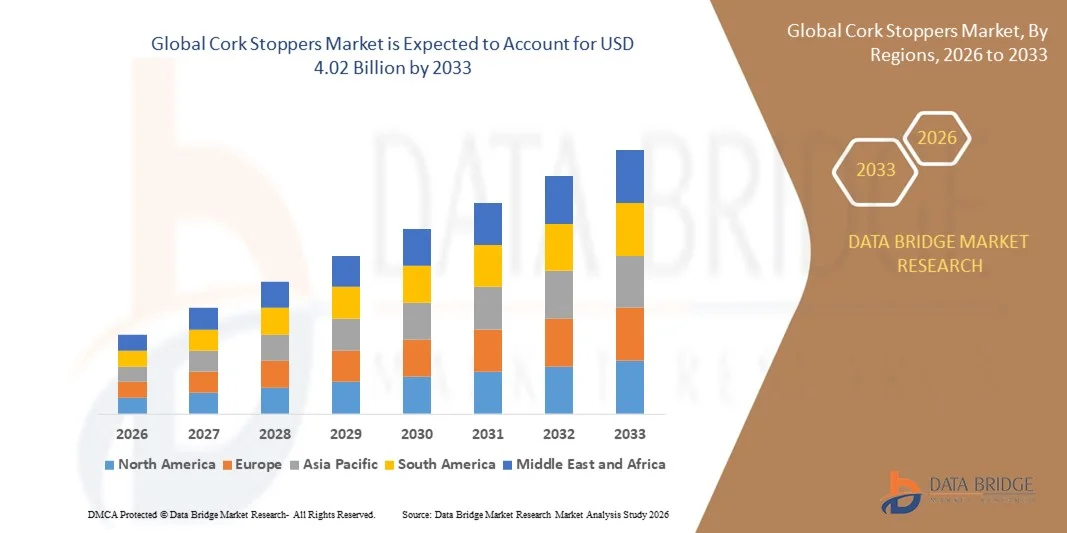
- The global cork stoppers market size was valued at USD 1.81 billion in 2025 and is expected to reach USD 4.02 billion by 2033, at a CAGR of10.50% during the forecast period
- Rising demand for sustainable packaging solutions is driving the growth in the cork stoppers market value. Growing demand for wine and premium spirits across the globe and growth and expansion of the food and beverages industry especially in the developing economies will further induce growth in the cork stoppers market value
What are the Major Takeaways of Cork Stoppers Market?
- Rising proliferation of e-commerce industry especially in the developing economies, increased focus on the adoption of advancement of manufacturing technology, increasing westernization, modernization, urbanization, ever-rising global population, improving distribution channel, and increasing personal disposable income are some other indirect factors that will also promote the cork stoppers market growth rate
- North America dominated the cork stoppers market with a 34.17% revenue share in 2025, driven by strong consumption of wine and premium spirits, well-established packaging standards, and high demand for sustainable and natural closures across the U.S. and Canada
- Asia-Pacific is projected to register the fastest CAGR of 10.4% from 2026 to 2033, driven by rapid growth in wine consumption, expanding premium spirits markets, and increasing local bottling activities across China, Japan, India, South Korea, and Australia
- The Natural Cork Stoppers segment dominated the market with a 38.6% share in 2025, driven by strong preference among premium wine producers for traditional closures that support controlled oxygen transfer, aging performance, and brand authenticity
Report Scope and Cork Stoppers Market Segmentation
|
Attributes |
Cork Stoppers Key Market Insights |
|
Segments Covered |
|
|
Countries Covered |
North America
Europe
Asia-Pacific
Middle East and Africa
South America
|
|
Key Market Players |
|
|
Market Opportunities |
|
|
Value Added Data Infosets |
In addition to the insights on market scenarios such as market value, growth rate, segmentation, geographical coverage, and major players, the market reports curated by the Data Bridge Market Research also include in-depth expert analysis, pricing analysis, brand share analysis, consumer survey, demography analysis, supply chain analysis, value chain analysis, raw material/consumables overview, vendor selection criteria, PESTLE Analysis, Porter Analysis, and regulatory framework. |
What is the Key Trend in the Cork Stoppers Market?
Increasing Shift Toward Sustainable, High-Performance, and Quality-Certified Cork Stoppers
- The cork stoppers market is witnessing strong adoption of natural, technical, and agglomerated cork stoppers that support sustainability goals, product authenticity, and long-term wine preservation
- Manufacturers are introducing quality-certified, TCA-controlled, and precision-engineered cork stoppers that offer consistent sealing performance, oxygen transfer control, and improved sensory outcomes
- Growing demand for eco-friendly, renewable, and biodegradable packaging solutions is driving adoption across wine, spirits, and premium beverage producers worldwide
- For instance, companies such as Corticeira Amorim, Vinventions, Jelinek Cork Group, Cork Supply, and Portocork have launched advanced cork stoppers with enhanced quality screening, traceability, and sustainability certifications
- Increasing emphasis on brand differentiation, premiumization, and wine aging performance is accelerating the shift toward high-quality natural and technical cork stoppers
- As sustainability regulations and consumer preference for natural materials strengthen, Cork Stoppers will remain vital for premium beverage sealing and brand positioning
What are the Key Drivers of Cork Stoppers Market?
- Rising demand for sustainable, renewable, and recyclable wine closures to reduce environmental impact and support circular economy initiatives
- For instance, in 2025, leading manufacturers such as Corticeira Amorim, Vinventions, and cork supply expanded their product portfolios with TCA-free, micro-agglomerated, and performance-optimized cork stoppers
- Growing global wine consumption, premium wine production, and long-term bottle aging requirements are boosting demand across Europe, North America, and Asia-Pacific
- Advancements in cork processing technologies, TCA removal systems, and oxygen permeability control have strengthened product consistency and reliability
- Rising preference for natural wine closures among winemakers and consumers is driving replacement of synthetic stoppers and screw caps in premium segments
- Supported by steady investments in cork forestry management, quality control, and sustainable sourcing, the Cork Stoppers market is expected to witness stable long-term growth
Which Factor is Challenging the Growth of the Cork Stoppers Market?
- Higher costs associated with premium natural and technical cork stoppers compared to synthetic closures and aluminum screw caps restrict adoption in value wine segments
- For instance, during 2024–2025, fluctuations in cork raw material availability, harvesting costs, and processing expenses increased production costs for several global suppliers
- Variability in cork quality and concerns related to TCA contamination require continuous investment in advanced screening and quality assurance technologies
- Limited awareness in emerging markets regarding the performance benefits of high-quality cork stoppers slows adoption
- Competition from synthetic stoppers, screw caps, and alternative closures creates pricing pressure and challenges market differentiation
- To address these issues, companies are focusing on advanced cork treatment technologies, cost optimization, certification programs, and winemaker education to expand global adoption of cork stoppers
How is the Cork Stoppers Market Segmented?
The market is segmented on the basis of product type, container type, and application.
- By Product Type
On the basis of product type, the cork stoppers market is segmented into Natural Cork Stoppers, Colmated Cork Stoppers, Champagne/Sparkling Wine Cork Stoppers, Agglomerated Cork Stoppers, Technical Cork Stoppers, Bar Top Cork Stoppers, and Multi-Piece Cork Stoppers. The Natural Cork Stoppers segment dominated the market with a 38.6% share in 2025, driven by strong preference among premium wine producers for traditional closures that support controlled oxygen transfer, aging performance, and brand authenticity. Natural cork is widely adopted due to its renewable nature, sustainability credentials, and positive consumer perception in the wine industry.
The Technical Cork Stoppers segment is expected to grow at the fastest CAGR from 2026 to 2033, supported by increasing demand for performance consistency, reduced TCA risk, and precise oxygen control. Advancements in cork processing and quality certification are accelerating adoption among premium and mid-range wine producers.
- By Container Type
On the basis of container type, the cork stoppers market is segmented into Wooden, Metal, Glass, Polyvinyl Chloride (PVC), Porcelain, and Other Material Containers. The Glass container segment dominated the market with a 44.2% share in 2025, owing to the extensive use of cork stoppers in wine, spirits, and specialty beverage bottles. Glass containers are preferred for their chemical stability, premium appearance, and compatibility with natural and technical cork closures. Their widespread adoption across global beverage packaging supports segment leadership.
The Porcelain container segment is projected to grow at the fastest CAGR from 2026 to 2033, driven by increasing demand for premium spirits, luxury fragrances, and decorative packaging. Rising use of cork stoppers in high-end bottles and artisanal products further supports growth of porcelain-based containers.
- By Application
On the basis of application, the cork stoppers market is segmented into Wines, Premium Spirits, Fragrances, Oils, Craft Accessories, and Others. The Wines segment dominated the market with a 57.4% share in 2025, supported by widespread use of cork stoppers for sealing still, sparkling, and premium wines. Cork closures are preferred for their oxygen permeability, aging compatibility, and sustainability, making them the industry standard for wine packaging.
The Premium Spirits segment is expected to grow at the fastest CAGR from 2026 to 2033, driven by rising demand for high-end whiskey, rum, tequila, and craft spirits. Increasing premiumization, brand differentiation, and use of bar-top and decorative cork stoppers are accelerating adoption in the spirits segment.
Which Region Holds the Largest Share of the Cork Stoppers Market?
- North America dominated the cork stoppers market with a 34.17% revenue share in 2025, driven by strong consumption of wine and premium spirits, well-established packaging standards, and high demand for sustainable and natural closures across the U.S. and Canada. The region’s mature wine industry, presence of large-scale wineries, and strong preference for natural and technical cork stoppers support consistent demand across premium and mid-range beverage segments
- Leading cork manufacturers and closure suppliers in North America are focusing on quality-certified, low-TCA, and performance-optimized cork stoppers to meet strict regulatory and brand quality requirements. Continuous innovation in technical cork solutions strengthens regional leadership
- Strong distribution networks, high consumer awareness of sustainable packaging, and premiumization trends further reinforce North America’s dominant market position
U.S. Cork Stoppers Market Insight
The U.S. is the largest contributor in North America, supported by a well-developed wine and spirits industry, rising premium wine consumption, and strong adoption of natural and technical cork stoppers. Increasing demand for sustainable packaging, controlled oxygen transmission, and brand differentiation drives cork stopper usage across wineries, distilleries, and craft beverage producers. Presence of major vineyards, premium spirits brands, and advanced bottling infrastructure further accelerates market growth.
Canada Cork Stoppers Market Insight
Canada contributes steadily to regional growth, driven by expanding domestic wine production, rising craft distillery activity, and growing preference for premium packaging solutions. Wineries increasingly adopt certified cork stoppers to ensure product quality and aging consistency. Supportive government policies, sustainability initiatives, and increasing export-oriented wine production strengthen cork stopper demand across the country.
Asia-Pacific Cork Stoppers Market
Asia-Pacific is projected to register the fastest CAGR of 10.4% from 2026 to 2033, driven by rapid growth in wine consumption, expanding premium spirits markets, and increasing local bottling activities across China, Japan, India, South Korea, and Australia. Rising disposable incomes, urbanization, and western lifestyle adoption are accelerating demand for cork-sealed alcoholic beverages. Growth in domestic wineries, imported wine consumption, and luxury spirits packaging is boosting adoption of natural, technical, and bar-top cork stoppers. Expanding food & beverage manufacturing infrastructure and increasing focus on sustainable packaging further support regional growth.
China Cork Stoppers Market Insight
China is the largest contributor to Asia-Pacific growth, supported by rising wine imports, growing domestic vineyards, and increasing demand for premium and collectible wines. Expansion of high-end spirits and gift packaging fuels adoption of decorative and technical cork stoppers. Government support for food-grade packaging quality and expanding distribution networks further strengthen market penetration.
Japan Cork Stoppers Market Insight
Japan shows steady growth due to strong demand for premium wines, craft spirits, and high-quality packaging solutions. Preference for reliability, quality consistency, and aesthetics drives adoption of certified cork stoppers, particularly in premium beverage segments. Growth in imported wines and luxury alcohol consumption supports long-term demand.
India Cork Stoppers Market Insight
India is emerging as a high-growth market, driven by expanding wine culture, rising premium spirits consumption, and increasing domestic bottling operations. Growth of hospitality, luxury retail, and export-oriented wineries is accelerating demand for cork stoppers. Government initiatives supporting food processing and packaging further enhance market adoption.
South Korea Cork Stoppers Market Insight
South Korea contributes significantly due to rising wine consumption, premium spirits demand, and strong gifting culture. Increasing preference for aesthetically appealing and sustainable packaging supports cork stopper adoption. Growth in imported wines and premium alcoholic beverages continues to strengthen market expansion.
Which are the Top Companies in Cork Stoppers Market?
The cork stoppers industry is primarily led by well-established companies, including:
- Vinventions (France)
- Cork Supply (U.S.)
- Corticeira Amorim (Portugal)
- M.A. Silva USA (U.S.)
- Advance Cork International (Portugal)
- PORTOCORK AMERICA (U.S.)
- Stanimirov Cork Industry Lda. (Bulgaria)
- CorkLink Westfield Technologies Lda (Portugal)
- CP Lab Safety (U.S.)
- Barnacork (Portugal)
- JELINEK CORK GROUP (Portugal)
- Bangor Cork (U.S.)
- WidgetCo, Inc. (U.S.)
- HEBEI BELIN CORK CO. LTD (China)
- MJO CORK AUSTRALIA (Australia)
- GRANORTE (Portugal)
- Home Legend (U.S.)
What are the Recent Developments in Global Cork Stoppers Market?
- In September 2025, West Lothian–based start-up Antero announced that it secured a USD 15,000 loan to scale the use of its CorkEco Solutions across the construction and textile industries to lower carbon emissions, while leveraging CorkStyle to offer sustainable jewellery, apparel, and corporate gifting products. This development highlights cork’s expanding role in decarbonization and value-added sustainable consumer goods
- In May 2025, The Cork Collective unveiled a new cork collection and recycling program in California aimed at promoting eco-conscious practices by converting used cork into high-value, environmentally friendly products that demonstrate cork’s versatility and circular-use potential. This initiative reinforces the growing emphasis on circular economy models within the cork ecosystem
- In November 2024, Portuguese cork closure manufacturer M.A. Silva announced the launch of Nobeltech and Nobel Corkstoppers, developed using AI-driven technology to enhance performance, consistency, and sustainability while preserving traditional cork craftsmanship. This launch reflects the integration of advanced technology to elevate innovation and environmental stewardship in cork manufacturing
SKU-
Get online access to the report on the World's First Market Intelligence Cloud
- Interactive Data Analysis Dashboard
- Company Analysis Dashboard for high growth potential opportunities
- Research Analyst Access for customization & queries
- Competitor Analysis with Interactive dashboard
- Latest News, Updates & Trend analysis
- Harness the Power of Benchmark Analysis for Comprehensive Competitor Tracking
Global Cork Stoppers Market, Supply Chain Analysis and Ecosystem Framework
To support market growth and help clients navigate the impact of geopolitical shifts, DBMR has integrated in-depth supply chain analysis into its Global Cork Stoppers Market research reports. This addition empowers clients to respond effectively to global changes affecting their industries. The supply chain analysis section includes detailed insights such as Global Cork Stoppers Market consumption and production by country, price trend analysis, the impact of tariffs and geopolitical developments, and import and export trends by country and HSN code. It also highlights major suppliers with data on production capacity and company profiles, as well as key importers and exporters. In addition to research, DBMR offers specialized supply chain consulting services backed by over a decade of experience, providing solutions like supplier discovery, supplier risk assessment, price trend analysis, impact evaluation of inflation and trade route changes, and comprehensive market trend analysis.
Research Methodology
Data collection and base year analysis are done using data collection modules with large sample sizes. The stage includes obtaining market information or related data through various sources and strategies. It includes examining and planning all the data acquired from the past in advance. It likewise envelops the examination of information inconsistencies seen across different information sources. The market data is analysed and estimated using market statistical and coherent models. Also, market share analysis and key trend analysis are the major success factors in the market report. To know more, please request an analyst call or drop down your inquiry.
The key research methodology used by DBMR research team is data triangulation which involves data mining, analysis of the impact of data variables on the market and primary (industry expert) validation. Data models include Vendor Positioning Grid, Market Time Line Analysis, Market Overview and Guide, Company Positioning Grid, Patent Analysis, Pricing Analysis, Company Market Share Analysis, Standards of Measurement, Global versus Regional and Vendor Share Analysis. To know more about the research methodology, drop in an inquiry to speak to our industry experts.
Customization Available
Data Bridge Market Research is a leader in advanced formative research. We take pride in servicing our existing and new customers with data and analysis that match and suits their goal. The report can be customized to include price trend analysis of target brands understanding the market for additional countries (ask for the list of countries), clinical trial results data, literature review, refurbished market and product base analysis. Market analysis of target competitors can be analyzed from technology-based analysis to market portfolio strategies. We can add as many competitors that you require data about in the format and data style you are looking for. Our team of analysts can also provide you data in crude raw excel files pivot tables (Fact book) or can assist you in creating presentations from the data sets available in the report.