Global Connected Car Market
Market Size in USD Billion
CAGR :
% 
 USD
94.42 Billion
USD
443.32 Billion
2024
2032
USD
94.42 Billion
USD
443.32 Billion
2024
2032
 Forecast Period Forecast Period |
2025 –2032 |
 Market Size (Base Year) Market Size (Base Year) |
USD 94.42 Billion |
 Market Size (Forecast Year) Market Size (Forecast Year) |
USD 443.32 Billion |
 CAGR CAGR |
% |
| Major Markets Players |
|
Connected Cars Market Size
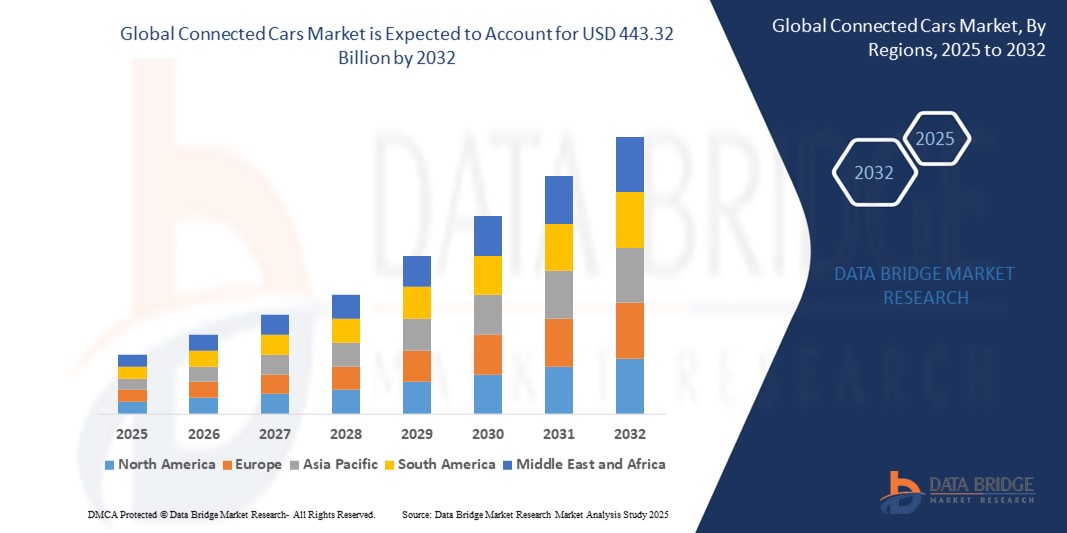
- The Global Connected Cars Market was valued at USD 94.42 billion in 2024 and is expected to reach USD 443.32 billion by 2032
- During the forecast period from 2025 to 2032, the Global Connected Cars Market is projected to grow at a CAGR of 21.30%, primarily driven by the anticipated launch of advanced connectivity solutions, enhanced vehicle-to-everything (V2X) technologies, and the integration of 5G networks that are set to revolutionize the automotive experience.
- This growth is driven by factors such as the rising demand for real-time vehicle connectivity, increasing adoption of autonomous and semi-autonomous vehicles, advancements in automotive telematics, and growing consumer preference for enhanced in-car experiences.
Connected Cars Market Analysis
- Connected cars are increasingly shaping the future of mobility by enabling seamless communication between vehicles, infrastructure, and external networks. These vehicles are equipped with cutting-edge technologies, including advanced sensors, real-time telematics, 5G integration, and intelligent infotainment systems all aimed at improving safety, efficiency, and the overall driving experience.
- The market is experiencing strong growth momentum, largely fueled by rising demand for enhanced in-vehicle connectivity, growing consumer interest in smart mobility, and regulatory initiatives aimed at improving road safety and reducing emissions. A significant share of global demand is being driven by the widespread adoption of Advanced Driver Assistance Systems (ADAS) and next-generation infotainment features, particularly in urbanized regions.
- North America continues to lead as a key region in the connected cars space, supported by its well-developed automotive sector, high consumer tech adoption, and advanced infrastructure that facilitates integration of IoT, AI, and 5G technologies.
- For instance, connected vehicle pilot projects across major U.S. cities, along with strategic collaborations between leading automakers and tech companies, are fostering rapid innovation and deployment. From traditional OEMs to emerging startups, stakeholders across the value chain are contributing to the region’s leadership in this space.
- On a global scale, connected cars have emerged as one of the most strategic focus areas within the automotive industry, ranking just behind electric vehicles in terms of investment and development priority. Their role is becoming increasingly central to the industry's shift toward autonomous, data-driven, and sustainable transportation systems.
Report Scope and Connected Cars Market Segmentation
|
Attributes |
Connected Cars Key Market Insights |
|
Segments Covered |
|
|
Countries Covered |
North America
Europe
Asia-Pacific
Middle East and Africa
South America
|
|
Key Market Players |
|
|
Market Opportunities |
|
|
Value Added Data Infosets |
In addition to the insights on market scenarios such as market value, growth rate, segmentation, geographical coverage, and major players, the market reports curated by the Data Bridge Market Research also include import export analysis, production capacity overview, production consumption analysis, price trend analysis, climate change scenario, supply chain analysis, value chain analysis, raw material/consumables overview, vendor selection criteria, PESTLE Analysis, Porter Analysis, and regulatory framework. |
Connected Cars Market Trends
“Growing Automation Trend in the Automotive Industry”
- The increasing shift toward automation within the automotive sector is significantly driving the growth of the connected cars market.
- Automakers are investing heavily in technologies that enable semi-autonomous and autonomous driving features, such as adaptive cruise control, lane-keeping assistance, and automated parking.
- Connected cars act as the foundation for achieving higher levels of automation by facilitating seamless communication between vehicles, infrastructure, and external networks.
For instance:
- In November 2024, Tesla announced advancements in its Full Self-Driving (FSD) software, highlighting how connected car technologies are integral to developing and deploying autonomous driving solutions worldwide.
Connected Cars Market Dynamics
Driver
“Rising Demand for Enhanced Comfort, Safety, and Convenience”
- The growing consumer expectation for improved driving experiences, combining comfort, safety, and convenience, is a major driver propelling the connected cars market forward.
- Connected cars offer real-time traffic updates, advanced driver-assistance systems (ADAS), automatic emergency responses, and remote diagnostics, enhancing overall vehicle safety and user experience.
- Automakers are increasingly integrating cutting-edge technologies to meet these demands, making connectivity features standard in modern vehicles.
For instance:
- According to a 2024 survey by McKinsey & Company, approximately 70% of consumers globally prioritize advanced safety and convenience features when purchasing a new vehicle, significantly influencing automakers' focus on connected technologies.
Opportunity
“Emergence of 5G and AI Technologies”
- The integration of 5G networks and Artificial Intelligence (AI) into automotive systems presents a significant opportunity for the connected cars market.
- 5G offers ultra-low latency and higher bandwidth, enabling faster vehicle-to-everything (V2X) communication, while AI enhances predictive maintenance, driver behavior analytics, and autonomous driving capabilities.
- These technological advancements are expected to revolutionize vehicle connectivity, making connected cars more efficient, intelligent, and safer.
For instance:
- In January 2025, Qualcomm announced the launch of its new automotive 5G platforms designed to improve vehicle connectivity and enhance autonomous driving features, aiming to support next-generation connected vehicle experiences.
Restraint/Challenge
“Lack of Infrastructure and Cybersecurity Concerns”
- The underdeveloped infrastructure, particularly in emerging markets, poses a significant barrier to the effective deployment and functioning of connected cars.
- Furthermore, cybersecurity threats, such as hacking and data breaches, present a major challenge, raising concerns about user privacy and system vulnerabilities.
- Ensuring robust and resilient communication networks and securing vehicle systems are essential to overcoming these challenges.
For instance:
- In October 2024, according to a report published by the European Union Agency for Cybersecurity (ENISA), connected vehicles faced a 25% increase in cyberattacks compared to 2023, emphasizing the urgent need for improved automotive cybersecurity standards.
Connected Cars Market Scope
The connected cars market is segmented on the basis of service, hardware type, form type, end market, transponder and network.
|
Segmentation |
Sub-Segmentation |
|
By Service |
|
|
By Hardware Type |
|
|
By Form Type |
|
|
By End Market
|
|
|
By Transponder |
|
|
By Network |
|
Connected Cars Market Regional Analysis
“North America is the Dominant Region in the Connected Cars Market”
- North America currently dominates the global Connected Cars market, fueled by its advanced automotive infrastructure, strong focus on technological innovation, and widespread adoption of smart mobility solutions.
- The United States holds a major share within the region, supported by the high penetration of connected vehicles, favorable government initiatives promoting vehicle safety and smart transportation, and the presence of leading automotive and technology firms.
- Additionally, robust investments in research and development, alongside well-established 5G networks and intelligent transport systems, are strengthening the connected mobility ecosystem in the region.
- The rising consumer demand for advanced driver-assistance systems (ADAS), real-time navigation, and in-car infotainment technologies further contributes to market expansion across North America.
“Asia-Pacific is Projected to Register the Highest Growth Rate”
- The Asia-Pacific region is projected to register the highest growth rate in the Connected Cars market, driven by rapid urbanization, growing demand for smart mobility, and increasing automotive production.
- Countries like China, Japan, South Korea, and India are emerging as key markets, supported by rising disposable incomes, technological advancements, and proactive government initiatives promoting smart city and connected vehicle projects.
- Japan remains a leader in the adoption of advanced automotive technologies, including V2V and V2X communication systems, while also focusing heavily on autonomous vehicle development.
- Meanwhile, China and India are experiencing significant growth due to expanding internet penetration, increasing demand for electric and connected vehicles, and heavy investments by both domestic and global players in intelligent transportation infrastructure.
- Furthermore, ongoing 5G deployments, combined with the push for cleaner, smarter mobility solutions, are accelerating the growth of the connected cars ecosystem throughout the Asia-Pacific region.
Connected Cars Market Share
The market competitive landscape provides details by competitor. Details included are company overview, company financials, revenue generated, market potential, investment in research and development, new market initiatives, global presence, production sites and facilities, production capacities, company strengths and weaknesses, product launch, product width and breadth, application dominance. The above data points provided are only related to the companies' focus related to market.
The Major Market Leaders Operating in the Market Are:
- Daimler AG(Germany)
- General Motors (United States)
- Tesla(United States)
- Continental AG(Germany)
- Audi AG(Germany)
- HARMAN(United States)
- BorgWarner Inc.(United States)
- Vodafone Group(United Kingdom)
- AT&T Intellectual Property(United States)
- DENSO CORPORATION(Japan)
- Robert Bosch GmbH(Germany)
- Airbiquity, Inc.(United States)
- NXP Semiconductors(Netherlands)
- Ford Motor Company(United States)
- Microsoft Corporation(United States)
- Tata Consultancy Services Limited(India)
- TOYOTA MOTOR CORPORATION(Japan)
- Verizon (United States)
- Intel Corporation(United States)
- Visteon (United States)
Latest Developments in Global Connected Cars Market
- In March 2025, Tesla, Inc. announced the global rollout of its next-generation Full Self-Driving (FSD) Beta software update, which enhances autonomous driving capabilities through improved neural networks and real-time decision-making. The new update significantly boosts performance in complex urban environments, helping Tesla maintain its leadership in connected and autonomous vehicle technology.
- In February 2025, General Motors, through its subsidiary Cruise, unveiled its Origin autonomous vehicle designed specifically for ride-hailing and goods delivery, featuring complete connectivity with smart city infrastructure. The vehicle’s launch underscores GM's commitment to a future centered around zero crashes, zero emissions, and zero congestion.
- In January 2025, Ford Motor Company introduced its new BlueCruise 2.0 hands-free driving system, expanding the system’s capabilities with lane-changing assist and predictive speed adjustment based on real-time traffic and road conditions. The upgrade aims to enhance driver safety and convenience by leveraging advanced connected vehicle technology.
- In December 2024, Audi AG collaborated with Deutsche Telekom to successfully demonstrate vehicle-to-network (V2N) communication using 5G standalone networks. This partnership enabled vehicles to receive real-time traffic updates, hazard alerts, and optimized route suggestions, significantly improving the driving experience and laying the foundation for future connected mobility solutions.
- In November 2024, Continental AG launched its new High-Performance Computer (HPC) for connected vehicles, designed to manage growing data flows between in-car applications and external cloud-based systems. The HPC offers faster processing speeds and supports the integration of advanced driver-assistance and infotainment systems, helping manufacturers meet rising consumer expectations for connectivity.
SKU-
Get online access to the report on the World's First Market Intelligence Cloud
- Interactive Data Analysis Dashboard
- Company Analysis Dashboard for high growth potential opportunities
- Research Analyst Access for customization & queries
- Competitor Analysis with Interactive dashboard
- Latest News, Updates & Trend analysis
- Harness the Power of Benchmark Analysis for Comprehensive Competitor Tracking
Research Methodology
Data collection and base year analysis are done using data collection modules with large sample sizes. The stage includes obtaining market information or related data through various sources and strategies. It includes examining and planning all the data acquired from the past in advance. It likewise envelops the examination of information inconsistencies seen across different information sources. The market data is analysed and estimated using market statistical and coherent models. Also, market share analysis and key trend analysis are the major success factors in the market report. To know more, please request an analyst call or drop down your inquiry.
The key research methodology used by DBMR research team is data triangulation which involves data mining, analysis of the impact of data variables on the market and primary (industry expert) validation. Data models include Vendor Positioning Grid, Market Time Line Analysis, Market Overview and Guide, Company Positioning Grid, Patent Analysis, Pricing Analysis, Company Market Share Analysis, Standards of Measurement, Global versus Regional and Vendor Share Analysis. To know more about the research methodology, drop in an inquiry to speak to our industry experts.
Customization Available
Data Bridge Market Research is a leader in advanced formative research. We take pride in servicing our existing and new customers with data and analysis that match and suits their goal. The report can be customized to include price trend analysis of target brands understanding the market for additional countries (ask for the list of countries), clinical trial results data, literature review, refurbished market and product base analysis. Market analysis of target competitors can be analyzed from technology-based analysis to market portfolio strategies. We can add as many competitors that you require data about in the format and data style you are looking for. Our team of analysts can also provide you data in crude raw excel files pivot tables (Fact book) or can assist you in creating presentations from the data sets available in the report.