


What is the Computer Graphics Market Size and Growth Rate?
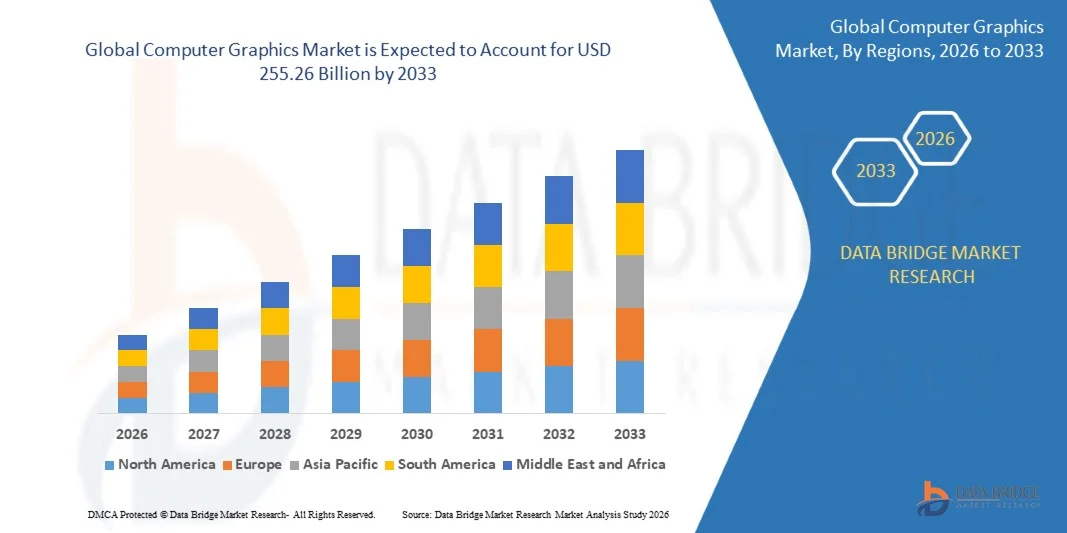
- As per Data Bridge Market Research Analysis the global computer graphics market size was valued at USD 158.71 billion in 2025 and is expected to reach USD 255.26 billion by 2033, at a CAGR of 6.12% during the forecast period
- The market growth is largely fuelled by the increasing demand for high-quality visual content in gaming, film, and virtual reality applications
- Rapid advancements in graphics processing units (GPUs) and real-time rendering technologies are driving enhanced performance and realism in digital content
Market Size and Forecast:
- Global Market Value (2025): USD 158.71 billion
- Expected Market Value (2033): USD 255.26 billion
- Forecast CAGR (2026–2033): 6.12%
How Computer Graphics Market Analysed?
- The market is witnessing significant innovation in AI-driven graphics, enabling faster creation of realistic visuals and animations
- Rising investments in cloud-based graphics rendering and streaming solutions are enhancing accessibility and scalability for businesses and consumers
- North America dominated the global computer graphics market with the largest revenue share of 38.75% in 2025, driven by the strong presence of major software vendors, widespread adoption of advanced graphics solutions across enterprises, and increasing demand for high-quality visualization in media, entertainment, and industrial design
- The Asia-Pacific region is expected to witness the highest growth rate in the global computer graphics market, driven by rapid urbanization, increasing disposable incomes, expanding gaming and animation industries, and government initiatives supporting digital technology adoption
- The Visualization segment held the largest market revenue share in 2025 driven by its extensive use across creative industries and its ability to generate realistic renderings for simulation, design verification and visual communication. Visualization tools often offer seamless support for high‑resolution output, real‑time rendering and integration with cloud‑based platforms, making them a preferred choice for professionals in media, entertainment and product design In addition, Visualization software supports collaboration workflows, further boosting its adoption among distributed teams
Report Scope and Computer Graphics Market Segmentation
|
Attributes |
Computer Graphics Key Market Insights |
|
Segments Covered |
|
|
Countries Covered |
North America
Europe
Asia-Pacific
Middle East and Africa
South America
|
|
Key Market Players |
|
|
Market Opportunities |
|
|
Value Added Data Infosets |
In addition to the market insights such as market value, growth rate, market segments, geographical coverage, market players, and market scenario, the market report curated by the Data Bridge Market Research team includes in-depth expert analysis, import/export analysis, pricing analysis, production consumption analysis, and pestle analysis. |
What are the Computer Graphics Market Trends?
“Rising Demand for High-Quality Visual Experiences”
• The increasing demand for realistic and immersive visual content is significantly shaping the computer graphics market, as industries such as gaming, film, and virtual reality increasingly require high-quality graphics rendering. Advanced graphics solutions enhance visual fidelity, enable interactive environments, and improve user experience across platforms, encouraging software developers and hardware manufacturers to innovate continuously
• Adoption of virtual reality (VR), augmented reality (AR), and mixed reality (MR) applications has accelerated the need for high-performance graphics. These technologies rely heavily on powerful graphics processing units (GPUs) and optimized rendering engines to deliver seamless experiences, driving market growth and prompting collaborations between software developers, hardware vendors, and entertainment companies
• The growing use of computer graphics in simulation, architectural visualization, automotive design, and healthcare applications is influencing market expansion. High-quality graphics enable precise modeling, real-time simulation, and enhanced visualization, allowing industries to optimize design processes, reduce costs, and improve efficiency
• For instance, in 2024, NVIDIA in the U.S. and Autodesk in U.K. launched new GPUs and rendering software updates aimed at improving real-time graphics performance for gaming, animation, and design workflows. These solutions enhanced visual quality, reduced rendering times, and supported more complex graphics projects, strengthening the adoption of high-end graphics technologies
• While demand for advanced computer graphics is rising, sustained market expansion depends on continuous innovation, cost-effective hardware solutions, and software compatibility across platforms. Manufacturers are focusing on improving GPU performance, rendering efficiency, and cloud-based graphics solutions to support broader adoption across industries
What are the Computer Graphics Market Dynamics?
Driver
“Growing Adoption of VR, AR, and Gaming Applications”
• Rising consumer and enterprise demand for immersive gaming, interactive simulations, and virtual experiences is a major driver for the computer graphics market. Developers are increasingly leveraging high-performance GPUs, graphics APIs, and AI-powered rendering to deliver realistic content and responsive experiences
• Expanding use of graphics solutions in film production, architectural visualization, healthcare imaging, automotive design, and education is fueling market growth. Enhanced graphics capabilities improve realism, enable precise simulations, and facilitate complex design processes, increasing adoption across professional and consumer segments
• Hardware and software providers are actively promoting graphics solutions through product launches, platform integrations, and partnerships. These efforts, combined with rising adoption of VR/AR headsets and cloud rendering technologies, are encouraging industries to upgrade to advanced graphics platforms for competitive advantage
• For instance, in 2023, AMD in the U.S. and Epic Games in U.K. reported expanded deployment of high-performance graphics cards and rendering engines in gaming and simulation applications. The adoption led to improved visual fidelity, smoother performance, and faster rendering, boosting consumer engagement and industry standards
• Although demand for advanced graphics is strong, wider adoption depends on cost, hardware availability, and software compatibility. Investment in cloud rendering, GPU efficiency, and cross-platform solutions will be critical to support global growth and maintain competitive positioning
Restraint/Challenge
“High Hardware Costs and Complex Software Integration”
• The high cost of GPUs, specialized graphics hardware, and advanced rendering software remains a key challenge, limiting adoption among budget-conscious consumers and small enterprises. Complex integration requirements further impact deployment timelines and operational efficiency
• Compatibility issues between different graphics APIs, software platforms, and hardware configurations may restrict seamless performance. This can lead to increased costs for enterprises and developers who need to maintain multiple graphics environments for various applications
• Limited awareness of advanced graphics solutions and lack of skilled personnel in emerging markets further restrains growth. Companies may face challenges in implementing high-end graphics solutions for simulation, gaming, and professional visualization
• For instance, in 2024, several small studios in India and Southeast Asia reported slower adoption of cloud rendering and high-performance GPUs due to elevated costs and integration challenges. These limitations affected project timelines and prevented wider access to cutting-edge graphics technologies
• Overcoming these challenges requires cost-effective hardware, simplified software solutions, and training initiatives to improve skills and awareness. Collaboration between hardware manufacturers, software developers, and educational institutions can help unlock the long-term growth potential of the global computer graphics market while driving innovation and adoption
What is Computer Graphics Market Scope?
The market is segmented on the basis of software, service, end‑user, and vertical.
• By Software
On the basis of software, the global computer graphics market is segmented into Computer‑Aided Design/Computer‑Aided Manufacturing (CAD/CAM), Visualization, Digital Video, Imaging, Modeling/Animation, and Others. The Visualization segment held the largest market revenue share in 2025 driven by its extensive use across creative industries and its ability to generate realistic renderings for simulation, design verification and visual communication. Visualization tools often offer seamless support for high‑resolution output, real‑time rendering and integration with cloud‑based platforms, making them a preferred choice for professionals in media, entertainment and product design In addition, Visualization software supports collaboration workflows, further boosting its adoption among distributed teams.
The Modeling/Animation segment is expected to witness the fastest growth rate from 2026 to 2033, driven by increasing demand for animated content in gaming, virtual production and augmented/virtual reality experiences. Modeling/Animation tools are particularly sought after for their robust capabilities in creating detailed 3D assets and character animations, making them essential for studios and independent creators focusing on immersive digital content.
• By Service
On the basis of service, the global computer graphics market is segmented into Consulting, Training and Support, and Integration. The Integration segment held the largest market revenue share in 2025 owing to the rising need for seamless deployment of graphics solutions across enterprise systems and design pipelines. Integration services often provide tailored workflows that ensure compatibility with existing IT infrastructure and third‑party applications, making them indispensable for large‑scale implementations In addition, integration service providers help organizations optimize performance and scalability of graphics solutions, further strengthening their appeal.
The Training and Support segment is expected to register the fastest growth from 2026 to 2033, driven by the rising complexity of advanced graphics tools and the increasing focus on upskilling workforces. Training and Support services are particularly valued for their role in reducing learning curves and enabling efficient utilization of software capabilities, making them critical for businesses adopting cutting‑edge graphics technologies.
• By End‑User
On the basis of end‑user, the global computer graphics market is segmented into Small and Medium Businesses and Enterprises. The Enterprises segment held the largest market revenue share in 2025 due to significant investments in high‑performance graphics solutions for complex design, simulation and content production tasks. Enterprises often deploy comprehensive graphics ecosystems that support cross‑departmental collaboration and high‑fidelity output, making them the dominant segment in terms of revenue In addition, enterprises benefit from long‑term service agreements and customized support that enhance operational efficiency.
The Small and Medium Businesses segment is expected to witness the fastest growth rate from 2026 to 2033, driven by increasing adoption of cost‑effective graphics software and cloud‑based rendering services. Small and medium businesses are leveraging affordable subscription models and scalable graphics solutions to compete with larger organizations, making this segment a key growth driver.
• By Vertical
On the basis of vertical, the global computer graphics market is segmented into Aerospace and Defense, Automobile, Entertainment and Advertising, Academia and Education, Healthcare, Manufacturing, Architecture, Building, and Construction and Others. The Entertainment and Advertising vertical held the largest market revenue share in 2025 owing to the high demand for visual effects, animation and digital campaigns across film, television and online platforms. Entertainment and Advertising applications often require advanced graphics capabilities for storytelling and brand engagement, making this vertical a major revenue contributor In addition, the growing consumption of digital media content has further propelled the integration of computer graphics technologies.
The Architecture, Building, and Construction vertical is expected to witness the fastest growth from 2026 to 2033, driven by the rising use of 3D visualization and Building Information Modeling (BIM) tools for design planning and project communication. Architecture and Construction professionals increasingly rely on computer graphics to create detailed visualizations of structures and facilitate stakeholder reviews, making this vertical a significant contributor to market expansion.
Which Region Holds the Largest Share of the Computer Graphics Market?
• North America dominated the global computer graphics market with the largest revenue share of 38.75% in 2025, driven by the strong presence of major software vendors, widespread adoption of advanced graphics solutions across enterprises, and increasing demand for high-quality visualization in media, entertainment, and industrial design
• Organizations and creative professionals in the region highly value the capabilities offered by computer graphics software, including real-time rendering, 3D modeling, and simulation, along with seamless integration with cloud and collaborative platforms
• This widespread adoption is further supported by high IT infrastructure investment, a technology-driven workforce, and the growing emphasis on digital content creation and immersive experiences, establishing computer graphics as a critical tool for enterprises and SMBs
U.S. Computer Graphics Market Insight
The U.S. computer graphics market captured the largest revenue share in 2025 within North America, fueled by the rapid adoption of visualization, modeling, and animation tools across media, gaming, aerospace, and automotive sectors. Organizations are increasingly prioritizing high-fidelity graphics solutions for design, simulation, and digital content production. The growing integration of graphics software with cloud services, AI-powered rendering, and real-time collaboration platforms further propels market growth. Moreover, the expansion of AR/VR applications and digital media production is significantly contributing to the market’s advancement.
Europe Computer Graphics Market Insight
The Europe computer graphics market is expected to witness the fastest growth rate from 2026 to 2033, primarily driven by increasing investment in digital media, architectural visualization, and advanced simulation tools. The region’s focus on innovation, coupled with government incentives for technology adoption, is fostering market growth. European organizations are also drawn to energy-efficient software and tools that enhance workflow efficiency. The market is experiencing notable growth across entertainment, automotive, and construction applications, with computer graphics increasingly integrated into both new projects and existing digital pipelines.
U.K. Computer Graphics Market Insight
The U.K. computer graphics market is expected to witness the fastest growth rate from 2026 to 2033, driven by the expanding media and entertainment sector and the rising trend of digital content creation. In addition, the adoption of advanced design and simulation tools in architecture, manufacturing, and automotive industries is encouraging both SMEs and large enterprises to invest in graphics solutions. The U.K.’s strong IT infrastructure, digital literacy, and thriving creative economy are expected to continue stimulating market growth.
Germany Computer Graphics Market Insight
The Germany computer graphics market is expected to witness the fastest growth rate from 2026 to 2033, fueled by increasing demand for high-precision CAD/CAM tools, visualization, and simulation software in manufacturing and engineering sectors. Germany’s emphasis on innovation, sustainability, and digitalization promotes adoption of advanced graphics solutions, particularly for industrial design, automotive, and construction projects. Integration of computer graphics with enterprise systems and digital twins is becoming increasingly prevalent, meeting the high standards of German consumers and industrial clients.
Asia-Pacific Computer Graphics Market Insight
The Asia-Pacific computer graphics market is expected to witness the fastest growth rate from 2026 to 2033, driven by rapid urbanization, rising disposable incomes, and growing investments in digital media, gaming, and animation in countries such as China, Japan, and India. The region’s expanding technology ecosystem, coupled with government initiatives supporting digitalization and innovation, is driving adoption of computer graphics solutions. Furthermore, APAC is emerging as a hub for software development and animation services, making high-quality graphics tools more accessible to businesses and creative professionals.
Japan Computer Graphics Market Insight
The Japan computer graphics market is expected to witness the fastest growth rate from 2026 to 2033 due to the country’s advanced technological infrastructure, strong gaming and entertainment industries, and demand for high-quality digital content. Japanese organizations emphasize precision and realism in graphics, with widespread adoption of 3D modeling, visualization, and animation tools. Integration with IoT and AR/VR platforms, along with support for remote collaboration, is fueling growth. Moreover, Japan’s aging workforce is driving demand for user-friendly, efficient graphics solutions for both enterprise and creative applications.
China Computer Graphics Market Insight
The China computer graphics market accounted for the largest market revenue share in Asia-Pacific in 2025, attributed to the country’s rapidly growing gaming, animation, and digital media industries. China stands as one of the largest markets for CAD/CAM, visualization, and modeling software, with increasing adoption in manufacturing, automotive, and architectural sectors. The push towards smart cities, government support for technology development, and the presence of leading domestic software vendors are key factors propelling the market in China
Which are the Top Companies in Computer Graphics Market?
The Computer Graphics industry is primarily led by well-established companies, including:
• Adobe (U.S.)
• Advanced Micro Devices, Inc (U.S.)
• Dassault Systèmes (France)
• Autodesk Inc. (U.S.)
• Intel Corporation (U.S.)
• Siemens (Germany)
• Microsoft (U.S.)
• SONY Corporation (Japan)
• Siemens Product Lifecycle Management Software Inc. (U.S.)
• Imagination Technologies Limited (U.K.)
• Nvidia Corporation (U.S.)
• ARM Ltd. (U.K.)
• Autodesk Inc. (U.S.)
• Matrox (Canada)
• Mentor Graphics, Inc (U.S.)
• 3D PLM-related software (various)
What are the Latest Developments in Global Computer Graphics Market?
- In August 2026, NVIDIA (U.S.) launched its latest GPU architecture, designed to significantly enhance real-time ray tracing and rendering capabilities. The new GPUs offer improved performance, lower latency, and higher energy efficiency, catering to both gaming and professional visualization sectors. This development strengthens NVIDIA’s competitive position while meeting the rising demand for realistic virtual environments. The technology also supports advanced simulation and AI-driven graphics workflows, providing a broader impact across industries such as media, entertainment, and engineering
- In September 2025, Adobe (U.S.) unveiled a new suite of AI-powered tools within its Creative Cloud platform, aimed at automating repetitive design tasks and streamlining creative workflows. The tools enable designers and content creators to enhance productivity, generate high-quality visuals faster, and focus on innovation rather than manual processes. This initiative reinforces Adobe’s leadership in creative software while addressing evolving customer expectations. By integrating AI capabilities, Adobe positions itself at the forefront of intelligent content creation and advanced graphics solutions
- In October 2024, Unity Technologies (U.S.) entered a strategic partnership with a leading virtual reality hardware manufacturer to expand its VR content creation platform. The collaboration provides developers with access to enhanced tools for immersive experiences, including optimized rendering, interactive simulations, and real-time testing. This partnership supports the growth of VR applications in gaming, training, architecture, and education. By broadening its ecosystem, Unity accelerates adoption of its platform and fosters innovation within the immersive content market
- In March 2024, NVIDIA (U.S.) introduced its Blackwell platform, enabling organizations to run real-time generative AI on trillions of large-parameter language models. The platform delivers up to 25 times lower energy consumption and costs compared with previous solutions, making AI-driven graphics and simulations more sustainable and scalable. It empowers enterprises to leverage generative AI for content creation, visualization, and complex modeling tasks. This launch strengthens NVIDIA’s role in AI-enabled computer graphics and reinforces its market leadership in high-performance GPU solutions
- In May 2023, AMD (U.S.) launched the Radeon RX 7600 graphics card, offering next-generation performance for gaming, content creation, and streaming applications. The GPU provides enhanced rendering speeds, higher frame rates, and improved energy efficiency, catering to both professional and consumer markets. This release reinforces AMD’s competitive edge in high-performance graphics solutions. It also supports the increasing demand for advanced gaming experiences, digital media production, and simulation workflows across multiple industries
- In 2022, NVIDIA (U.S.) introduced several advancements in AI-powered rendering and real-time visualization technologies, aimed at accelerating graphics performance for professional design, gaming, and simulation applications. These improvements allowed faster rendering, higher fidelity visuals, and integration with machine learning frameworks. The developments reinforced NVIDIA’s dominance in the computer graphics market and encouraged broader adoption of AI-enhanced graphics solutions. Enterprises and creative professionals benefited from increased efficiency, reduced computational costs, and enhanced workflow capabilities

- Interactive Data Analysis Dashboard
- Company Analysis Dashboard for high growth potential opportunities
- Research Analyst Access for customization & queries
- Competitor Analysis with Interactive dashboard
- Latest News, Updates & Trend analysis
- Harness the Power of Benchmark Analysis for Comprehensive Competitor Tracking
Data collection and base year analysis are done using data collection modules with large sample sizes. The stage includes obtaining market information or related data through various sources and strategies. It includes examining and planning all the data acquired from the past in advance. It likewise envelops the examination of information inconsistencies seen across different information sources. The market data is analysed and estimated using market statistical and coherent models. Also, market share analysis and key trend analysis are the major success factors in the market report. To know more, please request an analyst call or drop down your inquiry.
The key research methodology used by DBMR research team is data triangulation which involves data mining, analysis of the impact of data variables on the market and primary (industry expert) validation. Data models include Vendor Positioning Grid, Market Time Line Analysis, Market Overview and Guide, Company Positioning Grid, Patent Analysis, Pricing Analysis, Company Market Share Analysis, Standards of Measurement, Global versus Regional and Vendor Share Analysis. To know more about the research methodology, drop in an inquiry to speak to our industry experts.
Data Bridge Market Research is a leader in advanced formative research. We take pride in servicing our existing and new customers with data and analysis that match and suits their goal. The report can be customized to include price trend analysis of target brands understanding the market for additional countries (ask for the list of countries), clinical trial results data, literature review, refurbished market and product base analysis. Market analysis of target competitors can be analyzed from technology-based analysis to market portfolio strategies. We can add as many competitors that you require data about in the format and data style you are looking for. Our team of analysts can also provide you data in crude raw excel files pivot tables (Fact book) or can assist you in creating presentations from the data sets available in the report.













