


What is the Cognitive Security Market Size and Growth Rate?
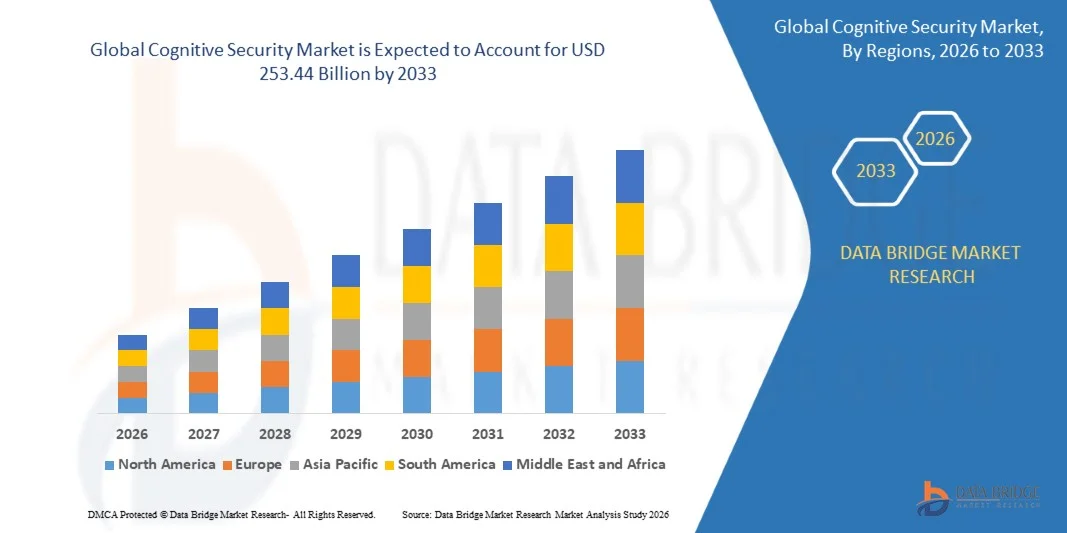
- As per Data Bridge Market Research Analysis the global cognitive security market size was valued at USD 31.63 billion in 2025 and is expected to reach USD 253.44 billion by 2033, at a CAGR of 29.71% during the forecast period
- The market growth is largely fueled by the increasing adoption of AI-powered security solutions and advanced threat intelligence platforms, driving digital transformation and proactive cybersecurity measures across enterprises and government organizations
- Furthermore, rising demand for automated risk mitigation, anomaly detection, and compliance management is positioning cognitive security as a critical component of modern security infrastructure. These converging factors are accelerating the deployment of cognitive security solutions, thereby significantly boosting market growth
Market Size and Forecast:
- Global Market Value (2025): USD 31.63 billion
- Expected Market Value (2033): USD 253.44 billion
- Forecast CAGR (2026–2033): 29.71%
How Cognitive Security Market Analysed?
- Cognitive security solutions leverage AI, machine learning, and behavioral analytics to detect, analyze, and respond to complex cyber threats in real time. These platforms provide automated monitoring, predictive threat intelligence, and risk assessment capabilities, helping enterprises safeguard sensitive data and critical infrastructure
- The escalating demand for cognitive security is primarily driven by increasing cyberattacks, regulatory compliance requirements, and the need for scalable, AI-enabled threat detection and response. Organizations are prioritizing cognitive security to enhance operational efficiency, reduce manual workload, and strengthen their overall cybersecurity posture
- North America dominated the cognitive security market with a share of 35.75% in 2025, due to increasing cybersecurity investments, government initiatives to strengthen critical infrastructure, and widespread adoption of AI-powered threat intelligence solutions
- Asia-Pacific is expected to be the fastest growing region in the cognitive security market during the forecast period due to increasing digitalization, rising cyber threats, and growing adoption of cloud and AI-based security platforms across major economies such as China, Japan, and India
- Cybersecurity segment dominated the market with a market share of 61.7% in 2025, due to the increasing number of sophisticated cyberattacks targeting enterprises and critical infrastructure. Businesses prioritize advanced cybersecurity solutions to safeguard sensitive data, ensure business continuity, and comply with regulatory standards. Cognitive cybersecurity systems leverage AI and machine learning to identify threats, predict attack patterns, and automate responses, making them indispensable for modern digital operations
Report Scope and Cognitive Security Market Segmentation
|
Attributes |
Cognitive Security Key Market Insights |
|
Segments Covered |
|
|
Countries Covered |
North America
Europe
Asia-Pacific
Middle East and Africa
South America
|
|
Key Market Players |
|
|
Market Opportunities |
|
|
Value Added Data Infosets |
In addition to the market insights such as market value, growth rate, market segments, geographical coverage, market players, and market scenario, the market report curated by the Data Bridge Market Research team includes in-depth expert analysis, import/export analysis, pricing analysis, production consumption analysis, and pestle analysis. |
What are the Cognitive Security Market Trends?
“Rising Adoption of AI-Powered Threat Intelligence Solutions”
- A significant trend in the cognitive security market is the growing adoption of AI-driven threat intelligence solutions, fueled by the need for proactive cybersecurity measures and advanced threat detection capabilities across enterprises and government organizations. These AI-powered solutions enhance the identification of emerging cyber threats, automate risk analysis, and improve overall security posture in increasingly complex digital environments
- For instance, IBM Security leverages its Watson AI platform to deliver cognitive threat intelligence that predicts, detects, and responds to cyberattacks in real time. This integration enables organizations to anticipate sophisticated threats and strengthen defense mechanisms across network and endpoint infrastructures
- The use of AI and machine learning in security operations centers is expanding rapidly as these technologies enable automated threat prioritization, anomaly detection, and adaptive response strategies. This trend positions cognitive security as a critical enabler for organizations seeking continuous monitoring and intelligent decision-making capabilities
- Enterprises are increasingly integrating AI-driven solutions with existing security frameworks to enhance compliance and regulatory adherence, ensuring that sensitive data is protected against evolving risks. Cognitive security applications are supporting this shift by providing contextual insights and automated reporting features
- The rise in sophisticated cyberattacks and targeted phishing campaigns is driving organizations to adopt cognitive security platforms that can learn and adapt from attack patterns. This growing reliance on intelligent security analytics is transforming traditional cybersecurity models and enhancing threat resilience
- The market is witnessing increased investment in cognitive security technologies from sectors such as finance, healthcare, and critical infrastructure, where high-value data and operational continuity are priorities. This trend reinforces the essential role of AI-powered intelligence in modern cybersecurity strategies
What are the Cognitive Security Market Dynamics?
Driver
“Increasing Demand for Automated Risk Mitigation and Compliance”
- The demand for automated risk mitigation and compliance solutions is rising as organizations seek to reduce manual intervention in threat management and ensure regulatory adherence across complex IT environments. Automated cognitive security solutions enable continuous monitoring, risk scoring, and incident response with minimal human involvement
- For instance, Palo Alto Networks provides AI-based Cortex XSOAR solutions that automate security operations, incident response, and compliance reporting, improving operational efficiency for large enterprises. These platforms help organizations manage security incidents faster and reduce potential regulatory penalties
- Organizations are prioritizing automation to manage growing volumes of security alerts and to enhance response speed against cyber threats. This focus is increasing adoption of cognitive platforms capable of integrating with existing cybersecurity tools and providing actionable insights
- The need to maintain compliance with frameworks such as GDPR, HIPAA, and NIST is reinforcing the adoption of cognitive security systems that provide audit-ready reporting and continuous monitoring. Automated solutions are helping organizations meet regulatory obligations while optimizing security operations
- Growing awareness of the financial and reputational impact of data breaches is compelling organizations to adopt advanced cognitive security solutions. These systems support strategic decision-making and operational efficiency by combining automated threat detection with regulatory compliance support
Restraint/Challenge
“Complexity and High Implementation Costs of Cognitive Security Solutions”
- The cognitive security market faces challenges due to the technical complexity of deploying AI-driven security platforms, which require integration with multiple IT systems and specialized expertise. Implementation often involves significant configuration, tuning, and ongoing management to ensure optimal performance
- For instance, Splunk Enterprise Security integrates AI and machine learning for cognitive threat detection, but its deployment requires skilled cybersecurity professionals and dedicated infrastructure, raising costs and complexity for organizations
- High investment requirements for software licensing, hardware infrastructure, and skilled personnel can be a barrier for small and medium enterprises seeking cognitive security solutions. These costs may slow adoption despite the clear benefits in threat intelligence and automation
- The reliance on continuous updates, AI model training, and maintenance adds to operational complexity and can strain internal IT resources. Organizations must balance the need for advanced security capabilities with available budgets and technical capacity
- Scalability challenges arise when organizations attempt to expand cognitive security solutions across multiple departments or geographic locations, requiring consistent configuration and monitoring. These challenges collectively limit the speed of deployment and may impact return on investment for organizations implementing cognitive security platforms
What is the Cognitive Security Market Scope?
The market is segmented on the basis of application, security type, component, deployment mode, organization size, and vertical.
• By Application
On the basis of application, the cognitive security market is segmented into threat intelligence, anomaly detection and risk mitigation, automated compliance management, and others. The threat intelligence segment dominated the largest market revenue share in 2025, driven by its critical role in providing actionable insights to anticipate and prevent cyberattacks. Organizations increasingly rely on threat intelligence solutions to aggregate, analyze, and correlate threat data from multiple sources, enabling proactive defense strategies. These solutions also help businesses prioritize security risks and optimize response protocols, ensuring comprehensive protection against evolving threats. Integration with AI and machine learning enhances predictive capabilities, making threat intelligence highly valuable for enterprises across sectors.
The anomaly detection and risk mitigation segment is expected to witness the fastest CAGR from 2026 to 2033, fueled by growing adoption across industries requiring real-time monitoring and rapid threat response. For instance, IBM Security’s QRadar platform enables organizations to detect unusual patterns and mitigate potential risks automatically, reducing incident response times. Organizations are increasingly deploying anomaly detection solutions to identify behavioral deviations in networks, applications, and endpoints, enhancing overall security posture. The segment benefits from advances in AI-driven analytics, which improve accuracy and reduce false positives.
• By Security Type
On the basis of security type, the market is segmented into physical security and cybersecurity. Cybersecurity dominated the largest market revenue share of 61.7% in 2025 due to the increasing number of sophisticated cyberattacks targeting enterprises and critical infrastructure. Businesses prioritize advanced cybersecurity solutions to safeguard sensitive data, ensure business continuity, and comply with regulatory standards. Cognitive cybersecurity systems leverage AI and machine learning to identify threats, predict attack patterns, and automate responses, making them indispensable for modern digital operations. The adoption of cloud and hybrid IT environments further reinforces the demand for cybersecurity-focused cognitive solutions.
The physical security segment is anticipated to witness the fastest growth rate from 2026 to 2033, driven by the integration of cognitive technologies in access control, surveillance, and facility monitoring. For instance, Honeywell’s physical security platforms incorporate AI-driven analytics to detect unauthorized access or suspicious behavior in real time. Growing awareness of workplace safety, critical infrastructure protection, and IoT-enabled monitoring systems contributes to the rising adoption of physical security solutions. The trend is further supported by convergence between IT and operational technology security strategies.
• By Component
On the basis of component, the market is segmented into solution and services. The solutions segment dominated the largest market revenue share in 2025, attributed to the demand for comprehensive platforms that provide end-to-end security monitoring, threat detection, and automated response capabilities. Organizations prefer solution-based deployments for their ability to integrate multiple cognitive security functionalities, reducing operational complexity and enhancing efficiency. Advanced solutions often include analytics dashboards, AI-driven alerts, and real-time reporting, which support informed decision-making. The growing emphasis on risk-based security strategies further drives solution adoption across industries.
The services segment is expected to witness the fastest growth from 2026 to 2033, driven by increasing demand for managed security services, consulting, and integration support. For instance, Accenture’s cybersecurity services help organizations implement AI-powered security frameworks while optimizing operational workflows. Services provide scalability, expert guidance, and continuous monitoring, allowing enterprises to focus on core business while mitigating security risks effectively. Outsourcing and subscription-based service models further contribute to rapid market expansion.
• By Deployment Mode
On the basis of deployment mode, the market is segmented into cloud and on-premises. Cloud deployment dominated the largest market revenue share in 2025, owing to its flexibility, scalability, and reduced infrastructure requirements. Cloud-based cognitive security solutions enable organizations to access real-time threat intelligence, automated updates, and centralized monitoring without significant upfront investments. Integration with SaaS applications and remote workforce enablement further strengthens the adoption of cloud deployment models. Enterprises increasingly value the agility and cost-effectiveness offered by cloud-based cognitive security solutions.
The on-premises deployment segment is anticipated to witness the fastest growth from 2026 to 2033, driven by organizations requiring strict data control, compliance adherence, and customized security architectures. For instance, Palo Alto Networks’ on-premises security solutions provide tailored AI-based threat detection for highly regulated sectors. Organizations in banking, government, and defense often prefer on-premises deployment to maintain data sovereignty and mitigate risks associated with cloud connectivity. Hybrid deployment strategies also boost growth by combining the benefits of cloud and on-premises models.
• By Organization Size
On the basis of organization size, the market is segmented into large enterprises and small and medium-sized enterprises (SMEs). Large enterprises dominated the largest market revenue share in 2025 due to their higher security budgets, complex IT infrastructure, and exposure to sophisticated cyber threats. These organizations deploy comprehensive cognitive security solutions to protect sensitive data, maintain compliance, and prevent financial losses from breaches. Integration with enterprise-wide risk management frameworks and digital transformation initiatives reinforces the adoption of advanced cognitive security systems.
The SME segment is expected to witness the fastest growth from 2026 to 2033, driven by increasing awareness of cyber threats and availability of cost-effective, AI-driven solutions. For instance, Cisco’s SME-focused security offerings provide scalable cognitive threat detection and automated incident response for small businesses. Cloud-based services, subscription models, and simplified management tools make cognitive security accessible to SMEs with limited IT resources. Growth is supported by rising regulatory requirements and digital adoption among SMEs.
• By Vertical
On the basis of vertical, the market is segmented into aerospace and defense, government, banking, financial services, and insurance (BFSI), IT and telecom, healthcare, retail, manufacturing, energy and utilities, and others. The BFSI vertical dominated the largest market revenue share in 2025 due to the high value of financial assets and sensitive customer data, which necessitates advanced threat detection and fraud prevention mechanisms. Cognitive security solutions help BFSI organizations identify suspicious transactions, prevent breaches, and ensure regulatory compliance. The integration of AI-driven risk analytics enhances operational efficiency and mitigates financial and reputational losses.
The healthcare vertical is expected to witness the fastest growth from 2026 to 2033, fueled by the increasing digitization of patient records, telemedicine, and medical devices. For instance, Cerner’s cognitive security solutions monitor network activity to protect electronic health records and detect unauthorized access in real time. Rising cyberattacks targeting healthcare institutions, along with stringent data privacy regulations, drive the adoption of AI-enabled threat detection. Cognitive security also supports operational resilience by safeguarding critical healthcare infrastructure and ensuring patient safety.
Which Region Holds the Largest Share of the Cognitive Security Market?
- North America dominated the cognitive security market with the largest revenue share of 35.75% in 2025, driven by increasing cybersecurity investments, government initiatives to strengthen critical infrastructure, and widespread adoption of AI-powered threat intelligence solutions
- Organizations in the region prioritize proactive risk mitigation and automated compliance management to address evolving cyber threats. High awareness of advanced security technologies, coupled with substantial IT budgets and a strong presence of cognitive security solution providers, further accelerates adoption across enterprises
- The region’s focus on integrating cognitive security with cloud and on-premises IT environments enhances operational efficiency and supports digital transformation initiatives
U.S. Cognitive Security Market Insight
The U.S. cognitive security market captured the largest revenue share in North America in 2025, fueled by the increasing prevalence of sophisticated cyberattacks targeting financial institutions, healthcare, and government organizations. Enterprises are investing in AI-enabled threat intelligence and anomaly detection solutions to enhance real-time monitoring and automated response capabilities. The growing demand for cloud-based cognitive security platforms, along with integration with existing IT infrastructure and compliance frameworks, drives market growth. In addition, government support for cybersecurity readiness and initiatives promoting digital resilience contribute to the rapid expansion of the U.S. market.
Europe Cognitive Security Market Insight
The Europe cognitive security market is projected to grow at a significant CAGR during the forecast period, driven by stringent data protection regulations such as GDPR and rising cybersecurity awareness among enterprises. Organizations across BFSI, IT, and healthcare sectors are adopting cognitive solutions to prevent data breaches and ensure compliance. The increasing trend of digital transformation and deployment of AI-powered security platforms enhances operational efficiency and threat detection capabilities. Countries such as the U.K. and Germany are witnessing accelerated adoption, supported by government initiatives and investments in secure digital infrastructures.
U.K. Cognitive Security Market Insight
The U.K. cognitive security market is anticipated to grow at a noteworthy CAGR during the forecast period, driven by escalating cyber threats and heightened regulatory compliance requirements. Enterprises are focusing on AI-enabled threat intelligence, anomaly detection, and automated compliance management to strengthen their security posture. The region’s adoption of cloud-based solutions, coupled with a robust IT and fintech ecosystem, supports rapid market growth. Furthermore, awareness of data privacy, along with increasing integration of cognitive security with enterprise IT operations, is fueling adoption in both public and private sectors.
Germany Cognitive Security Market Insight
The Germany cognitive security market is expected to expand at a considerable CAGR during the forecast period, fueled by the demand for advanced AI-driven cybersecurity solutions and proactive risk management frameworks. German enterprises are increasingly deploying cognitive security to protect critical infrastructure, ensure regulatory compliance, and mitigate sophisticated cyber threats. The presence of well-established IT and technology companies, combined with government support for cybersecurity innovation, promotes adoption. Integration with enterprise-wide IT systems and preference for privacy-focused, automated security solutions further enhance market growth.
Asia-Pacific Cognitive Security Market Insight
The Asia-Pacific cognitive security market is poised to grow at the fastest CAGR during the forecast period of 2026 to 2033, driven by increasing digitalization, rising cyber threats, and growing adoption of cloud and AI-based security platforms across major economies such as China, Japan, and India. Enterprises are leveraging cognitive security to automate threat detection, monitor anomalous activities, and manage regulatory compliance efficiently. Government initiatives promoting smart cities and digital infrastructures accelerate market adoption. In addition, the expanding IT and telecom sectors, coupled with increasing cybersecurity budgets, contribute to rapid growth in APAC.
Japan Cognitive Security Market Insight
The Japan cognitive security market is gaining momentum due to the country’s high-tech ecosystem, rapid digital adoption, and increasing cyberattack incidents targeting enterprises and critical infrastructure. Japanese organizations are investing in AI-driven threat intelligence and anomaly detection platforms to enhance automated monitoring and response. Integration with existing IT systems and cloud infrastructures enables efficient security management. Moreover, strong government support for cybersecurity initiatives and increasing demand from manufacturing, BFSI, and healthcare sectors drive market expansion.
China Cognitive Security Market Insight
The China cognitive security market accounted for the largest revenue share in Asia-Pacific in 2025, attributed to rapid digital transformation, government emphasis on cybersecurity, and adoption of AI-powered security solutions across enterprises. Organizations in BFSI, IT, and e-commerce sectors are deploying cognitive security to detect and mitigate evolving threats in real time. The rise of smart cities, cloud adoption, and strong domestic solution providers further support market growth. Increased regulatory focus on data protection and proactive cyber defense strategies drives the demand for comprehensive cognitive security platforms.
Which are the Top Companies in Cognitive Security Market?
The cognitive security industry is primarily led by well-established companies, including:
- Amazon Web Services, Inc. (U.S.)
- Acalvio Technologies Inc. (U.S.)
- Broadcom (U.S.)
- NEOM (Saudi Arabia)
- Check Point Software Technologies Ltd. (Israel)
- Cisco Systems, Inc. (U.S.)
- Cybraics, Inc. (U.S.)
- Cylance Inc. (U.S.)
- DXC Technology Company (U.S.)
- Darktrace (U.K.)
- Deep Instinct (Israel)
- Palo Alto Networks, Inc. (U.S.)
- EXPERT.AI (Italy)
- Feedzai (Portugal)
- Fortinet Inc. (U.S.)
- Google LLC (U.S.)
- IBM (U.S.)
- LogRhythm, Inc. (U.S.)
- McAfee LLC (U.S.)
- Securonix, Inc. (U.S.)
- Sift (U.S.)
- )
What are the Latest Developments in Global Cognitive Security Market?
- In February 2026, Palo Alto Networks completed its USD 25 billion acquisition of CyberArk, significantly enhancing its identity security and privileged access management capabilities. This move strengthens its cognitive security portfolio, enabling enterprises to protect critical assets against AI‑driven threats more effectively. The acquisition accelerates the adoption of integrated AI‑centric security solutions, positioning Palo Alto Networks as a market leader capable of delivering comprehensive threat detection, automated response, and risk mitigation across large-scale enterprise environments
- In March 2026, Check Point Software Technologies launched its AI Defense Plane platform, designed to secure AI‑driven enterprise environments by automating complex threat hunting and remediation processes. This solution addresses the growing shortage of skilled cybersecurity professionals while allowing organizations to scale their cognitive security infrastructure efficiently. By leveraging AI to monitor, detect, and neutralize threats in real time, Check Point strengthens its market presence and supports enterprises in managing sophisticated AI-enabled attacks
- In June 2025, Israeli data‑security firm Cyera raised USD 540 million at a USD 6 billion valuation, reflecting strong investor confidence in AI-powered data protection. The funding underscores the market’s growing emphasis on solutions that unify data discovery, classification, and risk mitigation across cloud and on-premises environments. Cyera’s expansion supports the broader adoption of cognitive security platforms capable of handling large-scale enterprise data and addressing evolving regulatory and compliance requirements
- In May 2025, Tenable announced its plan to acquire Apex Security to expand its exposure management coverage across AI attack surfaces. This strategic move highlights the market’s focus on consolidating capabilities to offer more comprehensive security solutions. By integrating Apex Security’s expertise, Tenable enhances its ability to detect vulnerabilities, monitor risk in real time, and provide enterprises with actionable insights to counter increasingly complex AI-driven threats
- In April 2025, Palo Alto Networks disclosed plans to acquire Protect AI for USD 650‑700 million, marking the largest cognitive security transaction since 2020. This acquisition demonstrates the intensifying investment trend in AI-powered security automation, helping organizations accelerate threat detection and response. By integrating Protect AI’s capabilities, Palo Alto Networks strengthens its cognitive security offerings, enabling enterprises to leverage AI for predictive threat analytics and operational efficiency

- Interactive Data Analysis Dashboard
- Company Analysis Dashboard for high growth potential opportunities
- Research Analyst Access for customization & queries
- Competitor Analysis with Interactive dashboard
- Latest News, Updates & Trend analysis
- Harness the Power of Benchmark Analysis for Comprehensive Competitor Tracking
Data collection and base year analysis are done using data collection modules with large sample sizes. The stage includes obtaining market information or related data through various sources and strategies. It includes examining and planning all the data acquired from the past in advance. It likewise envelops the examination of information inconsistencies seen across different information sources. The market data is analysed and estimated using market statistical and coherent models. Also, market share analysis and key trend analysis are the major success factors in the market report. To know more, please request an analyst call or drop down your inquiry.
The key research methodology used by DBMR research team is data triangulation which involves data mining, analysis of the impact of data variables on the market and primary (industry expert) validation. Data models include Vendor Positioning Grid, Market Time Line Analysis, Market Overview and Guide, Company Positioning Grid, Patent Analysis, Pricing Analysis, Company Market Share Analysis, Standards of Measurement, Global versus Regional and Vendor Share Analysis. To know more about the research methodology, drop in an inquiry to speak to our industry experts.
Data Bridge Market Research is a leader in advanced formative research. We take pride in servicing our existing and new customers with data and analysis that match and suits their goal. The report can be customized to include price trend analysis of target brands understanding the market for additional countries (ask for the list of countries), clinical trial results data, literature review, refurbished market and product base analysis. Market analysis of target competitors can be analyzed from technology-based analysis to market portfolio strategies. We can add as many competitors that you require data about in the format and data style you are looking for. Our team of analysts can also provide you data in crude raw excel files pivot tables (Fact book) or can assist you in creating presentations from the data sets available in the report.













