Global Clean Room Robot Market
Market Size in USD Billion
CAGR :
% 
 USD
8.59 Billion
USD
21.14 Billion
2025
2033
USD
8.59 Billion
USD
21.14 Billion
2025
2033
 Forecast Period Forecast Period |
2026 –2033 |
 Market Size (Base Year) Market Size (Base Year) |
USD 8.59 Billion |
 Market Size (Forecast Year) Market Size (Forecast Year) |
USD 21.14 Billion |
 CAGR CAGR |
% |
| Major Markets Players |
|
What is the Global Clean Room Robot Market Size and Growth Rate?
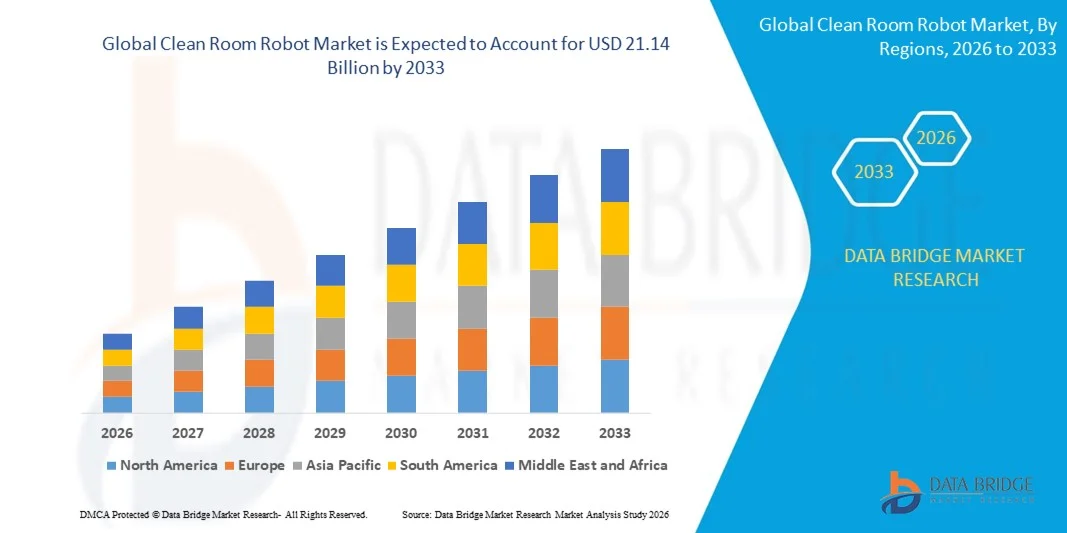
- The global clean room robot market size was valued at USD 8.59 billion in 2025 and is expected to reach USD 21.14 billion by 2033, at a CAGR of11.90% during the forecast period
- The rise in need to pass goods and materials between areas of different environmental grades through material airlocks (MAL) is expected to influence the growth of clean room robot market
- Also, the increase in demand for contaminant-free machines and equipment in clean rooms and high adoption of collaborative robots for clean room applications are also anticipated to flourish the growth of the clean room robot market
What are the Major Takeaways of Clean Room Robot Market?
- The lack of skilled workforce in manufacturing industries owing to restrictions on migration due to COVID-19 is also such asly to positively impact the growth of the market. Moreover, the high demand and use of smart devices, wireless and cloud technology are also expected create a huge demand for clean room robot as well as lifting the growth of the clean room robot market
- However, the high installation cost of industrial robots, particularly for small and medium-sized enterprises and interoperability and integration issues with industrial robots are expected to act as the major limitations for the growth of clean room robot
- North America dominated the clean room robot market with an estimated 39.47% revenue share in 2025, driven by strong demand from semiconductor fabrication, pharmaceutical manufacturing, medical device production, and advanced electronics assembly across the U.S. and Canada
- Asia-Pacific is projected to register the fastest CAGR of 8.21% from 2026 to 2033, driven by rapid semiconductor capacity expansion, strong electronics manufacturing ecosystems, and rising pharmaceutical and biotechnology production across China, Japan, India, South Korea, and Southeast Asia
- The Traditional Industrial Robots segment dominated the market with an estimated 62.3% share in 2025, driven by their high payload capacity, superior speed, and proven reliability in high-volume cleanroom operations such as semiconductor wafer handling, pharmaceutical filling, and electronics assembly
Report Scope and Clean Room Robot Market Segmentation
|
Attributes |
Clean Room Robot Key Market Insights |
|
Segments Covered |
|
|
Countries Covered |
North America
Europe
Asia-Pacific
Middle East and Africa
South America
|
|
Key Market Players |
|
|
Market Opportunities |
|
|
Value Added Data Infosets |
In addition to the insights on market scenarios such as market value, growth rate, segmentation, geographical coverage, and major players, the market reports curated by the Data Bridge Market Research also include in-depth expert analysis, pricing analysis, brand share analysis, consumer survey, demography analysis, supply chain analysis, value chain analysis, raw material/consumables overview, vendor selection criteria, PESTLE Analysis, Porter Analysis, and regulatory framework. |
What is the Key Trend in the Clean Room Robot Market?
Increasing Shift Toward High-Speed, Compact, and Intelligent Clean Room Robots
- The clean room robot market is witnessing rising adoption of compact, high-speed, and precision-engineered robots designed for contamination-sensitive environments such as semiconductor fabs, pharmaceutical cleanrooms, and medical device manufacturing
- Manufacturers are introducing robots with smaller footprints, higher payload-to-size ratios, and advanced motion control systems to support wafer handling, material transfer, and aseptic processing
- Growing demand for space-efficient, energy-efficient, and low-particle-emission robots is driving deployment across electronics manufacturing, biotechnology labs, and sterile packaging facilities
- For instance, companies such as FANUC, KUKA, ABB, and Yaskawa are upgrading cleanroom-rated robots with improved sealing, ISO Class 1–5 compliance, and integrated vision and force-sensing capabilities
- Increasing need for high-throughput automation, reduced human intervention, and consistent quality is accelerating adoption of intelligent cleanroom robots
- As manufacturing environments become more regulated and precision-driven, Clean Room Robots will remain essential for high-yield, contamination-free production
What are the Key Drivers of Clean Room Robot Market?
- Rising demand for ultra-clean, automated manufacturing processes in semiconductors, pharmaceuticals, medical devices, and optics manufacturing
- For instance, in 2024–2025, leading robot manufacturers such as ABB, FANUC, and Kawasaki introduced next-generation cleanroom robots with enhanced speed, repeatability, and compliance with stringent hygiene standards
- Rapid expansion of semiconductor fabrication plants, biologics production, and sterile drug manufacturing across the U.S., Europe, and Asia-Pacific is boosting demand
- Advancements in robotics components such as precision drives, sensors, sealed actuators, and AI-based control software have improved performance and reliability
- Increasing adoption of Industry 4.0, smart factories, and lights-out manufacturing is driving demand for autonomous cleanroom automation
- Supported by strong investments in electronics, healthcare manufacturing, and advanced industrial automation, the Clean Room Robot market is expected to witness sustained long-term growth
Which Factor is Challenging the Growth of the Clean Room Robot Market?
- High initial costs associated with cleanroom-certified robots, specialized materials, and compliance testing limit adoption among small and mid-sized manufacturers
- For instance, during 2024–2025, rising costs of precision components, sensors, and sealed robotic assemblies increased overall system prices for several global vendors
- Complexity in system integration, validation, and compliance with strict cleanroom and regulatory standards increases deployment time and operational challenges
- Limited availability of skilled personnel for programming, maintenance, and validation of cleanroom robotic systems restrains market penetration in emerging economies
- Competition from semi-automated solutions and manual processes in cost-sensitive industries creates pricing pressure
- To overcome these challenges, manufacturers are focusing on modular robot designs, cost-optimized platforms, digital twins, and enhanced service support to accelerate global adoption of clean room robots
How is the Clean Room Robot Market Segmented?
The market is segmented on the basis of type, component, and end user.
- By Type
On the basis of type, the clean room robot market is segmented into Traditional Industrial Robots and Collaborative Robots (Cobots). The Traditional Industrial Robots segment dominated the market with an estimated 62.3% share in 2025, driven by their high payload capacity, superior speed, and proven reliability in high-volume cleanroom operations such as semiconductor wafer handling, pharmaceutical filling, and electronics assembly. These robots are widely deployed in ISO Class 1–5 environments due to their sealed designs, low particle emission, and ability to operate continuously with high precision.
The Collaborative Robots segment is expected to grow at the fastest CAGR from 2026 to 2033, supported by increasing demand for flexible automation, human–robot collaboration, and space-efficient solutions. Cobots are gaining traction in laboratories, medical device manufacturing, and small-batch pharmaceutical production, where adaptability, safety, and ease of programming are critical.
- By Component
On the basis of component, the clean room robot market is segmented into Robotic Arms, End Effectors, Drives, Controllers, Sensors, Power Supply, Motors, and Others. The Robotic Arms segment dominated the market with a 34.7% share in 2025, as they form the structural backbone of cleanroom robots and are engineered with corrosion-resistant materials, smooth surfaces, and sealed joints to minimize contamination. High demand for precision pick-and-place, wafer transfer, and aseptic handling applications continues to drive this segment.
The Sensors segment is projected to grow at the fastest CAGR from 2026 to 2033, driven by rising integration of vision systems, force sensors, and proximity sensors for real-time monitoring, adaptive motion control, and defect reduction. Advancements in AI-enabled sensing and smart controllers are further accelerating adoption across advanced clean manufacturing environments.
- By End User
On the basis of end user, the clean room robot market is segmented into Aerospace, Electrical and Electronics, Plastics, Rubber and Chemicals, Food and Beverages, Optics, Pharmaceuticals and Cosmetics, and Others. The Electrical and Electronics segment dominated the market with a 38.9% share in 2025, driven by extensive use of cleanroom robots in semiconductor fabrication, PCB manufacturing, display panel production, and microelectronics assembly. Strict contamination control requirements and rising chip complexity make robotics essential in this sector.
The Pharmaceuticals and Cosmetics segment is expected to grow at the fastest CAGR from 2026 to 2033, supported by increasing biologics production, sterile drug manufacturing, vaccine development, and regulatory pressure for contamination-free processing. Growing investments in automated aseptic filling and packaging are further strengthening segment growth.
Which Region Holds the Largest Share of the Clean Room Robot Market?
- North America dominated the clean room robot market with an estimated 39.47% revenue share in 2025, driven by strong demand from semiconductor fabrication, pharmaceutical manufacturing, medical device production, and advanced electronics assembly across the U.S. and Canada. High adoption of automation in ISO-certified cleanrooms, rising investments in biologics, and increasing use of robotics for contamination-free material handling continue to fuel market growth across semiconductor fabs, life sciences facilities, aerospace component manufacturing, and research laboratories.
- Leading companies in North America are deploying high-precision, low-particle-emission clean room robots with advanced motion control, vision systems, and AI-enabled monitoring, strengthening the region’s technological leadership. Continuous investments in Industry 4.0, smart factories, and advanced manufacturing further support long-term expansion.
- Strong availability of skilled engineering talent, robust innovation ecosystems, and sustained capital spending on high-value manufacturing reinforce North America’s dominant position.
U.S. Clean Room Robot Market Insight
The U.S. is the largest contributor within North America, supported by extensive semiconductor R&D, large-scale pharmaceutical and biotechnology production, and high automation adoption in medical device manufacturing. Growing investments in chip fabs, sterile drug manufacturing, and aerospace electronics drive demand for clean room robots offering ultra-high precision, reliability, and contamination control. Presence of global automation leaders and strong regulatory focus on quality further accelerates market growth.
Canada Clean Room Robot Market Insight
Canada contributes steadily to regional growth, driven by expanding life sciences manufacturing, rising electronics assembly activities, and growing adoption of automation in research institutions and clean manufacturing facilities. Government-backed innovation programs and increasing focus on advanced robotics and smart manufacturing strengthen market adoption across the country.
Asia-Pacific Clean Room Robot Market
Asia-Pacific is projected to register the fastest CAGR of 8.21% from 2026 to 2033, driven by rapid semiconductor capacity expansion, strong electronics manufacturing ecosystems, and rising pharmaceutical and biotechnology production across China, Japan, India, South Korea, and Southeast Asia. High-volume manufacturing of chips, displays, medical devices, and precision components significantly boosts demand for clean room automation.
China Clean Room Robot Market Insight
China is the largest contributor to Asia-Pacific, supported by massive semiconductor investments, expanding pharmaceutical manufacturing, and strong government initiatives promoting automation and domestic robotics production. Rising demand for contamination-free manufacturing and cost-competitive robotic solutions accelerates adoption.
Japan Clean Room Robot Market Insight
Japan shows stable growth, driven by precision electronics manufacturing, advanced robotics expertise, and strict quality standards in semiconductor and pharmaceutical production. Continuous modernization of industrial processes supports sustained demand for premium clean room robots.
India Clean Room Robot Market Insight
India is emerging as a high-growth market, supported by expanding semiconductor design centres, increasing pharmaceutical exports, and government-led manufacturing initiatives. Growing focus on sterile manufacturing and automation accelerates clean room robot adoption.
South Korea Clean Room Robot Market Insight
South Korea contributes significantly due to strong semiconductor, display, and electronics manufacturing industries. Rapid development of memory chips, advanced processors, and high-tech consumer electronics drives demand for high-precision clean room robots, supporting long-term market growth.
Which are the Top Companies in Clean Room Robot Market?
The clean room robot industry is primarily led by well-established companies, including:
- ABB (Switzerland)
- FANUC (Japan)
- KUKA AG (Germany)
- Mitsubishi Electric Corporation (Japan)
- Yaskawa Europe GmbH (Germany)
- Yamaha Motor Co., Ltd. (Japan)
- Bosch Rexroth Corporation (Germany)
- NACHI-FUJIKOSHI CORP. (Japan)
- Aerotech Inc. (U.S.)
- DENSO CORPORATION (Japan)
- Kawasaki Heavy Industries, Ltd. (Japan)
- Seiko Epson Corporation (Japan)
- PARKER HANNIFIN CORP (U.S.)
- IAI America, Inc. (U.S.)
- Universal Robots (Denmark)
- Stäubli International AG (Switzerland)
- OMRON Corporation (Japan)
- Nordson Corporation (U.S.)
- Comau S.p.A. (Italy)
- TECHMAN ROBOT INC. (Taiwan)
What are the Recent Developments in Global Clean Room Robot Market?
- In October 2024, Karcher India introduced advanced cleaning solutions, including autonomous scrubber-dryers and robotic vacuum cleaners such as RCV3 and RCV5, with a strategic goal to raise its India revenue contribution from 1% to 10% of global sales. By integrating AI capabilities and strengthening localized manufacturing, the company aims to enhance cleaning efficiency while supporting infrastructure development and cleanroom applications across industries, reinforcing its long-term commitment to smart and automated hygiene solutions
- In July 2024, ChargePoint Technology launched a robotic material handling solution designed to improve safety and operational efficiency in solid-dosage pharmaceutical manufacturing. Using PuroGrip and PuroVaso containers, the system automates powder transfer, minimizing manual handling and reducing cross-contamination risks, thereby supporting faster, safer, and higher-quality production workflows for future-ready cleanroom operations
- In April 2024, LionsBot International announced the opening of Southeast Asia’s largest cleaning robots manufacturing facility in Singapore, significantly expanding its production and R&D capacity. With an annual output potential of up to 4,000 robots, including R3 ScrubPro and Rex models, the facility strengthens LionsBot’s innovation pipeline, global expansion strategy, and focus on clean room robots for healthcare and advanced manufacturing environments
- In November 2023, Syrius Technology entered a strategic partnership with SoftBank Robotics and Iris Ohyama to introduce a next-generation commercial cleaning robot. Focused on high-precision cleanroom environments, the collaboration aims to deliver advanced robotic cleaning solutions that enhance operational efficiency and set new benchmarks in the commercial and industrial cleaning robotics market
SKU-
Get online access to the report on the World's First Market Intelligence Cloud
- Interactive Data Analysis Dashboard
- Company Analysis Dashboard for high growth potential opportunities
- Research Analyst Access for customization & queries
- Competitor Analysis with Interactive dashboard
- Latest News, Updates & Trend analysis
- Harness the Power of Benchmark Analysis for Comprehensive Competitor Tracking
Global Clean Room Robot Market, Supply Chain Analysis and Ecosystem Framework
To support market growth and help clients navigate the impact of geopolitical shifts, DBMR has integrated in-depth supply chain analysis into its Global Clean Room Robot Market research reports. This addition empowers clients to respond effectively to global changes affecting their industries. The supply chain analysis section includes detailed insights such as Global Clean Room Robot Market consumption and production by country, price trend analysis, the impact of tariffs and geopolitical developments, and import and export trends by country and HSN code. It also highlights major suppliers with data on production capacity and company profiles, as well as key importers and exporters. In addition to research, DBMR offers specialized supply chain consulting services backed by over a decade of experience, providing solutions like supplier discovery, supplier risk assessment, price trend analysis, impact evaluation of inflation and trade route changes, and comprehensive market trend analysis.
Research Methodology
Data collection and base year analysis are done using data collection modules with large sample sizes. The stage includes obtaining market information or related data through various sources and strategies. It includes examining and planning all the data acquired from the past in advance. It likewise envelops the examination of information inconsistencies seen across different information sources. The market data is analysed and estimated using market statistical and coherent models. Also, market share analysis and key trend analysis are the major success factors in the market report. To know more, please request an analyst call or drop down your inquiry.
The key research methodology used by DBMR research team is data triangulation which involves data mining, analysis of the impact of data variables on the market and primary (industry expert) validation. Data models include Vendor Positioning Grid, Market Time Line Analysis, Market Overview and Guide, Company Positioning Grid, Patent Analysis, Pricing Analysis, Company Market Share Analysis, Standards of Measurement, Global versus Regional and Vendor Share Analysis. To know more about the research methodology, drop in an inquiry to speak to our industry experts.
Customization Available
Data Bridge Market Research is a leader in advanced formative research. We take pride in servicing our existing and new customers with data and analysis that match and suits their goal. The report can be customized to include price trend analysis of target brands understanding the market for additional countries (ask for the list of countries), clinical trial results data, literature review, refurbished market and product base analysis. Market analysis of target competitors can be analyzed from technology-based analysis to market portfolio strategies. We can add as many competitors that you require data about in the format and data style you are looking for. Our team of analysts can also provide you data in crude raw excel files pivot tables (Fact book) or can assist you in creating presentations from the data sets available in the report.