Global Cheese Culture Market
Market Size in USD Billion
CAGR :
% 
 USD
1.27 Billion
USD
2.02 Billion
2025
2033
USD
1.27 Billion
USD
2.02 Billion
2025
2033
 Forecast Period Forecast Period |
2026 –2033 |
 Market Size (Base Year) Market Size (Base Year) |
USD 1.27 Billion |
 Market Size (Forecast Year) Market Size (Forecast Year) |
USD 2.02 Billion |
 CAGR CAGR |
% |
| Major Markets Players |
|
What is the Global Cheese Culture Market Size and Growth Rate?
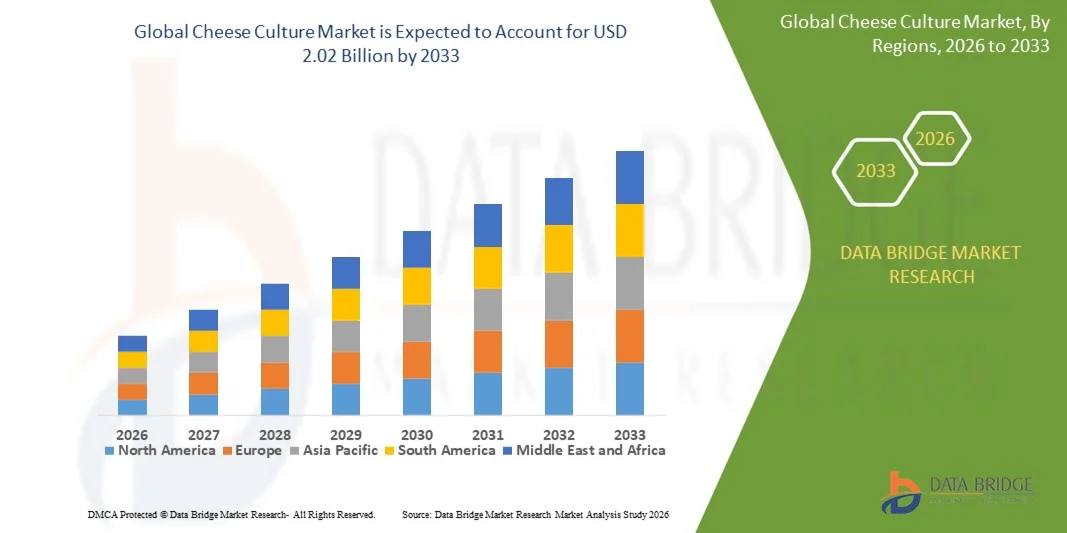
- The global cheese culture market size was valued at USD 1.27 billion in 2025 and is expected to reach USD 2.02 billion by 2033, at a CAGR of 6.00% during the forecast period
- The surging consumption of ready-to-eat food and savoury snacks products especially among the working population is major factor contributing for growth in market
- The increasing awareness amongst health-conscious customers regarding various functionalities and the short and long-term health benefits to the overall wellness of cheese culture as good bacteria known as probiotics helps in restoring gut health and has various digestive enzymes is estimated to contribute to growth of the cheese culture market
What are the Major Takeaways of Cheese Culture Market?
- The easy availability of cheese cultures in both smooth and consistent form is expected to heighten demand for the cheese culture market
- However, the cheese is a major source of saturated fat which raises harmful LDL cholesterol, thus increasing possibilities of heart disease which is projected to act as a restraint, whereas the surging lactose intolerant people across the globe is projected to challenge the growth of the cheese culture market
- North America dominated the cheese culture market with a revenue share of 41.23% in 2025, driven by high cheese consumption, advanced dairy processing infrastructure, and strong presence of industrial cheese manufacturers across the U.S. and Canada
- Asia-Pacific is projected to register the fastest CAGR of 7.42% from 2026 to 2033, driven by rapidly rising cheese consumption, westernization of diets, expanding foodservice chains, and growing dairy processing capacity across China, India, Japan, South Korea, and Southeast Asia
- The pasta filata/mozzarella segment dominated the market with a 31.6% share in 2025, driven by its extensive use in pizza, fast food, and ready-to-eat meals globally
Report Scope and Cheese Culture Market Segmentation
|
Attributes |
Cheese Culture Key Market Insights |
|
Segments Covered |
|
|
Countries Covered |
North America
Europe
Asia-Pacific
Middle East and Africa
South America
|
|
Key Market Players |
|
|
Market Opportunities |
|
|
Value Added Data Infosets |
In addition to the insights on market scenarios such as market value, growth rate, segmentation, geographical coverage, and major players, the market reports curated by the Data Bridge Market Research also include in-depth expert analysis, pricing analysis, brand share analysis, consumer survey, demography analysis, supply chain analysis, value chain analysis, raw material/consumables overview, vendor selection criteria, PESTLE Analysis, Porter Analysis, and regulatory framework. |
What is the Key Trend in the Cheese Culture Market?
Rising Demand for Specialized and Clean-Label Cheese Cultures
- The cheese cultures market is witnessing growing adoption of specialized starter and adjunct cultures designed to enhance flavor, texture, ripening control, and consistency across industrial and artisanal cheese production
- Manufacturers are increasingly developing strain-specific, region-tailored, and application-focused cultures to support diverse cheese varieties such as cheddar, mozzarella, feta, parmesan, and specialty cheeses
- Growing consumer preference for clean-label, natural, and minimally processed dairy products is driving demand for cultures with reduced additives and non-GMO formulations
- For instance, companies such as Chr. Hansen, DSM-Firmenich, Lallemand, and BIOPROX are expanding portfolios of mesophilic, thermophilic, and probiotic cheese cultures to meet evolving taste and functionality requirements
- Increased focus on texture optimization, shelf-life extension, and fermentation efficiency is accelerating the adoption of advanced culture blends
- As global cheese consumption rises and product differentiation becomes critical, cheese cultures are emerging as a core innovation driver in dairy processing
What are the Key Drivers of Cheese Culture Market?
- Rising global demand for cheese and fermented dairy products, supported by urbanization, westernized diets, and growing protein consumption
- For instance, in 2024–2025, companies such as DSM-Firmenich and Chr. Hansen introduced enhanced cultures enabling faster fermentation, consistent yields, and improved flavor development
- Expansion of industrial cheese manufacturing, quick-service restaurants, and ready-to-eat food products is increasing large-scale culture adoption
- Growing popularity of artisanal, specialty, and premium cheeses is driving demand for customized and region-specific culture strains
- Increasing focus on food safety, batch consistency, and production efficiency is encouraging dairy processors to adopt standardized, high-performance cultures
- Supported by innovation in microbial science and fermentation technology, the Cheese Cultures market is expected to witness steady long-term growth
Which Factor is Challenging the Growth of the Cheese Culture Market?
- High costs of specialized and proprietary culture strains limit adoption among small-scale and artisanal cheese producers
- For instance, premium cultures offering extended shelf life or accelerated ripening often require higher upfront investment and controlled storage conditions
- Sensitivity of cultures to temperature, handling, and storage increases logistics and cold-chain dependency
- Regulatory approval requirements and labeling compliance for microbial cultures vary across regions, increasing time-to-market complexity
- Limited technical expertise among small producers regarding culture selection and fermentation optimization can impact performance outcomes
- Despite these challenges, ongoing efforts in cost optimization, technical support, and culture standardization are expected to improve accessibility and adoption of cheese cultures globally
How is the Cheese Culture Market Segmented?
The market is segmented on the basis of product, type, category, cultures, application, and sales channel.
- By Product
On the basis of product, the cheese culture market is segmented into cheddar, continental, pasta filata/mozzarella, cottage, propionic, soft, grana, and white brined cheeses. The pasta filata/mozzarella segment dominated the market with a 31.6% share in 2025, driven by its extensive use in pizza, fast food, and ready-to-eat meals globally. Rising demand from QSR chains and frozen food manufacturers has significantly boosted culture consumption for mozzarella production. Cultures used in this segment focus on stretchability, melt behavior, and consistent texture.
The grana cheese segment is expected to grow at the fastest CAGR from 2026 to 2033, supported by increasing consumption of premium aged cheeses such as parmesan and grana padano. Longer ripening cycles and strict quality requirements are driving demand for advanced ripening cultures that enhance flavor development, yield stability, and maturation efficiency.
- By Type
On the basis of type, the market is segmented into mesophilic culture, thermophilic culture, starter culture, non-starter culture, and probiotics. The starter culture segment dominated the market with a 42.3% share in 2025, as starter cultures form the foundation of cheese fermentation by controlling acidification, texture formation, and flavor consistency. They are widely used across industrial and artisanal cheese production due to reliability and standardized performance.
The probiotics segment is projected to grow at the fastest CAGR from 2026 to 2033, driven by rising consumer interest in functional foods and gut-health-enhancing dairy products. Incorporation of probiotic strains in cheese offers health benefits while maintaining taste and shelf life, making them increasingly attractive to premium and health-focused cheese brands.
- By Category
On the basis of category, the cheese culture market is segmented into fresh cheese, soft cheese, and hard cheese. The fresh cheese segment held the largest market share of 38.9% in 2025, attributed to high consumption of products such as cottage cheese, cream cheese, and ricotta. Short fermentation cycles, high production volumes, and growing demand for high-protein fresh dairy products are supporting culture demand in this segment.
The hard cheese segment is expected to witness the fastest growth from 2026 to 2033, driven by increasing popularity of aged and premium cheeses. Hard cheese production requires precise culture formulations for controlled ripening, flavor depth, and texture development, increasing demand for advanced and strain-specific cultures.
- By Cultures
On the basis of cultures, the market is segmented into ripening cultures, protective cultures, and kosher cultures. The ripening cultures segment dominated the market with a 45.1% share in 2025, as these cultures play a critical role in developing flavor, aroma, and texture during cheese maturation. They are extensively used in semi-hard and hard cheeses where aging is essential.
The protective cultures segment is expected to grow at the fastest CAGR from 2026 to 2033, driven by increasing focus on natural preservation and clean-label cheese production. Protective cultures inhibit spoilage organisms and pathogens, helping manufacturers extend shelf life while reducing reliance on chemical preservatives.
- By Application
On the basis of application, the cheese culture market is segmented into strains and cultures compounding. The cultures compounding segment dominated the market with a 100% functional share in 2025, as compounding enables customization of multiple strains to achieve desired fermentation behavior, flavor profiles, and textural outcomes. Dairy processors increasingly rely on compounded cultures to meet product differentiation and batch consistency requirements.
The same segment is also expected to grow steadily at a high CAGR from 2026 to 2033, supported by growing demand for tailor-made culture solutions across industrial, artisanal, and specialty cheese producers.
- By Sales Channel
On the basis of sales channel, the market is segmented into specialty stores, direct store, third-party online, and other sales channels. The direct store segment dominated the market with a 41.7% share in 2025, driven by long-term supply contracts between culture manufacturers and large dairy processors. Direct sales ensure technical support, consistent supply, and customized culture solutions.
The third-party online segment is projected to grow at the fastest CAGR from 2026 to 2033, fueled by rising adoption among small-scale, artisanal, and home cheesemakers. Increased availability of cultures through e-commerce platforms and global distribution networks is expanding accessibility and market reach.
Which Region Holds the Largest Share of the Cheese Culture Market?
- North America dominated the cheese culture market with a revenue share of 41.23% in 2025, driven by high cheese consumption, advanced dairy processing infrastructure, and strong presence of industrial cheese manufacturers across the U.S. and Canada. Widespread adoption of standardized starter and adjunct cultures supports consistent quality, large-scale production, and regulatory compliance across the region
- Leading culture producers are continuously introducing advanced strains for improved flavor development, texture control, yield optimization, and shelf-life extension, strengthening North America’s technological leadership
- Strong R&D ecosystems, high consumer demand for natural and clean-label cheese products, and sustained investments in dairy innovation further reinforce the region’s market dominance
U.S. Cheese Culture Market Insight
The U.S. is the largest contributor in North America, supported by high consumption of mozzarella, cheddar, and specialty cheeses, along with a well-established dairy processing industry. Rising demand from quick-service restaurants, packaged food manufacturers, and retail cheese brands is increasing adoption of customized starter, ripening, and protective cultures. Strong presence of global culture suppliers, advanced cold-chain logistics, and continuous innovation in probiotic and clean-label cheese products further drive market growth
Canada Cheese Culture Market Insight
Canada contributes significantly to regional growth, driven by steady demand for natural and specialty cheeses, strong dairy cooperatives, and regulated milk production systems. Increasing focus on quality consistency, extended shelf life, and sustainable dairy processing is supporting adoption of advanced cheese cultures. Government-backed food safety regulations and innovation programs further strengthen market expansion.
Asia-Pacific Cheese Culture Market
Asia-Pacific is projected to register the fastest CAGR of 7.42% from 2026 to 2033, driven by rapidly rising cheese consumption, westernization of diets, expanding foodservice chains, and growing dairy processing capacity across China, India, Japan, South Korea, and Southeast Asia. Increasing adoption of mozzarella and processed cheese in pizzas, bakery products, and ready-to-eat foods is fueling demand for starter and thermophilic cultures. Expansion of local cheese manufacturing facilities, rising disposable income, and growing awareness of functional and probiotic dairy products are accelerating market growth across the region.
China Cheese Culture Market Insight
China is the largest contributor in Asia-Pacific due to rapid growth in processed food consumption, expanding domestic cheese production, and strong investment in modern dairy infrastructure. Increasing use of cultures for mozzarella, cream cheese, and processed cheese applications is driving market adoption.
Japan Cheese Culture Market Insight
Japan shows steady growth supported by demand for premium, high-quality cheeses and strict food safety standards. Advanced fermentation expertise and preference for consistent flavor profiles drive adoption of specialized and ripening cultures.
India Cheese Culture Market Insight
India is emerging as a high-growth market, driven by rapid expansion of pizza chains, bakery applications, and packaged cheese products. Growing investments in dairy processing and rising demand for cost-efficient starter cultures are accelerating adoption.
South Korea Cheese Culture Market Insight
South Korea contributes strongly due to increasing consumption of processed and western-style cheeses, growth in convenience foods, and strong emphasis on food quality and safety. Rising demand for functional and probiotic cheese products supports continued market expansion.
Which are the Top Companies in Cheese Culture Market?
The cheese culture industry is primarily led by well-established companies, including:
- Cultures For Health (U.S.)
- Chr. Hansen Holding A/S (Denmark)
- Home Make It (U.S.)
- New England Cheesemaking Supply Company (U.S.)
- GEA Group Aktiengesellschaft (Germany)
- DSM (Netherlands)
- Dairy Connection, Inc. (U.S.)
- BIOPROX (France)
- Hjemmeriet (Denmark)
- Lallemand Inc. (Canada)
- Vivolac (U.S.)
- Mooreland Cheesemaking LTD (U.K.)
- Biena Snacks (U.S.)
- Make Cheese Inc. (U.S.)
- KPM Analytics (U.S.)
- Posh Flavours (India)
- Siemens (Germany)
- Benny Impex (India)
SKU-
Get online access to the report on the World's First Market Intelligence Cloud
- Interactive Data Analysis Dashboard
- Company Analysis Dashboard for high growth potential opportunities
- Research Analyst Access for customization & queries
- Competitor Analysis with Interactive dashboard
- Latest News, Updates & Trend analysis
- Harness the Power of Benchmark Analysis for Comprehensive Competitor Tracking
Global Cheese Culture Market, Supply Chain Analysis and Ecosystem Framework
To support market growth and help clients navigate the impact of geopolitical shifts, DBMR has integrated in-depth supply chain analysis into its Global Cheese Culture Market research reports. This addition empowers clients to respond effectively to global changes affecting their industries. The supply chain analysis section includes detailed insights such as Global Cheese Culture Market consumption and production by country, price trend analysis, the impact of tariffs and geopolitical developments, and import and export trends by country and HSN code. It also highlights major suppliers with data on production capacity and company profiles, as well as key importers and exporters. In addition to research, DBMR offers specialized supply chain consulting services backed by over a decade of experience, providing solutions like supplier discovery, supplier risk assessment, price trend analysis, impact evaluation of inflation and trade route changes, and comprehensive market trend analysis.
Research Methodology
Data collection and base year analysis are done using data collection modules with large sample sizes. The stage includes obtaining market information or related data through various sources and strategies. It includes examining and planning all the data acquired from the past in advance. It likewise envelops the examination of information inconsistencies seen across different information sources. The market data is analysed and estimated using market statistical and coherent models. Also, market share analysis and key trend analysis are the major success factors in the market report. To know more, please request an analyst call or drop down your inquiry.
The key research methodology used by DBMR research team is data triangulation which involves data mining, analysis of the impact of data variables on the market and primary (industry expert) validation. Data models include Vendor Positioning Grid, Market Time Line Analysis, Market Overview and Guide, Company Positioning Grid, Patent Analysis, Pricing Analysis, Company Market Share Analysis, Standards of Measurement, Global versus Regional and Vendor Share Analysis. To know more about the research methodology, drop in an inquiry to speak to our industry experts.
Customization Available
Data Bridge Market Research is a leader in advanced formative research. We take pride in servicing our existing and new customers with data and analysis that match and suits their goal. The report can be customized to include price trend analysis of target brands understanding the market for additional countries (ask for the list of countries), clinical trial results data, literature review, refurbished market and product base analysis. Market analysis of target competitors can be analyzed from technology-based analysis to market portfolio strategies. We can add as many competitors that you require data about in the format and data style you are looking for. Our team of analysts can also provide you data in crude raw excel files pivot tables (Fact book) or can assist you in creating presentations from the data sets available in the report.