


Central Fill Pharmacy Automation Market Size
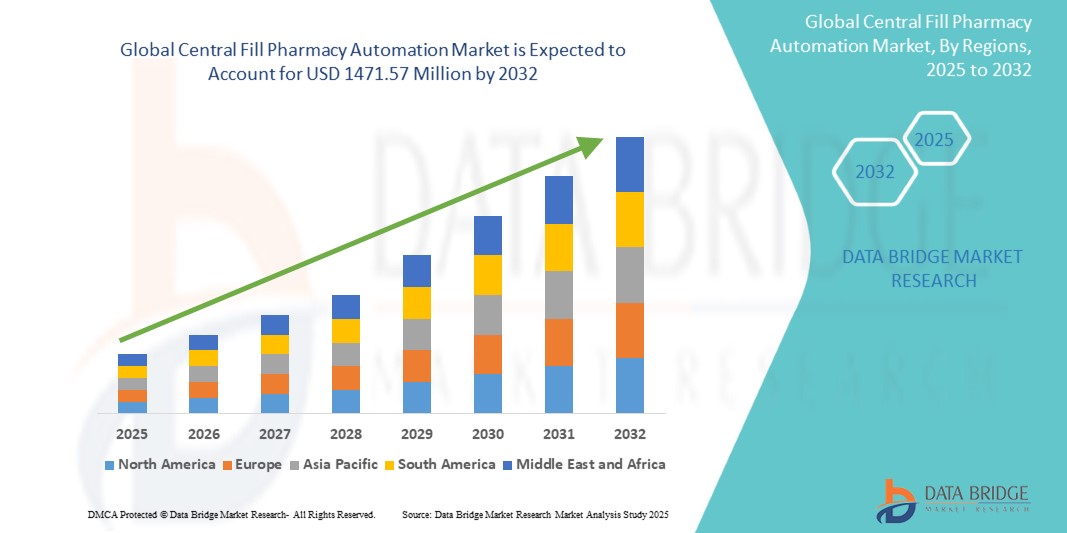
- The global central fill pharmacy automation market was valued at USD 662.67 Million in 2024 and is expected to reach USD 1471.57 Million by 2032
- During the forecast period of 2025 to 2032 the market is likely to grow at a CAGR of 11.35%, primarily driven by the increasing demand for efficiency, accuracy, and safety in pharmaceutical operation
- This growth is driven by factors such as the rising prescription volumes, need for improved inventory management, and the integration of advanced technologies such as robotics and artificial intelligence in pharmacy automation systems
Central Fill Pharmacy Automation Market Analysis
- The central fill pharmacy automation market is experiencing significant growth due to the increasing demand for efficient, accurate, and cost-effective pharmaceutical solutions
- These systems are transforming pharmacy operations by automating the medication dispensing and packaging processes, reducing human error and enhancing operational efficiency
- With rising prescription volumes, pharmacies are increasingly adopting advanced automation systems that offer better tracking and inventory management, ensuring accurate medication delivery
- The integration of artificial intelligence and robotics into central fill pharmacy systems is improving decision-making and enabling predictive maintenance, further increasing system efficiency
- CVS Health has integrated automated dispensing systems to handle prescriptions efficiently, meeting the growing demand for pharmaceuticals while ensuring regulatory compliance and patient safety
Report Scope and Central Fill Pharmacy Automation Market Segmentation
|
Attributes |
Central Fill Pharmacy Automation Key Market Insights |
|
Segments Covered |
|
|
Countries Covered |
North America
Europe
Asia-Pacific
Middle East and Africa
South America
|
|
Key Market Players |
|
|
Market Opportunities |
|
|
Value Added Data Infosets |
In addition to the insights on market scenarios such as market value, growth rate, segmentation, geographical coverage, and major players, the market reports curated by the Data Bridge Market Research also include in-depth expert analysis, patient epidemiology, pipeline analysis, pricing analysis, and regulatory framework. |
Central Fill Pharmacy Automation Market Trends
“Increasing Adoption of Artificial Intelligence and Robotics”
- The central fill pharmacy automation market is growing due to the rising demand for efficient and cost-effective pharmaceutical solutions
- Automation systems streamline medication dispensing, improving accuracy and reducing human error, while speeding up prescription processing
- These systems enhance inventory management, optimize workflows, and ensure better patient safety through automated packaging and labeling
- Technological advancements, including robotics and artificial intelligence, are improving the capabilities of central fill pharmacy systems, allowing for real-time monitoring and predictive maintenance
- The adoption of automation is expanding as pharmacies seek to improve service delivery, meet growing demand, and maintain high-quality standards in pharmaceutical services
Central Fill Pharmacy Automation Market Dynamics
Driver
“Increasing Prescription Volume and Demand for Efficiency”
- A key driver of the central fill pharmacy automation market is the growing volume of prescriptions due to an increase in chronic diseases and aging populations
- Manual dispensing methods are becoming increasingly inefficient, leading pharmacies to seek automation solutions that handle high prescription volumes accurately and quickly
- Central fill systems automate medication dispensing processes such as packaging, labeling, and sorting, improving speed and reducing human error
- Automation allows pharmacies to manage larger volumes of prescriptions without compromising accuracy, improving patient safety and overall satisfaction
- By automating tasks, pharmacies can reduce labor costs and minimize medication errors, addressing key challenges in healthcare industry operations
Opportunity
“Increasing demand for efficiency, accuracy, and cost savings in the healthcare industry”
- Automation reduces manual labor by speeding up the prescription filling process.
- For instance, automated dispensing systems, such as those used by Omnicell and Swisslog, streamline the process, allowing central fill pharmacies to handle large volumes of prescriptions with fewer errors and delays. This increases throughput and reduces human intervention
- Automated systems minimize human errors, ensuring that medications are dispensed accurately. ScriptPro’s robotic dispensing systems, for instance, offer barcode scanning and real-time verification, reducing the risk of dispensing the wrong medication and enhancing patient safety
- With rising labor costs, automation provides a cost-effective solution by reducing the need for manual labor in high-volume prescription fulfillment. McKesson's automated solutions enable central fill pharmacies to operate more efficiently, reducing overhead and increasing profitability
- Automation helps central fill pharmacies stay compliant with stringent regulations and optimize inventory management. KUKA Robotics integrates advanced technologies that track and manage medication inventory in real-time, ensuring accurate reporting and adherence to regulatory standards such as the Drug Enforcement Administration (DEA) guidelines
Restraint/Challenge
“High Initial Investment and Maintenance Costs”
- A major challenge in the central fill pharmacy automation market is the high initial investment required for purchasing and installing automation systems
- Smaller pharmacies or independent operators often struggle to justify the high upfront costs associated with hardware, software, and system integration
- Specialized personnel are needed for installation, maintenance, and troubleshooting, adding to the overall expense of implementing automation systems
- Over time, maintenance costs accumulate due to the need for regular software updates, system calibration, and hardware repairs, further increasing operational costs
- High initial and ongoing maintenance costs create a barrier to widespread adoption, particularly in regions with limited access to funding or technological support
Central Fill Pharmacy Automation Market Scope
The market is segmented on the basis of product and services and vendor
|
Segmentation |
Sub-Segmentation |
|
By Product and services |
|
|
By Vendor |
|
Central Fill Pharmacy Automation Market Regional Analysis
“North America is the Dominant Region in the Central Fill Pharmacy Automation Market”
- North America leads the central fill pharmacy automation market, primarily due to high adoption rates of automation technologies in pharmacies, particularly in the U.S.
- Key players such as Omnicell, Inc. and McKesson Corporation are driving the market by providing solutions that enhance operational efficiency and improve patient safety
- The focus on reducing labor costs, increasing pharmacy throughput, and minimizing medication errors further solidifies North America's dominant position in the market
“Asia-Pacific is Projected to Register the Highest Growth Rate”
- The Asia-Pacific region is experiencing rapid growth in the central fill pharmacy automation market, particularly in China, India, and Japan
- Factors such as population growth, healthcare reforms, and a rising number of healthcare facilities are driving the demand for pharmaceutical automation in the region
- Increased investments in automation solutions and a focus on reducing human error and improving patient safety are accelerating market adoption in APAC
Central Fill Pharmacy Automation Market Share
The market competitive landscape provides details by competitor. Details included are company overview, company financials, revenue generated, market potential, investment in research and development, new market initiatives, global presence, production sites and facilities, production capacities, company strengths and weaknesses, product launch, product width and breadth, application dominance. The above data points provided are only related to the companies' focus related to market.
The Major Market Leaders Operating in the Market Are:
- ARxIUM (Canada)
- RxSafe, LLC (U.S.)
- Omnicell, Inc. (U.S.)
- Tension Packaging & Automation (U.S.)
- Parata Systems, LLC (U.S.)
- Providen Logistics Ltd. (U.K.)
- McKesson Corporation (U.S.)
- ScriptPro LLC (U.S.)
- KUKA AG (Germany)
Latest Developments in Global Central Fill Pharmacy Automation Market
- In April 2024, Omnicell announced the launch of XT Amplify, a multi-year innovation program aimed at maximizing the value of its XT Automated Dispensing System in healthcare facilities. This initiative includes several new solutions such as XTExtend, which enhances security and user experience, and MedChill, designed to improve the safety and security of temperature-controlled medications. Additionally, SupplyXpert offers inventory management software to optimize stock levels and reduce waste. The program will also provide ServerScale, a subscription-based virtual server solution, and CarePlus, expert services aimed at improving system adoption. The XT Amplify program aims to streamline pharmacy and nursing efficiency, reduce medication errors, and contribute to the Autonomous Pharmacy vision by automating manual processes. The introduction of this program will further strengthen Omnicell's position in the central fill pharmacy automation market by offering continuous innovation that addresses both current and future operational challenges for healthcare providers
- In March 2024, Capsa Healthcare announced the expansion of its NexSysADC suite, designed to enhance pharmacy and medication management systems. The new update includes the introduction of NexSysADC Touch and the NexSysADC with Point-of-Use technology, which offers improved medication dispensing and tracking capabilities. These advancements enable pharmacies to more efficiently manage their medication inventory, reduce human error, and improve medication safety. The NexSysADC suite also incorporates enhanced cloud-based analytics, providing real-time data to optimize pharmacy workflows and decision-making. By integrating these new solutions, pharmacies can reduce medication waste, improve patient safety, and streamline operations, leading to significant cost savings. The expansion is expected to strengthen Capsa Healthcare’s position in the central fill pharmacy automation market by providing scalable and efficient solutions to healthcare providers, helping them meet the growing demand for automation and operational efficiency in medication dispensing
- In March 2024, Relay Robotics announced the launch of the next generation of delivery robots designed specifically for hospitals. These advanced robots are equipped with improved navigation and artificial intelligence technology, enabling them to transport medications, supplies, and other essential items within hospital settings. The new robots are faster, more efficient, and equipped with enhanced security features, ensuring safe and reliable delivery of critical resources. By automating the delivery process, hospitals can reduce human errors, enhance operational efficiency, and free up staff to focus on more critical tasks. Additionally, the robots are designed to integrate seamlessly with hospital management systems, providing real-time tracking and data analytics. This launch will have a significant impact on the healthcare automation market, accelerating the adoption of robotic solutions in hospital environments. It will also contribute to the broader healthcare automation trend, making hospital operations safer and more efficient while reducing operational costs

- Interactive Data Analysis Dashboard
- Company Analysis Dashboard for high growth potential opportunities
- Research Analyst Access for customization & queries
- Competitor Analysis with Interactive dashboard
- Latest News, Updates & Trend analysis
- Harness the Power of Benchmark Analysis for Comprehensive Competitor Tracking
Data collection and base year analysis are done using data collection modules with large sample sizes. The stage includes obtaining market information or related data through various sources and strategies. It includes examining and planning all the data acquired from the past in advance. It likewise envelops the examination of information inconsistencies seen across different information sources. The market data is analysed and estimated using market statistical and coherent models. Also, market share analysis and key trend analysis are the major success factors in the market report. To know more, please request an analyst call or drop down your inquiry.
The key research methodology used by DBMR research team is data triangulation which involves data mining, analysis of the impact of data variables on the market and primary (industry expert) validation. Data models include Vendor Positioning Grid, Market Time Line Analysis, Market Overview and Guide, Company Positioning Grid, Patent Analysis, Pricing Analysis, Company Market Share Analysis, Standards of Measurement, Global versus Regional and Vendor Share Analysis. To know more about the research methodology, drop in an inquiry to speak to our industry experts.
Data Bridge Market Research is a leader in advanced formative research. We take pride in servicing our existing and new customers with data and analysis that match and suits their goal. The report can be customized to include price trend analysis of target brands understanding the market for additional countries (ask for the list of countries), clinical trial results data, literature review, refurbished market and product base analysis. Market analysis of target competitors can be analyzed from technology-based analysis to market portfolio strategies. We can add as many competitors that you require data about in the format and data style you are looking for. Our team of analysts can also provide you data in crude raw excel files pivot tables (Fact book) or can assist you in creating presentations from the data sets available in the report.













