Global Cbd Cannabidiol Infused Cosmetics Market
Market Size in USD Billion
CAGR :
% 
 USD
2.35 Billion
USD
14.03 Billion
2025
2033
USD
2.35 Billion
USD
14.03 Billion
2025
2033
 Forecast Period Forecast Period |
2026 –2033 |
 Market Size (Base Year) Market Size (Base Year) |
USD 2.35 Billion |
 Market Size (Forecast Year) Market Size (Forecast Year) |
USD 14.03 Billion |
 CAGR CAGR |
% |
| Major Markets Players |
|
What is the Global CBD (Cannabidiol) Infused Cosmetics Market Size and Growth Rate?
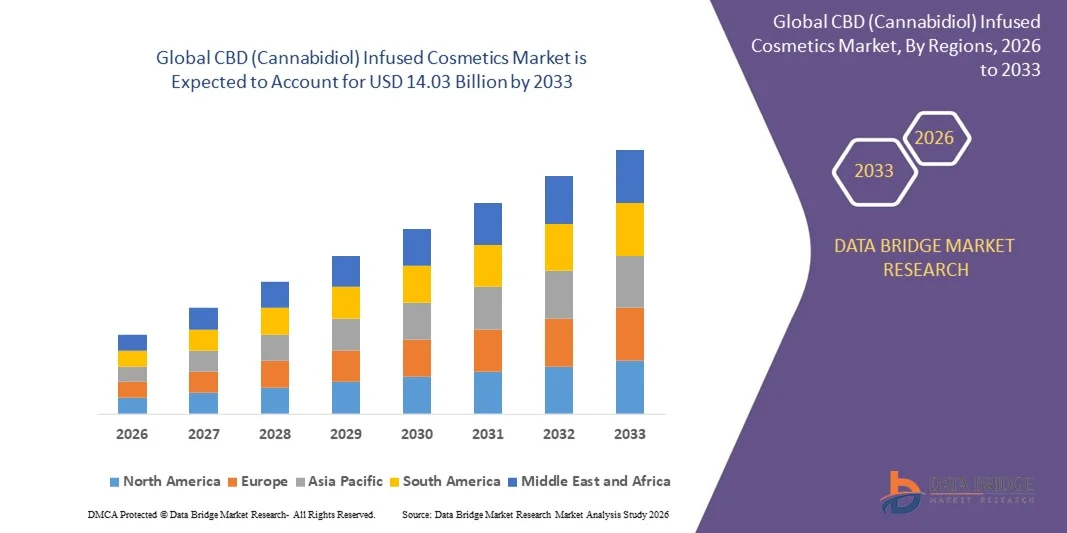
- The global CBD (Cannabidiol) infused cosmetics market size was valued at USD 2.35 billion in 2025 and is expected to reach USD 14.03 billion by 2033, at a CAGR of25.00% during the forecast period
- Major factors that are expected to boost the growth of the CBD (cannabidiol) infused cosmetics market in the forecast period are the rise in the development of the product portfolio and manufacturers directing the premium customers by launching the finest products
- Furthermore, the increase in the acceptance of organic CBD cosmetic products is further anticipated to propel the growth of the CBD (cannabidiol) infused cosmetics market
What are the Major Takeaways of CBD (Cannabidiol) Infused Cosmetics Market?
- The growing need for the facial masks sheet and serums is estimated to further cushion the growth of the CBD (cannabidiol) infused cosmetics market. On the other hand, CBD remains an illegal industry in several countries, which further projects to impede the growth in the CBD (cannabidiol) infused cosmetics market
- In addition, the investment in research and development will further provide potential opportunities for the growth of the CBD (cannabidiol) infused cosmetics market in the coming years
- Europe dominated the CBD (cannabidiol) infused cosmetics market with the largest revenue share of 41.05% in 2025, driven by strong consumer demand for natural, organic, and clean-label beauty products, along with growing acceptance of hemp-derived CBD in cosmetics across key countries such as Germany, the U.K., France, and Italy
- Asia-Pacific is projected to register the fastest CAGR of 8.25% from 2026 to 2033, driven by rapid urbanization, growing middle-class populations, rising beauty consciousness, and increasing demand for innovative skincare products across China, Japan, South Korea, India, and Southeast Asia
- The Skin Care segment dominated the market with an estimated share of around 41.6% in 2025, driven by high consumer demand for CBD-infused creams, serums, lotions, and balms offering calming, anti-aging, and anti-inflammatory benefits
Report Scope and CBD (Cannabidiol) Infused Cosmetics Market Segmentation
|
Attributes |
CBD (Cannabidiol) Infused Cosmetics Key Market Insights |
|
Segments Covered |
|
|
Countries Covered |
North America
Europe
Asia-Pacific
Middle East and Africa
South America
|
|
Key Market Players |
|
|
Market Opportunities |
|
|
Value Added Data Infosets |
In addition to the insights on market scenarios such as market value, growth rate, segmentation, geographical coverage, and major players, the market reports curated by the Data Bridge Market Research also include in-depth expert analysis, pricing analysis, brand share analysis, consumer survey, demography analysis, supply chain analysis, value chain analysis, raw material/consumables overview, vendor selection criteria, PESTLE Analysis, Porter Analysis, and regulatory framework. |
What is the Key Trend in the CBD (Cannabidiol) Infused Cosmetics Market?
Rising Integration of CBD-Based Functional Ingredients in Premium and Wellness-Focused Cosmetics
- The CBD (Cannabidiol) Infused Cosmetics market is witnessing increasing adoption of CBD-derived ingredients in skincare, haircare, and personal care products due to their perceived anti-inflammatory, soothing, and antioxidant properties
- Cosmetic manufacturers are formulating creams, serums, balms, and masks infused with cannabidiol to address concerns such as acne, redness, aging, dryness, and sensitive skin
- Growing consumer preference for clean-label, plant-based, and wellness-oriented beauty products is accelerating demand for CBD-infused cosmetic formulations
- For instance, leading brands such as L’Oréal, The Estée Lauder Companies, and Unilever are exploring cannabinoid-based actives and natural extracts to expand their premium and dermocosmetic portfolios
- Increased awareness through social media, influencer marketing, and dermatology-backed claims is strengthening consumer trust and product adoption
- As beauty trends shift toward holistic self-care and skin wellness, CBD-infused cosmetics are emerging as a key innovation area within the global cosmetics industry
What are the Key Drivers of CBD (Cannabidiol) Infused Cosmetics Market?
- Rising consumer demand for natural, organic, and multifunctional cosmetic products that support skin health and stress relief
- For instance, in 2024–2025, several CBD skincare brands expanded product lines focusing on anti-aging, calming, and repair-focused formulations to capture wellness-driven consumers
- Increasing legalization and regulatory clarity around hemp-derived CBD in cosmetics across North America and parts of Europe are supporting market growth
- Advancements in extraction technologies and formulation science are improving CBD stability, efficacy, and compatibility with cosmetic ingredients
- Growing penetration of e-commerce, specialty beauty stores, and direct-to-consumer channels is enhancing product accessibility and brand visibility
- Supported by rising disposable incomes and premium beauty spending, the CBD (Cannabidiol) Infused Cosmetics market is expected to witness sustained long-term growth
Which Factor is Challenging the Growth of the CBD (Cannabidiol) Infused Cosmetics Market?
- Regulatory uncertainty and varying compliance standards for CBD usage in cosmetics across different countries limit global market expansion
- For instance, inconsistent labeling rules, THC threshold regulations, and approval processes create challenges for cross-border product launches
- High formulation and raw material costs associated with pharmaceutical-grade CBD increase product pricing, restricting mass-market adoption
- Limited consumer awareness regarding the actual benefits and safety of CBD in cosmetics may slow purchase decisions in emerging markets
- Concerns related to product quality, authenticity, and misinformation about cannabinoid content impact consumer confidence
- To address these challenges, companies are focusing on transparent sourcing, regulatory compliance, consumer education, and clinically supported product claims to strengthen global adoption of CBD (Cannabidiol) infused cosmetics
How is the CBD (Cannabidiol) Infused Cosmetics Market Segmented?
The market is segmented on the basis of product type, source, category, gender, and distribution channel.
- By Product Type
On the basis of product type, the market is segmented into Colour Cosmetics, Skin Care, Hair Care, Bath and Shower, O.T.C., and Others. The Skin Care segment dominated the market with an estimated share of around 41.6% in 2025, driven by high consumer demand for CBD-infused creams, serums, lotions, and balms offering calming, anti-aging, and anti-inflammatory benefits. Increasing skin sensitivity issues, pollution exposure, and stress-related skin concerns are accelerating adoption. CBD’s antioxidant and soothing properties make it highly suitable for daily skincare routines.
The Hair Care segment is expected to grow at the fastest CAGR from 2026 to 2033, supported by rising demand for scalp-care solutions, anti-hair fall products, and nourishing shampoos and oils. Growing awareness of CBD’s role in improving scalp health and reducing irritation is driving innovation in this segment.
- By Source
Based on source, the market is segmented into Hemp and Marijuana. The Hemp segment dominated the market with a share of approximately 78.9% in 2025, owing to wider legal acceptance, lower THC content, and easier regulatory approvals across major markets. Hemp-derived CBD is extensively used in cosmetics due to its safety profile and compatibility with clean-label formulations.
The Marijuana segment is projected to grow at the fastest CAGR during the forecast period, supported by gradual regulatory relaxation in select regions and growing interest in full-spectrum cannabinoid formulations. However, its growth remains region-specific due to strict compliance requirements.
- By Category
On the basis of category, the market is segmented into Mass and Premium. The Premium segment held the largest market share of about 63.4% in 2025, driven by high consumer willingness to pay for clean, organic, cruelty-free, and dermatologist-tested CBD cosmetic products. Premium brands focus on advanced formulations, clinical positioning, and luxury branding, especially in skincare.
The Mass segment is expected to register the fastest growth rate from 2026 to 2033, supported by price normalization, private-label launches, and expanding retail availability. Increased affordability is making CBD cosmetics accessible to a broader consumer base.
- By Gender
Based on gender, the market is segmented into Male and Female. The Female segment dominated the market with a share of nearly 69.2% in 2025, driven by higher consumption of skincare, beauty, and wellness products. Women show stronger preference for CBD-infused solutions targeting acne, aging, and sensitive skin.
The Male segment is anticipated to grow at the fastest CAGR, supported by rising grooming awareness, expansion of male-focused skincare brands, and increasing acceptance of wellness-oriented cosmetic products among men.
- By Distribution Channel
On the basis of distribution channel, the market is segmented into Online and Offline. The Offline segment dominated the market with a share of around 54.7% in 2025, driven by specialty stores, pharmacies, and premium beauty retailers offering product trials and expert consultation.
The Online segment is expected to witness the fastest growth from 2026 to 2033, fueled by e-commerce expansion, direct-to-consumer models, influencer marketing, and wider product availability. Convenience, subscription models, and transparent product information are accelerating online adoption.
Which Region Holds the Largest Share of the CBD (Cannabidiol) Infused Cosmetics Market?
- Europe dominated the CBD (cannabidiol) infused cosmetics market with the largest revenue share of 41.05% in 2025, driven by strong consumer demand for natural, organic, and clean-label beauty products, along with growing acceptance of hemp-derived CBD in cosmetics across key countries such as Germany, the U.K., France, and Italy
- Increasing preference for premium skincare, dermocosmetics, and wellness-oriented beauty solutions, combined with well-established regulatory frameworks for cosmetic safety, is supporting widespread adoption of CBD-infused formulations
- Strong presence of global cosmetic brands, advanced formulation expertise, and rising sustainability and vegan beauty trends position Europe as the most mature and innovation-driven region for CBD-infused cosmetics
Germany CBD (Cannabidiol) Infused Cosmetics Market Insight
Germany is a leading contributor in Europe, supported by high consumer awareness of natural ingredients, strong demand for dermatologically tested products, and a robust organic cosmetics industry. Growing retail penetration through pharmacies, specialty beauty stores, and online platforms is accelerating market growth.
U.K. CBD (Cannabidiol) Infused Cosmetics Market Insight
The U.K. market is expanding steadily, driven by rising interest in wellness beauty, premium skincare, and CBD-based stress-relief products. Clearer regulatory guidance for CBD cosmetics and strong e-commerce adoption are boosting brand visibility and consumer trust.
Asia-Pacific CBD (Cannabidiol) Infused Cosmetics Market
Asia-Pacific is projected to register the fastest CAGR of 8.25% from 2026 to 2033, driven by rapid urbanization, growing middle-class populations, rising beauty consciousness, and increasing demand for innovative skincare products across China, Japan, South Korea, India, and Southeast Asia. Expansion of online beauty platforms and K-beauty and J-beauty influence are accelerating CBD cosmetic adoption.
China CBD (Cannabidiol) Infused Cosmetics Market Insight
China is emerging as a key growth engine due to strong demand for premium skincare, rising interest in plant-based ingredients, and expanding cross-border e-commerce channels enabling access to CBD-infused cosmetic brands.
Japan CBD (Cannabidiol) Infused Cosmetics Market Insight
Japan shows steady growth supported by demand for high-quality, gentle skincare solutions, aging population needs, and strong focus on product safety and formulation precision.
South Korea CBD (Cannabidiol) Infused Cosmetics Market Insight
South Korea contributes significantly to regional growth due to its innovation-driven beauty industry, rapid trend adoption, and increasing experimentation with functional and wellness-oriented cosmetic ingredients.
Which are the Top Companies in CBD (Cannabidiol) Infused Cosmetics Market?
The CBD (Cannabidiol) infused cosmetics industry is primarily led by well-established companies, including:
- Cannuka, L.L.C. (U.S.)
- Cronos Group Inc. (Canada)
- Elixinol Global Limited (Australia)
- ENDOCA (Netherlands)
- Isodiol International Inc. (Canada)
- Khiron Life Sciences Corp. (Canada)
- L’Oréal S.A. (France)
- THE CBD SKINCARE CO. (U.S.)
- The Estée Lauder Companies Inc. (U.S.)
- Unilever (U.K./Netherlands)
- Kiehl’s (U.S.)
- LEEF ORGANICS (U.S.)
- CBD For Life (U.S.)
- Kana Skincare (U.S.)
- Apothecanna (U.S.)
- Pacific Roots, LLC. (U.S.)
- CBD Care Garden, L.L.C. (U.S.)
- FOLIUM BIOSCIENCES (U.S.)
- Nordic Oil (Germany)
- JOSIE MARAN COSMETICS (U.S.)
SKU-
Get online access to the report on the World's First Market Intelligence Cloud
- Interactive Data Analysis Dashboard
- Company Analysis Dashboard for high growth potential opportunities
- Research Analyst Access for customization & queries
- Competitor Analysis with Interactive dashboard
- Latest News, Updates & Trend analysis
- Harness the Power of Benchmark Analysis for Comprehensive Competitor Tracking
Research Methodology
Data collection and base year analysis are done using data collection modules with large sample sizes. The stage includes obtaining market information or related data through various sources and strategies. It includes examining and planning all the data acquired from the past in advance. It likewise envelops the examination of information inconsistencies seen across different information sources. The market data is analysed and estimated using market statistical and coherent models. Also, market share analysis and key trend analysis are the major success factors in the market report. To know more, please request an analyst call or drop down your inquiry.
The key research methodology used by DBMR research team is data triangulation which involves data mining, analysis of the impact of data variables on the market and primary (industry expert) validation. Data models include Vendor Positioning Grid, Market Time Line Analysis, Market Overview and Guide, Company Positioning Grid, Patent Analysis, Pricing Analysis, Company Market Share Analysis, Standards of Measurement, Global versus Regional and Vendor Share Analysis. To know more about the research methodology, drop in an inquiry to speak to our industry experts.
Customization Available
Data Bridge Market Research is a leader in advanced formative research. We take pride in servicing our existing and new customers with data and analysis that match and suits their goal. The report can be customized to include price trend analysis of target brands understanding the market for additional countries (ask for the list of countries), clinical trial results data, literature review, refurbished market and product base analysis. Market analysis of target competitors can be analyzed from technology-based analysis to market portfolio strategies. We can add as many competitors that you require data about in the format and data style you are looking for. Our team of analysts can also provide you data in crude raw excel files pivot tables (Fact book) or can assist you in creating presentations from the data sets available in the report.