Global Canned Fruits Market
Market Size in USD Billion
CAGR :
% 
 USD
15.01 Billion
USD
20.11 Billion
2025
2033
USD
15.01 Billion
USD
20.11 Billion
2025
2033
 Forecast Period Forecast Period |
2026 –2033 |
 Market Size (Base Year) Market Size (Base Year) |
USD 15.01 Billion |
 Market Size (Forecast Year) Market Size (Forecast Year) |
USD 20.11 Billion |
 CAGR CAGR |
% |
| Major Markets Players |
|
Canned Fruits Market Size
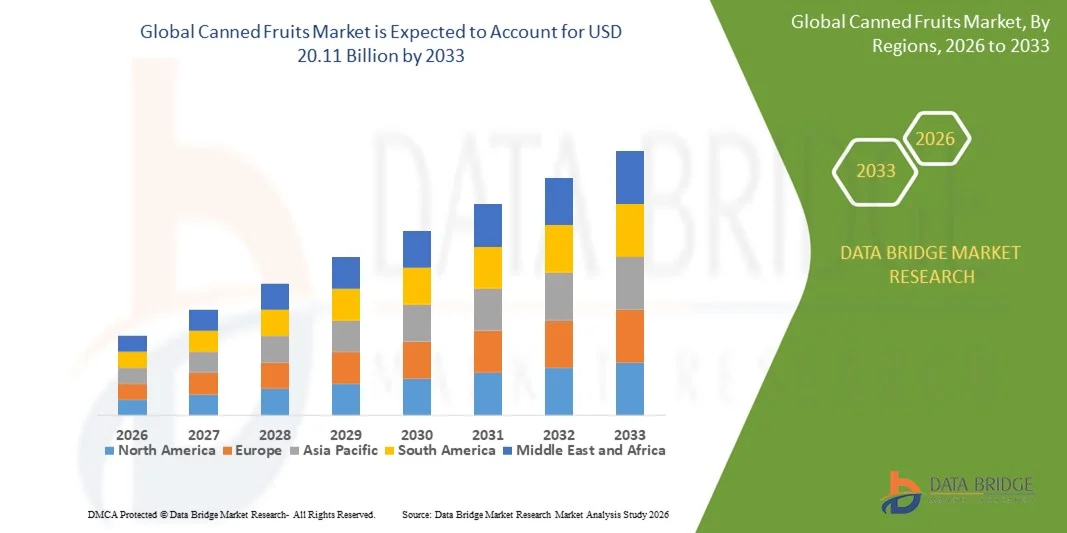
- The global canned fruits market size was valued at USD 15.01 billion in 2025 and is expected to reach USD 20.11 billion by 2033, at a CAGR of 3.73% during the forecast period
- The market growth is largely fueled by increasing consumer demand for convenient, ready-to-eat, and long-shelf-life fruit products, which are widely used in households, foodservice, and commercial kitchens
- Furthermore, rising health awareness and preference for nutritious, high-quality, and natural fruit options are encouraging the adoption of canned fruits as a versatile ingredient across desserts, beverages, salads, and culinary applications. These converging factors are accelerating the uptake of canned fruits, thereby significantly boosting the industry’s growth
Canned Fruits Market Analysis
- Canned fruits, offering preserved fruit products that retain flavor, texture, and nutritional value, are increasingly vital components of modern diets and foodservice operations due to their convenience, extended shelf life, and consistent quality across seasons
- The escalating demand for canned fruits is primarily fueled by growing urbanization, busier lifestyles, increasing disposable incomes, and expanding retail and e-commerce distribution channels, which make these products easily accessible to consumers across diverse regions
- North America dominated the canned fruits market with a share of 37.90% in 2025, due to high consumption of processed and ready-to-eat fruit products, as well as increasing demand for convenient and long-shelf-life food items
- Asia-Pacific is expected to be the fastest growing region in the canned fruits market during the forecast period due to rising urbanization, increasing disposable incomes, and expanding retail networks in countries such as China, Japan, and India
- Pineapple segment dominated the market with a market share of 35.1% in 2025, due to its wide consumer acceptance, year-round availability in canned form, and extensive use in desserts, beverages, and culinary preparations. Pineapple’s balanced sweet-tangy flavor and longer shelf stability further support its dominance across retail and foodservice channels
Report Scope and Canned Fruits Market Segmentation
|
Attributes |
Canned Fruits Key Market Insights |
|
Segments Covered |
|
|
Countries Covered |
North America
Europe
Asia-Pacific
Middle East and Africa
South America
|
|
Key Market Players |
|
|
Market Opportunities |
|
|
Value Added Data Infosets |
In addition to the insights on market scenarios such as market value, growth rate, segmentation, geographical coverage, and major players, the market reports curated by the Data Bridge Market Research also include in-depth expert analysis, pricing analysis, brand share analysis, consumer survey, demography analysis, supply chain analysis, value chain analysis, raw material/consumables overview, vendor selection criteria, PESTLE Analysis, Porter Analysis, and regulatory framework. |
Canned Fruits Market Trends
Rising Adoption of Ready-to-Eat and Convenient Fruit Products
- A notable trend in the canned fruits market is the increasing consumer preference for ready-to-eat and convenient fruit products, driven by hectic lifestyles and the growing need for easily accessible nutritious options. This trend is fueling innovation in packaging, portion sizes, and preservation techniques to enhance shelf life while maintaining quality and flavor
- For instance, Del Monte Foods offers a wide range of ready-to-eat canned fruit products such as fruit cups and mixed fruit blends that cater to on-the-go consumption and convenience-focused consumers. Such offerings are contributing to wider acceptance of canned fruits as quick meal and snack options
- The incorporation of exotic and tropical fruit varieties in canned products is gaining traction, as companies seek to diversify their portfolios and appeal to adventurous consumers. This is encouraging product differentiation and increasing market competitiveness
- Retailers are expanding shelf space and promotions for canned fruits due to rising consumer demand, strengthening visibility and accessibility in grocery and convenience stores. These initiatives support sustained consumption and brand recognition across varied demographics
- The trend toward health-conscious snacking is driving manufacturers to develop canned fruits with reduced sugar, no added preservatives, and fortified nutritional profiles. This aligns with consumer expectations for safe, wholesome, and functional food choices
- The market is witnessing growth in innovative packaging formats such as resealable cans and single-serve portions, enhancing convenience, reducing food waste, and encouraging repeated purchases. These strategies are shaping the canned fruits market toward greater consumer engagement and long-term adoption
Canned Fruits Market Dynamics
Driver
Growing Health Awareness and Preference for Nutritional Food Options
- Rising health awareness among consumers is significantly influencing the demand for canned fruits, as individuals seek convenient options that do not compromise nutritional value. This is encouraging manufacturers to highlight vitamin content, fiber, and natural fruit benefits in product labeling and marketing
- For instance, Del Monte Foods emphasizes the nutritional value of its canned fruit products, promoting high vitamin C content and low-calorie offerings to attract health-conscious consumers. Such initiatives enhance product appeal and encourage repeat purchases among health-focused demographics
- The growing popularity of balanced diets and functional foods is leading to increased consumption of fruit-based products that contribute to immunity, digestion, and overall wellness. Manufacturers are formulating products to align with these health trends, supporting market expansion
- Schools, hospitals, and corporate cafeterias are incorporating canned fruits into meal programs to provide accessible and nutritious fruit servings. This institutional adoption strengthens steady demand and reinforces the perception of canned fruits as reliable dietary choices
- Awareness campaigns and certifications emphasizing non-GMO, organic, and preservative-free canned fruits are further influencing purchasing decisions. These practices reinforce consumer trust and contribute to sustained market growth
Restraint/Challenge
Stringent Quality and Food Safety Regulations
- The canned fruits market faces challenges due to strict quality control and food safety regulations imposed by authorities to prevent contamination, ensure proper labeling, and maintain consistent nutritional standards. Compliance with these regulations requires substantial investments in testing, certification, and monitoring processes
- For instance, Del Monte Foods adheres to rigorous FDA guidelines and international food safety standards such as HACCP to ensure product safety and maintain consumer confidence. These compliance measures increase operational complexity and production costs
- Manufacturers must implement advanced sterilization, preservation, and packaging technologies to meet safety standards without compromising taste or nutritional content. These technical requirements can slow down production and limit flexibility in product innovation
- The evolving regulatory landscape across different regions, including limits on sugar content, additives, and preservatives, demands continuous adaptation by producers. Companies must stay updated with global and local policies to avoid penalties and maintain market access
- Maintaining consistent quality across large-scale production and multiple distribution channels remains challenging, especially when sourcing fruits from diverse geographies. These challenges collectively place pressure on manufacturers to optimize processes while ensuring compliance and product integrity
Canned Fruits Market Scope
The market is segmented on the basis of fruit type, type, form, application, and end users.
- By Fruit Type
On the basis of fruit type, the canned fruits market is segmented into peaches, pineapple, mandarin oranges, pears, strawberries, raspberry, and other fruit types. The pineapple segment dominated the market with the largest revenue share of 35.1% in 2025, driven by its wide consumer acceptance, year-round availability in canned form, and extensive use in desserts, beverages, and culinary preparations. Pineapple’s balanced sweet-tangy flavor and longer shelf stability further support its dominance across retail and foodservice channels.
The mandarin oranges segment is expected to witness the fastest growth from 2026 to 2033, supported by rising demand for ready-to-eat fruit snacks and their popularity in salads, bakery fillings, and confectionery applications. Growing health awareness and preference for naturally sweet, vitamin-rich fruits are accelerating adoption of canned mandarin oranges globally.
- By Type
On the basis of type, the canned fruits market is segmented into inorganic and organic. The inorganic segment dominated the market in 2025 due to its lower production costs, longer shelf life, and widespread availability across mass retail and institutional buyers. Conventional canned fruits remain the preferred choice in price-sensitive markets, supported by established supply chains and consistent product quality.
The organic segment is projected to register the fastest growth during the forecast period, driven by increasing consumer inclination toward clean-label, chemical-free, and sustainably sourced food products. Rising awareness regarding health, environmental impact, and premium food consumption is boosting demand for organic canned fruits, particularly in developed and urban markets.
- By Form
On the basis of form, the market is segmented into peeled, sliced, chopped, and others. The sliced segment accounted for the largest market share in 2025, as sliced canned fruits offer convenience, uniformity, and ease of use across household consumption and foodservice applications. Their suitability for desserts, toppings, and baking applications makes sliced fruits a preferred choice among consumers and commercial users.
The chopped segment is anticipated to grow at the fastest rate from 2026 to 2033, driven by increasing use in ready-to-eat meals, bakery fillings, and food processing applications. Demand is further supported by the foodservice sector’s need for time-saving, pre-processed ingredients that reduce preparation efforts.
- By Application
On the basis of application, the canned fruits market is segmented into toppings and dressings, salad, culinary, and other applications. The culinary segment dominated the market in 2025, supported by extensive usage of canned fruits in bakery products, desserts, sauces, and cooked dishes across both household and commercial kitchens. Their consistent taste and year-round availability make them a reliable ingredient for culinary preparations.
The toppings and dressings segment is expected to witness the fastest growth over the forecast period, driven by rising consumption of desserts, ice creams, yogurts, and ready-to-eat foods. Growing café culture and demand for visually appealing and flavorful food products are contributing to increased adoption of canned fruits as toppings.
- By End Users
On the basis of end users, the market is segmented into 20–40 years old, 40–50 years old, and above 50 years old. The 20–40 years old segment dominated the market in 2025, driven by busy lifestyles, higher consumption of convenience foods, and preference for ready-to-use fruit products. This age group shows strong inclination toward packaged foods that offer ease of preparation and consistent quality.
The above 50 years old segment is projected to grow at the fastest pace from 2026 to 2033, supported by increasing focus on nutrition, digestive health, and balanced diets. Canned fruits appeal to this group due to their softness, easy consumption, and perceived nutritional benefits, encouraging higher adoption among aging populations.
Canned Fruits Market Regional Analysis
- North America dominated the canned fruits market with the largest revenue share of 37.90% in 2025, driven by high consumption of processed and ready-to-eat fruit products, as well as increasing demand for convenient and long-shelf-life food items
- Consumers in the region highly value the ease of use, consistent quality, and nutritional benefits offered by canned fruits, making them a staple in households, foodservice, and commercial kitchens
- This widespread adoption is further supported by strong retail distribution channels, rising health-consciousness, and the growing preference for fruit-based desserts and ready-to-eat meals, establishing canned fruits as a preferred choice for both individual and institutional consumption
U.S. Canned Fruits Market Insight
The U.S. canned fruits market captured the largest revenue share in 2025 within North America, fueled by the growing trend of convenient and packaged fruit products. Consumers are increasingly seeking products that provide long shelf life, ease of preparation, and versatility in culinary applications. The rising demand for ready-to-eat fruit snacks, desserts, and toppings further drives market expansion. Moreover, increasing awareness regarding nutrition and fortified fruit products is promoting consumption across households and foodservice channels.
Europe Canned Fruits Market Insight
The Europe canned fruits market is projected to expand at a significant CAGR during the forecast period, driven by growing demand for processed and health-oriented fruit products. Rising urbanization and busier lifestyles are increasing the adoption of convenient fruit options in households. European consumers also favor fruit products with clean-label, non-GMO, and organic certifications. The market is witnessing growth across retail, hospitality, and institutional applications, with canned fruits becoming a popular ingredient in culinary and dessert preparations.
U.K. Canned Fruits Market Insight
The U.K. canned fruits market is anticipated to grow at a noteworthy CAGR during the forecast period, supported by consumer preference for convenient, ready-to-use fruit products. Increasing health awareness and the demand for fruit-based desserts, yogurts, and salads are encouraging both households and foodservice providers to adopt canned fruits. The robust retail infrastructure and rising popularity of organic and premium fruit variants are expected to sustain market growth.
Germany Canned Fruits Market Insight
The Germany canned fruits market is expected to expand at a considerable CAGR during the forecast period, driven by the country’s high consumption of processed foods and the emphasis on nutritional quality. German consumers prefer fruit products with consistent taste, quality, and traceability, promoting the adoption of canned fruits in households and commercial kitchens. Integration of canned fruits in culinary, bakery, and dessert applications is becoming increasingly prevalent, with growing demand for convenient, ready-to-use ingredients.
Asia-Pacific Canned Fruits Market Insight
The Asia-Pacific canned fruits market is poised to grow at the fastest CAGR during the forecast period of 2026 to 2033, fueled by rising urbanization, increasing disposable incomes, and expanding retail networks in countries such as China, Japan, and India. The region’s growing inclination toward convenience foods and ready-to-eat fruit products is driving market adoption. Furthermore, local fruit production, coupled with the expansion of modern food processing facilities, is enhancing the availability and affordability of canned fruits across diverse consumer segments.
Japan Canned Fruits Market Insight
The Japan canned fruits market is gaining momentum due to high demand for convenience foods, urban lifestyles, and emphasis on nutritional diets. Japanese consumers prefer canned fruits for their ease of use, consistent quality, and integration in desserts, snacks, and beverages. The market is further supported by the country’s technological advancements in food processing and packaging, ensuring longer shelf life and freshness. Aging population trends are also promoting demand for softer, ready-to-eat fruit products that are easy to consume.
China Canned Fruits Market Insight
The China canned fruits market accounted for the largest market revenue share in Asia Pacific in 2025, driven by rapid urbanization, rising disposable incomes, and increasing consumption of processed foods. The popularity of canned fruits in residential, commercial, and institutional applications is growing due to convenience, affordability, and year-round availability. Government initiatives promoting food processing industries, alongside strong domestic fruit production and processing capabilities, are key factors propelling the market in China.
Canned Fruits Market Share
The canned fruits industry is primarily led by well-established companies, including:
- Nestlé (Switzerland)
- chb.gr. (Greece)
- Del Monte Food, Inc. (U.S.)
- Dole Food Company, Inc. (U.S.)
- The Kraft Heinz Company (U.S.)
- Seneca Foods (U.S.)
- Ayam Sarl. (Singapore)
- Delicia Foods India Pvt. Ltd. (India)
- Bösch Boden Spies (Germany)
- Shanghai Meilin Zhengguanghe Co., Ltd. (China)
- Welch’s (U.S.)
- Pinnacle Foods Inc. (U.S.)
- Bellisio Foods, Inc. (U.S.)
- HANOVER FOODS (U.S.)
- Tropicana Products, Inc. (U.S.)
- Linyi Kangfa Food and Beverage Co., Ltd. (China)
Latest Developments in Global Canned Fruits Market
- In August 2025, Malibu partnered with Dole to introduce the "Malibu & Dole" Ready-to-Drink cocktail lineup, featuring an 8-pack of 12oz cans in flavors such as Pineapple, Pineapple Mango, Pineapple Strawberry, and Pineapple Dragon Fruit, alongside larger 19.2oz single cans in Pineapple and Pineapple Mango. This collaboration strengthened the market presence of canned pineapple products by tapping into the ready-to-drink and premium cocktail segments, attracting younger consumers seeking convenience and innovative tropical flavor combinations, thereby expanding the overall appeal of pineapple-based canned fruit offerings
- In April 2024, Predilecta Alimentos participated in Super Rio Expofood 2024, one of Brazil’s largest supermarket and food service exhibitions, showcasing its extensive range of preserves, including canned fruits and vegetables, seasonings, and other products. This strategic participation enhanced brand visibility and market penetration in Latin America, reinforcing Predilecta’s influence in the retail and foodservice segments while promoting greater adoption of canned fruit products across emerging markets
- In April 2024, Dole PLC launched the "Dole Can It Pineapple Snack Hackathon," a three-week competition encouraging recipe innovators to create unique dishes using Dole canned pineapple. The initiative highlighted Dole’s high-quality, vitamin C-rich, no-added-sugar pineapple products and stimulated consumer engagement, fostering creative use of canned fruits in culinary applications, which helped drive demand for versatile and convenient fruit products in both household and foodservice markets
- In July 2023, Del Monte Foods launched a premium range of canned fruit products, including Tropical Gold Pineapple and Tropical Fruit Mix, emphasizing natural ingredients and being free from preservatives. This product expansion targeted health-conscious consumers and the growing demand for natural, high-quality fruit options, elevating the perception of canned fruits as a nutritious and premium category in the global market
- In March 2023, Bonduelle introduced its “Bonduelle Premium Canned Fruit Collection” in Europe, featuring pineapple, peach, and mixed tropical fruit variants with no added sugar or artificial preservatives. This launch strengthened Bonduelle’s foothold in the European market, catering to consumers seeking clean-label, convenient fruit options, and contributing to the increasing adoption of canned fruits in ready-to-eat and dessert applications
SKU-
Get online access to the report on the World's First Market Intelligence Cloud
- Interactive Data Analysis Dashboard
- Company Analysis Dashboard for high growth potential opportunities
- Research Analyst Access for customization & queries
- Competitor Analysis with Interactive dashboard
- Latest News, Updates & Trend analysis
- Harness the Power of Benchmark Analysis for Comprehensive Competitor Tracking
Global Canned Fruits Market, Supply Chain Analysis and Ecosystem Framework
To support market growth and help clients navigate the impact of geopolitical shifts, DBMR has integrated in-depth supply chain analysis into its Global Canned Fruits Market research reports. This addition empowers clients to respond effectively to global changes affecting their industries. The supply chain analysis section includes detailed insights such as Global Canned Fruits Market consumption and production by country, price trend analysis, the impact of tariffs and geopolitical developments, and import and export trends by country and HSN code. It also highlights major suppliers with data on production capacity and company profiles, as well as key importers and exporters. In addition to research, DBMR offers specialized supply chain consulting services backed by over a decade of experience, providing solutions like supplier discovery, supplier risk assessment, price trend analysis, impact evaluation of inflation and trade route changes, and comprehensive market trend analysis.
Research Methodology
Data collection and base year analysis are done using data collection modules with large sample sizes. The stage includes obtaining market information or related data through various sources and strategies. It includes examining and planning all the data acquired from the past in advance. It likewise envelops the examination of information inconsistencies seen across different information sources. The market data is analysed and estimated using market statistical and coherent models. Also, market share analysis and key trend analysis are the major success factors in the market report. To know more, please request an analyst call or drop down your inquiry.
The key research methodology used by DBMR research team is data triangulation which involves data mining, analysis of the impact of data variables on the market and primary (industry expert) validation. Data models include Vendor Positioning Grid, Market Time Line Analysis, Market Overview and Guide, Company Positioning Grid, Patent Analysis, Pricing Analysis, Company Market Share Analysis, Standards of Measurement, Global versus Regional and Vendor Share Analysis. To know more about the research methodology, drop in an inquiry to speak to our industry experts.
Customization Available
Data Bridge Market Research is a leader in advanced formative research. We take pride in servicing our existing and new customers with data and analysis that match and suits their goal. The report can be customized to include price trend analysis of target brands understanding the market for additional countries (ask for the list of countries), clinical trial results data, literature review, refurbished market and product base analysis. Market analysis of target competitors can be analyzed from technology-based analysis to market portfolio strategies. We can add as many competitors that you require data about in the format and data style you are looking for. Our team of analysts can also provide you data in crude raw excel files pivot tables (Fact book) or can assist you in creating presentations from the data sets available in the report.