Global Calcium Tartrate Market
Market Size in USD Billion
CAGR :
% 
 USD
1.13 Billion
USD
1.51 Billion
2025
2033
USD
1.13 Billion
USD
1.51 Billion
2025
2033
 Forecast Period Forecast Period |
2026 –2033 |
 Market Size (Base Year) Market Size (Base Year) |
USD 1.13 Billion |
 Market Size (Forecast Year) Market Size (Forecast Year) |
USD 1.51 Billion |
 CAGR CAGR |
% |
| Major Markets Players |
|
Calcium Tartrate Market Size
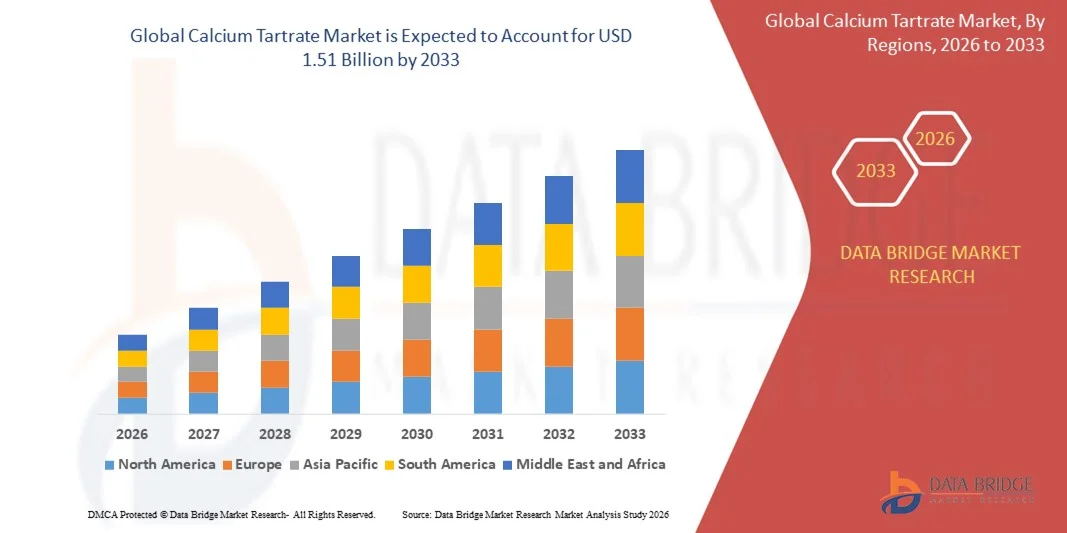
- The global calcium tartrate market size was valued at USD 1.13 billion in 2025 and is expected to reach USD 1.51 billion by 2033, at a CAGR of 3.7% during the forecast period
- The market growth is largely fueled by the increasing demand for natural and multifunctional ingredients in food, beverages, and pharmaceutical applications, driving widespread adoption of calcium tartrate as a key additive and stabilizer
- Furthermore, rising consumer preference for clean-label, safe, and natural ingredients in processed foods and dietary supplements is establishing calcium tartrate as a preferred solution for manufacturers. These converging factors are accelerating the uptake of calcium tartrate across industrial and consumer segments, thereby significantly boosting market growth
Calcium Tartrate Market Analysis
- Calcium tartrate is a naturally derived compound primarily used in tartaric acid production, food preservation, and pharmaceutical formulations. It functions as an acidity regulator, stabilizer, and antioxidant, enhancing the quality, shelf life, and safety of various products
- The escalating demand for calcium tartrate is primarily fueled by the growing processed food and beverage industry, rising consumption of dietary supplements, and increasing focus on natural additives for health-conscious consumers. In addition, expanding applications in pharmaceuticals and chemical industries further support market growth
- North America dominated the calcium tartrate market with a share of over 40% in 2025, due to high demand from the food and beverages industry and increasing use in pharmaceutical formulations
- Asia-Pacific is expected to be the fastest growing region in the calcium tartrate market during the forecast period due to rising demand from food, beverage, and pharmaceutical industries in countries such as China, India, and Japan
- Tartaric acid production segment dominated the market with a market share of 47.1% in 2025, due to its crucial role as a precursor in industrial tartaric acid manufacturing. Manufacturers prefer calcium tartrate for its high purity and consistency, which ensures efficiency in tartaric acid synthesis. Its widespread use in winemaking, baking, and other food industries further strengthens demand. In addition, its multifunctional properties such as pH regulation and stabilization contribute to its preference in industrial processes. The segment’s established applications across multiple industries continue to maintain its market dominance
Report Scope and Calcium Tartrate Market Segmentation
|
Attributes |
Calcium Tartrate Key Market Insights |
|
Segments Covered |
|
|
Countries Covered |
North America
Europe
Asia-Pacific
Middle East and Africa
South America
|
|
Key Market Players |
|
|
Market Opportunities |
|
|
Value Added Data Infosets |
In addition to the insights on market scenarios such as market value, growth rate, segmentation, geographical coverage, and major players, the market reports curated by the Data Bridge Market Research also include import export analysis, production capacity overview, production consumption analysis, price trend analysis, climate change scenario, supply chain analysis, value chain analysis, raw material/consumables overview, vendor selection criteria, PESTLE Analysis, Porter Analysis, and regulatory framework. |
Calcium Tartrate Market Trends
Rising Demand for Natural and Clean-Label Ingredients
- A significant trend in the calcium tartrate market is the growing preference for natural and clean-label ingredients in food, beverage, and pharmaceutical products, driven by consumer demand for transparency and health-conscious choices. This trend is positioning calcium tartrate as a preferred additive due to its natural origin and multifunctional applications in improving taste, texture, and stability
- For instance, companies such as Archer Daniels Midland (ADM) supply natural calcium tartrate for use in dietary supplements and functional foods, supporting product formulations that appeal to health-conscious consumers. These offerings strengthen the market by providing trusted, certified clean-label ingredients that meet regulatory requirements
- The increasing use of calcium tartrate in wine and beverage stabilization is contributing to its rising demand as it helps maintain flavor profiles and extend shelf life. This application is encouraging producers to adopt calcium tartrate as a natural alternative to synthetic stabilizers
- Pharmaceutical applications are leveraging calcium tartrate for its mineral supplementation and excipient properties, enhancing the bioavailability of active compounds. This is driving innovation in capsule and tablet formulations where natural additives are preferred
- Functional foods enriched with calcium tartrate are gaining popularity in the nutraceutical sector, supporting bone health and overall wellness. This is expanding the scope of calcium tartrate beyond traditional culinary uses and into health-focused product lines
- The demand for calcium tartrate is further reinforced by increasing regulatory support for natural and safe food additives across regions such as the U.S. and Europe. This trend is shaping industry priorities toward ingredients that align with consumer safety expectations and sustainable sourcing practices
Calcium Tartrate Market Dynamics
Driver
Growing Adoption in Food, Beverage, and Pharmaceutical Applications
- The market for calcium tartrate is driven by its versatile applications in food, beverage, and pharmaceutical industries, where it functions as a stabilizer, acidity regulator, and nutritional supplement. These properties are creating opportunities for manufacturers to incorporate calcium tartrate into a wide range of products, enhancing their quality and functionality
- For instance, Cargill supplies calcium tartrate for confectionery and beverage applications, enabling manufacturers to maintain product stability and improve nutritional value. These solutions are supporting product innovation in segments focused on natural and functional ingredients
- The rising demand for dietary supplements and fortified foods is expanding the use of calcium tartrate as a calcium source, particularly in bone health formulations. This is reinforcing its importance as an ingredient that meets both functional and nutritional requirements
- Pharmaceutical companies are adopting calcium tartrate as an excipient and mineral additive to improve tablet stability and bioavailability. This trend is increasing the integration of calcium tartrate into high-value formulations for the global healthcare market
- The incorporation of calcium tartrate into beverages and wine stabilization processes is boosting its adoption, driven by quality and sensory improvement goals. This is positioning the ingredient as a critical component for maintaining consistency and consumer acceptance
Restraint/Challenge
Fluctuating Raw Material Prices and Availability
- The calcium tartrate market faces challenges due to volatility in raw material prices and limited availability of naturally sourced tartrate compounds, which can disrupt production and affect supply chain stability. These fluctuations are influencing manufacturers’ cost structures and pricing strategies
- For instance, companies such as Archer Daniels Midland (ADM) have reported supply challenges due to seasonal variations in raw material sourcing, impacting production timelines and market pricing. These constraints emphasize the need for reliable sourcing strategies and inventory management
- Dependence on grape-derived and fermentation-based tartrate sources makes the market vulnerable to agricultural conditions, harvest yields, and climate impacts. This creates uncertainty in supply continuity and can hinder the scalability of calcium tartrate production
- Price volatility can limit the ability of smaller manufacturers to compete in a market increasingly focused on cost efficiency and consistent supply. This pressure is encouraging investment in alternative sourcing and improved logistics
- Sustaining production quality while managing raw material cost fluctuations remains a critical challenge, as any compromise on quality can affect regulatory compliance and consumer acceptance. These factors collectively necessitate strategic planning in procurement and supply chain management
Calcium Tartrate Market Scope
The market is segmented on the basis of application and end-use.
- By Application
On the basis of application, the calcium tartrate market is segmented into tartaric acid production, food preservative, and medicines. The tartaric acid production segment dominated the largest market revenue share of 47.1% in 2025, driven by its crucial role as a precursor in industrial tartaric acid manufacturing. Manufacturers prefer calcium tartrate for its high purity and consistency, which ensures efficiency in tartaric acid synthesis. Its widespread use in winemaking, baking, and other food industries further strengthens demand. In addition, its multifunctional properties such as pH regulation and stabilization contribute to its preference in industrial processes. The segment’s established applications across multiple industries continue to maintain its market dominance.
The food preservative segment is anticipated to witness the fastest growth rate from 2026 to 2033, fueled by increasing demand for natural and clean-label preservatives in packaged foods and beverages. Calcium tartrate acts as an effective antioxidant and acidity regulator, extending shelf life and maintaining product quality. Rising consumer preference for minimally processed foods is driving adoption in bakery, dairy, and beverage products. In addition, regulatory approvals in major markets support its credibility as a food-grade preservative. Innovations in calcium tartrate-based formulations to replace synthetic additives further enhance growth. The segment’s increasing integration into food processing and preservation processes positions it as the fastest-growing application.
- By End-Use
On the basis of end-use, the calcium tartrate market is segmented into the food and beverages industry, pharmaceutical industry, and chemical industry. The food and beverages industry segment dominated the largest market revenue share in 2025, attributed to calcium tartrate’s extensive use for acidity control, stabilization, and flavor enhancement. Its role in preventing crystallization and maintaining product consistency makes it indispensable for food manufacturers. In addition, its multifunctional properties reduce the need for multiple additives, strengthening its adoption across various products. Rising demand for clean-label ingredients further supports growth in this sector. The segment’s well-established applications ensure its continued dominance in the market.
The pharmaceutical industry segment is expected to witness the fastest CAGR from 2026 to 2033, driven by calcium tartrate’s use as an excipient in drug formulations and effervescent tablets for pH control and stability. Its compatibility with various active pharmaceutical ingredients ensures consistent efficacy and safety. Growing demand for high-quality, stable, and patient-friendly formulations supports market growth. In addition, regulatory compliance and proven safety profiles reinforce confidence in pharmaceutical applications. The segment’s expanding role in drug production positions it as the fastest-growing end-use category.
Calcium Tartrate Market Regional Analysis
- North America dominated the calcium tartrate market with the largest revenue share of over 40% in 2025, driven by high demand from the food and beverages industry and increasing use in pharmaceutical formulations
- Manufacturers in the region prioritize calcium tartrate for its purity and multifunctional properties, ensuring consistent quality across tartaric acid production and preservative applications
- The market growth is further supported by advanced food processing infrastructure, stringent quality standards, and rising consumer preference for natural additives
U.S. Calcium Tartrate Market Insight
The U.S. calcium tartrate market captured the largest revenue share in 2025 within North America, fueled by increasing demand from processed foods, beverages, and pharmaceutical applications. Rising adoption of clean-label ingredients and fortified products is driving usage in the food sector. In addition, well-established manufacturing capabilities and technological advancements in additive processing further enhance the market growth. The preference for high-purity, multifunctional calcium tartrate in tartaric acid production and food stabilization is supporting market expansion.
Europe Calcium Tartrate Market Insight
The Europe calcium tartrate market is projected to expand at a substantial CAGR throughout the forecast period, primarily driven by rising demand in food preservation, pharmaceuticals, and chemical industries. Consumers and manufacturers in the region are increasingly focusing on natural, safe, and multifunctional ingredients. The market growth is supported by stringent food safety regulations, high-quality production standards, and increasing adoption in industrial applications such as tartaric acid synthesis and effervescent formulations.
U.K. Calcium Tartrate Market Insight
The U.K. calcium tartrate market is anticipated to grow at a noteworthy CAGR during the forecast period, driven by rising consumption in the food and beverage sector and pharmaceutical applications. Growing consumer preference for natural additives and functional ingredients supports demand. In addition, the U.K.’s well-developed food processing and pharmaceutical industries are expected to continue fueling market growth, with calcium tartrate increasingly used in stabilization and preservation processes.
Germany Calcium Tartrate Market Insight
The Germany calcium tartrate market is expected to expand at a considerable CAGR during the forecast period, fueled by rising industrial demand in food processing, pharmaceuticals, and chemical applications. Germany’s emphasis on high-quality production standards, food safety, and sustainable practices promotes calcium tartrate adoption. Increasing use in tartaric acid production and as a natural preservative for bakery, dairy, and beverage products is driving market expansion in the region.
Asia-Pacific Calcium Tartrate Market Insight
The Asia-Pacific calcium tartrate market is poised to grow at the fastest CAGR during the forecast period of 2026 to 2033, driven by rising demand from food, beverage, and pharmaceutical industries in countries such as China, India, and Japan. Rapid urbanization, increasing disposable incomes, and growing awareness of clean-label and natural ingredients are supporting market adoption. In addition, expanding production capacities and the presence of major regional manufacturers are enhancing accessibility and affordability of calcium tartrate across the region.
Japan Calcium Tartrate Market Insight
The Japan calcium tartrate market is gaining momentum due to high consumption in food and beverage applications and increasing use in pharmaceutical formulations. The Japanese market emphasizes ingredient purity, multifunctionality, and safety, supporting the adoption of calcium tartrate in industrial and consumer products. Increasing demand for natural preservatives and stabilizers in processed foods and beverages further propels market growth.
China Calcium Tartrate Market Insight
The China calcium tartrate market accounted for the largest market revenue share in Asia-Pacific in 2025, attributed to the country’s expanding food and beverage sector, pharmaceutical industry growth, and rapid urbanization. High rates of technological adoption and growing awareness of natural, multifunctional additives are boosting demand. In addition, the presence of major domestic manufacturers and cost-effective production is further driving market expansion in both industrial and consumer applications.
Calcium Tartrate Market Share
The calcium tartrate industry is primarily led by well-established companies, including:
- The Tartaric Chemicals Corporation (U.S.)
- Tarcol S.A. (Argentina)
- Giovanni Randi S.p.A. (Italy)
- Vinicos Derivatives S.A. (Chile)
- Changmao Biochemical Engineering Company Limited (China)
- Gruppo Caviro. Tutti i diritti riservati. (Italy)
- ATPGroup (U.S.)
- Tosoh Corporation (Japan)
- Solvay (Belgium)
- Westlake Chemical Corporation (U.S.)
- Lonza (Switzerland)
- China Petrochemical Corporation (China)
- Distillerie Mazzari S.p.A. (Italy)
- American Elements (U.S.)
Latest Developments in Global Calcium Tartrate Market
- In November 2025, Zhejiang Zanyu Technology Company Limited unveiled a new high-purity calcium tartrate product line for bakery and confectionery applications. This launch is expected to cater to the rising demand for clean-label ingredients in processed foods and strengthen the company’s footprint in the food industry, supporting market growth across APAC and Europe
- In July 2025, Nanjing Jiahua Chemical Co., Ltd. entered into a strategic partnership with a leading beverage manufacturer to supply natural calcium tartrate for functional beverages. This collaboration is expected to broaden the company’s market reach and enhance product portfolios, catering to the rising consumer preference for fortified and natural beverages, thereby driving overall demand for calcium tartrate in the beverage sector
- In January 2024, Sankyo Seiko Co., Ltd. launched a new line of natural calcium tartrate dietary supplements targeting health-conscious consumers. This product introduction is anticipated to strengthen the company’s presence in the nutraceutical segment and support the growing adoption of natural calcium sources in supplements, contributing to market expansion
- In August 2024, Evonik Industries AG signed a long-term supply agreement with a major pharmaceutical company to provide natural calcium tartrate for effervescent and medicinal formulations. This development is projected to secure a stable revenue stream, increase adoption in pharmaceutical applications, and further establish calcium tartrate as a preferred ingredient in health-focused products
- In March 2023, Tartaric Chemicals announced the expansion of its production facility in California to meet increasing demand for natural calcium tartrate in the wine industry. This expansion is projected to enhance manufacturing capacity, improve supply chain efficiency, and reinforce the company’s market position in the North American region
SKU-
Get online access to the report on the World's First Market Intelligence Cloud
- Interactive Data Analysis Dashboard
- Company Analysis Dashboard for high growth potential opportunities
- Research Analyst Access for customization & queries
- Competitor Analysis with Interactive dashboard
- Latest News, Updates & Trend analysis
- Harness the Power of Benchmark Analysis for Comprehensive Competitor Tracking
Global Calcium Tartrate Market, Supply Chain Analysis and Ecosystem Framework
To support market growth and help clients navigate the impact of geopolitical shifts, DBMR has integrated in-depth supply chain analysis into its Global Calcium Tartrate Market research reports. This addition empowers clients to respond effectively to global changes affecting their industries. The supply chain analysis section includes detailed insights such as Global Calcium Tartrate Market consumption and production by country, price trend analysis, the impact of tariffs and geopolitical developments, and import and export trends by country and HSN code. It also highlights major suppliers with data on production capacity and company profiles, as well as key importers and exporters. In addition to research, DBMR offers specialized supply chain consulting services backed by over a decade of experience, providing solutions like supplier discovery, supplier risk assessment, price trend analysis, impact evaluation of inflation and trade route changes, and comprehensive market trend analysis.
Research Methodology
Data collection and base year analysis are done using data collection modules with large sample sizes. The stage includes obtaining market information or related data through various sources and strategies. It includes examining and planning all the data acquired from the past in advance. It likewise envelops the examination of information inconsistencies seen across different information sources. The market data is analysed and estimated using market statistical and coherent models. Also, market share analysis and key trend analysis are the major success factors in the market report. To know more, please request an analyst call or drop down your inquiry.
The key research methodology used by DBMR research team is data triangulation which involves data mining, analysis of the impact of data variables on the market and primary (industry expert) validation. Data models include Vendor Positioning Grid, Market Time Line Analysis, Market Overview and Guide, Company Positioning Grid, Patent Analysis, Pricing Analysis, Company Market Share Analysis, Standards of Measurement, Global versus Regional and Vendor Share Analysis. To know more about the research methodology, drop in an inquiry to speak to our industry experts.
Customization Available
Data Bridge Market Research is a leader in advanced formative research. We take pride in servicing our existing and new customers with data and analysis that match and suits their goal. The report can be customized to include price trend analysis of target brands understanding the market for additional countries (ask for the list of countries), clinical trial results data, literature review, refurbished market and product base analysis. Market analysis of target competitors can be analyzed from technology-based analysis to market portfolio strategies. We can add as many competitors that you require data about in the format and data style you are looking for. Our team of analysts can also provide you data in crude raw excel files pivot tables (Fact book) or can assist you in creating presentations from the data sets available in the report.