Global Bulk Food Ingredients Market
Market Size in USD Billion
CAGR :
% 
 USD
353.45 Billion
USD
478.16 Billion
2025
2033
USD
353.45 Billion
USD
478.16 Billion
2025
2033
 Forecast Period Forecast Period |
2026 –2033 |
 Market Size (Base Year) Market Size (Base Year) |
USD 353.45 Billion |
 Market Size (Forecast Year) Market Size (Forecast Year) |
USD 478.16 Billion |
 CAGR CAGR |
% |
| Major Markets Players |
|
Bulk Food Ingredients Market Size
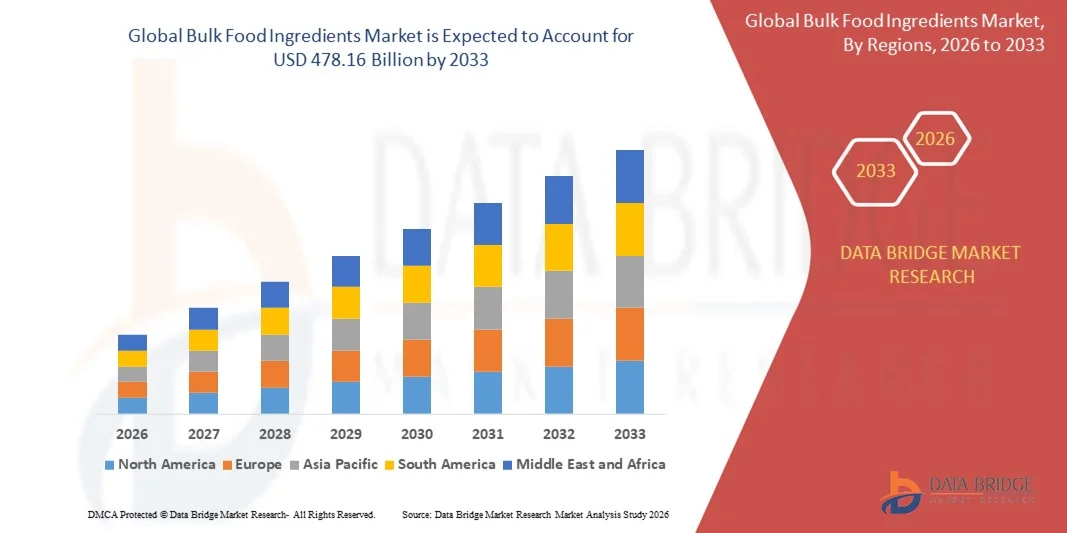
- The global bulk food ingredients market size was valued at USD 353.45 billion in 2025 and is expected to reach USD 478.16 billion by 2033, at a CAGR of 3.85% during the forecast period
- The market growth is largely fuelled by increasing demand for processed and convenience foods, rising global population, and the expansion of foodservice and retail sectors
- Growing consumer preference for fortified and functional ingredients is driving manufacturers to innovate and diversify product offerings
Bulk Food Ingredients Market Analysis
- Rising adoption of clean-label, natural, and plant-based ingredients is influencing product development strategies in the market
- Increased investment in R&D for nutrient-rich and cost-effective ingredients is enabling manufacturers to meet evolving consumer demands
- North America dominated the global bulk food ingredients market with the largest revenue share of 25.50% in 2025, driven by rising demand for processed and convenience foods, coupled with increasing awareness of nutrition and functional ingredients
- Asia-Pacific region is expected to witness the highest growth rate in the global bulk food ingredients market, driven by rapid urbanization, expanding food processing industry, increasing adoption of functional ingredients, and government initiatives supporting food safety and innovation
- The Primary Processed Bulk Food Ingredients segment held the largest market revenue share in 2025, driven by the high demand for basic raw materials such as grains, sugar, oils, and dairy products used across multiple food and beverage applications. Primary ingredients serve as the foundation for processed foods, making them essential for manufacturers and maintaining steady demand across regions
Report Scope and Bulk Food Ingredients Market Segmentation
|
Attributes |
Bulk Food Ingredients Key Market Insights |
|
Segments Covered |
|
|
Countries Covered |
North America
Europe
Asia-Pacific
Middle East and Africa
South America
|
|
Key Market Players |
• Tate & Lyle (U.K.) |
|
Market Opportunities |
|
|
Value Added Data Infosets |
In addition to the insights on market scenarios such as market value, growth rate, segmentation, geographical coverage, and major players, the market reports curated by the Data Bridge Market Research also include import export analysis, production capacity overview, production consumption analysis, price trend analysis, climate change scenario, supply chain analysis, value chain analysis, raw material/consumables overview, vendor selection criteria, PESTLE Analysis, Porter Analysis, and regulatory framework. |
Bulk Food Ingredients Market Trends
Rising Demand For Convenience And Functional Foods
- The increasing focus on convenience and ready-to-eat food products is significantly shaping the bulk food ingredients market, as consumers prefer ingredients that enhance taste, shelf life, and nutritional value. Bulk food ingredients are gaining traction due to their ability to improve product quality while reducing processing time, encouraging manufacturers to innovate with new formulations that cater to evolving consumer preferences
- Growing awareness around health, wellness, and dietary requirements has accelerated the demand for functional bulk ingredients in bakery, dairy, beverages, and snacks. Health-conscious consumers are actively seeking products formulated with high-protein, fiber-rich, and low-sugar ingredients, prompting brands to prioritize nutritional benefits and clean-label claims
- Trends toward convenience, customization, and sustainability are influencing purchasing decisions, with manufacturers emphasizing easy-to-use ingredients, bulk packaging, and eco-friendly sourcing. These factors are helping brands differentiate products in a competitive market and build consumer trust while also supporting large-scale industrial and foodservice operations
- For instance, in 2024, Cargill in the U.S. and Ingredion in Canada expanded their bulk ingredient portfolios to include plant-based protein blends and fiber-rich powders. These launches responded to rising consumer demand for functional, convenient, and sustainable products, distributed across retail, foodservice, and industrial channels
- While demand for bulk food ingredients is growing, sustained market expansion depends on consistent quality, cost-effective production, and regulatory compliance. Manufacturers are also focusing on improving scalability, supply chain efficiency, and product innovation to meet global demand and maintain a competitive advantage
Bulk Food Ingredients Market Dynamics
Driver
Rising Demand For Convenience And Functional Foods
- Increasing consumer preference for convenient, ready-to-eat, and nutritionally enhanced products is a major driver for the bulk food ingredients market. Manufacturers are integrating functional ingredients such as proteins, fibers, and prebiotics into formulations to meet evolving consumer demands
- Expanding applications in bakery, beverages, dairy, snacks, and sauces are influencing market growth. Bulk food ingredients enhance taste, texture, and shelf life while maintaining nutritional value, enabling manufacturers to deliver high-quality products that cater to health-conscious consumers
- Foodservice, industrial, and packaged food manufacturers are actively promoting bulk ingredient-based formulations through innovation, marketing campaigns, and sustainability initiatives. These efforts, coupled with the growing demand for plant-based and clean-label foods, encourage partnerships between ingredient suppliers and brands to expand market reach and improve product performance
- For instance, in 2023, ADM in the U.S. and Tate & Lyle in the U.K. reported increased incorporation of protein and fiber-rich bulk ingredients in bakery and beverage applications. This expansion followed higher demand for convenience foods with functional benefits, driving repeat purchases and product differentiation
- Although rising trends in convenience and functional foods support growth, wider adoption depends on cost optimization, raw material availability, and efficient production processes. Investment in sustainable sourcing, innovative formulations, and advanced processing technology will be critical for meeting global demand and maintaining market competitiveness
Restraint/Challenge
Price Volatility And Supply Chain Constraints
- The fluctuation in raw material prices remains a key challenge, affecting cost stability and profit margins for bulk food ingredient manufacturers. Dependence on agricultural commodities and seasonal variations can lead to supply inconsistencies and increased operational costs
- Limited awareness and understanding of functional ingredients among smaller manufacturers and emerging markets restrict adoption. Lack of technical expertise may lead to underutilization of bulk ingredients or hesitation to adopt newer formulations
- Logistical complexities and storage requirements for bulk ingredients also impact market growth. Large-scale handling, temperature control, and transportation infrastructure are necessary to maintain ingredient quality, particularly for perishable and specialty functional powders
- For instance, in 2024, disruptions in global shipping and raw material supply affected the distribution of protein and fiber-rich powders to foodservice and industrial clients in Southeast Asia, limiting market penetration
- Overcoming these challenges will require robust supply chain management, cost-effective sourcing strategies, and educational initiatives for manufacturers and distributors. Collaboration with foodservice operators, industrial buyers, and certification bodies can help unlock the long-term growth potential of the global bulk food ingredients market while ensuring quality, sustainability, and market expansion
Bulk Food Ingredients Market Scope
The market is segmented on the basis of product type and application
- By Product Type
On the basis of product type, the global bulk food ingredients market is segmented into Primary Processed Bulk Food Ingredients and Secondary Processed Bulk Food Ingredients. The Primary Processed Bulk Food Ingredients segment held the largest market revenue share in 2025, driven by the high demand for basic raw materials such as grains, sugar, oils, and dairy products used across multiple food and beverage applications. Primary ingredients serve as the foundation for processed foods, making them essential for manufacturers and maintaining steady demand across regions.
The Secondary Processed Bulk Food Ingredients segment is expected to witness the fastest growth rate from 2026 to 2033, driven by their added functionality and convenience, such as flavorings, protein concentrates, and pre-mixes, which reduce processing time for manufacturers. Secondary ingredients are particularly popular in ready meals, snacks, and bakery products for enhancing taste, nutrition, and shelf life, making them a preferred choice for food processors seeking efficiency and innovation.
- By Application
On the basis of application, the global bulk food ingredients market is segmented into Beverages, Ready Meals, Confectionery Products, Food, Snacks, And Spreads, Bakery Products, Alcoholic Beverages, Non-Alcoholic Beverages, and Others. The Beverages segment held the largest market revenue share in 2025, fueled by the increasing consumption of functional drinks, juices, and dairy-based beverages worldwide. Bulk ingredients used in beverages, such as sweeteners, flavorings, and stabilizers, play a crucial role in product formulation, quality, and consistency.
The Ready Meals segment is expected to witness the fastest growth rate from 2026 to 2033, driven by rising urbanization, busier lifestyles, and the growing preference for convenient, easy-to-prepare food options. Bulk ingredients tailored for ready meals, including pre-cooked grains, sauces, and fortified additives, enable manufacturers to deliver diverse, nutritious, and shelf-stable products that meet evolving consumer demands.
Bulk Food Ingredients Market Regional Analysis
- North America dominated the global bulk food ingredients market with the largest revenue share of 25.50% in 2025, driven by rising demand for processed and convenience foods, coupled with increasing awareness of nutrition and functional ingredients
- Consumers in the region highly value the quality, safety, and consistency offered by bulk food ingredients, as well as their ability to support product innovation across beverages, bakery, and ready meals
- This widespread adoption is further supported by well-established food processing infrastructure, high disposable incomes, and growing preference for healthy and fortified food products, positioning bulk food ingredients as a key solution for manufacturers in both retail and foodservice sectors
U.S. Bulk Food Ingredients Market Insight
The U.S. bulk food ingredients market captured the largest revenue share in 2025 within North America, fueled by the rising consumption of packaged and processed foods and the expanding trend of functional and fortified products. Manufacturers are increasingly focusing on incorporating proteins, fibers, and flavor enhancers to meet evolving consumer preferences. The demand for clean-label, natural, and convenience-oriented ingredients, along with strong R&D capabilities, is significantly propelling the market’s growth.
Europe Bulk Food Ingredients Market Insight
The Europe bulk food ingredients market is expected to witness the fastest growth rate from 2026 to 2033, primarily driven by increasing demand for health-focused, organic, and plant-based ingredients. Stringent food safety regulations, coupled with growing urbanization and awareness of nutritional benefits, are fostering the adoption of bulk food ingredients. Manufacturers are also focusing on sustainable sourcing and reducing food waste, further encouraging market expansion.
U.K. Bulk Food Ingredients Market Insight
The U.K. bulk food ingredients market is expected to witness the fastest growth rate from 2026 to 2033, driven by rising consumer demand for convenience foods, ready meals, and fortified products. Additionally, health-conscious trends and an increased preference for clean-label and natural ingredients are encouraging food and beverage manufacturers to adopt high-quality bulk ingredients. The U.K.’s robust retail and e-commerce infrastructure further supports market growth.
Germany Bulk Food Ingredients Market Insight
The Germany bulk food ingredients market is expected to witness the fastest growth rate from 2026 to 2033, fueled by increasing focus on functional foods, organic ingredients, and sustainable sourcing practices. Germany’s well-developed food processing industry, combined with consumer demand for innovative and eco-conscious products, promotes the adoption of bulk food ingredients across bakery, confectionery, and ready meals. Manufacturers are also leveraging advanced ingredient formulations to enhance product quality and shelf life.
Asia-Pacific Bulk Food Ingredients Market Insight
The Asia-Pacific bulk food ingredients market is expected to witness the fastest growth rate from 2026 to 2033, driven by rapid urbanization, rising disposable incomes, and increasing consumption of processed and convenience foods in countries such as China, India, and Japan. Government initiatives promoting food safety, digitalization in food manufacturing, and the region’s emergence as a manufacturing hub for bulk food ingredients are expanding accessibility and affordability, encouraging adoption across both retail and commercial sectors.
Japan Bulk Food Ingredients Market Insight
The Japan bulk food ingredients market is expected to witness the fastest growth rate from 2026 to 2033 due to the country’s high demand for convenience foods, functional ingredients, and fortified products. Consumers prioritize health, quality, and safety, fueling the use of bulk ingredients in bakery, snacks, beverages, and ready meals. The integration of innovative formulations and the focus on clean-label and easy-to-use ingredients further supports market growth.
China Bulk Food Ingredients Market Insight
The China bulk food ingredients market accounted for the largest market revenue share in Asia-Pacific in 2025, attributed to rapid urbanization, a growing middle class, and increasing processed food consumption. Manufacturers are leveraging affordable and high-quality bulk ingredients to meet demand in beverages, bakery, ready meals, and snacks. The push for functional and fortified foods, along with strong domestic production capabilities, is a key factor driving the market in China.
Bulk Food Ingredients Market Share
The Bulk Food Ingredients industry is primarily led by well-established companies, including:
• Tate & Lyle (U.K.)
• ADM (U.S.)
• DuPont (U.S.)
• Olam International (Singapore)
• Cargill, Incorporated (U.S.)
• Ingredion Incorporated (U.S.)
• Associated British Foods Plc (U.K.)
• EHL Ingredients (U.K.)
• DMH Ingredients (U.S.)
• Community Foods Ltd (U.K.)
• McCormick & Company, Inc (U.S.)
• The Source Bulk Foods (Australia)
• Essex Food Ingredients (U.K.)
• The Green Labs LLC (U.S.)
• Ingredients Inc. (U.S.)
• GCL Food Ingredients (China)
• Pure Ingredients (U.S.)
• Organic Partners International, LLC (U.S.)
• DSM (Netherlands)
• Dow (U.S.)
Latest Developments in Global Bulk Food Ingredients Market
- In July 2022, Olam Group (Singapore) acquired Club Coffee L.P., one of Canada’s largest coffee roasters and packaging providers. The acquisition strengthens Olam’s coffee business, expands its market share in Canada, and meets the increasing demand for coffee products
- In June 2022, ADM (U.S.) partnered with Bayer AG (Germany) to implement a sustainable crop protection model for soybean farmers in Maharashtra, India. This collaboration aims to improve agricultural practices, enhance crop yields, and promote sustainability in soybean and pulse production, benefiting both farmers and the food ingredients supply chain
- In August 2023, Cargill (U.S.) announced a partnership with a leading biotechnology firm to develop plant-based protein ingredients, aiming to cater to the growing vegan market. This initiative is expected to accelerate product development, expand Cargill’s sustainable food portfolio, and strengthen its position in the rapidly expanding plant-based segment
- In September 2023, Archer Daniels Midland (U.S.) launched a new line of organic sweeteners derived from natural sources. The development targets health-conscious consumers, enhances ADM’s product offerings, and supports its market growth by meeting rising demand for healthier food alternatives
- In July 2023, Ingredion Incorporated (U.S.) expanded its operations in Asia by opening a new manufacturing facility in Vietnam. This expansion is expected to improve supply chain efficiency, strengthen regional presence, and capture the growing demand for food ingredients in the Asia-Pacific market
- In January 2023, Cargill (U.S.) completed the acquisition of Owensboro Grain Company, a soybean processing facility in Kentucky. This move enhances Cargill’s oilseeds network, increases production capacity, and helps meet rising demand across the food, feed, and renewable fuel industries
SKU-
Get online access to the report on the World's First Market Intelligence Cloud
- Interactive Data Analysis Dashboard
- Company Analysis Dashboard for high growth potential opportunities
- Research Analyst Access for customization & queries
- Competitor Analysis with Interactive dashboard
- Latest News, Updates & Trend analysis
- Harness the Power of Benchmark Analysis for Comprehensive Competitor Tracking
Global Bulk Food Ingredients Market, Supply Chain Analysis and Ecosystem Framework
To support market growth and help clients navigate the impact of geopolitical shifts, DBMR has integrated in-depth supply chain analysis into its Global Bulk Food Ingredients Market research reports. This addition empowers clients to respond effectively to global changes affecting their industries. The supply chain analysis section includes detailed insights such as Global Bulk Food Ingredients Market consumption and production by country, price trend analysis, the impact of tariffs and geopolitical developments, and import and export trends by country and HSN code. It also highlights major suppliers with data on production capacity and company profiles, as well as key importers and exporters. In addition to research, DBMR offers specialized supply chain consulting services backed by over a decade of experience, providing solutions like supplier discovery, supplier risk assessment, price trend analysis, impact evaluation of inflation and trade route changes, and comprehensive market trend analysis.
Research Methodology
Data collection and base year analysis are done using data collection modules with large sample sizes. The stage includes obtaining market information or related data through various sources and strategies. It includes examining and planning all the data acquired from the past in advance. It likewise envelops the examination of information inconsistencies seen across different information sources. The market data is analysed and estimated using market statistical and coherent models. Also, market share analysis and key trend analysis are the major success factors in the market report. To know more, please request an analyst call or drop down your inquiry.
The key research methodology used by DBMR research team is data triangulation which involves data mining, analysis of the impact of data variables on the market and primary (industry expert) validation. Data models include Vendor Positioning Grid, Market Time Line Analysis, Market Overview and Guide, Company Positioning Grid, Patent Analysis, Pricing Analysis, Company Market Share Analysis, Standards of Measurement, Global versus Regional and Vendor Share Analysis. To know more about the research methodology, drop in an inquiry to speak to our industry experts.
Customization Available
Data Bridge Market Research is a leader in advanced formative research. We take pride in servicing our existing and new customers with data and analysis that match and suits their goal. The report can be customized to include price trend analysis of target brands understanding the market for additional countries (ask for the list of countries), clinical trial results data, literature review, refurbished market and product base analysis. Market analysis of target competitors can be analyzed from technology-based analysis to market portfolio strategies. We can add as many competitors that you require data about in the format and data style you are looking for. Our team of analysts can also provide you data in crude raw excel files pivot tables (Fact book) or can assist you in creating presentations from the data sets available in the report.