


Breast Reconstruction Market Size
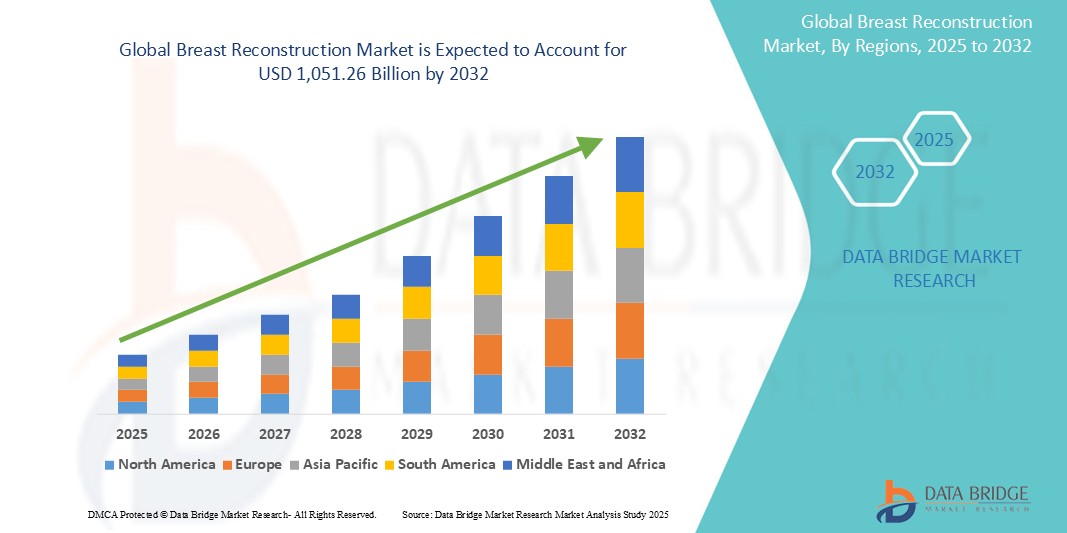
- The global breast reconstruction market size was valued at USD 535.40 million in 2024 and is expected to reach USD 1,051.26 million by 2032, at a CAGR of 8.80% during the forecast period
- The market growth is largely fueled by the rising incidence of breast cancer globally and increasing awareness about breast reconstruction options among patients and healthcare providers
- Furthermore, continuous advancements in surgical techniques and technologies, including 3D-printed implants, bioengineered tissue scaffolds, fat grafting, and innovative implant materials, are significantly boosting the market. Favorable reimbursement policies in various regions and a growing focus on personalized treatment approaches also contribute to the accelerating uptake of breast reconstruction solutions
Breast Reconstruction Market Analysis
- Breast reconstruction is a surgical procedure to restore the shape, volume, and aesthetic appearance of the breast after mastectomy, lumpectomy, or due to congenital deformities. It utilizes either breast implants or autologous tissues from the patient's body and is increasingly vital for improving patient physical image, self-esteem, and mental health
- The escalating demand for breast reconstruction is primarily fueled by the rising global incidence of breast cancer, increasing awareness among patients and healthcare professionals about reconstructive options, and a growing emphasis on aesthetic outcomes post-mastectomy
- North America dominates the breast reconstruction market with the largest revenue share of 58.59% in 2024, characterized by a high incidence of breast cancer, advanced healthcare infrastructure, high healthcare spending, and well-established reimbursement frameworks, with the U.S. being a leading country due to the presence of major breast implant manufacturers and continuous product innovation
- Asia-Pacific is expected to be the fastest growing region in the breast reconstruction market during the forecast period due to increasing urbanization, rising disposable incomes, improving healthcare infrastructure, and a surging number of breast cancer cases coupled with growing awareness about reconstruction options in countries
- Breast Implants segment dominates the breast reconstruction market with a market share of 60.44% in 2024, driven by its widespread use in breast augmentation and reconstruction surgeries, with silicone implants being particularly popular due to their natural feel and aesthetic results
Report Scope and Breast Reconstruction Market Segmentation
|
Attributes |
Breast Reconstruction Key Market Insights |
|
Segments Covered |
|
|
Countries Covered |
North America
Europe
Asia-Pacific
Middle East and Africa
South America
|
|
Key Market Players |
|
|
Market Opportunities |
|
|
Value Added Data Infosets |
In addition to the insights on market scenarios such as market value, growth rate, segmentation, geographical coverage, and major players, the market reports curated by the Data Bridge Market Research also include in-depth expert analysis, pricing analysis, brand share analysis, consumer survey, demography analysis, supply chain analysis, value chain analysis, raw material/consumables overview, vendor selection criteria, PESTLE Analysis, Porter Analysis, and regulatory framework. |
Breast Reconstruction Market Trends
“Technological Advancements and Personalized Approaches”
- A significant and accelerating trend in the global breast reconstruction market is the approaches. These innovations continuous advancement in surgical techniques, biomaterials, and personalized treatment are significantly enhancing aesthetic outcomes, functional results, and overall patient satisfaction
- For instance, the increasing use of 3D printing and customized implant technologies is revolutionizing the sector by offering highly personalized surgical options, enhancing both cosmetic and functional results. Companies are investing heavily in research and development to refine implant longevity and biocompatibility
- Advancements in fat grafting techniques, where a patient's own body fat is used to reconstruct breast tissue, are gaining popularity due to natural-looking results and lower rejection risks. Some companies are also developing bioengineered tissue scaffolds and regenerative medicine approaches to accelerate tissue regeneration and healing post-surgery
- The growing preference for flap-based reconstruction techniques, such as DIEP flap, which utilize the patient's own tissue, offers more natural outcomes and fewer long-term complications. In addition, the development of pre-pectoral breast reconstruction is becoming more common, offering less pain and faster recovery times
- This trend towards more intelligent, intuitive, and patient-centric reconstructive solutions is fundamentally reshaping expectations for post-mastectomy care. Consequently, companies are focusing on developing products and techniques that offer improved safety profiles, better aesthetic results, and enhanced patient comfort
- The demand for breast reconstruction procedures that offer cutting-edge technology and personalized options is growing rapidly as patients and healthcare providers increasingly prioritize optimal functional and aesthetic outcomes
Breast Reconstruction Market Dynamics
Driver
“Rising Incidence of Breast Cancer and Increasing Awareness”
- The increasing global incidence of breast cancer, coupled with growing awareness among patients and healthcare professionals about the benefits and availability of breast reconstruction options, is a significant driver for the heightened demand for breast reconstruction procedures
- For instance, the American Cancer Society estimated that in 2023, there would be approximately 297,790 new cases of invasive breast cancer in women in the U.S. This high prevalence directly translates to a greater number of mastectomies and, consequently, an increased demand for reconstructive surgeries. Organizations such as the American Society of Plastic Surgeons (ASPS) actively promote awareness campaigns, such as Breast Reconstruction Awareness Day, to educate women about their options post-mastectomy
- As more women are diagnosed with breast cancer and undergo mastectomy procedures, there is a rising desire to restore physical form and improve psychological well-being. Breast reconstruction offers significant benefits in terms of body image, self-esteem, and mental health, making it a compelling option for many survivors
- Furthermore, the efforts by medical societies, patient advocacy groups, and healthcare providers to disseminate information about reconstructive techniques and their positive impact are empowering more patients to consider and opt for these procedures.
- This growing understanding of the benefits of breast reconstruction, coupled with improved access to specialized surgical care, is a key factor propelling market growth
Restraint/Challenge
“High Cost of Procedures and Potential Complications”
- Concerns surrounding the high initial cost of breast reconstruction procedures, coupled with the potential for surgical complications, pose a significant challenge to broader market penetration and patient adoption, particularly in regions with limited healthcare access or insurance coverage
- For instance, breast reconstruction surgery can be expensive, with costs varying significantly based on the type of procedure, surgeon's fees, hospital charges, and geographical location. In many parts of the world, where insurance coverage may be insufficient or non-existent, the financial burden can deter patients from opting for reconstruction
- Furthermore, such as any surgical procedure, breast reconstruction carries inherent risks of complications. These can include infection, hematoma seroma poor wound healing, changes in sensation, and implant-related issues such as rupture, displacement, or capsular contracture. Autologous flap procedures also carry risks related to the donor site, such as pain, weakness, or hernia
- While advancements in techniques aim to minimize these risks, the possibility of complications can lead to additional surgeries, prolonged recovery, and increased costs, creating anxiety for patients. The rare but serious risk of Breast Implant-Associated Anaplastic Large Cell Lymphoma associated with certain textured implants has also raised patient concerns and prompted regulatory actions
- Overcoming these challenges through enhanced financial assistance programs, improved insurance coverage, and continuous innovation in surgical techniques to reduce complication rates will be vital for sustained market growth. Patient education about realistic outcomes and comprehensive pre- and post-operative care is also crucial for building trust and mitigating hesitancy
Breast Reconstruction Market Scope
The market is segmented on the basis of product, type, shape, technology, placement, procedure, and end user.
- By Product
On the basis of product, the breast reconstruction market is segmented into breast implants, tissue expanders, and acellular dermal matrix. The breast implants segment held the largest market revenue share of 60.44% in 2024, driven by their widespread use in both augmentation and reconstruction procedures due to their established safety profile, aesthetic appeal, and various options in terms of size, shape, and fill material. Silicone implants are particularly favored for their natural feel and look, contributing significantly to this segment's dominance.
The tissue expanders segment is anticipated to witness the fastest growth rate from 2025 to 2032, fueled by their essential role in staged breast reconstruction, where they prepare the skin and muscle for subsequent implant placement. This segment's growth is also supported by continuous advancements in expander technology, offering improved patient comfort and outcomes
- By Type
On the basis of type, the breast reconstruction market is segmented into unilateral breast reconstruction and bilateral breast reconstruction. The unilateral breast reconstruction segment accounted for the larger market revenue share in 2024, primarily driven by the higher incidence of breast cancer affecting one breast and the subsequent demand for restoring symmetry after a single mastectomy. This approach is more commonly performed due to its straightforward nature and the direct need for reconstruction on the affected side
The bilateral breast reconstruction segment is expected to witness the fastest CAGR from 2025 to 2032, driven by the increasing number of prophylactic bilateral mastectomies in high-risk patients and a growing preference among breast cancer survivors for achieving complete symmetry, even after unilateral cancer, to minimize future cancer risk or for aesthetic balance
- By Shape
On the basis of shape, the breast reconstruction market is segmented into round implants and anatomical implants. The round implants segment held the largest market revenue share in 2024, primarily due to their versatility, ease of placement, and ability to create a full, youthful appearance. Their symmetrical design makes them a popular choice for many patients and surgeons
The anatomical implants segment is expected to witness the fastest CAGR from 2025 to 2032, driven by increasing patient and surgeon preference for more natural-looking results. Anatomical implants are designed to mimic the natural slope of a breast, offering a more nuanced and realistic contour, especially in patients with less existing breast tissue
- By Technology
On the basis of technology, the breast reconstruction market is segmented into inframammary, peri-areolar, trans-axillary, and transumbilical. The inframammary segment held the largest market revenue share in 2024, owing to its common use and advantages such as ease of access for the surgeon, ability to conceal the scar within the natural breast fold, and minimal disruption to the breast tissue.
The peri-areolar segment is expected to witness the fastest CAGR from 2025 to 2032, driven by its aesthetic benefit of a less conspicuous scar around the nipple-areola complex. This approach is gaining popularity as surgeons refine techniques to minimize potential complications while maintaining a natural appearance
- By Placement
On the basis of placement, the breast reconstruction market is segmented into dual-plane insertion, subglandular insertion, and submuscular insertion. The submuscular insertion segment held the largest market revenue share in 2024, primarily due to its benefits in providing better implant coverage, lower rates of capsular contracture, and easier mammographic screening.
The dual-plane insertion segment is expected to witness the fastest CAGR from 2025 to 2032, fueled by its ability to combine the advantages of both submuscular and subglandular placements. This technique offers improved aesthetic outcomes by providing muscle coverage in the upper pole and natural tissue contour in the lower pole
- By Procedure
On the basis of procedure, the breast reconstruction market is segmented into immediate procedures, delayed procedures, and revision procedures. The immediate procedures segment held the largest market revenue share in 2024, driven by the significant psychological benefits to patients by avoiding the experience of living without a breast, and the convenience of undergoing reconstruction during the same surgery as the mastectomy.
The revision procedures segment is expected to witness the fastest CAGR from 2024 to 2032, fueled by the growing number of initial breast reconstructions performed and the inevitable need for adjustments, corrections, or replacements over time due to complications, implant longevity, or evolving patient preference
- By End User
On the basis of end user, the breast reconstruction market is segmented into hospitals, cosmetology clinics, and ambulatory surgical centers (ASCs). The hospitals segment accounted for the largest market revenue share in 2023, attributed to their extensive infrastructure, availability of specialized surgical teams, advanced medical equipment, and capacity to manage complex cases and potential post-operative complications. Hospitals remain the primary setting for the majority of intricate breast reconstruction surgeries.
The ambulatory surgical centers (ASCs) segment is expected to witness the fastest CAGR from 2025 to 2032, driven by their increasing popularity for outpatient procedures due to lower costs, greater efficiency, and a patient-centric environment. As surgical techniques become less invasive, more breast reconstruction procedures can be safely performed in ASCs, leading to shorter hospital stays and quicker recovery times.
Breast Reconstruction Market Regional Analysis
- North America dominates the breast reconstruction market with the largest revenue share of 58.59% in 2024, driven by a high incidence of breast cancer, advanced healthcare
- infrastructure, high healthcare spending, and well-established reimbursement frameworks
- This dominance is driven by a high incidence of breast cancer, advanced healthcare infrastructure, high patient awareness of reconstructive options, and well-established reimbursement frameworks
- The presence of leading breast implant manufacturers and continuous product innovation, including cutting-edge technologies such as 3D-printed implants and bio-integrated scaffolds, further solidify North America's leadership in the market
U.S. Breast Reconstruction Market Insight
The U.S. breast reconstruction market captured the largest revenue share within North America, fueled by the high incidence of breast cancer and well-established patient awareness. Consumers in the region highly value the advanced reconstructive options, including both implant-based and autologous techniques, and access to highly skilled plastic surgeons. The robust insurance coverage landscape, combined with a strong emphasis on patient choice and psychological well-being post-mastectomy, further propels the breast reconstruction industry. Moreover, the increasing integration of personalized medicine approaches and continuous innovations in biomaterials and surgical technologies are significantly contributing to the market's expansion.
Europe Breast Reconstruction Market Insight
The Europe breast reconstruction market is projected to expand at a substantial CAGR throughout the forecast period, primarily driven by the increasing incidence of breast cancer across the continent and growing awareness campaigns about reconstructive options. The focus on holistic patient care, coupled with advancements in surgical techniques and biomaterials, is fostering the adoption of breast reconstruction. European healthcare systems are also increasingly emphasizing patient quality of life post-cancer treatment. The region is experiencing significant growth across various healthcare settings, with reconstruction procedures being incorporated into comprehensive cancer care pathways
U.K. Breast Reconstruction Market Insight
The U.K. breast reconstruction market is anticipated to grow at a noteworthy CAGR during the forecast period, driven by the increasing number of breast cancer diagnoses and a strong emphasis on patient-centered care within the National Health Service (NHS). In addition, rising awareness regarding the aesthetic and psychological benefits of reconstruction is encouraging more women to choose these procedures. The U.K.'s commitment to improving cancer outcomes, alongside its robust medical research and clinical infrastructure, is expected to continue to stimulate market growth
Germany Breast Reconstruction Market Insight
The Germany breast reconstruction market is expected to expand at a considerable CAGR during the forecast period, fueled by a high standard of healthcare, increasing awareness of reconstructive options, and a strong preference for technically advanced solutions. Germany’s well-developed healthcare infrastructure, combined with its emphasis on quality and patient safety, promotes the adoption of breast reconstruction, particularly through innovative surgical techniques and materials. The integration of breast reconstruction into multidisciplinary cancer treatment plans is also becoming increasingly prevalent, with a strong preference for solutions that prioritize natural outcomes and long-term patient satisfaction
Asia-Pacific Breast Reconstruction Market Insight
The Asia-Pacific breast reconstruction market is poised to grow at the fastest CAGR during the forecast period, driven by increasing urbanization, rising disposable incomes, and improving healthcare infrastructure in countries such as China, Japan, and India. The region's growing understanding of breast cancer and reconstructive options, supported by governmental and non-governmental initiatives promoting cancer awareness, is driving the adoption of breast reconstruction. Furthermore, as healthcare expenditure increases and access to specialized surgical care expands, the affordability and accessibility of breast reconstruction procedures are widening to a larger patient base
Japan Breast Reconstruction Market Insight
The Japan breast reconstruction market is gaining momentum due to the country’s advanced medical technology, high standards of healthcare, and increasing awareness of breast cancer care. The Japanese market places a significant emphasis on precise surgical techniques and high-quality outcomes, and the adoption of breast reconstruction is driven by the increasing number of breast cancer diagnoses and a strong patient desire for aesthetic restoration. The integration of advanced imaging and surgical planning tools is fueling growth. Moreover, Japan's aging population means a higher incidence of breast cancer, which is likely to spur demand for both primary and revision reconstruction procedures
India Breast Reconstruction Market Insight
The India breast reconstruction market accounted for a significant market revenue share in Asia Pacific in 2024, attributed to the country's expanding healthcare sector, rapid urbanization, and growing awareness about breast cancer and its treatment. India stands as a rapidly growing market for medical procedures, and breast reconstruction is becoming increasingly popular in metropolitan hospitals and specialized cancer centers. The increasing affordability of advanced medical treatments, alongside a growing number of skilled plastic surgeons, are key factors propelling the market in India
Breast Reconstruction Market Share
The breast reconstruction industry is primarily led by well-established companies, including:
- POLYTECH Health & Aesthetics GmbH (Germany)
- Valtris Specialty Chemicals (South Korea)
- Establishment Labs (Costa Rica)
- AbbVie Inc. (U.S.)
- Johnson & Johnson Services, Inc. (U.S.)
- GC Aesthetics (Ireland)
- Laboratories Arion (France)
- Bimini Health Tech (U.S.)
- Tiger Aesthetics Medical, LLC (U.S.)
- HANSBIOMED (South Korea)
- AirXpanders (U.S.)
- PMT Corporation (U.S.)
- Silimed (Brazil)
- Integra Lifesciences Corporation (U.S.)
- DPS Technology Development Ltd (Hong Kong)
- Wanhe Group (China)
- KOKEN (Japan)
- Sebbin (France)
- DEFYGRAVITY (U.K.)
Latest Developments in Global Breast Reconstruction Market
- In April 2025, Johnson & Johnson MedTech announced the FDA approval of MENTOR MemoryGel Enhance Breast Implants, the first and only implant line developed specifically for women with larger breasts (sizes from 930 cc to 1445 cc). This innovation aims to address a significant gap in reconstruction options, allowing surgeons to provide more personalized solutions for primary or revision reconstruction following a mastectomy. This development highlights a commitment to inclusivity and better aesthetic outcomes for a broader patient population
- In March 2025, MTF Biologics successfully completed the first implantation of FlexHD Pliable in a milestone Investigational Device Exemption (IDE) clinical trial for pre-pectoral breast reconstruction. This marks a significant step towards obtaining Premarket Approval (PMA) from the U.S. FDA for this human acellular dermis matrix (hADM). FlexHD Pliable is designed to provide optimal balance of thickness, flexibility, and strength for supporting implant-based breast reconstruction
- In November 2023, RTI Surgical received FDA IDE approval for the clinical investigation of Cortiva allograft dermis in breast reconstruction. This technique involves using additional materials to support breast implants and improve tissue integration, aiming to create the desired breast shape and size
- In April 2023, an Israeli 3D printing company, Stratasys, and an American bioinks company, CollPlant Technologies, announced a collaboration to develop technology for 3D-printing breast implants. These innovative implants are designed to facilitate the regeneration of a patient's natural breast tissue without triggering an immune response, offering a potentially revolutionary alternative to traditional silicone implants or autologous fat transfer
- In January 2023, Schlage, a leading provider of access and home security solutions under Allegion Plc, unveiled the Schlage Encode Smart Wi-Fi Lever at the NAHB International Builders’ Show (IBS) 2023. This innovative residential Breast Reconstruction, equipped with Wi-Fi connectivity, enables users to manage access remotely through a dedicated app. The Schlage Encode lever highlights the company’s commitment to integrating advanced technology into home security systems, offering homeowners enhanced convenience and control while ensuring robust security

- Interactive Data Analysis Dashboard
- Company Analysis Dashboard for high growth potential opportunities
- Research Analyst Access for customization & queries
- Competitor Analysis with Interactive dashboard
- Latest News, Updates & Trend analysis
- Harness the Power of Benchmark Analysis for Comprehensive Competitor Tracking
Data collection and base year analysis are done using data collection modules with large sample sizes. The stage includes obtaining market information or related data through various sources and strategies. It includes examining and planning all the data acquired from the past in advance. It likewise envelops the examination of information inconsistencies seen across different information sources. The market data is analysed and estimated using market statistical and coherent models. Also, market share analysis and key trend analysis are the major success factors in the market report. To know more, please request an analyst call or drop down your inquiry.
The key research methodology used by DBMR research team is data triangulation which involves data mining, analysis of the impact of data variables on the market and primary (industry expert) validation. Data models include Vendor Positioning Grid, Market Time Line Analysis, Market Overview and Guide, Company Positioning Grid, Patent Analysis, Pricing Analysis, Company Market Share Analysis, Standards of Measurement, Global versus Regional and Vendor Share Analysis. To know more about the research methodology, drop in an inquiry to speak to our industry experts.
Data Bridge Market Research is a leader in advanced formative research. We take pride in servicing our existing and new customers with data and analysis that match and suits their goal. The report can be customized to include price trend analysis of target brands understanding the market for additional countries (ask for the list of countries), clinical trial results data, literature review, refurbished market and product base analysis. Market analysis of target competitors can be analyzed from technology-based analysis to market portfolio strategies. We can add as many competitors that you require data about in the format and data style you are looking for. Our team of analysts can also provide you data in crude raw excel files pivot tables (Fact book) or can assist you in creating presentations from the data sets available in the report.













