


What is the Global Bow and Stern Thrusters Market Size and Growth Rate?
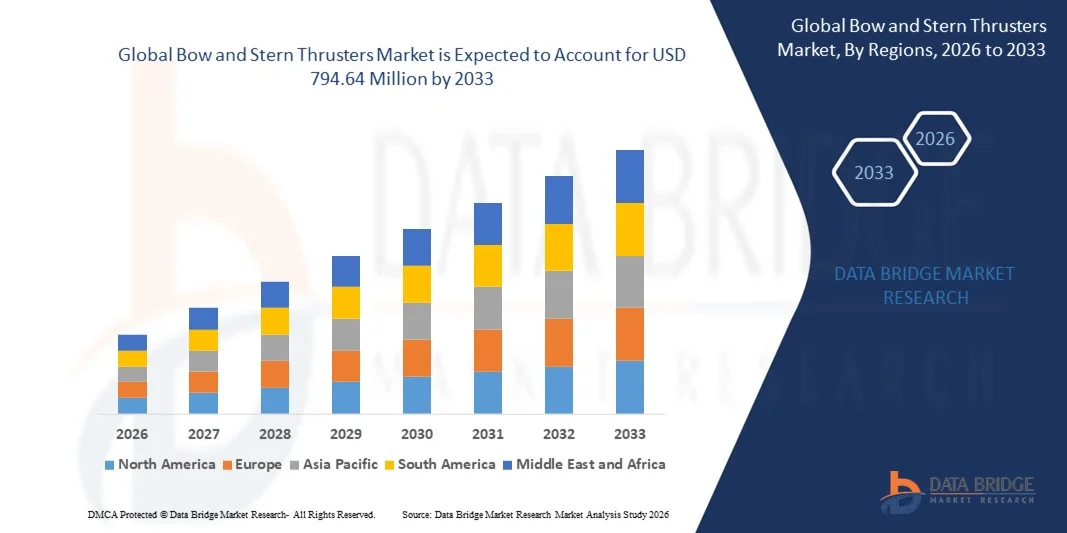
- The global bow and stern thrusters market size was valued at USD 521.73 million in 2025 and is expected to reach USD 794.64 million by 2033, at a CAGR of 5.40% during the forecast period
- Growing overseas travel and tourism as a result of the increased disposable income is the main driving factor for the growth of bow and stern thrusters market
- Emerging economies and the shift of logistics activities towards these economies will generate more demand for cargo ships in the market which is also a driving factor for the bow and stern thrusters market
What are the Major Takeaways of Bow and Stern Thrusters Market?
- The availability of bow and stern thrusters via e-commerce is also an opportunity for the growth of bow and stern thrusters market
- Huge expenditure incurred in the development of bow and stern thrusters is a challenge for the bow and stern thrusters market. However, high initial cost of a ship is the main restraint for the growth of bow and stern thrusters market
- Asia-Pacific dominated the bow and stern thrusters market with a 38.6% revenue share in 2025, supported by strong shipbuilding activity, rising marine fleet expansion, and increasing adoption of advanced maneuvering systems across China, Japan, South Korea, and India
- North America is projected to register the fastest CAGR of 9.25% from 2026 to 2033, driven by increasing demand for high-power bow and stern thrusters in recreational boats, military vessels, tugboats, and offshore support fleets across the U.S. and Canada
- The Tunnel Bow and Stern Thrusters segment dominated the market with a 42.7% revenue share in 2025, driven by its high thrust efficiency, robust structural design, and widespread installation across commercial vessels, offshore ships, and large cargo fleets
Report Scope and Bow and Stern Thrusters Market Segmentation
|
Attributes |
Bow and Stern Thrusters Key Market Insights |
|
Segments Covered |
|
|
Countries Covered |
North America
Europe
Asia-Pacific
Middle East and Africa
South America
|
|
Key Market Players |
|
|
Market Opportunities |
|
|
Value Added Data Infosets |
In addition to the insights on market scenarios such as market value, growth rate, segmentation, geographical coverage, and major players, the market reports curated by the Data Bridge Market Research also include in-depth expert analysis, pricing analysis, brand share analysis, consumer survey, demography analysis, supply chain analysis, value chain analysis, raw material/consumables overview, vendor selection criteria, PESTLE Analysis, Porter Analysis, and regulatory framework. |
What is the Key Trend in the Bow and Stern Thrusters Market?
Rising Demand for High-Performance, Energy-Efficient, and Multi-Directional Thruster Systems
- The bow and stern thrusters market is witnessing a rapid shift toward high-efficiency, low-noise, and multi-directional propulsion systems that enhance vessel maneuverability, stability, and safety across commercial, naval, and recreational fleets
- Manufacturers are increasingly developing hybrid, electric, and variable-speed thrusters that reduce fuel consumption, minimize emissions, and optimize power usage for modern vessels
- Adoption of smart, digitally monitored, and networked thruster systems is growing, as shipowners prioritize real-time diagnostics, predictive maintenance, and automation for enhanced operational control
- For instance, leading players such as Wärtsilä, Sleipner Motor AS, ZF Friedrichshafen AG, VETUS, and Kawasaki Heavy Industries have expanded their portfolios with energy-efficient, intelligent, and compact thruster systems designed for luxury yachts, naval ships, and offshore support vessels
- As the maritime sector accelerates toward green mobility, automation, and high-precision maneuvering, energy-efficient and multi-functional Bow and Stern Thrusters are set to remain central to innovation and vessel modernization worldwide
What are the Key Drivers of Bow and Stern Thrusters Market?
- Growing demand for enhanced maneuverability, docking efficiency, and vessel safety across cargo ships, tugboats, ferries, patrol vessels, and yachts is a major growth driver
- For instance, in 2025, companies such as Wärtsilä, Sleipner Motor AS, and ZF Friedrichshafen AG introduced new electric and hybrid thruster models designed for low-emission vessels and high-performance marine applications
- Expansion of global maritime trade, naval modernization programs, and rising yacht ownership in Europe, the U.S., and Asia-Pacific are accelerating product adoption
- Technological advances such as brushless motors, variable frequency drives (VFDs), noise-reduction systems, and corrosion-resistant materials have significantly improved durability and efficiency
- Growing emphasis on eco-friendly, low-emission, IMO-compliant propulsion systems is boosting demand for electric bow and stern thrusters, especially in environmentally regulated ports
- With rising investments in R&D, automation technologies, and vessel electrification, the Bow and Stern Thrusters market is expected to register strong global growth during the forecast period
Which Factor is Challenging the Growth of the Bow and Stern Thrusters Market?
- High installation, maintenance, and integration costs, especially for advanced electric and hydraulic thruster systems, pose challenges for small and medium vessel owners
- For instance, fluctuations in raw material prices, electronic components, and marine-grade alloys during 2024–2025 increased production costs for several manufacturers
- Strict maritime regulations, IMO compliance standards, and certification requirements add complexity to manufacturing and product approval
- Limited awareness among smaller fleet operators regarding long-term fuel savings and performance benefits restricts adoption in developing regions
- Strong competition from low-cost mechanical thrusters and alternative propulsion technologies puts pressure on pricing and product differentiation
- To overcome these challenges, industry players are focusing on cost-efficient designs, scalable systems, strategic partnerships, and improved operator training to strengthen global adoption of advanced Bow and Stern Thrusters
How is the Bow and Stern Thrusters Market Segmented?
The market is segmented on the basis of type, application, and power source.
- By Type
On the basis of type, the bow and stern thrusters market is segmented into Tunnel, Externally Mounted, Retractable, and Water Jet Bow and Stern Thrusters. The Tunnel Bow and Stern Thrusters segment dominated the market with a 42.7% revenue share in 2025, driven by its high thrust efficiency, robust structural design, and widespread installation across commercial vessels, offshore ships, and large cargo fleets. Tunnel thrusters offer superior lateral maneuvering, cost-effective integration, and long operational life, making them the most preferred thruster configuration among shipyards globally. Their proven performance in docking, station-keeping, and confined-water navigation has further strengthened adoption.
The Retractable Bow and Stern Thrusters segment is projected to grow at the fastest CAGR from 2026 to 2033, supported by increasing deployments in luxury yachts, research vessels, AUVs, and naval platforms that require reduced hydrodynamic drag, flexible deployment, and compact, energy-efficient maneuvering systems.
- By Application
On the basis of application, the bow and stern thrusters market is segmented into Boat, Barge, Ship, Yacht, Tugboat, and AUVs (Autonomous Underwater Vehicles). The Ship segment dominated the market with a 39.4% revenue share in 2025, driven by heavy usage across tankers, container vessels, offshore support ships, cruise liners, and naval fleets. Ships require high-power thruster systems for precise harbor navigation, dynamic positioning, and improved docking efficiency, which fuels consistent demand. Expanding international trade, increasing shipbuilding activities, and modernization of maritime fleets are key contributors to segment leadership.
The AUVs segment is projected to grow at the fastest CAGR from 2026 to 2033, supported by rising investments in subsea exploration, oceanographic surveys, defense surveillance, and offshore inspection. The growing shift toward autonomous marine technologies is accelerating the demand for compact, lightweight, and energy-optimized thrusters tailored for unmanned underwater platforms.
- By Power Source
On the basis of power source, the bow and stern thrusters market is segmented into Electric and Hydraulic. The Electric segment dominated the market with a 56.8% revenue share in 2025, owing to increasing adoption in ferries, yachts, passenger vessels, and hybrid marine vessels. Electric thrusters offer low noise, high energy efficiency, reduced maintenance, and precise control—making them highly suitable for modern vessel designs focused on sustainability and automation. Growing maritime electrification initiatives and global emission-reduction regulations are further accelerating adoption across North America, Europe, and Asia-Pacific.
The Hydraulic segment is expected to grow at the fastest CAGR from 2026 to 2033, supported by strong demand in tugboats, barges, offshore support vessels, and heavy-duty marine operations. Their superior torque output, rugged construction, and reliability in demanding conditions make hydraulic thrusters essential for vessels requiring high thrust performance and continuous operation in harsh marine environments.
Which Region Holds the Largest Share of the Bow and Stern Thrusters Market?
- Asia-Pacific dominated the bow and stern thrusters market with a 38.6% revenue share in 2025, supported by strong shipbuilding activity, rising marine fleet expansion, and increasing adoption of advanced maneuvering systems across China, Japan, South Korea, and India. The region’s leadership is driven by high production volumes of commercial ships, naval vessels, offshore support vessels, and large cargo carriers
- Leading manufacturers are investing in high-thrust, energy-efficient, and digitally controlled thruster systems, supported by advancements in electric propulsion, automation, and hybrid marine technologies. Strong government initiatives to modernize maritime infrastructure and expand shipyard capabilities further strengthen regional dominance
- Growing cross-border trade, coastal security programs, and rising demand for efficient docking and navigation systems fuel strong regional growth
North America Bow and Stern Thrusters Market Insight
North America is projected to register the fastest CAGR of 9.25% from 2026 to 2033, driven by increasing demand for high-power bow and stern thrusters in recreational boats, military vessels, tugboats, and offshore support fleets across the U.S. and Canada. The region is witnessing rapid adoption of electric and hybrid propulsion thrusters, supported by strict emission regulations and growing maritime sustainability initiatives. Advancements in automation, noise reduction, and dynamic positioning systems are further accelerating adoption. Strong investments in naval modernization and yacht production continue to support long-term market expansion.
U.S. Bow and Stern Thrusters Market Insight
The U.S. is the largest contributor in North America, driven by high demand from the naval sector, offshore oil & gas, and luxury yacht industries. Manufacturers are investing in intelligent thruster monitoring, high-efficiency motors, and integrated propulsion architectures to enhance vessel maneuverability. Growing recreational boating activities, marina development, and adoption of advanced docking technologies continue to push market growth.
Canada Bow and Stern Thrusters Market Insight
Canada contributes significantly to regional demand, supported by expansion in coastal patrolling, Arctic marine operations, and commercial shipping. Increasing replacement of traditional propulsion units with high-efficiency bow and stern thrusters is boosting adoption across tugboats, ferries, and research vessels. Government investments in marine security and shipbuilding under the National Shipbuilding Strategy further accelerate market development.
China Bow and Stern Thrusters Market Insight
China is the largest contributor to Asia-Pacific, driven by extensive shipbuilding capacity, large commercial fleet size, and strong naval expansion programs. Manufacturers are investing in AI-enabled propulsion control, energy-optimized motors, and high-power tunnel thrusters, strengthening both domestic supply and export capability.
Japan Bow and Stern Thrusters Market Insight
Japan shows stable demand with strong adoption in ferries, cargo ships, and technologically advanced vessels. The country focuses on quiet-operation thrusters, precision docking, and thrusters compatible with hybrid and LNG-powered ships. Strong regulatory support and premium technology offerings drive market growth.
India Bow and Stern Thrusters Market Insight
India is emerging as a fast-growing market, driven by expansion of ports, shipbuilding initiatives, and rising coastal surveillance activities. Increasing installation of tunnel and externally mounted thrusters in patrol vessels, fishing fleets, and commercial ships is fueling adoption. Government maritime programs such as Sagarmala and Make in India further strengthen market penetration.
South Korea Bow and Stern Thrusters Market Insight
South Korea contributes significantly due to its position as a major global shipbuilding hub. Adoption of advanced bow and stern thrusters is rising across LNG carriers, tankers, container ships, and offshore vessels. Strong export demand, continuous innovation in marine engineering, and integration of digital propulsion controls support long-term market expansion.
Which are the Top Companies in Bow and Stern Thrusters Market?
The bow and stern thrusters industry is primarily led by well-established companies, including:
- Lewmar Limited (U.K.)
- ZF Friedrichshafen AG (Germany)
- Dutch Thruster Group BV (Netherlands)
- Western Marine Electronics, Inc. (U.S.)
- Holland Marine Parts B.V. (Netherlands)
- ThrustEMS. (Netherlands)
- Lalizas Italia s.r.l. (Italy)
- Sleipner Motor AS (Norway)
- SJMATEK (Suzhou) Marine Machine Co., Ltd. (China)
- Osmotech (Europe)
- Kawasaki Heavy Industries, Ltd. (Japan)
- Bosch Rexroth AG (Germany)
- YMV Kreyn ve Makina Sistemleri A.S. (Turkey)
- Wärtsilä (Finland)
- AnchorLift (Netherlands)
- VETUS (Netherlands)
- CMC Marine srl (Italy)
- Florida Bow Thrusters (U.S.)
- YMV Crane (Turkey)
What are the Recent Developments in Global Bow and Stern Thrusters Market?
- In February 2022, VETUS introduced a fully electric propulsion package named “E-DRIVES,” marking two decades since the launch of the EP2200. This complete modular system reinforces VETUS’s position as an innovator in modern boat propulsion, strengthening its competitive edge in the marine technology market
- In November 2021, VETUS expanded its BOW PRO range by unveiling the BOW PRO Boosted 300 series, including the BOWB285, BOWB300, and BOWB320 thrusters. Designed for boats up to 30 meters, these units offer enhanced DC-to-DC charging, quieter operation, and improved proportional control, expanding VETUS’s reach among advanced thruster users and boosting its market influence
- In February 2021, VETUS received NMEA 2000 certification for its CANverter gateway device, enabling advanced connectivity for users of its proportional bow and stern thrusters. This certification positioned VETUS as a pioneer in integrating seamless communication systems into marine thruster technologies, enhancing user confidence and market adoption
- In October 2020, VETUS launched innovative solutions for new builds and retrofit vessels through its E-LINE and E-POD electric propulsion systems, featuring active motor braking for precise control. Combined with BOW PRO thrusters and steering components, these systems offered a fully integrated vessel solution, further underscoring VETUS’s commitment to complete marine outfitting excellence

- Interactive Data Analysis Dashboard
- Company Analysis Dashboard for high growth potential opportunities
- Research Analyst Access for customization & queries
- Competitor Analysis with Interactive dashboard
- Latest News, Updates & Trend analysis
- Harness the Power of Benchmark Analysis for Comprehensive Competitor Tracking
Data collection and base year analysis are done using data collection modules with large sample sizes. The stage includes obtaining market information or related data through various sources and strategies. It includes examining and planning all the data acquired from the past in advance. It likewise envelops the examination of information inconsistencies seen across different information sources. The market data is analysed and estimated using market statistical and coherent models. Also, market share analysis and key trend analysis are the major success factors in the market report. To know more, please request an analyst call or drop down your inquiry.
The key research methodology used by DBMR research team is data triangulation which involves data mining, analysis of the impact of data variables on the market and primary (industry expert) validation. Data models include Vendor Positioning Grid, Market Time Line Analysis, Market Overview and Guide, Company Positioning Grid, Patent Analysis, Pricing Analysis, Company Market Share Analysis, Standards of Measurement, Global versus Regional and Vendor Share Analysis. To know more about the research methodology, drop in an inquiry to speak to our industry experts.
Data Bridge Market Research is a leader in advanced formative research. We take pride in servicing our existing and new customers with data and analysis that match and suits their goal. The report can be customized to include price trend analysis of target brands understanding the market for additional countries (ask for the list of countries), clinical trial results data, literature review, refurbished market and product base analysis. Market analysis of target competitors can be analyzed from technology-based analysis to market portfolio strategies. We can add as many competitors that you require data about in the format and data style you are looking for. Our team of analysts can also provide you data in crude raw excel files pivot tables (Fact book) or can assist you in creating presentations from the data sets available in the report.













