


Bone Marrow Market Size
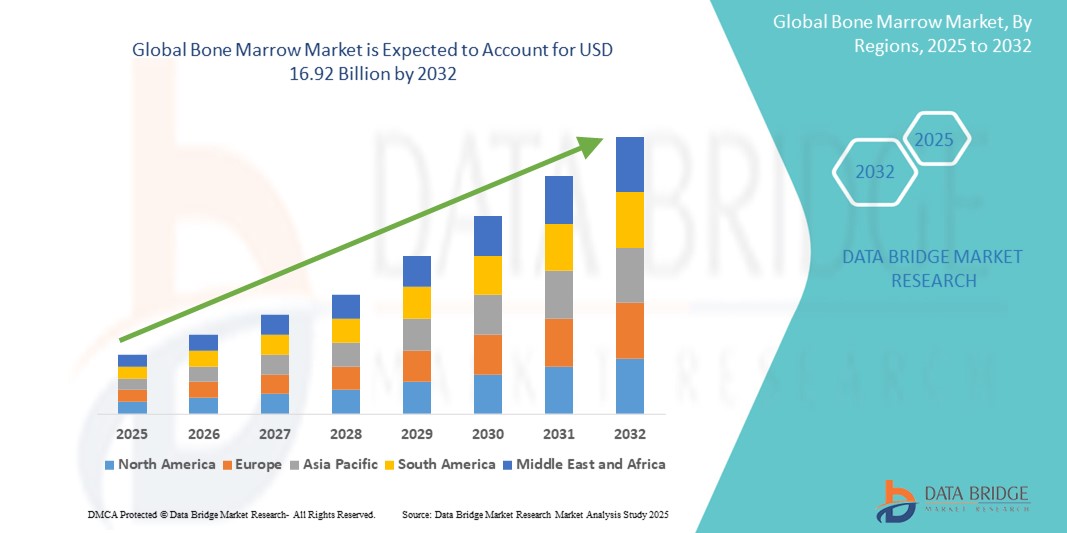
- The global bone marrow market size was valued at USD 11.11 billion in 2024 and is expected to reach USD 16.92 billion by 2032, at a CAGR of 5.40% during the forecast period
- Market growth is primarily driven by the increasing prevalence of hematological disorders, advancements in transplantation techniques, and growing awareness of bone marrow transplant benefits for treating life-threatening diseases
- Rising demand for personalized medicine and regenerative therapies is further propelling the adoption of bone marrow transplantation across hospitals and specialty clinics
Bone Marrow Market Analysis
- The bone marrow market is experiencing robust growth due to the rising incidence of blood-related disorders such as leukemia, lymphoma, and myeloma, coupled with advancements in allogeneic and autologous transplantation technologies
- Increasing investments in healthcare infrastructure and research into stem cell therapies are encouraging innovation in bone marrow transplantation, improving success rates and patient outcomes
- Europe dominates the bone marrow market with the largest revenue share of 35.7% in 2024, driven by a well-established healthcare system, high adoption of advanced medical technologies, and strong presence of key market players
- North America is projected to be the fastest-growing region during the forecast period, fuelled by increasing R&D investments, rising awareness of bone marrow transplantation benefits, and a growing number of specialized treatment centers in the U.S. and Canada
- The allogeneic bone marrow transplantation segment holds the largest market revenue share of 62.5% in 2024, supported by its widespread use in treating complex hematological disorders and the availability of advanced donor-matching technologies. The growing demand for minimally invasive procedures and improved post-transplant care is also driving this segment’s growth
Report Scope and Bone Marrow Market Segmentation
|
Attributes |
Bone Marrow Key Market Insights |
|
Segments Covered |
|
|
Countries Covered |
North America
Europe
Asia-Pacific
Middle East and Africa
South America
|
|
Key Market Players |
|
|
Market Opportunities |
|
|
Value Added Data Infosets |
In addition to the insights on market scenarios such as market value, growth rate, segmentation, geographical coverage, and major players, the market reports curated by the Data Bridge Market Research also include in-depth expert analysis, patient epidemiology, pipeline analysis, pricing analysis, and regulatory framework. |
Bone Marrow Market Trends
“Rising Preference for Autologous Bone Marrow Transplantation”
- Autologous bone marrow transplantation is gaining traction due to its lower risk of complications, such as graft-versus-host disease (GVHD), compared to allogeneic transplantation
- These transplants use the patient’s own stem cells, harvested before high-dose chemotherapy or radiation, making them ideal for treating conditions such as lymphoma and multiple myeloma
- In regions with advanced healthcare infrastructure, such as North America and Europe, autologous transplants account for a significant share of procedures, with approximately 60% of bone marrow transplants in the U.S. being autologous between 2015 and 2019
- Improved stem cell harvesting and cryopreservation techniques have enhanced the success rates of autologous transplants, driving their adoption in hospitals and multi-specialty clinics
- For instance, the FDA approval of APHEXDA™ (motixafortide) in September 2023 for mobilizing hematopoietic stem cells in multiple myeloma patients has further boosted autologous transplant efficiency
- Leading transplant centers, such as those in Germany and the U.S., are increasingly offering autologous transplant packages as a cost-effective and safer option for eligible patients
Bone Marrow Market Dynamics
Driver
“Increasing Prevalence of Hematologic Disorders and Demand for Curative Treatments”
- The growing incidence of blood-related disorders, such as leukemia, lymphoma, and multiple myeloma, is a major driver of the global bone marrow transplant market. For instance, the Leukemia & Lymphoma Society estimates that 1,698,339 people in the U.S. are living with or in remission from these conditions
- Bone marrow transplantation is often the only curative option for advanced-stage blood cancers and genetic disorders such as sickle cell anemia and thalassemia, increasing its demand globally
- Technological advancements, such as improved donor matching, next-generation conditioning regimens, and AI-driven stem cell viability assessments, have enhanced transplant success rates and patient outcomes
- The rise of cord blood banking and haploidentical transplants is addressing donor shortages, particularly in regions such as Asia Pacific, where countries such as India and China are seeing a surge in transplant procedures
- Automakers of the medical industry, such as biotech firms such as StemCyte and Osiris Therapeutics, are partnering with hospitals to provide advanced stem cell therapies, further fueling market growth
- The increasing adoption of bone marrow transplants for non-hematologic conditions, such as autoimmune and metabolic disorders, is expanding the market’s scope, especially in research-driven regions such as North America
Restraint/Challenge
“High Costs and Regulatory Challenges”
- The high cost of bone marrow transplantation, for autologous and allogeneic procedures, respectively, limits accessibility, particularly in developing regions with inadequate healthcare infrastructure
- Strict regulatory frameworks governing stem cell therapies and transplant procedures vary across countries, complicating standardization for global providers and increasing compliance costs
- Risks associated with allogeneic transplants, such as GVHD and infections, pose clinical challenges, deterring some patients and healthcare providers from pursuing these treatments
- For instance, in regions such as Africa and parts of Asia Pacific, limited donor registries and lack of trained professionals hinder market growth, despite rising disease prevalence
- Stringent regulations, such as those in the U.S. and Europe requiring rigorous donor matching and post-transplant monitoring, can delay procedures and increase operational costs for transplant centers
- These challenges discourage widespread adoption, particularly in cost-sensitive markets, and may result in limited market expansion in certain regions
Bone Marrow Market Scope
The market is segmented on the basis of transplantation type, disease indication, and end user.
- By Transplantation Type
On the basis of transplantation type, the market is segmented into allogeneic bone marrow transplantation and autologous bone marrow transplantation. The allogeneic bone marrow transplantation segment holds the largest market revenue share of 62.5% in 2024, supported by its widespread use in treating complex hematological disorders and the availability of advanced donor-matching technologies. The growing demand for minimally invasive procedures and improved post-transplant care is also driving this segment’s growth.
The autologous bone marrow transplantation segment is expected to witness the fastest growth rate from 2025 to 2032, fueled by increasing demand for treatments requiring patients’ own stem cells, particularly for conditions such as multiple myeloma and lymphoma, due to lower risks of graft-versus-host disease and improved patient recovery rates.
- By Disease Indication
On the basis of disease indication, the market is segmented into lymphoma, leukemia, myeloma, myelodysplasia, aplastic anemia, sickle cell anemia, solid tumors, thalassemia, myeloproliferative neoplasms, and others. The leukemia segment dominated with a revenue share of 35.7% in 2024, attributed to the high prevalence of leukemia globally and the critical role of bone marrow transplantation in its treatment.
The myeloma segment is projected to grow at the fastest rate during the forecast period, driven by rising incidences of multiple myeloma and advancements in transplant techniques that improve survival rates and patient outcomes.
- By End User
On the basis of end user, the market is segmented into hospitals, multi-specialty clinics, and ambulatory surgical centers. The hospital segment accounted for the largest revenue share of 68.3% in 2024, owing to the availability of advanced medical infrastructure, specialized transplant units, and skilled healthcare professionals in hospitals.
The ambulatory surgical centers segment is expected to witness the fastest growth rate from 2025 to 2032, driven by increasing adoption of outpatient transplant procedures, advancements in minimally invasive techniques, and growing patient preference for cost-effective and convenient treatment options.
Bone Marrow Market Regional Analysis
- Europe dominates the bone marrow market with the largest revenue share of 35.7% in 2024, driven by a well-established healthcare system, high adoption of advanced medical technologies, and strong presence of key market players
- The region benefits from extensive research and development in hematology and oncology, as well as favorable reimbursement policies for bone marrow transplantation
- Growth is further supported by increasing awareness of bone marrow therapies and collaborations between research institutions and healthcare providers
U.S. Bone Marrow Market Insight
The U.S. is projected to be the fastest-growing market in North America, fueled by advanced healthcare facilities, significant investments in stem cell research, and increasing prevalence of hematological disorders. The growing adoption of autologous transplants and advancements in precision medicine further boost market expansion. Partnerships between hospitals and research organizations, along with robust FDA regulations, support the development of innovative therapies.
Europe Bone Marrow Market Insight
Europe dominates the revenue growth of the bone marrow market, driven by its advanced medical research ecosystem and high adoption of bone marrow transplantation in countries such as Germany, France, and the U.K. The region’s focus on improving patient outcomes through innovative therapies and strong regulatory frameworks encourages market growth. Increasing collaborations between academic institutions and healthcare providers further enhance the adoption of advanced transplant techniques.
U.K. Bone Marrow Market Insight
The U.K. market is expected to witness significant growth, driven by increasing investments in healthcare infrastructure and growing awareness of bone marrow transplantation for treating blood-related disorders. The National Health Service (NHS) support for transplant procedures and advancements in donor registries contribute to market expansion. Rising research initiatives in stem cell therapies also bolster growth.
Germany Bone Marrow Market Insight
Germany is expected to witness a high growth rate in the bone marrow market, attributed to its leadership in medical research and a strong healthcare system focused on oncology and hematology. The country’s adoption of cutting-edge transplant technologies and government funding for stem cell research drive market growth. The integration of advanced therapies in leading hospitals supports sustained market expansion.
Asia-Pacific Bone Marrow Market Insight
The Asia-Pacific region is expected to witness the fastest growth rate, driven by rising healthcare expenditure, increasing prevalence of blood-related disorders, and growing awareness of bone marrow transplantation in countries such as China, India, and Japan. Government initiatives to improve healthcare access and advancements in medical tourism further encourage the adoption of bone marrow therapies.
Japan Bone Marrow Market Insight
Japan’s bone marrow market is expected to witness rapid growth due to its advanced healthcare infrastructure and strong focus on research in hematology and oncology. The presence of leading medical institutions and increasing adoption of allogeneic transplants for leukemia and lymphoma drive market penetration. Growing investments in regenerative medicine and stem cell research also contribute to growth.
China Bone Marrow Market Insight
China holds the largest share of the Asia-Pacific bone marrow market, propelled by rapid urbanization, increasing healthcare investments, and a rising burden of hematological diseases. The country’s expanding network of specialized hospitals and growing awareness of bone marrow transplantation support market growth. Strong government initiatives and competitive pricing of medical procedures enhance market accessibility.
Bone Marrow Market Share
The bone marrow market industry is primarily led by well-established companies, including:
- Agilent Technologies, Inc. (U.S.)
- Astellas Pharma Inc. (U.S.)
- Illumina, Inc. (U.S.)
- QIAGEN (U.S.)
- F Hoffmann-La Roche Ltd (U.S.)
- Sanofi (France)
- Stryker Corporation (U.S.)
- PromoCell GmbH (Germany)
- STEMCELL Technologies Inc. (Canada)
- Lonza (U.S.)
- ATCC (American Type Culture Collection) (U.S.)
- HemaCare (U.S.)
- Mesoblast Ltd. (U.S.)
- Merck KGaA (Germany)
- Discovery Life Sciences (U.S.)
Latest Developments in Global Bone Marrow Market
- In January 2024, Fortis Healthcare introduced CAR-T cell therapy across its Bone Marrow Transplant centers in Mohali, Delhi, Gurgaon, Noida, Mumbai, and Bangalore. This groundbreaking therapy enhances treatment options for blood cancers such as leukemia and lymphoma, utilizing advanced cellular technology to improve patient outcomes. The launch reinforces Fortis Healthcare’s leadership in the global bone marrow market, expanding access to cutting-edge therapies in India
- In September 2022, Scopio Labs introduced the Full-Field Bone Marrow Aspirate (FF-BMA) application, a digital workflow solution designed to streamline bone marrow aspirate scanning and analysis. This innovation enhances diagnostic efficiency and accuracy, addressing the rising demand for automated tools in bone marrow diagnostics. By integrating AI-powered imaging, the FF-BMA application strengthens the capabilities of transplant centers and laboratories worldwide
- In June 2022, the US FDA granted 510(k) approval for the MAXX-BMC bone marrow aspirate concentration system, developed by Royal Biologics. This system enables optimal sample collection of concentrated bone marrow aspirate at point-of-care settings, enhancing efficiency in orthopedic and sports medicine procedures. Featuring patented Lead Screw technology, MAXX-BMC improves stem cell concentration and accelerates bone growth and tissue regeneration
- In February 2022, Celgene and Bluebird Bio announced a collaboration to develop and commercialize CAR T-cell therapies for blood cancers. By combining Celgene’s expertise in hematology and oncology with Bluebird Bio’s CAR T-cell technology, the partnership aims to advance treatment options for bone marrow-related disorders. This collaboration strengthens their competitive position in the global bone marrow market, accelerating innovation and market reach
- In February 2022, Gilead Sciences and Kite Pharma partnered to develop and commercialize CAR T-cell therapies for blood cancers. This collaboration leverages Gilead’s global commercial expertise and Kite Pharma’s specialized CAR T-cell technology to enhance bone marrow transplant therapies. The partnership aims to advance treatment efficacy and expand access to innovative therapies worldwide

- Interactive Data Analysis Dashboard
- Company Analysis Dashboard for high growth potential opportunities
- Research Analyst Access for customization & queries
- Competitor Analysis with Interactive dashboard
- Latest News, Updates & Trend analysis
- Harness the Power of Benchmark Analysis for Comprehensive Competitor Tracking
Table of Content
1 INTRODUCTION
1.1 OBJECTIVES OF THE STUDY
1.2 MARKET DEFINITION
1.3 OVERVIEW OF GLOBAL BONE MARROW MARKET
1.4 CURRENCY AND PRICING
1.5 LIMITATION
1.6 MARKETS COVERED
2 MARKET SEGMENTATION
2.1 KEY TAKEAWAYS
2.2 ARRIVING AT THE GLOBAL BONE MARROW MARKET SIZE
2.2.1 VENDOR POSITIONING GRID
2.2.2 TECHNOLOGY LIFE LINE CURVE
2.2.3 MARKET GUIDE
2.2.4 COMPANY POSITIONING GRID
2.2.5 COMPANY MARKET SHARE ANALYSIS
2.2.6 MULTIVARIATE MODELLING
2.2.7 TOP TO BOTTOM ANALYSIS
2.2.8 STANDARDS OF MEASUREMENT
2.2.9 VENDOR SHARE ANALYSIS
2.2.10 DATA POINTS FROM KEY PRIMARY INTERVIEWS
2.2.11 DATA POINTS FROM KEY SECONDARY DATABASES
2.3 GLOBAL BONE MARROW MARKET: RESEARCH SNAPSHOT
2.4 ASSUMPTIONS
3 MARKET OVERVIEW
3.1 DRIVERS
3.2 RESTRAINTS
3.3 OPPORTUNITIES
3.4 CHALLENGES
4 EXECUTIVE SUMMARY
5 PREMIUM INSIGHTS
5.1 PESTEL ANALYSIS
5.2 PORTER’S FIVE FORCES MODEL
5.3 IN-DEPTH ANALYSIS OF OPERATIONAL TECNIQUES, BY COUNTRY
6 INDUSTRY INSIGHTS
6.1 MICRO AND MACRO ECONOMIC FACTORS
6.2 PENETRATION AND GROWTH PROSPECT MAPPING
6.3 KEY PRICING STRATEGIES
6.4 INTERVIEWS WITH SPECIALIST
6.5 ANALYIS AND RECOMMENDATION
7 COST ANALYSIS BREAKDOWN
8 TECHNONLOGY ROADMAP
9 INNOVATION TRACKER AND STRATEGIC ANALYSIS
9.1 MAJOR DEALS AND STRATEGIC ALLIANCES ANALYSIS
9.1.1 JOINT VENTURES
9.1.2 MERGERS AND ACQUISITIONS
9.1.3 LICENSING AND PARTNERSHIP
9.1.4 TECHNOLOGY COLLABORATIONS
9.1.5 STRATEGIC DIVESTMENTS
9.2 NUMBER OF PRODUCTS IN DEVELOPMENT
9.3 STAGE OF DEVELOPMENT
9.4 TIMELINES AND MILESTONES
9.5 INNOVATION STRATEGIES AND METHODOLOGIES
9.6 RISK ASSESSMENT AND MITIGATION
9.7 FUTURE OUTLOOK
10 REGULATORY COMPLIANCE
10.1 REGULATORY AUTHORITIES
10.2 REGULATORY CLASSIFICATIONS
10.2.1 CLASS I
10.2.2 CLASS II
10.2.3 CLASS III
10.3 REGULATORY SUBMISSIONS
10.4 INTERNATIONAL HARMONIZATION
10.5 COMPLIANCE AND QUALITY MANAGEMENT SYSTEMS
10.6 REGULATORY CHALLENGES AND STRATEGIES
11 REIMBURSEMENT FRAMEWORK
12 VALUE CHAIN ANALYSIS
13 HEALTHCARE ECONOMY
13.1 HEALTHCARE EXPENDITURE
13.2 CAPITAL EXPENDITURE
13.3 CAPEX TRENDS
13.4 CAPEX ALLOCATION
13.5 FUNDING SOURCES
13.6 INDUSTRY BENCHMARKS
13.7 GDP RATION IN OVERALL GDP
13.8 HEALTHCARE SYSTEM STRUCTURE
13.9 GOVERNMENT POLICIES
13.1 ECONOMIC DEVELOPMENT
14 GLOBAL BONE MARROW MARKET, BY TYPE
14.1 OVERVIEW
14.2 AUTOLOGOUS TRANSPLANTATION
14.3 ALLOGENEIC TRANSPLANTATION
14.4 OTHERS
15 GLOBAL BONE MARROW MARKET, BY DIAGNOSIS TEST
15.1 OVERVIEW
15.2 BONE MARROW BIOPSY
15.3 BONE MARROW ASPIRATION
15.4 OTHERS
16 GLOBAL BONE MARROW MARKET, BY PRODUCT
16.1 OVERVIEW
16.2 DEVICES
16.2.1 DIAGNOSTIC
16.2.2 FULL-FIELD BONE MARROW ASPIRATE
16.2.3 BONE MARROW BIOPSY AND ASPIRATION NEEDLES
16.2.4 OTHERS
16.2.5 COLLECTION
16.2.6 BONE MARROW CONCENTRATOR
16.2.7 BONE MARROW PROCESSING SYSTEM
16.2.8 OTHERS
16.3 BONE MARROW-DERIVED PRODUCTS
16.3.1 CD34+ HEMATOPOIETIC STEM AND PROGENITOR CELLS (HSPCS)
16.3.2 BONE MARROW ASPIRATE CONCENTRATE (BMAC)
16.3.3 MESENCHYMAL STEM CELLS (MSCS)
16.4 OTHERS
17 GLOBAL BONE MARROW MARKET, BY POPULATION TYPE
17.1 OVERVIEW
17.2 PEDIATRIC
17.3 ADULT
17.4 GERIATRIC
18 GLOBAL BONE MARROW MARKET, BY GENDER
18.1 OVERVIEW
18.2 MALE
18.2.1 PEDIATRIC
18.2.2 ADULT
18.2.3 GERIATRIC
18.3 FEMALE
18.3.1 PEDIATRIC
18.3.2 ADULT
18.3.3 GERIATRIC
19 GLOBAL BONE MARROW MARKET, BY APPLICATION
19.1 OVERVIEW
19.2 LYMPHOMA
19.3 LEUKEMIA
19.4 MYELOMA
19.5 MYELODYSPLASIA
19.6 APLASTIC ANEMIA
19.7 SICKLE CELL ANEMIA
19.8 SOLID TUMORS
19.9 THALASSEMIA
19.1 MYELOPROLIFERATIVE NEOPLASMS
19.11 OTHERS
20 GLOBAL BONE MARROW MARKET, BY END USER
20.1 OVERVIEW
20.2 HOSPITALS
20.2.1 PUBLIC
20.2.2 PRIVATE
20.3 ONCOLOGICAL CENTRES
20.4 MULTI-SPECIALTY CLINICS
20.5 ACADEMIC AND RESEARCH INSTITUTE
20.6 OTHERS
21 GLOBAL BONE MARROW MARKET, BY DISTRIBUTION CHANNEL
21.1 OVERVIEW
21.2 DIRECT TENDER
21.3 THIRD PARTY DISTRIBUTION
21.4 OTHERS
22 GLOBAL BONE MARROW MARKET, BY REGION
Global Bone Marrow Market, (ALL SEGMENTATION PROVIDED ABOVE IS REPRESENTED IN THIS CHAPTER BY COUNTRY)
22.1 NORTH AMERICA
22.1.1 U.S.
22.1.2 CANADA
22.1.3 MEXICO
22.2 EUROPE
22.2.1 GERMANY
22.2.2 FRANCE
22.2.3 U.K.
22.2.4 FINLAND
22.2.5 DENMARK
22.2.6 NORWAY
22.2.7 POLAND
22.2.8 ITALY
22.2.9 SPAIN
22.2.10 RUSSIA
22.2.11 TURKEY
22.2.12 BELGIUM
22.2.13 NETHERLANDS
22.2.14 SWITZERLAND
22.2.15 SWEDEN
22.2.16 REST OF EUROPE
22.3 ASIA-PACIFIC
22.3.1 JAPAN
22.3.2 CHINA
22.3.3 SOUTH KOREA
22.3.4 INDIA
22.3.5 SINGAPORE
22.3.6 THAILAND
22.3.7 INDONESIA
22.3.8 MALAYSIA
22.3.9 PHILIPPINES
22.3.10 AUSTRALIA
22.3.11 NEW ZEALAND
22.3.12 VIETNAM
22.3.13 TAIWAN
22.3.14 REST OF ASIA-PACIFIC
22.4 SOUTH AMERICA
22.4.1 BRZIL
22.4.2 ARGENTINA
22.4.3 REST OF SOUTH AMERICA
22.5 MIDDLE EAST AND AFRICA
22.5.1 SOUTH AFRICA
22.5.2 SAUDI ARABIA
22.5.3 UAE
22.5.4 EGYPT
22.5.5 KUWAIT
22.5.6 OMAN
22.5.7 ISRAEL
22.5.8 BAHRAIN
22.5.9 REST OF MIDDLE EAST AND AFRICA
22.6 KEY PRIMARY INSIGHTS: BY MAJOR COUNTRIES
23 GLOBAL BONE MARROW MARKET, COMPANY LANDSCAPE
23.1 COMPANY SHARE ANALYSIS: GLOBAL
23.2 COMPANY SHARE ANALYSIS: NORTH AMERICA
23.3 COMPANY SHARE ANALYSIS: EUROPE
23.4 COMPANY SHARE ANALYSIS: ASIA-PACIFIC
23.5 MERGERS & ACQUISITIONS
23.6 EXPANSIONS
23.7 PARTNERSHIP AND OTHER STRATEGIC DEVELOPMENTS
24 GLOBAL BONE MARROW MARKET, SWOT AND DBMR ANALYSIS
25 GLOBAL BONE MARROW MARKET, COMPANY PROFILE
25.1 CHARLES RIVER LABORATORIES
25.1.1 COMPANY OVERVIEW
25.1.2 GEOGRAPHIC PRESENCE
25.1.3 PRODUCT PORTFOLIO
25.1.4 RECENT DEVELOPMENTS
25.2 ATCC
25.2.1 COMPANY OVERVIEW
25.2.2 GEOGRAPHIC PRESENCE
25.2.3 PRODUCT PORTFOLIO
25.2.4 RECENT DEVELOPMENTS
25.3 KOSHEEKA
25.3.1 COMPANY OVERVIEW
25.3.2 GEOGRAPHIC PRESENCE
25.3.3 PRODUCT PORTFOLIO
25.3.4 RECENT DEVELOPMENTS
25.4 STEMCELL TECHNOLOGIES
25.4.1 COMPANY OVERVIEW
25.4.2 GEOGRAPHIC PRESENCE
25.4.3 PRODUCT PORTFOLIO
25.4.4 RECENT DEVELOPMENTS
25.5 LONZA
25.5.1 COMPANY OVERVIEW
25.5.2 GEOGRAPHIC PRESENCE
25.5.3 PRODUCT PORTFOLIO
25.5.4 RECENT DEVELOPMENTS
25.6 ACCEGEN
25.6.1 COMPANY OVERVIEW
25.6.2 GEOGRAPHIC PRESENCE
25.6.3 PRODUCT PORTFOLIO
25.6.4 RECENT DEVELOPMENTS
25.7 ALLCELLS, LLC
25.7.1 COMPANY OVERVIEW
25.7.2 GEOGRAPHIC PRESENCE
25.7.3 PRODUCT PORTFOLIO
25.7.4 RECENT DEVELOPMENTS
25.8 ZIMMER BIOMET
25.8.1 COMPANY OVERVIEW
25.8.2 GEOGRAPHIC PRESENCE
25.8.3 PRODUCT PORTFOLIO
25.8.4 RECENT DEVELOPMENTS
25.9 HUMANCELLS BIO
25.9.1 COMPANY OVERVIEW
25.9.2 GEOGRAPHIC PRESENCE
25.9.3 PRODUCT PORTFOLIO
25.9.4 RECENT DEVELOPMENTS
25.1 MERCK KGAA
25.10.1 COMPANY OVERVIEW
25.10.2 GEOGRAPHIC PRESENCE
25.10.3 PRODUCT PORTFOLIO
25.10.4 RECENT DEVELOPMENTS
25.11 BIOIVT LLC.
25.11.1 COMPANY OVERVIEW
25.11.2 GEOGRAPHIC PRESENCE
25.11.3 PRODUCT PORTFOLIO
25.11.4 RECENT DEVELOPMENTS
25.12 CGT GLOBAL.
25.12.1 COMPANY OVERVIEW
25.12.2 GEOGRAPHIC PRESENCE
25.12.3 PRODUCT PORTFOLIO
25.12.4 RECENT DEVELOPMENTS
25.13 LIFELINE CELL TECHNOLOGY
25.13.1 COMPANY OVERVIEW
25.13.2 GEOGRAPHIC PRESENCE
25.13.3 PRODUCT PORTFOLIO
25.13.4 RECENT DEVELOPMENTS
25.14 SCIENCELL RESEARCH LABORATORIES, INC
25.14.1 COMPANY OVERVIEW
25.14.2 GEOGRAPHIC PRESENCE
25.14.3 PRODUCT PORTFOLIO
25.14.4 RECENT DEVELOPMENTS
25.15 GLOBUS MEDICAL
25.15.1 COMPANY OVERVIEW
25.15.2 GEOGRAPHIC PRESENCE
25.15.3 PRODUCT PORTFOLIO
25.15.4 RECENT DEVELOPMENTS
25.16 EMCYTE CORPORATION
25.16.1 COMPANY OVERVIEW
25.16.2 GEOGRAPHIC PRESENCE
25.16.3 PRODUCT PORTFOLIO
25.16.4 RECENT DEVELOPMENTS
25.17 STRYKER
25.17.1 COMPANY OVERVIEW
25.17.2 GEOGRAPHIC PRESENCE
25.17.3 PRODUCT PORTFOLIO
25.17.4 RECENT DEVELOPMENTS
25.18 ISTO BIOLOGICS
25.18.1 COMPANY OVERVIEW
25.18.2 GEOGRAPHIC PRESENCE
25.18.3 PRODUCT PORTFOLIO
25.18.4 RECENT DEVELOPMENTS
25.19 RANFAC
25.19.1 COMPANY OVERVIEW
25.19.2 GEOGRAPHIC PRESENCE
25.19.3 PRODUCT PORTFOLIO
25.19.4 RECENT DEVELOPMENTS
25.2 ROYAL BIOLOGICS
25.20.1 COMPANY OVERVIEW
25.20.2 GEOGRAPHIC PRESENCE
25.20.3 PRODUCT PORTFOLIO
25.20.4 RECENT DEVELOPMENTS
25.21 ARTHREX, INC
25.21.1 COMPANY OVERVIEW
25.21.2 GEOGRAPHIC PRESENCE
25.21.3 PRODUCT PORTFOLIO
25.21.4 RECENT DEVELOPMENTS
25.22 TERUMO BCT, INC
25.22.1 COMPANY OVERVIEW
25.22.2 GEOGRAPHIC PRESENCE
25.22.3 PRODUCT PORTFOLIO
25.22.4 RECENT DEVELOPMENTS
25.23 FENWELL + BAXTER
25.23.1 COMPANY OVERVIEW
25.23.2 GEOGRAPHIC PRESENCE
25.23.3 PRODUCT PORTFOLIO
25.23.4 RECENT DEVELOPMENTS
NOTE: THE COMPANIES PROFILED IS NOT EXHAUSTIVE LIST AND IS AS PER OUR PREVIOUS CLIENT REQUIREMENT. WE PROFILE MORE THAN 100 COMPANIES IN OUR STUDY AND HENCE THE LIST OF COMPANIES CAN BE MODIFIED OR REPLACED ON REQUEST
26 RELATED REPORTS
27 QUESTIONNAIRE
28 ABOUT DATA BRIDGE MARKET RESEARCH

Data collection and base year analysis are done using data collection modules with large sample sizes. The stage includes obtaining market information or related data through various sources and strategies. It includes examining and planning all the data acquired from the past in advance. It likewise envelops the examination of information inconsistencies seen across different information sources. The market data is analysed and estimated using market statistical and coherent models. Also, market share analysis and key trend analysis are the major success factors in the market report. To know more, please request an analyst call or drop down your inquiry.
The key research methodology used by DBMR research team is data triangulation which involves data mining, analysis of the impact of data variables on the market and primary (industry expert) validation. Data models include Vendor Positioning Grid, Market Time Line Analysis, Market Overview and Guide, Company Positioning Grid, Patent Analysis, Pricing Analysis, Company Market Share Analysis, Standards of Measurement, Global versus Regional and Vendor Share Analysis. To know more about the research methodology, drop in an inquiry to speak to our industry experts.
Data Bridge Market Research is a leader in advanced formative research. We take pride in servicing our existing and new customers with data and analysis that match and suits their goal. The report can be customized to include price trend analysis of target brands understanding the market for additional countries (ask for the list of countries), clinical trial results data, literature review, refurbished market and product base analysis. Market analysis of target competitors can be analyzed from technology-based analysis to market portfolio strategies. We can add as many competitors that you require data about in the format and data style you are looking for. Our team of analysts can also provide you data in crude raw excel files pivot tables (Fact book) or can assist you in creating presentations from the data sets available in the report.













