


What is the Biofilms Treatment Market Size and Overview?
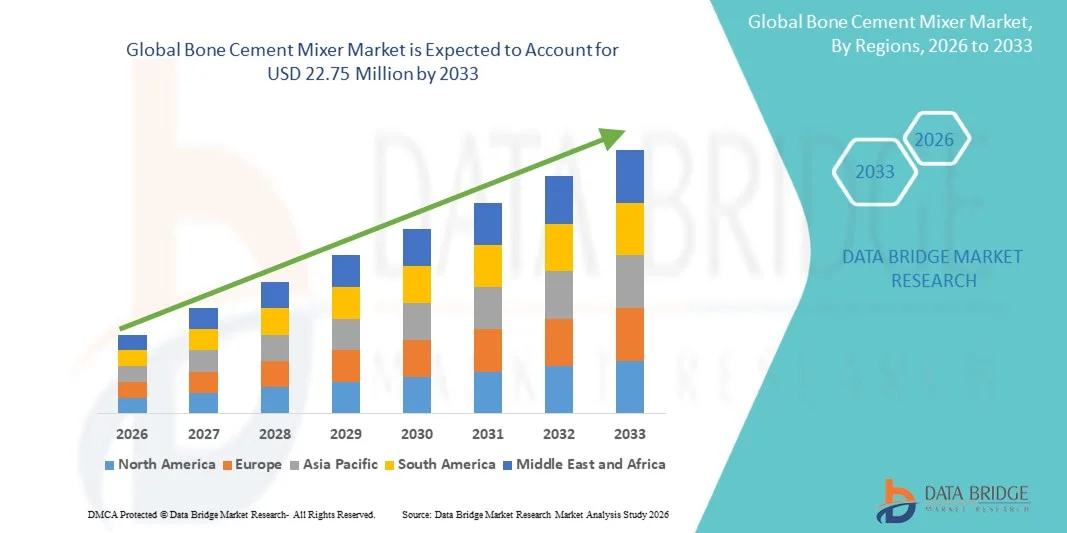
As per Data Bridge Market Research Analysis the Bone Cement Mixer Market was valued at USD 15.40 million in 2025 and is projected to reach USD 22.75 million by 2033, growing at a CAGR of 5.00% from 2026 to 2033. The market is witnessing steady growth driven by the rising volume of orthopedic surgeries, increasing prevalence of osteoporosis and degenerative joint disorders, and growing adoption of advanced surgical tools that improve cement mixing consistency and implant fixation outcomes.
The increasing number of hip and knee replacement procedures globally, combined with the aging population and rising incidence of trauma and spinal disorders, is driving demand for efficient and high-precision bone cement preparation systems. Vacuum mixing systems and closed mixing technologies are increasingly replacing conventional manual methods, as they help reduce air entrapment, improve cement strength, and enhance overall surgical success rates in hospitals and specialty orthopedic centers.
Market Size & Forecast
- Global Market Value (2025): USD 15.40 Million
- Expected Market Value (2033): USD 22.75 Million
- Forecast CAGR (2026–2033): 5.00%
- Leading Region in 2025: North America
- Fastest Growing Region: Asia Pacific
What are the Major Takeaways of Biofilms Treatment Market?
- North America dominated the Bone Cement Mixer Market with the largest revenue share of 36.28% in 2025, supported by high orthopedic surgery volumes, advanced hospital infrastructure, and strong adoption of vacuum-based cement mixing technologies.
- The Bench-Top Bone Cement Mixers segment led the market with a 58.6% share in 2025, driven by its widespread use in high-volume hospital operating rooms and orthopedic surgical centers where consistent cement preparation is critical.
- Asia-Pacific is expected to be the fastest-growing region at a CAGR of 7.4% from 2026 to 2033, fueled by rising geriatric population, expanding healthcare infrastructure, and increasing hip and knee replacement surgeries in emerging economies.
- Portable Bone Cement Mixers are the fastest-growing product type, projected to register a CAGR of 7.3%, reflecting the surge in demand for compact, easy-to-handle, and sterilization-friendly devices in modern operating rooms.
- The Vacuum Mixing segment dominated the mixing type category with a 46.8% revenue share in 2025, led by its superior ability to reduce porosity and improve mechanical strength of bone cement used in joint replacement surgeries.
- Arthroplasty accounted for 52.4% of the market, preferred by rising number of hip and knee replacement procedures globally due to aging populations and increasing prevalence of osteoarthritis.
- The Kyphoplasty segment is the fastest-growing application category, with a CAGR of 7.0%, driven by the rising cases of osteoporosis-related vertebral fractures in the elderly population.
Report Scope and Bone Cement Mixer Market Segmentation
|
Attributes |
Bone Cement Mixer Key Market Insights |
|
Segments Covered |
|
|
Countries Covered |
North America
Europe
Asia-Pacific
Middle East and Africa
South America
|
|
Key Market Players |
|
|
Market Opportunities |
|
|
Value Added Data Infosets |
In addition to the insights on market scenarios such as market value, growth rate, segmentation, geographical coverage, and major players, the market reports curated by the Data Bridge Market Research also include in-depth expert analysis, patient epidemiology, pipeline analysis, pricing analysis, and regulatory framework. |
What is the Key Trend in the Biofilms Treatment Market ?
Trend: Shift Toward Vacuum and Closed Mixing Systems in Orthopedic Surgery
Hospitals and orthopedic centers are increasingly adopting vacuum and closed bowl bone cement mixers to improve cement homogeneity, reduce air entrapment, and enhance implant fixation strength in joint replacement procedures. These systems are becoming standard in high-volume arthroplasty surgeries, where consistent cement quality directly impacts long-term surgical outcomes. Integration of compact, sterile, and easy-to-handle mixer designs is also improving operating room efficiency and reducing procedural variability, while digital monitoring features are gradually being introduced to standardize mixing performance across surgical teams. For instance, in many modern orthopedic centers, vacuum mixing kits are now routinely used during hip and knee arthroplasty procedures to ensure stronger cement bonding.
What are the Key Drivers of Biofilms Treatment Market ?
Key Market Driver: Rising Volume of Orthopedic and Joint Replacement Surgeries
The increasing prevalence of osteoarthritis, osteoporosis, and trauma-related fractures is significantly boosting the demand for hip and knee replacement procedures, directly driving the need for bone cement mixers in hospitals and surgical centers. Aging populations across developed and emerging economies are further accelerating surgical volumes, while improved healthcare access and insurance coverage are expanding patient eligibility for orthopedic interventions. This growing procedural demand is encouraging hospitals to adopt advanced cement mixing systems that ensure precision, safety, and improved implant longevity. For instance, high hip and knee replacement volumes in aging populations across Europe and North America are consistently driving higher usage of vacuum bone cement mixers in hospitals.
Key Restraint/Challenge: High Dependence on Skilled Surgical Handling and Cost Sensitivity
A major challenge in the bone cement mixer market is the reliance on trained orthopedic professionals to ensure proper cement preparation, as improper mixing can lead to implant loosening or surgical complications. In addition, advanced vacuum and cartridge-based systems involve higher procurement costs compared to manual mixing methods, limiting adoption in small hospitals and cost-sensitive healthcare facilities. Maintenance requirements, sterilization protocols, and single-use component expenses further add to operational costs, restricting widespread penetration in emerging healthcare systems.
For instance, many small and mid-sized hospitals in developing regions continue to use manual mixing techniques due to cost constraints and limited access to advanced orthopedic surgical equipment.
Key Market Opportunity: Expansion of Portable and Sterile Single-Use Mixing Systems
The growing demand for infection control and operating room efficiency is creating strong opportunities for portable and single-use bone cement mixing systems that reduce contamination risks and simplify surgical workflows. Manufacturers are increasingly focusing on lightweight, disposable, and pre-packaged mixing kits that ensure consistent cement quality while minimizing sterilization burden. Integration with modern orthopedic operating suites and ambulatory surgical centers is further expanding adoption potential, especially in high-volume outpatient procedures. For instance, ambulatory surgical centers performing day-care joint replacement procedures are increasingly adopting portable single-use cement mixing systems to streamline workflow and improve sterility.
How is the Biofilms Treatment Market Segmented?
The bone cement mixer market is segmented on the basis of product type, mixing technique, application, and end user.
- By Product Type
On the basis of product type, the Bone Cement Mixer Market is segmented into bench-top bone cement mixers and portable bone cement mixers. The Bench-Top Bone Cement Mixers segment dominated the market with a 58.6% share in 2025, owing to its widespread use in high-volume hospital operating rooms and orthopedic surgical centers where consistent cement preparation is critical. These systems provide stable mixing conditions, ensuring uniform cement viscosity and reduced air entrapment during arthroplasty procedures. They are preferred in complex surgeries due to their ability to deliver controlled and repeatable outcomes. Hospitals favor bench-top systems for their durability and compatibility with advanced surgical workflows. Increasing adoption in tertiary care hospitals further strengthens their dominance. However, higher space and infrastructure requirements limit their flexibility compared to portable systems.
The Portable Bone Cement Mixers segment is projected to witness the fastest growth, registering a CAGR of 7.3% from 2026 to 2033, driven by rising demand for compact, easy-to-handle, and sterilization-friendly devices in modern operating rooms. These mixers enable surgeons to prepare cement closer to the point of use, improving workflow efficiency and reducing contamination risks. Their lightweight design and ease of deployment make them ideal for ambulatory surgical centers and small hospitals. Increasing preference for minimally invasive orthopedic procedures is further accelerating adoption. Technological advancements are enhancing mixing precision despite their compact size. Growing focus on cost-effective surgical solutions is also supporting market expansion in emerging economies.
- By Mixing Technique
On the basis of mixing technique, the Bone Cement Mixer Market is segmented into bag or hand mixing, open bowl mixing, closed bowl mixing, cartridge mixing, and vacuum mixing. The Vacuum Mixing segment dominated the market with a 46.8% share in 2025, due to its superior ability to reduce porosity and improve mechanical strength of bone cement used in joint replacement surgeries. It is widely adopted in advanced hospitals where implant longevity and surgical precision are critical. Vacuum systems minimize air bubbles, resulting in stronger fixation and reduced risk of implant loosening. Their integration with modern orthopedic operating rooms enhances procedural efficiency. Increasing awareness among surgeons regarding cement quality is driving adoption. Strong clinical preference in arthroplasty procedures further reinforces dominance. However, higher system cost limits usage in smaller healthcare facilities.
The Cartridge Mixing segment is expected to register the fastest growth, witnessing a CAGR of 6.9% from 2026 to 2033, driven by increasing demand for safe, pre-packaged, and contamination-free cement preparation systems. These systems provide standardized mixing conditions, reducing human error and improving surgical consistency. Cartridge-based solutions are increasingly used in ambulatory surgical centers due to their ease of use and time efficiency. Rising emphasis on infection control in orthopedic surgeries is further boosting adoption. Manufacturers are focusing on disposable cartridge systems to enhance sterility and convenience. Growing shift toward standardized surgical workflows is also accelerating segment expansion globally.
- By Application
On the basis of application, the Bone Cement Mixer Market is segmented into arthroplasty, kyphoplasty, trauma surgery, and others. The Arthroplasty segment dominated the market with a 52.4% share in 2025, driven by the rising number of hip and knee replacement procedures globally due to aging populations and increasing prevalence of osteoarthritis. Bone cement mixers are extensively used in arthroplasty to ensure strong implant fixation and long-term joint stability. Hospitals rely heavily on vacuum mixing systems for these procedures to enhance cement quality. Growing demand for elective joint replacement surgeries is further supporting dominance. Continuous improvements in orthopedic implant technologies are also boosting procedure volumes. The segment benefits from high reimbursement rates in developed healthcare systems.
The Kyphoplasty segment is projected to witness the fastest growth, registering a CAGR of 7.0% from 2026 to 2033, driven by rising cases of osteoporosis-related vertebral fractures in the elderly population. This procedure requires precise cement injection, increasing demand for high-performance mixing systems. Improved awareness and early diagnosis of spinal conditions are supporting procedure adoption. Minimally invasive nature of kyphoplasty is increasing its preference among patients and surgeons. Expanding geriatric population globally is further accelerating demand. Advancements in spinal surgery techniques are also contributing to strong segment growth.
- By End User
On the basis of end user, the Bone Cement Mixer Market is segmented into hospitals, ambulatory surgical centers, and specialty clinics. The Hospitals segment dominated the market with a 63.2% share in 2025, owing to high patient inflow, availability of advanced surgical infrastructure, and concentration of complex orthopedic procedures. Hospitals are the primary settings for hip and knee replacement surgeries requiring high-precision cement mixing systems. They have skilled orthopedic surgeons and access to advanced vacuum mixing technologies. Strong procurement capacity allows adoption of premium surgical equipment. Increasing investments in hospital infrastructure further strengthen dominance. The segment continues to benefit from rising global surgical volumes.
The Ambulatory Surgical Centers (ASCs) segment is expected to register the fastest growth, witnessing a CAGR of 7.5% from 2026 to 2033, driven by the increasing shift toward outpatient and same-day orthopedic procedures. ASCs prefer portable and cartridge-based mixing systems due to their efficiency and ease of use. Lower treatment costs and faster patient recovery times are boosting ASC adoption. Growing demand for minimally invasive surgeries is further accelerating segment expansion. Expansion of healthcare infrastructure in emerging economies is also supporting growth. Increasing preference for decentralized surgical care models is strengthening long-term market potential.
Which Region Holds the Largest Share of the Biofilms Treatment Market ?
North America dominated the Bone Cement Mixer Market with the largest revenue share of 36.28% in 2025, supported by high orthopedic surgery volumes, advanced hospital infrastructure, and strong adoption of vacuum-based cement mixing technologies. The region also benefits from a well-established healthcare reimbursement framework, increasing prevalence of osteoarthritis and osteoporosis, and rising demand for hip and knee replacement procedures. Growing investments in modern operating room technologies and widespread use of advanced orthopedic surgical tools continue to strengthen North America’s leadership position in the global market.
U.S. Bone Cement Mixer Market Insight
The U.S. bone cement mixer market is witnessing strong growth due to rising volumes of hip and knee replacement surgeries, increasing prevalence of osteoporosis, and advanced orthopedic care infrastructure. The country’s well-developed hospital network, along with high adoption of vacuum bone cement mixing systems, is driving demand across hospitals and ambulatory surgical centers. In addition, growing focus on improving implant longevity and reducing surgical complications is accelerating the use of high-precision cement mixers across orthopedic procedures and specialized surgical settings.
Europe Bone Cement Mixer Market Insight
The Europe bone cement mixer market remains a major contributor to global revenue, driven by a high aging population, strong orthopedic surgery volumes, and advanced healthcare systems. The widespread use of vacuum and closed mixing systems in arthroplasty procedures is supporting market expansion across the region. Increasing investments in surgical innovation, coupled with strict clinical standards for implant fixation quality and patient safety, continue to enhance the adoption of bone cement mixers throughout Europe.
U.K. Bone Cement Mixer Market Insight
The U.K. bone cement mixer market is experiencing steady growth, supported by rising demand for joint replacement surgeries, expanding orthopedic care services, and increasing adoption of modern surgical tools. Growing preference for minimally invasive procedures and efficient operating room workflows is contributing to market growth. Furthermore, integration of advanced vacuum mixing technologies in public and private healthcare systems is improving surgical outcomes and strengthening the U.K.’s position in the orthopedic devices market.
Germany Bone Cement Mixer Market Insight
The Germany bone cement mixer market is expanding steadily due to the country’s strong orthopedic manufacturing base, advanced hospital infrastructure, and high surgical precision standards. Hospitals and specialty clinics are increasingly utilizing vacuum and cartridge-based mixing systems for improved cement consistency and implant stability. Continuous innovation in medical devices, along with strong focus on patient safety and surgical efficiency, is further driving market growth in Germany.
Asia-Pacific Bone Cement Mixer Market Insight
The Asia-Pacific bone cement mixer market is expected to witness rapid growth, driven by rising geriatric population, increasing orthopedic surgery volumes, and expanding healthcare infrastructure across countries such as China, India, and Japan. Growing awareness regarding advanced surgical techniques, rising adoption of cost-effective orthopedic devices, and increasing hospital investments are supporting regional market expansion. In addition, the growing presence of medical tourism and improving access to orthopedic care are accelerating demand across both public and private healthcare sectors.
Japan Bone Cement Mixer Market Insight
The Japan bone cement mixer market is witnessing consistent growth due to a rapidly aging population, high prevalence of degenerative joint diseases, and strong adoption of advanced orthopedic technologies. Hospitals and orthopedic centers are increasingly using high-precision vacuum mixing systems to improve surgical outcomes and implant durability. Moreover, the country’s focus on robotics, precision medicine, and minimally invasive procedures is further contributing to market growth.
China Bone Cement Mixer Market Insight
The China bone cement mixer market is growing rapidly, driven by expanding healthcare infrastructure, rising orthopedic surgery volumes, and increasing prevalence of age-related bone disorders. Growing adoption of advanced surgical equipment in tier-1 and tier-2 hospitals is significantly boosting demand. In addition, government investments in healthcare modernization, rising awareness of joint replacement procedures, and increasing availability of skilled orthopedic surgeons are positioning China as one of the fastest-growing markets globally.
Which are the Top Companies in Biofilms Treatment Market ?
The bone cement mixer industry is primarily led by well-established companies, including:
- Zimmer Biomet (U.S.)
- Stryker (U.S.)
- Johnson & Johnson Services, Inc. (U.S.)
- Smith & Nephew (U.K.)
- Braun SE (Germany)
- Heraeus Medical GmbH (Germany)
- Tecres S.p.A. (Italy)
- Medtronic (Ireland)
- DJO Global, Inc. (U.S.)
- MicroPort Scientific Corporation (China)
- Medacta International SA (Switzerland)
- Exactech, Inc. (U.S.)
- Wright Medical Group N.V. (U.S.)
- Limacorporate S.p.A. (Italy)
- Baumer Medical (Germany)
- Groupe Lepine (France)
- Arthrex, Inc. (U.S.)
- Braun SE (Germany)
- Corin Group (U.K.)
- OMNIlife science (U.S.)
What are Latest Developments in Biofilms Treatment Market ?
- In September 2025, Heraeus Medical received MDR certification for its PALAMIX® vacuum mixing system, strengthening regulatory approval for its orthopedic bone cement mixing technology used in arthroplasty procedures across Europe. This certification reinforces product safety compliance under stringent EU medical device regulations
- In September 2025, Heraeus Medical expanded its bone cement ecosystem with new dual antibiotic-loaded cement innovations and strengthened vacuum mixing system adoption across Europe and North America, improving infection control and surgical outcomes in orthopedic procedures
- In March 2025, Zimmer Biomet announced advancements in antibiotic-loaded bone cement solutions aimed at improving infection prevention and fixation strength in joint replacement surgeries, expanding its orthopedic cementing portfolio across global market
- In January 2025, Johnson & Johnson MedTech (DePuy Synthes) expanded its SMARTMIX™ bone cement mixing system portfolio, enhancing vacuum-assisted mixing efficiency and improving cement consistency for orthopedic surgeons performing arthroplasty procedures. This supports better implant fixation outcomes and surgical workflow efficiency.
- In October 2024, Stryker Corporation launched its next-generation high-viscosity PMMA bone cement (VariaFlex), improving handling characteristics and flow performance in orthopedic surgeries, particularly in hip and knee arthroplasty applications. This development enhances cement mixing consistency and surgical precision

- Interactive Data Analysis Dashboard
- Company Analysis Dashboard for high growth potential opportunities
- Research Analyst Access for customization & queries
- Competitor Analysis with Interactive dashboard
- Latest News, Updates & Trend analysis
- Harness the Power of Benchmark Analysis for Comprehensive Competitor Tracking
Data collection and base year analysis are done using data collection modules with large sample sizes. The stage includes obtaining market information or related data through various sources and strategies. It includes examining and planning all the data acquired from the past in advance. It likewise envelops the examination of information inconsistencies seen across different information sources. The market data is analysed and estimated using market statistical and coherent models. Also, market share analysis and key trend analysis are the major success factors in the market report. To know more, please request an analyst call or drop down your inquiry.
The key research methodology used by DBMR research team is data triangulation which involves data mining, analysis of the impact of data variables on the market and primary (industry expert) validation. Data models include Vendor Positioning Grid, Market Time Line Analysis, Market Overview and Guide, Company Positioning Grid, Patent Analysis, Pricing Analysis, Company Market Share Analysis, Standards of Measurement, Global versus Regional and Vendor Share Analysis. To know more about the research methodology, drop in an inquiry to speak to our industry experts.
Data Bridge Market Research is a leader in advanced formative research. We take pride in servicing our existing and new customers with data and analysis that match and suits their goal. The report can be customized to include price trend analysis of target brands understanding the market for additional countries (ask for the list of countries), clinical trial results data, literature review, refurbished market and product base analysis. Market analysis of target competitors can be analyzed from technology-based analysis to market portfolio strategies. We can add as many competitors that you require data about in the format and data style you are looking for. Our team of analysts can also provide you data in crude raw excel files pivot tables (Fact book) or can assist you in creating presentations from the data sets available in the report.













