

Boiler Water Treatment Chemicals Market Size
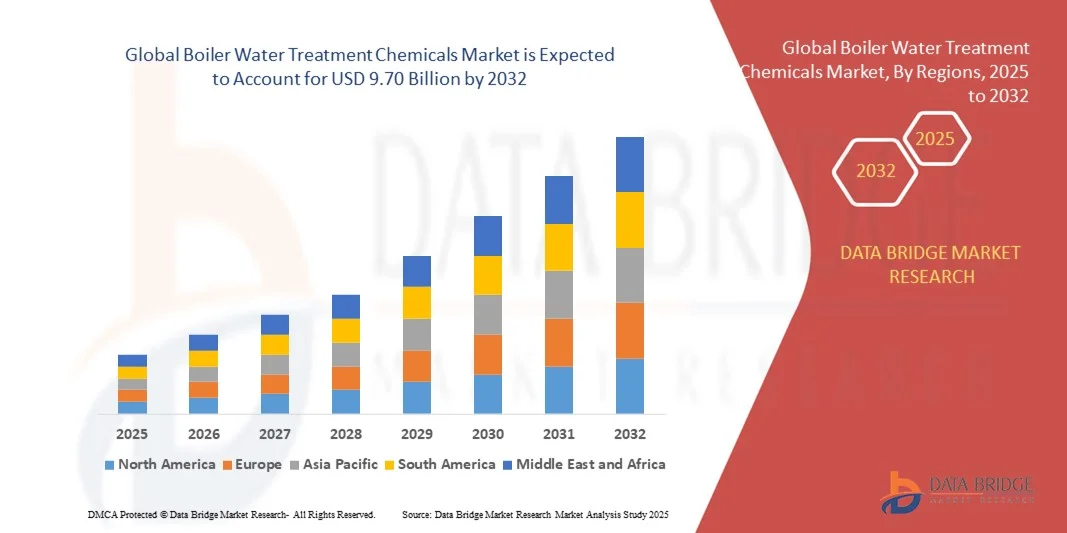
- The global boiler water treatment chemicals market size was valued at USD 5.10 billion in 2024 and is expected to reach USD 9.70 billion by 2032, at a CAGR of 8.36% during the forecast period
- The market growth is largely fuelled by the rising demand for high-efficiency boilers and stringent regulations regarding industrial water discharge
- Increasing industrialization, particularly in the power generation and manufacturing sectors, is boosting the need for effective water treatment solutions to prevent corrosion, scaling, and fouling in boilers
Boiler Water Treatment Chemicals Market Analysis
- The boiler water treatment chemicals market is witnessing strong growth driven by the increasing emphasis on operational efficiency and equipment longevity across industries such as power generation, oil & gas, and manufacturing
- These chemicals play a crucial role in maintaining boiler performance by mitigating corrosion, scale formation, and microbiological contamination, which helps in reducing downtime and maintenance costs
- Asia-Pacific dominated the boiler water treatment chemicals market with the largest revenue share of 42.15% in 2024, driven by rapid industrialization, urbanization, and expanding manufacturing and power generation capacities in countries such as China, India, and Japan
- North America region is expected to witness the highest growth rate in the global boiler water treatment chemicals market, driven by rising industrial modernization, demand for high-efficiency boilers, adoption of smart dosing and monitoring technologies, and compliance with strict wastewater discharge standards
- The Corrosion Inhibitors segment held the largest market revenue share in 2024, driven by its critical role in preventing metal degradation and extending boiler lifespan. These chemicals help maintain system integrity under high-temperature and high-pressure conditions, making them essential for continuous industrial operations
Report Scope and Boiler Water Treatment Chemicals Market Segmentation
|
Attributes |
Boiler Water Treatment Chemicals Key Market Insights |
|
Segments Covered |
|
|
Countries Covered |
North America
Europe
Asia-Pacific
Middle East and Africa
South America
|
|
Key Market Players |
|
|
Market Opportunities |
|
|
Value Added Data Infosets |
In addition to the insights on market scenarios such as market value, growth rate, segmentation, geographical coverage, and major players, the market reports curated by the Data Bridge Market Research also include import export analysis, production capacity overview, production consumption analysis, price trend analysis, climate change scenario, supply chain analysis, value chain analysis, raw material/consumables overview, vendor selection criteria, PESTLE Analysis, Porter Analysis, and regulatory framework. |
Boiler Water Treatment Chemicals Market Trends
Shift Toward Eco-Friendly and Sustainable Treatment Solutions
- The global boiler water treatment chemicals market is witnessing a significant shift toward green and sustainable chemical formulations aimed at minimizing environmental impact and complying with stringent regulatory standards. Industries are increasingly adopting biodegradable and non-toxic alternatives to reduce hazardous waste discharge while maintaining boiler efficiency
- The transition is being driven by growing environmental awareness and government initiatives promoting the use of eco-friendly water treatment technologies. Companies are investing in R&D to develop advanced formulations that offer similar or superior performance compared to conventional chemicals, ensuring corrosion and scale prevention without ecological harm
- The demand for sustainable solutions is especially strong among industries with high water consumption such as power generation and manufacturing, where environmental compliance and resource optimization are key operational priorities. This trend aligns with the global push toward cleaner production practices and circular economy principles
- For instance, in 2023, several leading chemical manufacturers introduced phosphate-free and biodegradable boiler treatment products designed to comply with international wastewater discharge standards. These innovations are gaining traction across Europe and North America, where environmental regulations are among the strictest globally
- While sustainability-driven products are redefining the competitive landscape, their market success depends on balancing cost-effectiveness, performance consistency, and regulatory compliance. Manufacturers must continue investing in technological innovation and scalable production to meet the rising demand for eco-conscious water treatment solutions
Boiler Water Treatment Chemicals Market Dynamics
Driver
Increasing Industrialization and Growing Demand for High-Efficiency Boilers
- Rapid industrialization across emerging economies has led to a surge in the installation of high-capacity boilers in power generation, oil & gas, and chemical processing sectors. This expansion has intensified the demand for boiler water treatment chemicals to enhance equipment efficiency and operational reliability. Industries are prioritizing continuous operation and long-term performance, which is directly supported by advanced chemical treatments that prevent corrosion and scaling over extended cycles of usage
- The need to maintain optimal heat transfer efficiency and prevent costly equipment failures has encouraged industries to implement comprehensive water treatment programs. Corrosion inhibitors, oxygen scavengers, and scale-control agents are being increasingly adopted to minimize downtime and extend boiler life. Proper chemical management ensures consistent system performance and contributes to reduced energy consumption, thereby improving overall plant profitability and sustainability metrics
- Governments and environmental authorities are enforcing strict guidelines on industrial water quality and discharge, further accelerating the adoption of specialized treatment solutions. Compliance with such standards has become a key priority for companies seeking to optimize performance while avoiding regulatory penalties. These regulations are driving the use of advanced, eco-friendly formulations that align with sustainability goals and help industries maintain their environmental certifications
- For instance, in 2023, several large industrial facilities in China and India upgraded their water treatment systems to incorporate advanced chemical dosing technologies aimed at improving energy efficiency and meeting local discharge norms. These facilities reported improved operational consistency and reduced maintenance downtime following the implementation of digital monitoring and automated control systems. Such upgrades have set new benchmarks for efficiency and compliance in industrial boiler operations
- While industrial growth continues to fuel chemical demand, ongoing technological upgrades and sustainability concerns are expected to further shape the market’s evolution during the forecast period. Continuous innovation in chemical compositions and smart dosing systems is likely to improve precision and reduce wastage. The growing focus on energy conservation and eco-compliance will remain a defining factor in the market’s long-term trajectory
Restraint/Challenge
High Operational Costs and Dependence on Skilled Workforce
- The boiler water treatment process requires precise chemical dosing, continuous monitoring, and periodic maintenance, leading to high operational expenses for industrial users. The rising cost of advanced treatment chemicals and automation equipment adds further pressure on budget-sensitive sectors. Small-scale industries often face difficulties in justifying these expenses, especially when short-term financial constraints outweigh long-term efficiency benefits
- Many small and medium-sized enterprises lack access to skilled professionals capable of managing complex boiler systems and implementing optimized chemical treatment programs. This skill gap often results in inefficient chemical usage and suboptimal water quality management. Without proper training and supervision, incorrect dosing can lead to scaling, corrosion, or even boiler failure, causing significant production losses and safety concerns
- The absence of standardized monitoring infrastructure and high equipment maintenance costs discourage adoption among smaller industrial units, particularly in developing regions. Limited awareness about the long-term benefits of proper water treatment also contributes to slower market penetration. Moreover, inconsistent chemical quality and poor maintenance protocols in such facilities further reduce the effectiveness of treatment programs and raise operational risks
- For instance, in 2023, a study conducted across Southeast Asian manufacturing plants revealed that nearly 60% of operators lacked trained water treatment specialists, leading to increased scaling and energy losses in boiler systems. The absence of automated monitoring systems compounded the issue, with many operators relying on manual testing that provided delayed or inaccurate results. These inefficiencies continue to challenge sustainable industrial operations in cost-sensitive markets
- While advancements in automation and smart dosing technologies are helping mitigate these challenges, reducing operational costs and expanding technical training programs will be crucial to unlocking the market’s full growth potential. Industry players are increasingly collaborating with educational institutions and technology providers to create skill development initiatives. Such efforts are expected to improve workforce competency and encourage wider adoption of efficient water treatment systems across all industry tiers
Boiler Water Treatment Chemicals Market Scope
The market is segmented on the basis of type, chemistry, and end-use industry.
- By Type
On the basis of type, the boiler water treatment chemicals market is segmented into Corrosion Inhibitors, Coagulants and Flocculants, pH Boosters, Scale Inhibitors, Oxygen Scavengers, Biocides, Foam Control Agents, Neutralizing Amine, All Volatile Treatment (AVT), and Others. The Corrosion Inhibitors segment held the largest market revenue share in 2024, driven by its critical role in preventing metal degradation and extending boiler lifespan. These chemicals help maintain system integrity under high-temperature and high-pressure conditions, making them essential for continuous industrial operations.
The Scale Inhibitors segment is expected to witness the fastest growth rate from 2025 to 2032, fuelled by rising industrial demand to reduce energy losses and maintenance costs caused by scale formation. Their ability to enhance heat transfer efficiency and ensure consistent performance in both low- and high-pressure boiler systems is accelerating adoption across industries such as power generation, manufacturing, and chemicals.
- By Chemistry
On the basis of chemistry, the boiler water treatment chemicals market is categorized into Basic Chemicals and Blended/Specialty Chemicals. The Blended/Specialty Chemicals segment dominated the market in 2024, owing to the increasing preference for customized formulations designed to meet specific industrial water quality requirements. These advanced blends often combine corrosion control, pH adjustment, and scaling prevention functions, delivering greater efficiency and reduced environmental impact.
The Basic Chemicals segment is expected to witness the fastest growth rate from 2025 to 2032, supported by their cost-effectiveness and widespread use in conventional water treatment applications. Basic chemicals such as sodium sulfite and hydrazine continue to be preferred in small- and medium-scale industries where standardized boiler systems are still prevalent.
- By End Use Industry
On the basis of end use industry, the boiler water treatment chemicals market is segmented into Oil and Gas, Power, Steel and Metals, Public Facilities, Textiles and Dyes, Automobile and Aerospace, Food and Beverage, Pulp and Paper, Commercials, Manufacturing, Construction, Chemical and Petrochemical, and Others. The Power segment accounted for the largest share of market revenue in 2024, driven by the high demand for high-pressure boilers and the need for efficient water treatment to optimize thermal power generation. Continuous operation and stringent water quality regulations in this sector have reinforced the importance of advanced chemical treatment programs.
The Food and Beverage segment is expected to witness the fastest growth rate from 2025 to 2032, as industries increasingly adopt safe and non-toxic boiler treatment solutions to comply with hygiene and food safety standards. The growing focus on steam purity and process water quality in food processing plants is expected to further boost the demand for specialized chemical formulations tailored for this sector.
Boiler Water Treatment Chemicals Market Regional Analysis
- Asia-Pacific dominated the boiler water treatment chemicals market with the largest revenue share of 42.15% in 2024, driven by rapid industrialization, urbanization, and expanding manufacturing and power generation capacities in countries such as China, India, and Japan
- Industries in the region are increasingly adopting advanced chemical treatments to prevent corrosion, scaling, and fouling in high-capacity boilers, ensuring operational efficiency and minimizing maintenance costs
- The market growth is further supported by government initiatives promoting energy efficiency, industrial sustainability, and compliance with environmental regulations, as well as the growing presence of domestic chemical manufacturers
China Boiler Water Treatment Chemicals Market Insight
The China boiler water treatment chemicals market accounted for the largest revenue share in Asia-Pacific in 2024, fueled by rapid industrial expansion, increasing energy demand, and extensive infrastructure development. High adoption of high-capacity boilers across power, steel, and chemical industries is driving the need for effective water treatment solutions. Domestic manufacturers and government policies promoting energy efficiency and eco-friendly operations are further bolstering market growth.
Japan Boiler Water Treatment Chemicals Market Insight
The Japan boiler water treatment chemicals market is expected to witness significant growth from 2025 to 2032 due to the country’s focus on technological innovation, energy efficiency, and sustainable industrial practices. Japanese industries are increasingly implementing advanced chemical monitoring and dosing systems to maintain boiler reliability, reduce operational costs, and integrate eco-friendly treatment solutions across power generation and manufacturing sectors.
Europe Boiler Water Treatment Chemicals Market Insight
The Europe boiler water treatment chemicals market is expected to witness the fastest growth rate from 2025 to 2032, primarily driven by stringent environmental regulations and the need to optimize boiler efficiency across industries. Rising industrial automation, coupled with the adoption of sustainable and non-toxic chemical formulations, is accelerating market penetration. The region is witnessing growth across power generation, steel, and chemical industries, with advanced treatment chemicals being incorporated in both new installations and retrofit projects.
U.K. Boiler Water Treatment Chemicals Market Insight
The U.K. boiler water treatment chemicals market is expected to witness the fastest growth rate from 2025 to 2032, driven by increasing industrial modernization and the need for reliable, high-efficiency boiler operations. The focus on energy efficiency, emission reduction, and sustainability is prompting industries to adopt advanced chemical treatment programs. Supportive regulatory frameworks and technological awareness among industrial operators are further boosting market expansion.
Germany Boiler Water Treatment Chemicals Market Insight
The Germany boiler water treatment chemicals market is expected to witness the fastest growth rate from 2025 to 2032, fueled by rising awareness of energy conservation and the adoption of eco-friendly treatment solutions. Germany’s emphasis on industrial efficiency, technological innovation, and environmental sustainability is promoting the integration of advanced chemical formulations in power plants and manufacturing facilities. Continuous monitoring and smart dosing systems are becoming increasingly prevalent, enhancing boiler performance and compliance.
North America Boiler Water Treatment Chemicals Market Insight
North America is expected to witness the fastest growth rate from 2025 to 2032, driven by increasing industrialization, stringent environmental regulations, and the presence of a mature industrial infrastructure. Industries in the region highly prioritize the prevention of boiler corrosion, scaling, and fouling, leveraging advanced chemical solutions to optimize equipment efficiency and reduce maintenance costs. The market growth is further supported by high adoption of automation and monitoring technologies, as well as the growing emphasis on energy efficiency and compliance with wastewater discharge standards.
U.S. Boiler Water Treatment Chemicals Market Insight
The U.S. boiler water treatment chemicals market is expected to witness the fastest growth rate from 2025 to 2032, fueled by the widespread use of high-capacity boilers in power generation, oil & gas, and manufacturing sectors. Industrial operators are increasingly investing in advanced chemical dosing systems and automated monitoring solutions to enhance operational reliability. The adoption of eco-friendly formulations and compliance with federal environmental regulations further propels the market growth in the country.
Boiler Water Treatment Chemicals Market Share
The Boiler Water Treatment Chemicals industry is primarily led by well-established companies, including:
- BASF SE (Germany)
- Kemira (Finland)
- Kurita Water Industries Ltd. (Japan)
- Solenis (U.S.)
- Ecolab (U.S.)
- SUEZ (France)
- Eastman Chemical Company (U.S.)
- Lonza (Switzerland)
- SNF (France)
- Solvay (Belgium)
- Akzo Nobel N.V. (Netherlands)
- Dow (U.S.)
- Chembond Chemicals Limited (India)
- Henkel AG & Co. KGaA (Germany)
- Chemtex Speciality Limited (India)
- Accepta Ltd – Accepta The Water Treatment Products Company (U.K.)
- ControlChem Canada Ltd. (Canada)
- ChemTreat, Inc. (U.S.)
- Bond Water Technologies, Inc. (U.S.)
- VEOLIA ENVIRONNEMENT SA (France)

- Interactive Data Analysis Dashboard
- Company Analysis Dashboard for high growth potential opportunities
- Research Analyst Access for customization & queries
- Competitor Analysis with Interactive dashboard
- Latest News, Updates & Trend analysis
- Harness the Power of Benchmark Analysis for Comprehensive Competitor Tracking
Table of Content
1 INTRODUCTION
1.1 OBJECTIVES OF THE STUDY
1.2 MARKET DEFINITION
1.3 OVERVIEW OF GLOBAL BOILER WATER TREATMENT CHEMICALS MARKET
1.4 CURRENCY AND PRICING
1.5 LIMITATION
1.6 MARKETS COVERED
2 MARKET SEGMENTATION
2.1 KEY TAKEAWAYS
2.2 ARRIVING AT THE GLOBAL BOILER WATER TREATMENT CHEMICALS MARKET SIZE
2.3 VENDOR POSITIONING GRID
2.4 MARKETS COVERED
2.5 GEOGRAPHIC SCOPE
2.6 YEARS CONSIDERED FOR THE STUDY
2.7 RESEARCH METHODOLOGY
2.8 TECHNOLOGY LIFE LINE CURVE
2.9 MULTIVARIATE MODELLING
2.1 PRIMARY INTERVIEWS WITH KEY OPINION LEADERS
2.11 DBMR MARKET POSITION GRID
2.12 MARKET APPLICATION COVERAGE GRID
2.13 DBMR MARKET CHALLENGE MATRIX
2.14 IMPORT AND EXPORT DATA
2.15 SECONDARY SOURCES
2.16 GLOBAL BOILER WATER TREATMENT CHEMICALS MARKET: RESEARCH SNAPSHOT
2.17 ASSUMPTIONS
3 MARKET OVERVIEW
3.1 DRIVERS
3.2 RESTRAINTS
3.3 OPPORTUNITIES
3.4 CHALLENGES
4 EXECUTIVE SUMMARY
5 PREMIUM INSIGHTS
5.1 REGUALTORY OVERVIEW
5.2 VALUE CHAIN ANALYSIS
6 INDUSTRY INSIGHTS
7 IMPACT OF COVID-19 PANDEMIC ON GLOBAL BOILER WATER TREATMENT CHEMICALS MARKET
7.1 ANALYSIS ON IMPACT OF COVID-19 ON THE MARKET
7.2 AFTERMATH OF COVID-19 AND GOVERNMENT INITIATIVE TO BOOST THE MARKET
7.3 STRATEGIC DECISIONS FOR MANUFACTUERS AFTER COVID-19 TO GAIN COMPETITIVE MARKET SHARE
7.4 PRICE IMPACT
7.5 IMPACT ON DEMAND
7.6 IMPACT ON SUPPLY CHAIN
7.7 CONCLUSION
8 GLOBAL BOILER WATER TREATMENT CHEMICALS MARKET, BY BIOLER TYPE
8.1 OVERVIEW
8.2 STEAM WATER BOILERS
8.3 HOT WATER BOILERS
9 GLOBAL BOILER WATER TREATMENT CHEMICALS MARKET, BY TREATMENT TYPE
9.1 OVERVIEW
9.2 EXTERNAL TREATMENT
9.2.1 SOFTENING
9.2.2 EVAPORATION
9.2.2.1. NATURAL
9.2.2.2. SYNTHETIC
9.2.3 DEAERATION
9.2.4 MEMBRANE CONTRACTORS
9.2.5 OTHERS
9.3 INTERNAL TREATMENT
9.3.1 SOFTENING
9.3.2 COMBINATION WITH EXTERNAL TREATMENT
10 GLOBAL BOILER WATER TREATMENT CHEMICALS MARKET, BY TYPE
10.1 OVERVIEW
10.2 COAGULANTS AND FLOCCULANTS
10.2.1 FERRIC SULAFTE
10.2.2 FERRIC CHLORIDE
10.2.3 SODIUM ALUMINATE
10.2.4 OTHERS
10.3 BIOCIDES
10.3.1 ALCOHOLS
10.3.2 ALDEHYDES
10.3.3 CHLORINE
10.3.4 CHLORINE- RELEASING AGENTS
10.3.4.1. SODIUM HYPOCHLORITE
10.3.4.2. CHLORHEXIDINE
10.3.4.3. OTHERS
10.3.5 IODINE
10.3.6 PEROXYGEN COMPOUNDS
10.3.6.1. HYDROGEN PEROXIDE
10.3.6.2. PERACETIC ACID
10.3.6.3. OTHERS
10.3.7 PHENOLIC TYPE COMPOUNDS
10.3.8 QUATERNARY AMMONIUM COMPOUNDS
10.3.9 BASES
10.3.9.1. SODIUM HYDROXIDE
10.3.9.2. POTASSIUM HYDROXIDE
10.3.9.3. SODIUM CARBONATE
10.3.9.4. OTHERS
10.3.10 ACIDS
10.3.10.1. MINERAL
10.3.10.2. ORGANIC ACIDS
10.3.10.3. OTHERS
10.3.11 OTHERS
10.4 ALKALINITY BUILDERS
10.4.1 SODIUM HYDROXIDE
10.4.2 POTASSIUM HYDROXIDE
10.5 CORROSION INHIBITORS
10.5.1 ANODIC INHIBITORS
10.5.1.1. CHROMATES
10.5.1.2. NITRATES
10.5.1.3. MOLYBDATES
10.5.1.4. TUNGSTATE
10.5.1.5. OTHERS
10.5.2 CATHODIC INHIBITORS
10.5.2.1. CATHODIC POISON
10.5.2.2. OXYGEN SCAVENGERS
10.5.2.3. OTHERS
10.5.3 MIXED INHIBITORS
10.5.3.1. SILICATES
10.5.3.2. PHOSPATES
10.5.3.3. OTHERS
10.5.4 VOLATILE CORROSION INHIBITORS (VCI)
10.5.4.1. MORPHOLINE
10.5.4.2. HYDRAZINE
10.5.4.3. OTHERS
10.5.5 OTHERS
10.6 OXYGEN SCAVENGERS
10.6.1 HYDRAZINE
10.6.2 CARBOHYDRAZIDE
10.6.3 SODIUM SULFITE
10.6.4 DIETHYLHYDROXYLAMINE (DEHA)
10.6.5 TANNINS
10.6.6 OTHERS
10.7 PH BOOSTERS
10.7.1 MORPHOLINE BASED ALKALINE FORMULATIONS
10.7.2 LIQUID ALKALINE FORMULATIONS
10.7.3 GRANULES PH BALLS
10.7.4 OTHERS
10.8 SCALE INHIBITORS
10.8.1 CHELATING AGENTS
10.8.2 PHOSPHONATES
10.8.2.1. INORGANIC POLYPHOSPHATES
10.8.2.2. ORGANIC PHOSPHATES ESTERS
10.8.2.3. ORGANIC PHOSPHONATES
10.8.3 CARBOXYLATES
10.8.4 OTHERS
10.9 FOAM CONTROL AGENTS
10.9.1 ALCOHOLS (CETOSTEARYL ALCOHOL)
10.9.2 INSOLUBLE OILS (CASTOR OIL)
10.9.3 STEARATES
10.9.4 POLYDIMETHYLSILOXANES AND OTHER SILICONES DERIVATIVES
10.9.5 ETHER AND GLYCOLS
10.9.6 OTHERS
10.1 AMINES
10.10.1 CYCLOHEXYLAMINE
10.10.2 MORPHOLINE
10.10.3 DIETHYLAMINOETHANOL
10.10.4 OTHERS
10.11 OTHERS
11 GLOBAL BOILER WATER TREATMENT CHEMICALS MARKET, BY CHEMISTRY
11.1 OVERVIEW
11.2 BASIC CHEMICALS
11.3 SPECIALTY CHEMICALS
12 GLOBAL BOILER WATER TREATMENT CHEMICALS MARKET, BY DISTRIBUTION CHANNEL
12.1 OVERVIEW
12.2 OFFLINE
12.3 ONLINE
13 GLOBAL BOILER WATER TREATMENT CHEMICALS MARKET, BY END-USER
13.1 OVERVIEW
13.2 OIL & GAS
13.2.1 OIL & GAS, BY TYPE
13.2.1.1. COAGULANTS AND FLOCCULANTS
13.2.1.2. BIOCIDES
13.2.1.3. ALKALINITY BUILDERS
13.2.1.4. CORROSION INHIBITORS
13.2.1.5. OXYGEN SCAVENGERS
13.2.1.6. PH BOOSTERS
13.2.1.7. SCALE INHIBITORS
13.2.1.8. FOAM CONTROL AGENTS
13.2.1.9. AMINES
13.2.1.10. OTHERS
13.3 CHEMICALS & PETROCHEMICALS
13.3.1 CHEMICALS & PETROCHEMICALS, BY TYPE
13.3.1.1. COAGULANTS AND FLOCCULANTS
13.3.1.2. BIOCIDES
13.3.1.3. ALKALINITY BUILDERS
13.3.1.4. CORROSION INHIBITORS
13.3.1.5. OXYGEN SCAVENGERS
13.3.1.6. PH BOOSTERS
13.3.1.7. SCALE INHIBITORS
13.3.1.8. FOAM CONTROL AGENTS
13.3.1.9. AMINES
13.3.1.10. OTHERS
13.4 FOOD & BEVERAGE
13.4.1 FOOD & BEVERAGE, BY TYPE
13.4.1.1. COAGULANTS AND FLOCCULANTS
13.4.1.2. BIOCIDES
13.4.1.3. ALKALINITY BUILDERS
13.4.1.4. CORROSION INHIBITORS
13.4.1.5. OXYGEN SCAVENGERS
13.4.1.6. PH BOOSTERS
13.4.1.7. SCALE INHIBITORS
13.4.1.8. FOAM CONTROL AGENTS
13.4.1.9. AMINES
13.4.1.10. OTHERS
13.5 POWER
13.5.1 POWER, BY TYPE
13.5.1.1. COAGULANTS AND FLOCCULANTS
13.5.1.2. BIOCIDES
13.5.1.3. ALKALINITY BUILDERS
13.5.1.4. CORROSION INHIBITORS
13.5.1.5. OXYGEN SCAVENGERS
13.5.1.6. PH BOOSTERS
13.5.1.7. SCALE INHIBITORS
13.5.1.8. FOAM CONTROL AGENTS
13.5.1.9. AMINES
13.5.1.10. OTHERS
13.6 TEXTILES
13.6.1 TEXTILES, BY TYPE
13.6.1.1. COAGULANTS AND FLOCCULANTS
13.6.1.2. BIOCIDES
13.6.1.3. ALKALINITY BUILDERS
13.6.1.4. CORROSION INHIBITORS
13.6.1.5. OXYGEN SCAVENGERS
13.6.1.6. PH BOOSTERS
13.6.1.7. SCALE INHIBITORS
13.6.1.8. FOAM CONTROL AGENTS
13.6.1.9. AMINES
13.6.1.10. OTHERS
13.7 PULP & PAPER
13.7.1 PULP & PAPER, BY TYPE
13.7.1.1. COAGULANTS AND FLOCCULANTS
13.7.1.2. BIOCIDES
13.7.1.3. ALKALINITY BUILDERS
13.7.1.4. CORROSION INHIBITORS
13.7.1.5. OXYGEN SCAVENGERS
13.7.1.6. PH BOOSTERS
13.7.1.7. SCALE INHIBITORS
13.7.1.8. FOAM CONTROL AGENTS
13.7.1.9. AMINES
13.7.1.10. OTHERS
13.8 PHARMACEUTICALS
13.8.1 PHARMACEUTICALS, BY TYPE
13.8.1.1. COAGULANTS AND FLOCCULANTS
13.8.1.2. BIOCIDES
13.8.1.3. ALKALINITY BUILDERS
13.8.1.4. CORROSION INHIBITORS
13.8.1.5. OXYGEN SCAVENGERS
13.8.1.6. PH BOOSTERS
13.8.1.7. SCALE INHIBITORS
13.8.1.8. FOAM CONTROL AGENTS
13.8.1.9. AMINES
13.8.1.10. OTHERS
13.9 INDUSTRIAL
13.9.1 INDUSTRIAL, BY TYPE
13.9.1.1. COAGULANTS AND FLOCCULANTS
13.9.1.2. BIOCIDES
13.9.1.3. ALKALINITY BUILDERS
13.9.1.4. CORROSION INHIBITORS
13.9.1.5. OXYGEN SCAVENGERS
13.9.1.6. PH BOOSTERS
13.9.1.7. SCALE INHIBITORS
13.9.1.8. FOAM CONTROL AGENTS
13.9.1.9. AMINES
13.9.1.10. OTHERS
13.1 OTHERS
13.10.1 OTHERS, BY TYPE
13.10.1.1. COAGULANTS AND FLOCCULANTS
13.10.1.2. BIOCIDES
13.10.1.3. ALKALINITY BUILDERS
13.10.1.4. CORROSION INHIBITORS
13.10.1.5. OXYGEN SCAVENGERS
13.10.1.6. PH BOOSTERS
13.10.1.7. SCALE INHIBITORS
13.10.1.8. FOAM CONTROL AGENTS
13.10.1.9. AMINES
13.10.1.10. OTHERS
14 GLOBAL BOILER WATER TREATMENT CHEMICALS MARKET, BY GEOGRAPHY
14.1 GLOBAL BOILER WATER TREATMENT CHEMICALS MARKET, (ALL SEGMENTATION PROVIDED ABOVE IS REPRESENTED IN THIS CHAPTER BY COUNTRY)
14.2 NORTH AMERICA
14.2.1 U.S.
14.2.2 CANADA
14.2.3 MEXICO
14.3 EUROPE
14.3.1 GERMANY
14.3.2 U.K.
14.3.3 ITALY
14.3.4 FRANCE
14.3.5 SPAIN
14.3.6 RUSSIA
14.3.7 SWITZERLAND
14.3.8 TURKEY
14.3.9 BELGIUM
14.3.10 NETHERLANDS
14.3.11 LUXEMBURG
14.3.12 REST OF EUROPE
14.4 ASIA-PACIFIC
14.4.1 JAPAN
14.4.2 CHINA
14.4.3 SOUTH KOREA
14.4.4 INDIA
14.4.5 SINGAPORE
14.4.6 THAILAND
14.4.7 INDONESIA
14.4.8 MALAYSIA
14.4.9 PHILIPPINES
14.4.10 AUSTRALIA & NEW ZEALAND
14.4.11 REST OF ASIA-PACIFIC
14.5 SOUTH AMERICA
14.5.1 BRAZIL
14.5.2 ARGENTINA
14.5.3 REST OF SOUTH AMERICA
14.6 MIDDLE EAST AND AFRICA
14.6.1 SOUTH AFRICA
14.6.2 EGYPT
14.6.3 SAUDI ARABIA
14.6.4 UNITED ARAB EMIRATES
14.6.5 ISRAEL
14.6.6 REST OF MIDDLE EAST AND AFRICA
15 GLOBAL BOILER WATER TREATMENT CHEMICALS MARKET, COMPANY LANDSCAPE
15.1 COMPANY SHARE ANALYSIS: GLOBAL
15.2 COMPANY SHARE ANALYSIS: NORTH AMERICA
15.3 COMPANY SHARE ANALYSIS: EUROPE
15.4 COMPANY SHARE ANALYSIS: ASIA-PACIFIC
15.5 MERGERS AND ACQUISITIONS
15.6 NEW PRODUCT DEVELOPMENT AND APPROVALS
15.7 EXPANSIONS
15.8 PARTNERSHIP AND OTHER STRATEGIC DEVELOPMENTS
16 SWOT AND DATA BRIDGE MARKET RESEARCH ANALYSIS
17 GLOBAL BOILER WATER TREATMENT CHEMICALS MARKET- COMPANY PROFILE
17.1 BASF SE
17.1.1 COMPANY SNAPSHOT
17.1.2 REVENUE ANALYSIS
17.1.3 PRODUCT PORTFOLIO
17.1.4 RECENT UPDATES
17.2 VEOLIA
17.2.1 COMPANY SNAPSHOT
17.2.2 REVENUE ANALYSIS
17.2.3 PRODUCT PORTFOLIO
17.2.4 RECENT UPDATES
17.3 SUEZ
17.3.1 COMPANY SNAPSHOT
17.3.2 REVENUE ANALYSIS
17.3.3 PRODUCT PORTFOLIO
17.3.4 RECENT UPDATES
17.4 ARKEMA
17.4.1 COMPANY SNAPSHOT
17.4.2 REVENUE ANALYSIS
17.4.3 PRODUCT PORTFOLIO
17.4.4 RECENT UPDATES
17.5 ECOLAB
17.5.1 COMPANY SNAPSHOT
17.5.2 REVENUE ANALYSIS
17.5.3 PRODUCT PORTFOLIO
17.5.4 RECENT UPDATES
17.6 WETICO
17.6.1 COMPANY SNAPSHOT
17.6.2 REVENUE ANALYSIS
17.6.3 PRODUCT PORTFOLIO
17.6.4 RECENT UPDATES
17.7 SOLENIS
17.7.1 COMPANY SNAPSHOT
17.7.2 REVENUE ANALYSIS
17.7.3 PRODUCT PORTFOLIO
17.7.4 RECENT UPDATES
17.8 CHEMTREAT, INC
17.8.1 COMPANY SNAPSHOT
17.8.2 REVENUE ANALYSIS
17.8.3 PRODUCT PORTFOLIO
17.8.4 RECENT UPDATES
17.9 METITO
17.9.1 COMPANY SNAPSHOT
17.9.2 REVENUE ANALYSIS
17.9.3 PRODUCT PORTFOLIO
17.9.4 RECENT UPDATES
17.1 THERMAX GLOBAL
17.10.1 COMPANY SNAPSHOT
17.10.2 REVENUE ANALYSIS
17.10.3 PRODUCT PORTFOLIO
17.10.4 RECENT UPDATES
17.11 BWA WATER ADDITIVES
17.11.1 COMPANY SNAPSHOT
17.11.2 REVENUE ANALYSIS
17.11.3 PRODUCT PORTFOLIO
17.11.4 RECENT UPDATES
17.12 BUCKMAN
17.12.1 COMPANY SNAPSHOT
17.12.2 REVENUE ANALYSIS
17.12.3 PRODUCT PORTFOLIO
17.12.4 RECENT UPDATES
17.13 ION EXCHANGE LLC
17.13.1 COMPANY SNAPSHOT
17.13.2 REVENUE ANALYSIS
17.13.3 PRODUCT PORTFOLIO
17.13.4 RECENT UPDATES
17.14 AES ARABIA LTD
17.14.1 COMPANY SNAPSHOT
17.14.2 REVENUE ANALYSIS
17.14.3 PRODUCT PORTFOLIO
17.14.4 RECENT UPDATES
17.15 KURITA WATER INDUSTRIES LTD.
17.15.1 COMPANY SNAPSHOT
17.15.2 REVENUE ANALYSIS
17.15.3 PRODUCT PORTFOLIO
17.15.4 RECENT UPDATES
17.16 KEMIRA
17.16.1 COMPANY SNAPSHOT
17.16.2 REVENUE ANALYSIS
17.16.3 PRODUCT PORTFOLIO
17.16.4 RECENT UPDATES
17.17 ACCEPTA WATER TREATMENT
17.17.1 COMPANY SNAPSHOT
17.17.2 REVENUE ANALYSIS
17.17.3 PRODUCT PORTFOLIO
17.17.4 RECENT UPDATES
17.18 ARIES CHEMICAL
17.18.1 COMPANY SNAPSHOT
17.18.2 REVENUE ANALYSIS
17.18.3 PRODUCT PORTFOLIO
17.18.4 RECENT UPDATES
17.19 WILHELMSEN
17.19.1 COMPANY SNAPSHOT
17.19.2 REVENUE ANALYSIS
17.19.3 PRODUCT PORTFOLIO
17.19.4 RECENT UPDATES
17.2 EASTMAN CHEMICAL COMPANY
17.20.1 COMPANY SNAPSHOT
17.20.2 REVENUE ANALYSIS
17.20.3 PRODUCT PORTFOLIO
17.20.4 RECENT UPDATES
17.21 AKZO NOBEL
17.21.1 COMPANY SNAPSHOT
17.21.2 REVENUE ANALYSIS
17.21.3 PRODUCT PORTFOLIO
17.21.4 RECENT UPDATES
17.22 CHEMFAX PRODUCTS
17.22.1 COMPANY SNAPSHOT
17.22.2 REVENUE ANALYSIS
17.22.3 PRODUCT PORTFOLIO
17.22.4 RECENT UPDATES
17.23 DOWDUPONT
17.23.1 COMPANY SNAPSHOT
17.23.2 REVENUE ANALYSIS
17.23.3 PRODUCT PORTFOLIO
17.23.4 RECENT UPDATES
17.24 GUARDIAN CHEMICALS
17.24.1 COMPANY SNAPSHOT
17.24.2 REVENUE ANALYSIS
17.24.3 PRODUCT PORTFOLIO
17.24.4 RECENT UPDATES
17.25 AQUAFILSEP
17.25.1 COMPANY SNAPSHOT
17.25.2 REVENUE ANALYSIS
17.25.3 PRODUCT PORTFOLIO
17.25.4 RECENT UPDATES
17.26 CHEMTEX SPECIALITY
17.26.1 COMPANY SNAPSHOT
17.26.2 REVENUE ANALYSIS
17.26.3 PRODUCT PORTFOLIO
17.26.4 RECENT UPDATES
17.27 LENNTECH B.V.
17.27.1 COMPANY SNAPSHOT
17.27.2 REVENUE ANALYSIS
17.27.3 PRODUCT PORTFOLIO
17.27.4 RECENT UPDATES
17.28 CHEMBOND CHEMICALS LIMITED
17.28.1 COMPANY SNAPSHOT
17.28.2 REVENUE ANALYSIS
17.28.3 PRODUCT PORTFOLIO
17.28.4 RECENT UPDATES
17.29 FEEDWATER
17.29.1 COMPANY SNAPSHOT
17.29.2 REVENUE ANALYSIS
17.29.3 PRODUCT PORTFOLIO
17.29.4 RECENT UPDATES
17.3 QUALICHEM, INC
17.30.1 COMPANY SNAPSHOT
17.30.2 REVENUE ANALYSIS
17.30.3 PRODUCT PORTFOLIO
17.30.4 RECENT UPDATES
*NOTE: THE COMPANIES PROFILED IS NOT EXHAUSTIVE LIST AND IS AS PER OUR PREVIOUS CLIENT REQUIREMENT. WE PROFILE MORE THAN 100 COMPANIES IN OUR STUDY AND HENCE THE LIST OF COMPANIES CAN BE MODIFIED OR REPLACED ON REQUEST
18 RELATED REPORTS
19 QUESTIONNAIRE
20 CONCLUSION
21 ABOUT DATA BRIDGE MARKET RESEARCH

Global Boiler Water Treatment Chemicals Market, Supply Chain Analysis and Ecosystem Framework
To support market growth and help clients navigate the impact of geopolitical shifts, DBMR has integrated in-depth supply chain analysis into its Global Boiler Water Treatment Chemicals Market research reports. This addition empowers clients to respond effectively to global changes affecting their industries. The supply chain analysis section includes detailed insights such as Global Boiler Water Treatment Chemicals Market consumption and production by country, price trend analysis, the impact of tariffs and geopolitical developments, and import and export trends by country and HSN code. It also highlights major suppliers with data on production capacity and company profiles, as well as key importers and exporters. In addition to research, DBMR offers specialized supply chain consulting services backed by over a decade of experience, providing solutions like supplier discovery, supplier risk assessment, price trend analysis, impact evaluation of inflation and trade route changes, and comprehensive market trend analysis.
Data collection and base year analysis are done using data collection modules with large sample sizes. The stage includes obtaining market information or related data through various sources and strategies. It includes examining and planning all the data acquired from the past in advance. It likewise envelops the examination of information inconsistencies seen across different information sources. The market data is analysed and estimated using market statistical and coherent models. Also, market share analysis and key trend analysis are the major success factors in the market report. To know more, please request an analyst call or drop down your inquiry.
The key research methodology used by DBMR research team is data triangulation which involves data mining, analysis of the impact of data variables on the market and primary (industry expert) validation. Data models include Vendor Positioning Grid, Market Time Line Analysis, Market Overview and Guide, Company Positioning Grid, Patent Analysis, Pricing Analysis, Company Market Share Analysis, Standards of Measurement, Global versus Regional and Vendor Share Analysis. To know more about the research methodology, drop in an inquiry to speak to our industry experts.
Data Bridge Market Research is a leader in advanced formative research. We take pride in servicing our existing and new customers with data and analysis that match and suits their goal. The report can be customized to include price trend analysis of target brands understanding the market for additional countries (ask for the list of countries), clinical trial results data, literature review, refurbished market and product base analysis. Market analysis of target competitors can be analyzed from technology-based analysis to market portfolio strategies. We can add as many competitors that you require data about in the format and data style you are looking for. Our team of analysts can also provide you data in crude raw excel files pivot tables (Fact book) or can assist you in creating presentations from the data sets available in the report.













