


What is the Global Barge Transportation Market Size and Growth Rate?
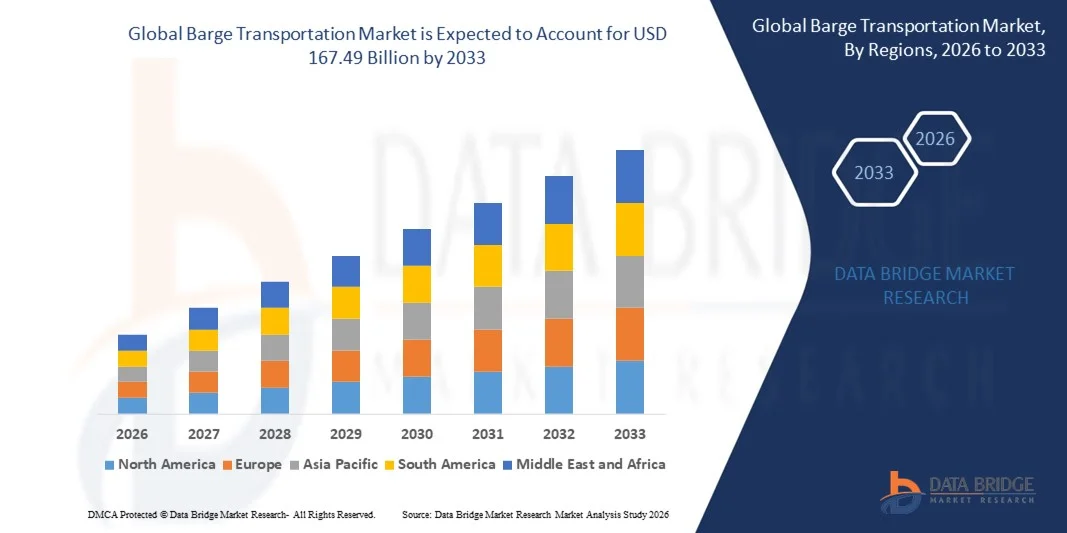
- The global barge transportation market size was valued at USD 128.18 billion in 2025 and is expected to reach USD 167.49 billion by 2033, at a CAGR of 3.40% during the forecast period
- Rise in the demand for petrochemical shipments is a crucial factor accelerating the market growth, also increase in the investments in port modernization, rise in the demand for crude oil in developing economies such as India and China, rise in the benefits related to barge transportation such as cost-effectiveness, safety and security, and efficiency and rise in the spending on research and development activities and subsequent advancements in technology are the major factors among others boosting the barge transportation market
What are the Major Takeaways of Barge Transportation Market?
- Rise in the demand from the emerging economies and increase in the technological advancements and modernization in the machinery will further create new opportunities barge transportation market in the forecast period mentioned above
- However, increase in the operating expenses in barge transportation, stringent government regulations pertaining to marine transportation and rise in the replacements of barges with pipelines for liquid cargo are the major factors among others restraining the market growth
- North America dominated the barge transportation market with a 35.26% revenue share in 2025, driven by the extensive inland waterway network across the U.S. and Canada, strong demand for bulk commodity transportation, and high reliance on cost-efficient river-based logistics
- Asia-Pacific is projected to register the fastest CAGR of 9.14% from 2026 to 2033, driven by rapid industrialization, expanding inland waterway development, and increasing demand for low-cost bulk transportation across China, India, Japan, South Korea, and Southeast Asia
- The Dry Cargo segment dominated the market with an estimated 48.6% revenue share in 2025, driven by extensive transportation of coal, grains, metal ores, construction materials, and industrial raw materials
Report Scope and Barge Transportation Market Segmentation
|
Attributes |
Barge Transportation Key Market Insights |
|
Segments Covered |
|
|
Countries Covered |
North America
Europe
Asia-Pacific
Middle East and Africa
South America
|
|
Key Market Players |
|
|
Market Opportunities |
|
|
Value Added Data Infosets |
In addition to the insights on market scenarios such as market value, growth rate, segmentation, geographical coverage, and major players, the market reports curated by the Data Bridge Market Research also include in-depth expert analysis, pricing analysis, brand share analysis, consumer survey, demography analysis, supply chain analysis, value chain analysis, raw material/consumables overview, vendor selection criteria, PESTLE Analysis, Porter Analysis, and regulatory framework. |
What is the Key Trend in the Barge Transportation Market?
Increasing Shift Toward Fuel-Efficient, Digitally Optimized, and Multimodal Barge Transportation
- The barge transportation market is witnessing a growing shift toward fuel-efficient fleets, larger-capacity barges, and digitally enabled operations to improve cost efficiency and environmental performance
- Operators are increasingly adopting GPS tracking, fleet management software, automated cargo monitoring, and predictive maintenance systems to enhance route optimization, asset utilization, and safety
- Rising demand for low-cost, high-volume freight movement is driving greater use of barges for transporting bulk commodities such as coal, petroleum products, agricultural goods, chemicals, and construction materials
- For instance, leading players such as Kirby Corporation, Ingram Marine Group, and American Commercial Barge Line are investing in modern barge designs, emission-reduction technologies, and digital navigation solutions
- Growing emphasis on multimodal logistics integration with rail and road transport is accelerating the adoption of inland and coastal barge transportation
- As sustainability regulations tighten and fuel costs remain volatile, barge transportation will remain a preferred mode for long-distance bulk cargo movement with lower carbon intensity
What are the Key Drivers of Barge Transportation Market?
- Rising demand for cost-effective transportation of bulk commodities across inland waterways and coastal routes is a major growth driver
- For instance, during 2024–2025, logistics operators across North America and Europe expanded barge capacity to support increased agricultural exports, energy shipments, and industrial raw material transport
- Growing focus on reducing carbon emissions compared to road and rail transport is boosting adoption of barges as an environmentally efficient alternative
- Infrastructure investments in ports, inland waterways, dredging projects, and river navigation systems are improving operational efficiency and capacity
- Expansion of oil & gas, chemical, mining, and construction industries continues to generate steady demand for large-volume barge transportation
- Supported by long asset lifecycles, lower fuel consumption, and favorable regulatory support, the Barge Transportation market is expected to witness stable long-term growth
Which Factor is Challenging the Growth of the Barge Transportation Market?
- Dependence on water levels, seasonal weather conditions, and river navigability creates operational uncertainties and capacity constraints
- For instance, during 2024–2025, drought conditions and fluctuating river depths disrupted barge traffic across major inland waterways, increasing transit times and freight costs
- High capital investment requirements for fleet modernization, port infrastructure, and environmental compliance pose challenges for smaller operators
- Slow transit speeds compared to road and rail limit suitability for time-sensitive cargo
- Regulatory compliance related to emissions, safety standards, and waterway usage increases operational complexity
- To mitigate these challenges, companies are investing in fleet optimization, digital route planning, hybrid propulsion systems, and strategic partnerships to strengthen the global adoption of Barge Transportation
How is the Barge Transportation Market Segmented?
The market is segmented on the basis of product, barge fleet, and application.
- By Product
On the basis of product, the barge transportation market is segmented into Dry Cargo, Liquid Cargo, and Gaseous Cargo. The Dry Cargo segment dominated the market with an estimated 48.6% revenue share in 2025, driven by extensive transportation of coal, grains, metal ores, construction materials, and industrial raw materials. Dry cargo barges offer high load capacity, low operating costs, and suitability for long-distance inland waterway transport, making them the preferred choice for bulk commodity movement across North America, Europe, and Asia-Pacific. Strong demand from power generation, mining, agriculture, and infrastructure development continues to support segment dominance.
The Liquid Cargo segment is expected to grow at the fastest CAGR from 2026 to 2033, supported by rising transportation of crude oil, refined petroleum products, chemicals, and liquid fertilizers. Increasing energy demand, expansion of petrochemical industries, and safety advantages of waterborne liquid transport are accelerating adoption of liquid cargo barges globally.
- By Barge Fleet
On the basis of barge fleet, the market is segmented into Open, Covered, and Tank barges. The Open barge segment dominated the market with approximately 44.2% share in 2025, owing to its widespread use in transporting dry bulk commodities such as coal, sand, gravel, ores, and agricultural products. Open barges are cost-effective, easy to load and unload, and highly suitable for short- and medium-haul inland transportation, making them a staple across river and canal networks. Strong deployment in construction, mining, and agricultural logistics reinforces segment leadership.
The Tank barge segment is projected to register the fastest CAGR from 2026 to 2033, driven by growing demand for safe and efficient transport of liquid chemicals, petroleum products, and hazardous materials. Stricter safety regulations, increasing chemical trade volumes, and investments in modern tank barge fleets are supporting rapid growth of this segment.
- By Application
On the basis of application, the barge transportation market is segmented into Coal & Crude Petroleum, Agricultural Products, Coke & Refined Petroleum Products, Metal Ores, Secondary Raw Materials & Wastes, Food Products, Beverages & Tobacco, Basic Metals & Fabricated Metal Products, Chemicals, Rubber & Plastic, and Nuclear Fuel. The Coal & Crude Petroleum segment dominated the market with a 35.7% share in 2025, supported by large-scale movement of energy commodities for power generation, refining, and industrial consumption. Barges remain a cost-efficient and environmentally favorable mode for transporting heavy energy cargo across inland waterways.
The Agricultural Products segment is expected to grow at the fastest CAGR from 2026 to 2033, driven by rising global food demand, expanding grain exports, and increasing use of barges for sustainable agricultural logistics. Seasonal harvest volumes, export-oriented supply chains, and lower transportation costs are accelerating growth in this segment.
Which Region Holds the Largest Share of the Barge Transportation Market?
- North America dominated the barge transportation market with a 35.26% revenue share in 2025, driven by the extensive inland waterway network across the U.S. and Canada, strong demand for bulk commodity transportation, and high reliance on cost-efficient river-based logistics. Large-scale movement of coal, crude oil, agricultural products, chemicals, and construction materials along the Mississippi River system and Great Lakes continues to support regional leadership
- Presence of established barge operators, advanced fleet management systems, and consistent investment in port infrastructure and river dredging strengthens North America’s competitive advantage
- Strong regulatory frameworks, environmental benefits of inland shipping, and lower fuel consumption compared to road and rail further reinforce regional dominance
U.S. Barge Transportation Market Insight
The U.S. is the largest contributor in North America, supported by one of the world’s most developed inland waterway systems. High volumes of agricultural exports, petroleum products, coal, and industrial raw materials transported via rivers drive sustained demand. Continuous investments in fleet modernization, navigation infrastructure, and intermodal connectivity further enhance market growth.
Canada Barge Transportation Market Insight
Canada contributes significantly through barge operations across the Great Lakes–St. Lawrence Seaway system. Growing movement of grain, minerals, petroleum products, and industrial cargo, along with cross-border trade with the U.S., supports steady market expansion.
Asia-Pacific Barge Transportation Market
Asia-Pacific is projected to register the fastest CAGR of 9.14% from 2026 to 2033, driven by rapid industrialization, expanding inland waterway development, and increasing demand for low-cost bulk transportation across China, India, Japan, South Korea, and Southeast Asia. Rising trade volumes, infrastructure investments, and government initiatives to promote inland water transport as a sustainable alternative are accelerating market growth. Expanding energy, agriculture, and construction sectors further boost barge transportation demand.
China Barge Transportation Market Insight
China is the largest contributor in Asia-Pacific due to extensive river networks such as the Yangtze River, high industrial output, and strong government investment in inland shipping infrastructure.
Japan Barge Transportation Market Insight
Japan shows steady growth supported by coastal and inland barge operations for industrial materials, chemicals, and construction cargo, alongside modernization of port logistics.
India Barge Transportation Market Insight
India is emerging as a high-growth market, driven by national inland waterway development programs, rising agricultural transport, and increasing use of barges for bulk and energy cargo.
South Korea Barge Transportation Market Insight
South Korea contributes through coastal barge transport supporting industrial supply chains, shipbuilding, and energy logistics, reinforced by advanced port infrastructure.
Which are the Top Companies in Barge Transportation Market?
The barge transportation industry is primarily led by well-established companies, including:
- Kirby Corporation (U.S.)
- Ingram Marine Group (U.S.)
- SEACOR Holdings Inc. (U.S.)
- Continental AG (Germany)
- American Commercial Barge Line (U.S.)
- ABC India Limited (India)
- Alter Logistics (U.S.)
- Argosy International Inc. (U.S.)
- ATS (U.S.)
- Blessey Marine Services, Inc. (U.S.)
- Bouchard Transportation (U.S.)
- Campbell Transportation Company, Inc. (U.S.)
- Contargo GmbH & Co. KG (Germany)
- Crounse Corporation (U.S.)
- Heartland Barge. (U.S.)
- Marquette Transportation Company LLC (U.S.)
- McAllister Towing and Transportation Co., Inc. (U.S.)
- neska Container Line B.V. (Netherlands)
- Olson Marine, Inc. (U.S.)
- POSH (Singapore)
- Poh Tiong Choon Logistics Ltd (Singapore)
What are the Recent Developments in Global Barge Transportation Market?
- In February 2024, Future Proof Shipping launched H2 Barge 2, a hydrogen-powered inland vessel designed for zero-emission operations along the Rhine River between Duisburg, Germany, and Rotterdam, the Netherlands. Supported by the EU-funded Flagships project and the Interreg-backed ZEM Ports NS initiative, the vessel represents a major milestone in sustainable inland shipping. This development highlights the growing shift toward carbon-free propulsion in barge transportation
- In October 2023, Seacor Holdings announced the sale of its inland water transportation division to Ingram Barge Co., a subsidiary of Ingram Marine Group. The transaction expanded Ingram’s fleet to over 1,000 covered dry cargo barges, eight high-horsepower towboats, and extensive terminal infrastructure along the Mississippi River. This consolidation strengthens operational scale and efficiency in North America’s inland barge market
- In July 2023, Carbon Sink partnered with Rose Cay Maritime through a memorandum of understanding to develop a low-carbon marine fuel supply chain based on green methanol. The collaboration focuses on expanding fuel production, transportation, storage, and bunkering for the shipping industry. This partnership supports decarbonization efforts across marine and inland water transport sectors
- In June 2023, the U.S. government marked the expansion of the Lock 25 project on the Mississippi River, aimed at improving navigation efficiency, safety for mariners, and commodity flow across inland waterways. The project is expected to enhance economic activity and logistical reliability. This investment underscores the role of infrastructure modernization in boosting barge transportation efficiency
- In January 2022, DP World launched a premium barge service connecting the Upper Rhine region with the Port of Rotterdam, offering a sustainable and reliable inland transport alternative. The service supports smoother cargo movement between key European trade corridors. This initiative reinforces the importance of barge services in enabling greener port-to-hinterland logistics

- Interactive Data Analysis Dashboard
- Company Analysis Dashboard for high growth potential opportunities
- Research Analyst Access for customization & queries
- Competitor Analysis with Interactive dashboard
- Latest News, Updates & Trend analysis
- Harness the Power of Benchmark Analysis for Comprehensive Competitor Tracking
Data collection and base year analysis are done using data collection modules with large sample sizes. The stage includes obtaining market information or related data through various sources and strategies. It includes examining and planning all the data acquired from the past in advance. It likewise envelops the examination of information inconsistencies seen across different information sources. The market data is analysed and estimated using market statistical and coherent models. Also, market share analysis and key trend analysis are the major success factors in the market report. To know more, please request an analyst call or drop down your inquiry.
The key research methodology used by DBMR research team is data triangulation which involves data mining, analysis of the impact of data variables on the market and primary (industry expert) validation. Data models include Vendor Positioning Grid, Market Time Line Analysis, Market Overview and Guide, Company Positioning Grid, Patent Analysis, Pricing Analysis, Company Market Share Analysis, Standards of Measurement, Global versus Regional and Vendor Share Analysis. To know more about the research methodology, drop in an inquiry to speak to our industry experts.
Data Bridge Market Research is a leader in advanced formative research. We take pride in servicing our existing and new customers with data and analysis that match and suits their goal. The report can be customized to include price trend analysis of target brands understanding the market for additional countries (ask for the list of countries), clinical trial results data, literature review, refurbished market and product base analysis. Market analysis of target competitors can be analyzed from technology-based analysis to market portfolio strategies. We can add as many competitors that you require data about in the format and data style you are looking for. Our team of analysts can also provide you data in crude raw excel files pivot tables (Fact book) or can assist you in creating presentations from the data sets available in the report.













