


What is the Global Automotive Plastic Compounding Market Size and Growth Rate?
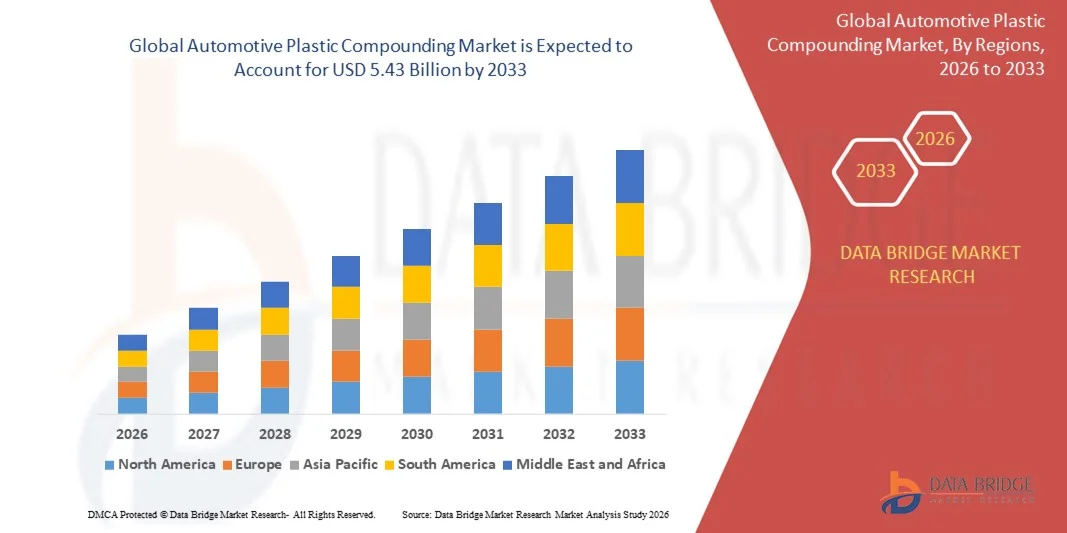
- The global automotive plastic compounding market size was valued at USD 3.50 billion in 2025 and is expected to reach USD 5.43 billion by 2033, at a CAGR of5.62% during the forecast period
- The rise in the plastics demand in construction, automotive and electrical and electronics is expected to influence the growth of the automotive plastic compounding market
- In line with this, the rapid increase in product applications in automotive sector and rise in the income level are also anticipated to act as key determinants favoring the growth of the automotive plastic compounding market
What are the Major Takeaways of Automotive Plastic Compounding Market?
- High demand for lightweight vehicles and thriving automotive industries are also expected to positively impact the growth of the automotive plastic compounding market. The major factor accountable for the growth of the market is the rapid industrialization
- However, the high cost in the price of the raw materials and various environmental regulations associated with the plastic recycling are such asly to act as key restraints towards automotive plastic compounding market
- Asia-Pacific dominated the automotive plastic compounding market with an estimated 44.3% revenue share in 2025, driven by large-scale automotive production, strong OEM presence, and extensive use of plastic compounds for lightweighting and cost optimization across passenger and commercial vehicles
- North America is expected to register the fastest CAGR of 9.21% from 2026 to 2033, driven by rapid adoption of electric vehicles, stringent fuel efficiency regulations, and increasing focus on vehicle lightweighting
- Polypropylene (PP) dominated the market with an estimated 38.6% share in 2025, owing to its lightweight nature, cost-effectiveness, excellent chemical resistance, and wide applicability across interior, exterior, and under-the-hood components
Report Scope and Automotive Plastic Compounding Market Segmentation
|
Attributes |
Automotive Plastic Compounding Key Market Insights |
|
Segments Covered |
|
|
Countries Covered |
North America
Europe
Asia-Pacific
Middle East and Africa
South America
|
|
Key Market Players |
|
|
Market Opportunities |
|
|
Value Added Data Infosets |
In addition to the insights on market scenarios such as market value, growth rate, segmentation, geographical coverage, and major players, the market reports curated by the Data Bridge Market Research also include in-depth expert analysis, pricing analysis, brand share analysis, consumer survey, demography analysis, supply chain analysis, value chain analysis, raw material/consumables overview, vendor selection criteria, PESTLE Analysis, Porter Analysis, and regulatory framework. |
What is the Key Trend in the Automotive Plastic Compounding Market?
Increasing Shift Toward Lightweight, High-Performance, and Sustainable Automotive Plastic Compounds
- The automotive plastic compounding market is witnessing a strong shift toward lightweight, high-strength, and multi-functional plastic compounds to support vehicle lightweighting, fuel efficiency, and emission reduction targets
- Manufacturers are increasingly developing glass-fiber-reinforced, mineral-filled, and impact-modified compounds that deliver improved mechanical strength, thermal resistance, and durability
- Rising demand for electric vehicles (EVs) is accelerating the adoption of flame-retardant, electrically insulating, and heat-resistant plastic compounds for battery housings and powertrain components
- For instance, companies such as BASF, SABIC, Covestro, and LyondellBasell are expanding their automotive-grade polymer compound portfolios to meet OEM sustainability and performance requirements
- Growing emphasis on recyclable, bio-based, and circular plastic compounds is reshaping material selection across interior, exterior, and under-the-hood applications
- As automotive designs evolve toward electrification and lightweight architectures, advanced plastic compounding will remain critical for performance optimization and regulatory compliance
What are the Key Drivers of Automotive Plastic Compounding Market?
- Rising demand for vehicle lightweighting to improve fuel efficiency and extend EV driving range is driving adoption of advanced plastic compounds
- For instance, in 2024–2025, leading compounders introduced high-flow, low-density, and reinforced thermoplastic compounds tailored for structural automotive parts
- Increasing production of electric vehicles, hybrid vehicles, and autonomous cars is boosting demand for heat-resistant and electrically safe plastic materials
- Advancements in compounding technologies, filler dispersion, and additive integration are enhancing mechanical, thermal, and chemical performance
- Growing use of plastics in interiors, exteriors, powertrain components, and battery systems is expanding the overall addressable market
- Supported by continuous investment in automotive R&D, material innovation, and sustainability initiatives, the market is expected to witness strong long-term growth
Which Factor is Challenging the Growth of the Automotive Plastic Compounding Market?
- Volatility in raw material prices, particularly petrochemical-based resins and specialty additives, impacts production costs and profit margins
- For instance, during 2024–2025, fluctuations in crude oil prices and supply chain disruptions affected polymer and filler availability globally
- Stringent automotive quality standards and regulatory compliance requirements increase development time and testing costs
- Limited recycling infrastructure for complex, multi-material automotive plastics restricts circular economy adoption
- Competition from metal substitutes, aluminum alloys, and advanced composites creates pricing pressure in certain applications
- To address these challenges, manufacturers are focusing on bio-based polymers, recycled-content compounds, and process optimization to improve cost efficiency and sustainability
How is the Automotive Plastic Compounding Market Segmented?
The market is segmented on the basis of product type and application.
- By Product Type
On the basis of product type, the automotive plastic compounding market is segmented into Acrylonitrile Butadiene Styrene (ABS), Polypropylene (PP), Polyurethane (PU), Polyvinyl Chloride (PVC), Polyethylene (PE), and Others. Polypropylene (PP) dominated the market with an estimated 38.6% share in 2025, owing to its lightweight nature, cost-effectiveness, excellent chemical resistance, and wide applicability across interior, exterior, and under-the-hood components. PP compounds are extensively used in bumpers, dashboards, trims, and battery casings, supporting vehicle lightweighting and fuel efficiency targets.
Polyurethane (PU) is expected to grow at the fastest CAGR from 2026 to 2033, driven by rising demand for seating foams, insulation materials, vibration-damping components, and comfort-enhancing interiors. Increasing EV production and focus on noise, vibration, and harshness (NVH) reduction are further accelerating PU compound adoption. Continuous innovation in reinforced and bio-based plastic compounds supports long-term product diversification.
- By Application
On the basis of application, the automotive plastic compounding market is segmented into Instrument Panels, Powertrain, Door Systems, Interior Components, Exterior Fascia, Under-the-Hood Components, and Others. Interior Components dominated the market with a 41.2% revenue share in 2025, supported by extensive use of plastic compounds in dashboards, consoles, trims, seat structures, and panels. Automotive OEMs increasingly prefer advanced plastic compounds for interiors due to design flexibility, lightweight benefits, surface finish quality, and enhanced passenger comfort.
The Under-the-Hood Components segment is projected to grow at the fastest CAGR from 2026 to 2033, driven by rising adoption of high-temperature-resistant and chemically stable plastic compounds in engine covers, air intake manifolds, battery enclosures, and fluid reservoirs. Growth in electric and hybrid vehicles, along with stringent emission and thermal performance requirements, is pushing demand for advanced reinforced compounds capable of replacing metal parts.
Which Region Holds the Largest Share of the Automotive Plastic Compounding Market?
- Asia-Pacific dominated the automotive plastic compounding market with an estimated 44.3% revenue share in 2025, driven by large-scale automotive production, strong OEM presence, and extensive use of plastic compounds for lightweighting and cost optimization across passenger and commercial vehicles. High vehicle manufacturing volumes in China, Japan, India, and South Korea, along with growing EV adoption, continue to boost demand for polypropylene, ABS, polyurethane, and reinforced plastic compounds
- Rapid expansion of automotive manufacturing hubs, availability of low-cost raw materials, and increasing localization of component production strengthen regional market leadership
- Rising focus on emission reduction, fuel efficiency, and electric mobility accelerates adoption of advanced plastic compounds across interiors, exteriors, and under-the-hood applications
China Automotive Plastic Compounding Market Insight
China is the largest contributor within Asia-Pacific, supported by the world’s largest automotive production base and rapid growth in electric vehicle manufacturing. Increasing use of plastic compounds in battery housings, interior trims, exterior fascia, and structural components supports lightweighting and cost efficiency. Strong domestic compounding capacity and government-backed EV policies further expand market adoption.
Japan Automotive Plastic Compounding Market Insight
Japan shows steady growth driven by advanced material engineering, high-quality automotive manufacturing, and continuous innovation in lightweight vehicle design. Strong demand for high-performance plastic compounds in hybrid vehicles, powertrain components, and interior systems supports market expansion. Emphasis on durability, safety, and sustainability sustains long-term growth.
India Automotive Plastic Compounding Market Insight
India is emerging as a high-growth market, driven by expanding passenger vehicle production, rising EV adoption, and increasing localization of automotive components. Government initiatives such as Make in India and growing demand for affordable, lightweight vehicles boost usage of plastic compounds across interior and exterior applications.
South Korea Automotive Plastic Compounding Market Insight
South Korea contributes significantly due to strong OEM presence, advanced polymer technology capabilities, and rising production of electric and hybrid vehicles. Increasing demand for high-strength, heat-resistant plastic compounds in powertrain and under-the-hood applications supports consistent market growth.
North America Automotive Plastic Compounding Market
North America is expected to register the fastest CAGR of 9.21% from 2026 to 2033, driven by rapid adoption of electric vehicles, stringent fuel efficiency regulations, and increasing focus on vehicle lightweighting. Automakers are increasingly replacing metal components with advanced plastic compounds to improve performance, sustainability, and cost efficiency. Strong investments in automotive R&D, recycling-based compounds, and bio-based plastics further accelerate regional market growth
U.S. Automotive Plastic Compounding Market Insight
The U.S. leads North America, supported by strong EV manufacturing, high adoption of lightweight materials, and continuous innovation in automotive design. Increasing demand for plastic compounds in battery systems, interior components, and exterior panels drives steady market expansion.
Canada Automotive Plastic Compounding Market Insight
Canada contributes through growing automotive component manufacturing, rising EV investments, and increasing focus on sustainable plastic compounds. Supportive government policies and cross-border OEM supply chains strengthen long-term market adoption.
Which are the Top Companies in Automotive Plastic Compounding Market?
The automotive plastic compounding industry is primarily led by well-established companies, including:
- BASF SE (Germany)
- Dow (U.S.)
- SABIC (Saudi Arabia)
- LyondellBasell Industries Holdings B.V. (Netherlands)
- DuPont (U.S.)
- KRATON CORPORATION (U.S.)
- 3M (U.S.)
- Covestro AG (Germany)
- Solvay (Belgium)
- LANXESS (Germany)
- RTP Company (U.S.)
- Asahi Kasei Corporation (Japan)
- Aurora Plastics LLC (U.S.)
- Ferro Corporation (U.S.)
- Washington Penn (U.S.)
- Eurostar Engineering Plastics (France)
- Kuraray Europe GmbH (Germany)
- Ravago Manufacturing India Pvt. Ltd. (India)
- TEIJIN LIMITED (Japan)
- Chevron Phillips Chemical Company LLC (U.S.)
What are the Recent Developments in Global Automotive Plastic Compounding Market?
- In January 2025, Arkema entered into a partnership with ALBIS, a leading distributor of engineering and high-performance plastics, to commercialize its medical-grade materials including Pebax MED thermoplastic elastomers, RilsanMED polyamide 11, Rilsamid MED polyamide 12, Rilsan MED Clear transparent polyamide, and Kynar MED PVDF. This collaboration strengthens Arkema’s market reach and supports rising demand from the global healthcare sector
- In February 2024, Arkema expanded its global production capacity for Pebax elastomers by 40% at its Serquigny manufacturing facility in France. This capacity expansion enhances supply reliability and positions the company to address growing demand from medical, automotive, and industrial applications
- In December 2023, Asahi Kasei Corporation secured the internationally recognized ISCC Plus sustainability certification for additional product categories including TPE, PVDC, PPE, PA, and styrene. This achievement reinforces the company’s commitment to sustainable material sourcing and environmentally responsible manufacturing
- In July 2023, LyondellBasell Industries Holdings completed the acquisition of Mepol Group, a producer of recycled high-performance technical compounds based in Italy and Poland. With Mepol and its subsidiaries integrated into LyondellBasell’s Advanced Polymer Solutions business, the move strengthens the company’s recycled and sustainable compounding portfolio
- In May 2023, SABIC introduced the LNP™ ELCRIN WF0051iQ compound, featuring thin-wall processing capability and non-brominated, non-chlorinated flame-retardant performance. This product launch addresses evolving safety and sustainability requirements across advanced electronics and industrial applications
- In July 2022, BASF SE and THOR GmbH collaborated by combining their expertise in non-halogenated flame-retardant additives to deliver enhanced plastic compounding solutions. This partnership enables customers to achieve higher fire safety standards while improving material sustainability and performance

- Interactive Data Analysis Dashboard
- Company Analysis Dashboard for high growth potential opportunities
- Research Analyst Access for customization & queries
- Competitor Analysis with Interactive dashboard
- Latest News, Updates & Trend analysis
- Harness the Power of Benchmark Analysis for Comprehensive Competitor Tracking
Global Automotive Plastic Compounding Market, Supply Chain Analysis and Ecosystem Framework
To support market growth and help clients navigate the impact of geopolitical shifts, DBMR has integrated in-depth supply chain analysis into its Global Automotive Plastic Compounding Market research reports. This addition empowers clients to respond effectively to global changes affecting their industries. The supply chain analysis section includes detailed insights such as Global Automotive Plastic Compounding Market consumption and production by country, price trend analysis, the impact of tariffs and geopolitical developments, and import and export trends by country and HSN code. It also highlights major suppliers with data on production capacity and company profiles, as well as key importers and exporters. In addition to research, DBMR offers specialized supply chain consulting services backed by over a decade of experience, providing solutions like supplier discovery, supplier risk assessment, price trend analysis, impact evaluation of inflation and trade route changes, and comprehensive market trend analysis.
Data collection and base year analysis are done using data collection modules with large sample sizes. The stage includes obtaining market information or related data through various sources and strategies. It includes examining and planning all the data acquired from the past in advance. It likewise envelops the examination of information inconsistencies seen across different information sources. The market data is analysed and estimated using market statistical and coherent models. Also, market share analysis and key trend analysis are the major success factors in the market report. To know more, please request an analyst call or drop down your inquiry.
The key research methodology used by DBMR research team is data triangulation which involves data mining, analysis of the impact of data variables on the market and primary (industry expert) validation. Data models include Vendor Positioning Grid, Market Time Line Analysis, Market Overview and Guide, Company Positioning Grid, Patent Analysis, Pricing Analysis, Company Market Share Analysis, Standards of Measurement, Global versus Regional and Vendor Share Analysis. To know more about the research methodology, drop in an inquiry to speak to our industry experts.
Data Bridge Market Research is a leader in advanced formative research. We take pride in servicing our existing and new customers with data and analysis that match and suits their goal. The report can be customized to include price trend analysis of target brands understanding the market for additional countries (ask for the list of countries), clinical trial results data, literature review, refurbished market and product base analysis. Market analysis of target competitors can be analyzed from technology-based analysis to market portfolio strategies. We can add as many competitors that you require data about in the format and data style you are looking for. Our team of analysts can also provide you data in crude raw excel files pivot tables (Fact book) or can assist you in creating presentations from the data sets available in the report.













