Global Automated Sortation System Market
Market Size in USD Billion
CAGR :
% 
 USD
6.16 Billion
USD
9.24 Billion
2025
2033
USD
6.16 Billion
USD
9.24 Billion
2025
2033
 Forecast Period Forecast Period |
2026 –2033 |
 Market Size (Base Year) Market Size (Base Year) |
USD 6.16 Billion |
 Market Size (Forecast Year) Market Size (Forecast Year) |
USD 9.24 Billion |
 CAGR CAGR |
% |
| Major Markets Players |
|
What is the Global Automated Sortation System Market Size and Growth Rate?
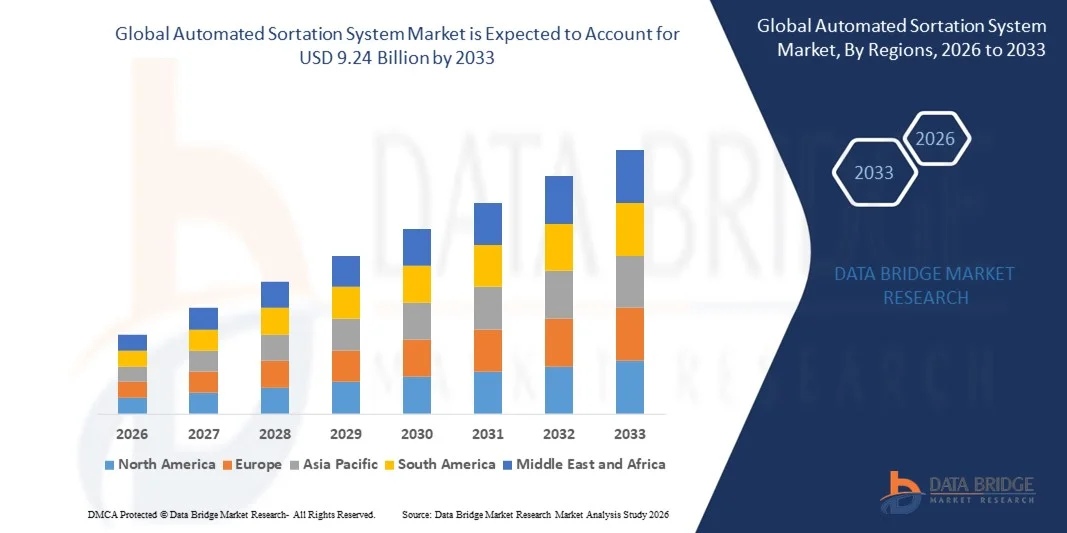
- The global automated sortation system market size was valued at USD 6.16 billion in 2025 and is expected to reach USD 9.24 billion by 2033, at a CAGR of 5.20% during the forecast period
- The rise in demand for automated solutions for efficient operations management at distribution centers acts as one of the major factors driving the growth of automated sortation system market
- The increase in the adoption of internet of thing (IoT) technology by organizations and the increase in use of the technology in order to improve their product offering and meet the various sortation requirements of end-users accelerate the automated sortation system market growth
What are the Major Takeaways of Automated Sortation System Market?
- The rise in investments in warehouse automation in various sectors and increase in adoption of pouch/pocket sorters in clothing and apparel applications further influence the automated sortation system market
- In addition, expansion of end user industries, rapid urbanization and digitization, high acceptance of automation to reduce labor cost and rise in investment in automation and connected solutions positively affect the automated sortation system market
- Europe dominated the automated sortation system market with a 39.8% revenue share in 2025, driven by strong growth in e-commerce logistics, airport baggage handling infrastructure, postal automation, and advanced manufacturing facilities across Germany, France, the U.K., and the Netherlands
- Asia-Pacific is projected to register the fastest CAGR of 10.2% from 2026 to 2033, driven by rapid expansion of e-commerce, rising parcel volumes, airport infrastructure development, and increasing warehouse automation across China, Japan, India, South Korea, and Southeast Asia
- The Linear Sortation segment dominated the market with an estimated 54.6% share in 2025, driven by its simple design, high sorting accuracy, and suitability for medium-to-high throughput operations
Report Scope and Automated Sortation System Market Segmentation
|
Attributes |
Automated Sortation System Key Market Insights |
|
Segments Covered |
|
|
Countries Covered |
North America
Europe
Asia-Pacific
Middle East and Africa
South America
|
|
Key Market Players |
|
|
Market Opportunities |
|
|
Value Added Data Infosets |
In addition to the insights on market scenarios such as market value, growth rate, segmentation, geographical coverage, and major players, the market reports curated by the Data Bridge Market Research also include in-depth expert analysis, pricing analysis, brand share analysis, consumer survey, demography analysis, supply chain analysis, value chain analysis, raw material/consumables overview, vendor selection criteria, PESTLE Analysis, Porter Analysis, and regulatory framework. |
What is the Key Trend in the Automated Sortation System Market?
Increasing Shift Toward High-Speed, Compact, and Software-Driven Automated Sortation Systems
- The automated sortation systems market is witnessing rising adoption of high-speed, space-efficient, and modular sortation solutions designed to handle growing parcel volumes, SKU complexity, and omni-channel fulfillment requirements
- Manufacturers are increasingly introducing PC-based and software-defined sortation systems integrated with AI, vision sensors, and real-time control software to enable precise, high-throughput operations
- Growing demand for compact footprints, flexible layouts, and scalable architectures is driving adoption across e-commerce warehouses, distribution centers, airports, and postal facilities
- For instance, companies such as Daifuku, Dematic, Vanderlande, Siemens, and BEUMER Group are upgrading sortation platforms with higher belt speeds, intelligent routing algorithms, and IoT-enabled monitoring
- Rising need for fast order processing, reduced manual handling, and real-time tracking is accelerating the shift toward automated, software-integrated sortation systems
- As logistics operations become faster and more complex, automated sortation systems will remain critical for high-throughput material handling, accuracy improvement, and operational efficiency
What are the Key Drivers of Automated Sortation System Market?
- Rising demand for fast, accurate, and labor-efficient parcel and item sorting across e-commerce, retail, and third-party logistics operations
- For instance, in 2024–2025, leading players such as Daifuku, TGW Logistics, and Interroll expanded their automated sortation portfolios with higher-speed cross-belt and shoe sorters
- Rapid growth of e-commerce, same-day delivery, and reverse logistics is increasing deployment of automated sortation systems across the U.S., Europe, and Asia-Pacific
- Advancements in conveyor technology, sensors, AI-based vision systems, and warehouse management software have enhanced sorting speed, accuracy, and system intelligence
- Increasing warehouse automation, labor shortages, and rising operational costs are driving investment in automated and semi-automated sortation solutions
- Supported by strong investments in logistics infrastructure, smart warehouses, and supply chain digitalization, the Automated Sortation Systems market is expected to witness robust long-term growth
Which Factor is Challenging the Growth of the Automated Sortation System Market?
- High initial capital investment and installation costs associated with advanced automated sortation systems limit adoption among small and mid-sized warehouses
- For instance, during 2024–2025, fluctuations in steel prices, electronic components, and automation hardware increased system procurement and deployment costs
- Complexity in system integration with existing warehouse layouts, WMS platforms, and legacy infrastructure increases deployment time and operational risk
- Limited technical expertise and skilled workforce availability in emerging markets slow down system adoption and optimization
- Competition from manual sorting, semi-automated conveyors, and lower-cost modular alternatives creates pricing pressure for full-scale automated solutions
- To overcome these challenges, manufacturers are focusing on modular designs, software-driven optimization, service-based models, and faster ROI-focused deployments to expand global adoption of Automated Sortation Systems
How is the Automated Sortation System Market Segmented?
The market is segmented on the basis of channel count, application, and vertical.
- By Type
On the basis of type, the automated sortation system market is segmented into Linear Sortation and Loop Sortation systems. The Linear Sortation segment dominated the market with an estimated 54.6% share in 2025, driven by its simple design, high sorting accuracy, and suitability for medium-to-high throughput operations. Linear sorters are widely deployed in distribution centers, manufacturing facilities, and regional logistics hubs due to their ease of installation, lower maintenance requirements, and ability to handle diverse product sizes. Their scalability and cost-effectiveness make them a preferred choice for warehouses transitioning from manual to automated sorting.
The Loop Sortation segment is expected to grow at the fastest CAGR from 2026 to 2033, supported by rising demand for ultra-high throughput, continuous operation, and space-optimized layouts. Loop sorters enable recirculation, dynamic routing, and high-speed sorting, making them ideal for large e-commerce fulfillment centers, parcel hubs, and airport baggage handling systems.
- By End User
On the basis of end user, the Automated Sortation System market is segmented into Retail and E-Commerce, Post and Parcel Sector, Food and Beverage, Pharmaceutical and Medical Sector, Large Airport, and Others. The Retail and E-Commerce segment dominated the market with a 38.9% share in 2025, driven by rapid growth in online shopping, same-day delivery models, and high SKU variability. Automated sortation systems enable fast order processing, accurate order fulfillment, and efficient reverse logistics, making them essential for large e-commerce warehouses and omnichannel distribution centers.
The Post and Parcel Sector is projected to grow at the fastest CAGR from 2026 to 2033, fueled by rising global parcel volumes, cross-border e-commerce, and automation initiatives by national postal services and private courier companies. Increasing investments in smart logistics hubs and high-speed parcel sortation infrastructure are further accelerating adoption across this segment.
Which Region Holds the Largest Share of the Automated Sortation System Market?
- Europe dominated the automated sortation system market with a 39.8% revenue share in 2025, driven by strong growth in e-commerce logistics, airport baggage handling infrastructure, postal automation, and advanced manufacturing facilities across Germany, France, the U.K., and the Netherlands. High adoption of cross-belt, shoe, and loop sortation systems across distribution centers and parcel hubs continues to fuel regional demand
- Leading European system integrators and automation providers are introducing high-speed, energy-efficient, and software-driven sortation platforms integrated with AI, vision systems, and warehouse management software, reinforcing Europe’s technological leadership
- Strong logistics infrastructure, high labor costs, stringent accuracy requirements, and early adoption of Industry 4.0 practices further strengthen Europe’s position as the leading Automated Sortation System market
Germany Automated Sortation System Market Insight
Germany is the largest contributor in Europe, supported by its role as a global logistics hub and strong presence of leading automation manufacturers. High deployment of automated sortation systems across e-commerce fulfillment centers, automotive supply chains, postal facilities, and airports drives sustained demand. Strong engineering expertise, advanced manufacturing ecosystems, and continuous investments in smart warehouses further boost market growth.
U.K. Automated Sortation System Market Insight
The U.K. market is driven by rapid growth in online retail, parcel delivery services, and reverse logistics. Increasing investments in automated fulfillment centers and airport baggage handling systems are accelerating adoption. Labor shortages and rising operational costs further push companies toward automated sortation solutions.
Asia-Pacific Automated Sortation System Market
Asia-Pacific is projected to register the fastest CAGR of 10.2% from 2026 to 2033, driven by rapid expansion of e-commerce, rising parcel volumes, airport infrastructure development, and increasing warehouse automation across China, Japan, India, South Korea, and Southeast Asia. High growth in retail logistics, express delivery networks, and smart manufacturing facilities is accelerating deployment of automated sortation systems. Government investments in logistics modernization and industrial automation further support long-term market expansion.
China Automated Sortation System Market Insight
China is the largest contributor in Asia-Pacific due to massive e-commerce volumes, expanding courier networks, and large-scale investments in automated logistics hubs. Rapid deployment of high-speed sortation systems across parcel centers and distribution warehouses continues to drive market growth.
Japan Automated Sortation System Market Insight
Japan shows steady growth supported by advanced logistics infrastructure, high automation adoption, and strong focus on precision and efficiency. Automated sortation systems are widely used in postal services, airports, and retail distribution centers.
India Automated Sortation System Market Insight
India is emerging as a high-growth market, driven by expanding e-commerce platforms, rising demand for fast parcel delivery, and increasing investment in warehouse automation. Government initiatives supporting logistics infrastructure and digital supply chains are accelerating market adoption.
South Korea Automated Sortation System Market Insight
South Korea contributes significantly due to strong demand from e-commerce, airport modernization projects, and advanced manufacturing logistics. High technology adoption, compact warehouse designs, and smart logistics initiatives support continued market growth.
Which are the Top Companies in Automated Sortation System Market?
The automated sortation system industry is primarily led by well-established companies, including:
- Daifuku Co., Ltd. (Japan)
- Siemens (Germany)
- Honeywell Intelligrated (U.S.)
- Dematic (U.S.)
- BEUMER GROUP (Germany)
- Bastian Solutions, Inc. (U.S.)
- Interroll Group (Switzerland)
- KNAPP AG (Austria)
- Murata Machinery, Ltd. (Japan)
- TGW Logistics Group (Austria)
- Vanderlande Industries B.V. (Netherlands)
- Okura Yusoki Co., Ltd. (Japan)
- Mitsubishi Electric Corporation (Japan)
- Fives (France)
- Schaefer Systems International Pvt Ltd (Germany)
- Shanxi Oriental Material Handling Co., Ltd. (China)
- ITOH DENKI (Japan)
SKU-
Get online access to the report on the World's First Market Intelligence Cloud
- Interactive Data Analysis Dashboard
- Company Analysis Dashboard for high growth potential opportunities
- Research Analyst Access for customization & queries
- Competitor Analysis with Interactive dashboard
- Latest News, Updates & Trend analysis
- Harness the Power of Benchmark Analysis for Comprehensive Competitor Tracking
Research Methodology
Data collection and base year analysis are done using data collection modules with large sample sizes. The stage includes obtaining market information or related data through various sources and strategies. It includes examining and planning all the data acquired from the past in advance. It likewise envelops the examination of information inconsistencies seen across different information sources. The market data is analysed and estimated using market statistical and coherent models. Also, market share analysis and key trend analysis are the major success factors in the market report. To know more, please request an analyst call or drop down your inquiry.
The key research methodology used by DBMR research team is data triangulation which involves data mining, analysis of the impact of data variables on the market and primary (industry expert) validation. Data models include Vendor Positioning Grid, Market Time Line Analysis, Market Overview and Guide, Company Positioning Grid, Patent Analysis, Pricing Analysis, Company Market Share Analysis, Standards of Measurement, Global versus Regional and Vendor Share Analysis. To know more about the research methodology, drop in an inquiry to speak to our industry experts.
Customization Available
Data Bridge Market Research is a leader in advanced formative research. We take pride in servicing our existing and new customers with data and analysis that match and suits their goal. The report can be customized to include price trend analysis of target brands understanding the market for additional countries (ask for the list of countries), clinical trial results data, literature review, refurbished market and product base analysis. Market analysis of target competitors can be analyzed from technology-based analysis to market portfolio strategies. We can add as many competitors that you require data about in the format and data style you are looking for. Our team of analysts can also provide you data in crude raw excel files pivot tables (Fact book) or can assist you in creating presentations from the data sets available in the report.