


Automated Blood Tube Labeller - Specimen Transport Box Market Size
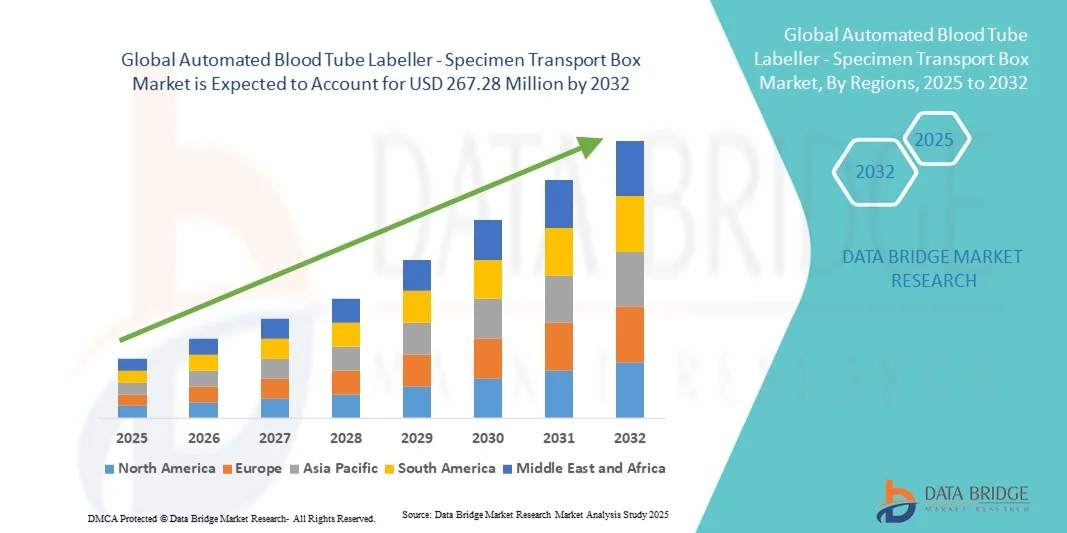
- The global automated blood tube labeller - specimen transport box market size was valued at USD 148.2 million in 2024 and is expected to reach USD 267.28 Million by 2032, at a CAGR of 6.75% during the forecast period
- The market growth is largely fueled by the increasing adoption of automation technologies in clinical laboratories and diagnostic centers, enhancing efficiency, accuracy, and throughput in specimen handling and labeling processes. Automated systems reduce manual errors, streamline workflows, and improve sample traceability, supporting high-volume laboratory operations
- Furthermore, rising demand for standardized and reliable specimen transport solutions, coupled with advancements in lab automation, is accelerating the uptake of Automated Blood Tube Labeller and Specimen Transport Box solutions. Integration with laboratory information management systems (LIMS) and automated sorting technologies is further boosting operational efficiency and minimizing sample mix-ups, thereby significantly driving the market’s growth
Automated Blood Tube Labeller - Specimen Transport Box Market Analysis
- Automated Blood Tube Labeller - Specimen Transport Box systems are increasingly essential in modern laboratories and healthcare facilities, offering precise, efficient, and error-reducing solutions for specimen identification, tracking, and transport across diagnostic and research workflows
- The escalating demand for automated blood tube labeller - specimen transport box systems is primarily fueled by growing adoption in hospitals, diagnostic laboratories, and biobanks, increasing automation in laboratory processes, and rising emphasis on reducing manual errors and improving patient safety
- North America dominated the automated blood tube labeller - specimen transport box market with the largest revenue share of 40.22% in 2024, supported by advanced healthcare infrastructure, high R&D investments, and strong presence of key market players. The U.S. experienced substantial growth in Automated Blood Tube Labeller - Specimen Transport Box installations, particularly in large hospital networks and high-throughput laboratories, driven by innovations from both established companies and emerging technology providers focusing on automation and integration with laboratory information management systems (LIMS)
- Asia-Pacific is expected to be the fastest-growing region in the automated blood tube labeller - specimen transport box market during the forecast period, due to rapid urbanization, increasing healthcare expenditure, and the expanding number of diagnostic laboratories and research institutions investing in automated labelling and specimen transport solutions
- The Traditional Boxes segment dominated the automated blood tube labeller - specimen transport box market with the largest market revenue share of 57.7% in 2024, driven by their widespread use, low cost, and simple design that meets standard specimen transport requirements
Report Scope and Automated Blood Tube Labeller - Specimen Transport Box Market Segmentation
|
Attributes |
Automated Blood Tube Labeller - Specimen Transport Box Key Market Insights |
|
Segments Covered |
|
|
Countries Covered |
North America
Europe
Asia-Pacific
Middle East and Africa
South America
|
|
Key Market Players |
|
|
Market Opportunities |
|
|
Value Added Data Infosets |
In addition to the insights on market scenarios such as market value, growth rate, segmentation, geographical coverage, and major players, the market reports curated by the Data Bridge Market Research also include in-depth expert analysis, pricing analysis, brand share analysis, consumer survey, demography analysis, supply chain analysis, value chain analysis, raw material/consumables overview, vendor selection criteria, PESTLE Analysis, Porter Analysis, and regulatory framework. |
Automated Blood Tube Labeller - Specimen Transport Box Market Trends
Increasing Adoption of Automated Specimen Handling Systems
- A major and accelerating trend in the global automated blood tube labeller - specimen transport box market is the growing adoption of fully automated systems that streamline labeling, tracking, and transport of blood and other biological specimens. These systems are becoming indispensable in hospitals, diagnostic laboratories, and research institutions, as they enhance operational efficiency, minimize human errors, and ensure strict compliance with regulatory and safety standards
- Automation not only reduces manual labor but also enables laboratories to process larger volumes of samples with consistent accuracy, which is increasingly important in high-throughput environments and during periods of heightened diagnostic demand, such as public health crises
- For instance, in March 2023, Roche introduced its Cobas Pro integrated system with automated tube labeling and specimen transport capabilities. The system enables high-throughput sample processing, real-time tracking, and complete traceability, ensuring laboratory staff can focus on critical analytical tasks rather than manual handling
- Furthermore, integration with laboratory information management systems (LIMS) is increasingly being adopted, enabling real-time monitoring, automated data logging, and seamless communication across multiple departments or facilities. This integration helps laboratories scale operations efficiently while maintaining accuracy and compliance
- The trend is also driven by increasing awareness among healthcare administrators about patient safety, error reduction, and the importance of operational efficiency. Automated solutions allow laboratories to standardize workflows, minimize turnaround times, and deliver consistent, high-quality diagnostic results
- In addition, the growing prevalence of multi-site hospital networks and centralized diagnostic laboratories has further fueled demand, as automated labelling and specimen transport systems simplify coordination and reduce delays in sample management across large facilities
- Overall, the adoption of automated blood tube labellers is reshaping laboratory operations globally, driving laboratories to invest in systems that combine speed, reliability, and traceability for superior performance
Automated Blood Tube Labeller - Specimen Transport Box Market Dynamics
Driver
Rising Need for Accuracy, Efficiency, and Compliance in Laboratories
- The increasing requirement for precision and operational efficiency in hospitals, diagnostic laboratories, and research centers is a key driver of market growth. Automated blood tube labellers reduce labeling errors, enhance sample traceability, and streamline workflows, which is essential for patient safety, quality control, and regulatory compliance
- As the number of diagnostic tests and clinical samples grows annually, manual labeling processes are prone to errors, which can lead to sample misidentification, inaccurate results, or delays. Automated systems address these challenges by ensuring each tube is correctly labeled and tracked throughout its lifecycle
- For instance, in April 2024, Siemens Healthineers expanded its Atellica Solution with an automated specimen labeling and transport module, allowing laboratories to handle higher sample volumes with minimal human intervention, thus increasing operational efficiency and maintaining data integrity
- Rising investments in advanced laboratory infrastructure and adoption of ISO and CLIA standards are also driving demand, as laboratories seek systems that maintain compliance while reducing operational bottlenecks
- Furthermore, hospitals and research institutions are increasingly implementing centralized laboratory management strategies. Automated labellers improve workflow standardization across departments, enabling faster result turnaround, better inventory management, and enhanced resource utilization
- The growth of biobanks and large-scale genomic or clinical research initiatives is another factor driving adoption. Automated labeling systems provide reliable sample tracking and long-term storage compatibility, ensuring that research and clinical trials can be conducted without risk of sample mix-ups
- In addition, the need for cost efficiency and reduction of manual labor in high-throughput laboratories reinforces the trend toward automated solutions, with institutions preferring systems that deliver consistent performance, minimize errors, and improve overall operational productivity
Restraint/Challenge
High Initial Costs and Integration Complexity
- Despite the benefits, the high initial investment required for advanced automated blood tube labellers, combined with the complexity of integrating them into existing laboratory workflows, presents a significant restraint for market growth. Small or mid-sized diagnostic centers often face budgetary limitations, making adoption slower than in larger hospitals or centralized laboratories
- For instance, several regional hospitals in Europe reported delays in implementing high-throughput automated labeling and transport systems due to the need for significant infrastructure upgrades, staff training, and workflow redesign to accommodate the new equipment
- The integration of these systems with existing Laboratory Information Management Systems (LIMS), electronic medical records, and other hospital IT infrastructure can be technically challenging and may require customization or third-party support, adding to adoption costs
- Additional challenges include the need for continuous maintenance, occasional calibration, and software updates to ensure accurate and reliable operation over time. These factors can temporarily disrupt laboratory workflows and require specialized technical personnel
- Overcoming these challenges often requires modular or scalable systems that can be implemented in phases, financing options to ease the upfront investment, and comprehensive training programs for laboratory staff to ensure smooth adoption
- Moreover, smaller institutions may be hesitant to adopt fully automated solutions until proven cost-effectiveness, reliability, and return on investment are clearly demonstrated through case studies or peer benchmarks
- Addressing these challenges is critical for sustained market growth, and as vendors introduce more affordable, adaptable, and easy-to-integrate solutions, adoption rates are expected to rise across both emerging and developed regions
Automated Blood Tube Labeller - Specimen Transport Box Market Scope
The market is segmented on the basis of type, box type, and end-user.
- By Type
On the basis of type, the automated blood tube labeller – specimen transport box market is segmented into Plastic Tubes and Glass Tubes. The Glass Tubes segment dominated the largest market revenue share of 52.3% in 2024, driven by their established use in clinical laboratories and high chemical compatibility for a wide range of assays. Glass tubes are preferred in diagnostic centers and research labs for specialized testing that requires minimal interference with reagents or analytes. They offer superior resistance to extreme temperatures and maintain sample stability over long-term storage. Laboratories with legacy systems and automated tube labellers are highly compatible with glass tubes, reinforcing their market dominance. The segment benefits from well-established manufacturing standards and trusted vendor relationships. Stringent quality control and high transparency for visual inspection support laboratory confidence. Global adoption is driven by regions with developed healthcare infrastructure and large-scale laboratory operations. The growing number of clinical trials and specialized testing further maintains demand. Glass tubes remain essential in high-precision assays and are widely recognized for accuracy and reliability.
The Plastic Tubes segment is expected to witness the fastest CAGR of 11.5% from 2025 to 2032, fueled by increasing preference for lightweight, cost-effective, and shatter-resistant sample collection options in hospitals, diagnostic centers, and blood banks. Plastic tubes are widely adopted due to their compatibility with automated labelling systems and high-throughput analyzers, which reduce handling errors and increase efficiency. They are easier to dispose of safely, and their design supports better sample integrity under varying temperature conditions. Emerging markets are increasingly adopting plastic tubes as a safer and more economical alternative to glass. Technological innovations in plastic tube manufacturing, including enhanced sterility, leak-proof caps, and anti-coagulant coatings, are boosting adoption. Integration with automated labelling and transport systems further enhances operational workflow in high-volume laboratories. Plastic tubes also reduce breakage risks during transport, improving sample reliability. The segment benefits from strong vendor support, growing awareness of safety standards, and regulatory approvals. Reusability and recycling initiatives further promote growth.
- By Box Type
On the basis of box type, the automated blood tube labeller – specimen transport box market is segmented into Traditional Boxes and Smart Transportation Boxes. The Traditional Boxes segment dominated the largest market revenue share of 57.7% in 2024, driven by their widespread use, low cost, and simple design that meets standard specimen transport requirements. Hospitals, diagnostic centers, and blood banks rely on traditional boxes for day-to-day operations due to their robustness and compatibility with existing lab workflows. They offer adequate protection for sample tubes during routine handling and shipping. The segment benefits from long-standing market familiarity, established vendor relationships, and standardization across laboratories. Traditional boxes remain essential in regions with lower automation adoption or limited access to smart infrastructure. Their straightforward design, ease of cleaning, and reusability make them a cost-effective choice for high-volume facilities. Established supply chains and global distribution networks support steady revenue generation. Adoption is supported by training programs and operational simplicity, ensuring minimal learning curves for laboratory staff.
The Smart Transportation Boxes segment is expected to witness the fastest CAGR of 12.2% from 2025 to 2032, supported by rising adoption of boxes equipped with temperature monitoring, barcode/RFID integration, and automated tracking for real-time sample management. Smart boxes ensure optimal sample conditions during transport, reducing errors and enhancing workflow efficiency. Hospitals and diagnostic centers are increasingly investing in connected transport solutions to comply with regulatory standards and reduce sample losses. Integration with LIMS allows automated logging and alerts, minimizing human intervention. The segment benefits from technological advancements in sensors, IoT connectivity, and battery life for continuous monitoring. Increased focus on patient safety, sample integrity, and operational efficiency drives adoption. Smart transportation boxes also improve traceability across multiple facilities and enable rapid reporting. Their use in blood banks, high-volume laboratories, and research centers is accelerating. Vendor support, training, and robust after-sales service further enhance market growth. Regulatory compliance and cost-effectiveness add to their adoption.
- By End-User
On the basis of end-user, the automated blood tube labeller – specimen transport box market is segmented into Hospitals, Diagnostic Centres, Blood Banks, and Others. The Hospitals segment dominated the largest market revenue share of 55.6% in 2024, driven by their high-volume testing requirements, large-scale sample collection, and integration with automated blood tube labellers for efficient specimen handling. Hospitals require robust and reliable solutions for labeling and transporting samples across departments and to central laboratories. The segment benefits from established procurement processes, long-term vendor partnerships, and strong focus on patient safety and operational efficiency. High dependency on accurate sample management and traceability supports steady adoption. Hospitals increasingly adopt both traditional and smart transport solutions to manage diverse clinical workflows. The segment’s dominance is reinforced by growing organ and blood transfusion services, standardized lab protocols, and increasing demand for automation. Global hospital networks prioritize reliable tube labelling systems to reduce errors, improve throughput, and ensure compliance. Continuous improvements in device reliability, integration capabilities, and ease of use further strengthen their market position.
The Diagnostic Centres segment is expected to witness the fastest CAGR of 10.9% from 2025 to 2032, fueled by increasing adoption of automated labelling and specimen transport systems to manage high testing volumes efficiently. Diagnostic centers handle large daily sample inflows and require reliable tube labelling and transport solutions to ensure accuracy and patient safety. Automation helps reduce manual errors, increase throughput, and integrate with laboratory information management systems (LIMS) for seamless workflow. Adoption is driven by the need for faster turnaround times, enhanced sample traceability, and compliance with regulatory standards. Investments in modern lab infrastructure and high-throughput analyzers also accelerate the segment’s growth. Technological advancements, including temperature-controlled transport and barcode/RFID-enabled systems, support operational efficiency. Expansion of diagnostic networks in emerging markets further contributes to growth. Vendor support, training programs, and equipment maintenance ensure long-term adoption. Smart workflow integration, real-time monitoring, and error reduction are key advantages driving adoption.
Automated Blood Tube Labeller - Specimen Transport Box Market Regional Analysis
- North America dominated the automated blood tube labeller - specimen transport box market with the largest revenue share of 40.22% in 2024, supported by advanced healthcare infrastructure, high R&D investments, and the strong presence of key market players
- The market experienced substantial growth in automated blood tube labeller - specimen transport box installations, particularly in large hospital networks and high-throughput laboratories, driven by innovations from both established companies and emerging technology providers focusing on automation and integration with Laboratory Information Management Systems (LIMS)
- The region’s market growth is further bolstered by the rising adoption of automated diagnostic solutions that improve laboratory efficiency, ensure sample traceability, and reduce operational errors. Hospitals and diagnostic centers in North America are increasingly investing in these solutions to streamline specimen management and meet the growing demand for rapid and accurate testing
U.S. Automated Blood Tube Labeller - Specimen Transport Box Market Insight
The U.S. automated blood tube labeller - specimen transport box market captured the largest revenue share in 2024 within North America, driven by the rapid expansion of hospital networks and high-throughput diagnostic laboratories. Investments in next-generation laboratory automation and increasing adoption of integrated lab systems, including automated labeling and transport solutions, are accelerating market growth. The focus on reducing manual errors, enhancing workflow efficiency, and ensuring compliance with regulatory standards is encouraging healthcare providers to implement automated specimen handling systems across both research and clinical facilities.
Europe Automated Blood Tube Labeller - Specimen Transport Box Market Insight
The Europe automated blood tube labeller - specimen transport box market is projected to expand at a substantial CAGR throughout the forecast period, primarily driven by stringent regulatory requirements for sample handling and the need for enhanced operational efficiency in diagnostic laboratories. Growing investments in healthcare infrastructure, coupled with rising demand for high-throughput automation, are encouraging laboratories to adopt advanced labeling and transport systems. The market is witnessing notable growth in both residential testing centers and commercial laboratories, with automation improving accuracy, reducing manual errors, and ensuring faster turnaround times for diagnostic results.
U.K. Automated Blood Tube Labeller - Specimen Transport Box Market Insight
The U.K. automated blood tube labeller - specimen transport box market is anticipated to grow at a noteworthy CAGR during the forecast period, driven by increasing organ and hematopoietic stem cell transplants, expanding adoption of next-generation sequencing (NGS) and immunogenetic testing technologies, and rising clinical awareness of the benefits of precise sample handling. Government initiatives and funding programs supporting laboratory modernization are further stimulating growth. Independent reference laboratories and major hospital networks are increasingly investing in automated labelling and transport systems to enhance throughput, improve sample traceability, and reduce the risk of diagnostic errors.
Germany Automated Blood Tube Labeller - Specimen Transport Box Market Insight
The Germany automated blood tube labeller - specimen transport box market is expected to expand at a considerable CAGR during the forecast period, fueled by a robust healthcare infrastructure, high adoption of advanced laboratory technologies, and government support for innovation in diagnostic services. Hospitals and transplant centers in Germany have been early adopters of automated specimen management solutions, ensuring precise labeling, safe transport, and integration with laboratory information management systems. The market benefits from ongoing R&D investments and the presence of specialized manufacturers offering high-throughput, reliable solutions tailored to local regulatory requirements.
Asia-Pacific Automated Blood Tube Labeller - Specimen Transport Box Market Insight
The Asia-Pacific automated blood tube labeller - specimen transport box market is expected to be the fastest-growing region during the forecast period, driven by rapid urbanization, increasing healthcare expenditure, and the expanding number of diagnostic laboratories and research institutions investing in automated labeling and transport solutions. Countries such as China, Japan, and India are witnessing growing adoption due to the increasing demand for high-throughput laboratories, rising patient volumes, and government initiatives promoting healthcare digitalization and automation. The market is also supported by the availability of cost-effective solutions and local manufacturing of Automated Blood Tube Labeller systems.
Japan Automated Blood Tube Labeller - Specimen Transport Box Market Insight
The Japan automated blood tube labeller - specimen transport box market is gaining momentum due to a technologically advanced healthcare system, rising demand for operational efficiency in laboratories, and emphasis on quality and precision. Increasing investment in high-throughput automation, coupled with growing awareness among healthcare providers about sample traceability and error reduction, is driving adoption. Automated labelling and specimen transport solutions are being integrated across hospitals and research centers to streamline workflow, improve turnaround times, and support advanced clinical and research applications.
China Automated Blood Tube Labeller - Specimen Transport Box Market Insight
The China automated blood tube labeller - specimen transport box market accounted for the largest revenue share in Asia-Pacific in 2024, fueled by rapid urbanization, a growing middle class, and increasing healthcare infrastructure investments. The expanding number of diagnostic laboratories and research institutions, combined with government initiatives promoting digitalization and automation in healthcare, is driving demand for automated labelling and specimen transport systems. Local manufacturers are also making cost-effective solutions widely accessible, supporting broader adoption across hospitals, clinical laboratories, and research facilities.
Automated Blood Tube Labeller - Specimen Transport Box Market Share
The Automated Blood Tube Labeller - Specimen Transport Box industry is primarily led by well-established companies, including:
- BD (U.S.)
- F. Hoffmann-La Roche Ltd. (Switzerland)
- Siemens Healthineers AG (Germany)
- Thermo Fisher Scientific Inc. (U.S.)
- Greiner Bio-One International GmbH (Germany)
- Sarstedt AG & Co. (Germany)
- Novolab (France)
- QuidelOrtho Corporation (U.S.)
- Tecan Group (Switzerland)
- Hamilton Company (U.S.)
- Simport (Canada)
- Hangzhou Allsheng Instruments (China)
- Mettler-Toledo International (Switzerland)
- PerkinElmer (U.S.)
- Sysmex Corporation (Japan)
Latest Developments in Global Automated Blood Tube Labeller - Specimen Transport Box Market
- In March 2025, Inpeco and Grifols announced a partnership to deliver the transfusion medicine “lab of the future,” combining Grifols’ diagnostic platforms with Inpeco’s automation systems like FlexLab X to streamline sample handling, dispatch, and traceability in blood/transfusion labs
- In July 2024, Inpeco launched its next-generation total lab automation system at ADLM 2024 (Chicago) as part of its news announcements under its laboratory automation portfolio
- In September 2023, Inpeco expanded its automation solutions to Anatomical Pathology laboratories, reflecting its push into integrated sample management beyond just blood tube labeling
- In 2023, a research article described a prototype “smart specimen transport box” using RFID and narrowband IoT (NB-IoT) technologies to monitor and transport specimen tubes, illustrating academic/technological developments in intelligent transport boxes

- Interactive Data Analysis Dashboard
- Company Analysis Dashboard for high growth potential opportunities
- Research Analyst Access for customization & queries
- Competitor Analysis with Interactive dashboard
- Latest News, Updates & Trend analysis
- Harness the Power of Benchmark Analysis for Comprehensive Competitor Tracking
Data collection and base year analysis are done using data collection modules with large sample sizes. The stage includes obtaining market information or related data through various sources and strategies. It includes examining and planning all the data acquired from the past in advance. It likewise envelops the examination of information inconsistencies seen across different information sources. The market data is analysed and estimated using market statistical and coherent models. Also, market share analysis and key trend analysis are the major success factors in the market report. To know more, please request an analyst call or drop down your inquiry.
The key research methodology used by DBMR research team is data triangulation which involves data mining, analysis of the impact of data variables on the market and primary (industry expert) validation. Data models include Vendor Positioning Grid, Market Time Line Analysis, Market Overview and Guide, Company Positioning Grid, Patent Analysis, Pricing Analysis, Company Market Share Analysis, Standards of Measurement, Global versus Regional and Vendor Share Analysis. To know more about the research methodology, drop in an inquiry to speak to our industry experts.
Data Bridge Market Research is a leader in advanced formative research. We take pride in servicing our existing and new customers with data and analysis that match and suits their goal. The report can be customized to include price trend analysis of target brands understanding the market for additional countries (ask for the list of countries), clinical trial results data, literature review, refurbished market and product base analysis. Market analysis of target competitors can be analyzed from technology-based analysis to market portfolio strategies. We can add as many competitors that you require data about in the format and data style you are looking for. Our team of analysts can also provide you data in crude raw excel files pivot tables (Fact book) or can assist you in creating presentations from the data sets available in the report.













