Global Autoimmune Treatment Market
Market Size in USD Billion
CAGR :
% 
 USD
75.09 Billion
USD
101.19 Billion
2024
2032
USD
75.09 Billion
USD
101.19 Billion
2024
2032
 Forecast Period Forecast Period |
2025 –2032 |
 Market Size (Base Year) Market Size (Base Year) |
USD 75.09 Billion |
 Market Size (Forecast Year) Market Size (Forecast Year) |
USD 101.19 Billion |
 CAGR CAGR |
% |
| Major Markets Players |
|
Autoimmune Treatment Market Size
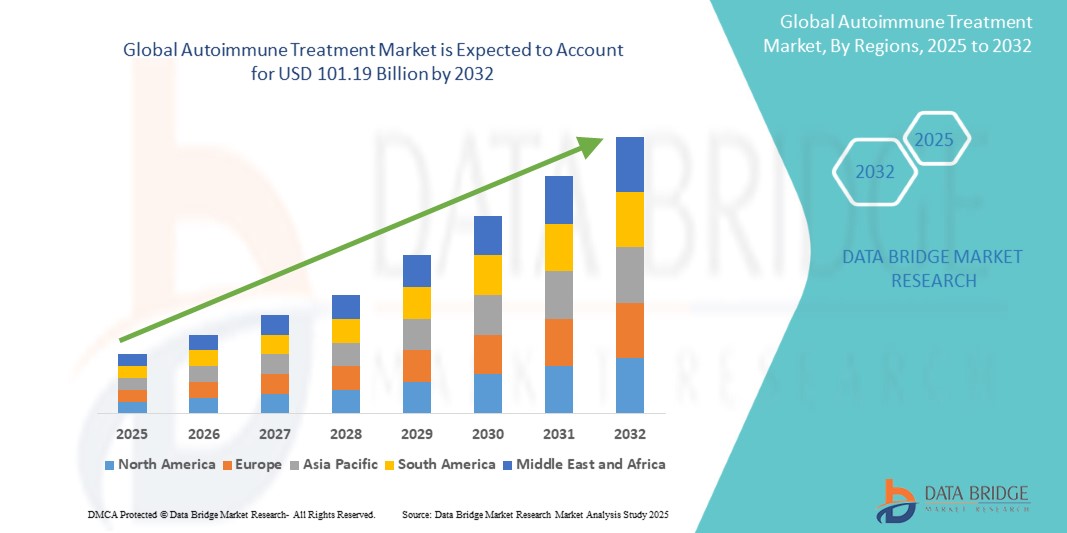
- The global autoimmune treatment market size was valued at USD 75.09 billion in 2024 and is expected to reach USD 101.19 billion by 2032, at a CAGR of 3.80% during the forecast period
- The growth is driven by factors such as increasing autoimmune disease prevalence, advancements in biologics and immunotherapies, rising awareness and early diagnosis of autoimmune disorders, and a growing focus on personalized medicine
Autoimmune Treatment Market Analysis
- Autoimmune treatments are essential therapies used to manage a wide range of autoimmune diseases, including rheumatoid arthritis, lupus, multiple sclerosis, and inflammatory bowel disease. These treatments help regulate the immune system to prevent it from attacking the body’s own tissues and organs
- The demand for autoimmune treatments is largely driven by the increasing prevalence of autoimmune diseases, growing awareness about early diagnosis and treatment, and advancements in biologics, immunotherapies, and personalized medicine
- North America is expected to dominate the autoimmune treatment market with a market share of 43.3% due to high healthcare spending, advanced healthcare infrastructure, and widespread access to innovative therapies
- Asia-Pacific is expected to be the fastest growing region in the autoimmune treatment market during the forecast period due to increase in autoimmune disease awareness, improved healthcare access, and growing healthcare infrastructure, driving market growth in emerging economies such as China and India
- Localized autoimmune diseases segment is expected to dominate the market with a market share of 64.8% due to long procedure volumes compared to systemic diseases and high patient awareness regarding conditions such as multiple sclerosis and type 1 diabetes drive segment growth. Unlike systemic autoimmune diseases that affect the whole body, localized diseases target specific organs or tissues
Report Scope and Autoimmune Treatment Market Segmentation
|
Attributes |
Autoimmune Treatment Key Market Insights |
|
Segments Covered |
|
|
Countries Covered |
North America
Europe
Asia-Pacific
Middle East and Africa
South America
|
|
Key Market Players |
|
|
Market Opportunities |
|
|
Value Added Data Infosets |
In addition to the insights on market scenarios such as market value, growth rate, segmentation, geographical coverage, and major players, the market reports curated by the Data Bridge Market Research also include in-depth expert analysis, patient epidemiology, pipeline analysis, pricing analysis, and regulatory framework. |
Autoimmune Treatment Market Trends
"Shift Towards Personalized and Biologic Therapies in Autoimmune Disease Treatment"
- One prominent trend in the global autoimmune treatment market is the increasing adoption of biologic therapies and personalized medicine
- These innovations are driving advancements in treatment efficacy, offering targeted therapies that address the specific mechanisms of autoimmune diseases, which leads to better clinical outcomes
- For instance, monoclonal antibodies and cytokine inhibitors have shown significant promise in treating conditions like rheumatoid arthritis, psoriasis, and Crohn's disease, offering patients more effective and tailored treatment options
- The rising prevalence of autoimmune disorders, combined with increasing patient awareness and advancements in biotechnology, is propelling the demand for novel therapies. These factors are transforming the autoimmune treatment landscape, improving patient quality of life, and driving the market toward a more precise and personalized approach to care
Autoimmune Treatment Market Dynamics
Driver
"Rising Prevalence of Autoimmune Diseases Driving Demand for Advanced Treatment Solutions"
- The increasing prevalence of autoimmune diseases is a major driver for the global autoimmune treatment market. Conditions such as rheumatoid arthritis, lupus, multiple sclerosis, and type 1 diabetes are on the rise, contributing to the growing demand for effective treatment solutions
- As the global population ages and lifestyle factors contribute to the rise in autoimmune disorders, there is an urgent need for innovative therapies to manage and treat these chronic conditions
- The growing awareness of autoimmune diseases, coupled with advancements in diagnostic techniques, has led to more individuals seeking treatment, further increasing the demand for targeted therapies
For instance,
- In 2020, the World Health Organization (WHO) reported a significant increase in the incidence of autoimmune diseases, especially in developed countries, where better awareness and diagnosis have contributed to higher case detection rates. This growing demand for treatment options is driving the market forward
- As a result, the rising prevalence of autoimmune diseases is fueling the development and adoption of advanced therapies, such as biologics and immunomodulators, which are significantly improving patient outcomes and enhancing the growth of the autoimmune treatment market
Opportunity
“Digital Health Integration for Autoimmune Treatment"
- The integration of digital health technologies, such as telemedicine, mobile health apps, and wearable devices, is creating new opportunities in the autoimmune treatment market. These technologies enable patients to manage their conditions more effectively, monitor symptoms in real-time, and communicate with healthcare providers remotely
- As autoimmune diseases often require long-term monitoring, digital health solutions can help improve patient adherence to treatment plans, provide personalized feedback, and support proactive disease management. This integration is particularly beneficial for patients with chronic conditions like rheumatoid arthritis or lupus, where continuous care and monitoring are crucial
- Furthermore, data collected from wearable devices and apps can help healthcare providers better understand disease progression and treatment effectiveness, facilitating the development of more personalized therapies
For instance,
- In 2024, a report by the European Medicines Agency (EMA) highlighted the growing role of digital health tools in autoimmune disease management, noting that real-time patient data collection significantly improves patient outcomes and can reduce healthcare costs
- With increasing acceptance of telemedicine and patient-centric care models, the adoption of digital health solutions is expected to drive further innovation in autoimmune treatments, enhancing patient outcomes and market growth
Restraint/Challenge
“High Cost of Biologic Therapies and Immunomodulators”
- The high cost of biologic therapies and immunomodulators poses a significant challenge for the global autoimmune treatment market, particularly impacting accessibility and affordability for patients, especially in low-income regions
- These advanced treatments, often ranging from thousands to tens of thousands of dollars per patient, can place a substantial financial burden on both patients and healthcare systems
- The high costs associated with these therapies may limit their availability, especially for patients without adequate insurance coverage or those in developing countries, leading to unequal access to essential treatment options
For instance,
- In 2023, according to a study published in the Journal of Autoimmunity, the cost of biologic treatments for rheumatoid arthritis and other autoimmune conditions is a significant concern, as many patients struggle to afford long-term therapy, resulting in treatment non-compliance and worse health outcomes
- As a result, the high cost of these treatments represents a major obstacle in the widespread adoption of advanced therapies, limiting market growth and hindering the overall accessibility of effective autoimmune disease management
Autoimmune Treatment Market Scope
The market is segmented on the basis of product type, disease type, and service type
|
Segmentation |
Sub-Segmentation |
|
By Product Type |
|
|
By Disease Type |
|
|
By Service Type |
|
In 2025, the localized autoimmune diseases is projected to dominate the market with a largest share in disease type segment
The localized autoimmune diseases segment is expected to dominate the autoimmune treatment market with the largest market share of more than 64.8% in 2025 due to long procedure volumes compared to systemic diseases and high patient awareness regarding conditions such as multiple sclerosis and type 1 diabetes drive segment growth. Unlike systemic autoimmune diseases that affect the whole body, localized diseases target specific organs or tissues
The consumables & assays is expected to account for the largest share during the forecast period in product type market
In 2025, the consumables & assays segment is expected to dominate the market with the largest market share of 41.8% due to their widespread use in managing autoimmune diseases like rheumatoid arthritis, lupus, and Crohn's disease. Drugs such as methotrexate and azathioprine are cost-effective, have a proven track record of long-term efficacy, and are accessible in both developed and developing regions
Autoimmune Treatment Market Regional Analysis
“North America Holds the Largest Share in the Autoimmune Treatment Market”
- North America dominates the global autoimmune treatment market, holding a significant market share of approximately 43.3%, driven by advanced healthcare infrastructure, high adoption of innovative therapies, and a strong presence of leading pharmaceutical companies
- The U.S. holds a significant share due to presence of many patients currently having autoimmune diseases in the country, growing awareness leading to increased diagnosis, and a vast network of clinical laboratories are expected to fuel demand for this market during forecast years. The country's advanced and technologically sophisticated infrastructure associated with diagnostics also plays a vital role in its growth
- Well-established healthcare reimbursement policies, coupled with significant investments in research & development, further strengthen the market in the region
- Additionally, the growing number of patients seeking advanced treatments and the increasing awareness around autoimmune diseases are fueling market expansion across North America
“Asia-Pacific is Projected to Register the Highest CAGR in the Autoimmune Treatment Market”
- The Asia-Pacific region is expected to witness the highest growth rate in the global autoimmune treatment market, driven by rapid advancements in healthcare infrastructure, increasing awareness about autoimmune diseases, and rising healthcare spending
- Countries like China, India, and Japan are emerging as key markets, with the growing incidence of autoimmune diseases, improving healthcare systems, and increased access to treatment options
- Japan, known for its advanced medical technology and high healthcare standards, remains a crucial market for autoimmune treatments, particularly biologic therapies
- China and India, with their large populations and increasing prevalence of autoimmune conditions, are seeing growing investments from both the government and private sectors in healthcare, driving the demand for innovative treatment options and better access to care
Autoimmune Treatment Market Share
The market competitive landscape provides details by competitor. Details included are company overview, company financials, revenue generated, market potential, investment in research and development, new market initiatives, global presence, production sites and facilities, production capacities, company strengths and weaknesses, product launch, product width and breadth, application dominance. The above data points provided are only related to the companies' focus related to market.
The Major Market Leaders Operating in the Market Are:
- AbbVie Inc. (U.S.)
- Johnson & Johnson (U.S.)
- Roche Holding AG (Switzerland)
- Novartis AG (Switzerland)
- Pfizer Inc. (U.S.)
- Bristol-Myers Squibb Company (U.S.)
- Merck & Co., Inc. (U.S.)
- Sanofi S.A. (France)
- Gilead Sciences, Inc. (U.S.)
- Amgen Inc. (U.S.)
- GlaxoSmithKline plc (U.K.)
- Eli Lilly and Company (U.S.)
- AstraZeneca PLC (U.K.)
- Abbott Laboratories (U.S.)
- Biogen Inc. (U.S.)
- UCB S.A. (Belgium)
- Celgene Corporation (U.S.)
- Teva Pharmaceutical Industries Ltd. (Israel)
- Mylan N.V. (U.S.)
- Bayer AG (Germany)
Latest Developments in Global Autoimmune Treatment Market
- In June 2022, Roivant Sciences and Pfizer announced the launch of Priovant Therapeutics, a new venture focused on the development and commercialization of innovative therapies aimed at autoimmune diseases with the highest levels of morbidity and mortality. This strategic collaboration underscores the growing commitment to addressing critical gaps in the autoimmune treatment landscape, enhancing the global autoimmune treatment market by introducing novel, targeted therapies that could significantly improve patient outcomes for some of the most challenging autoimmune conditions
- In February 2022, the UK Medicines and Healthcare products Regulatory Agency (MHRA) granted Revolo Biotherapeutics approval to initiate two Phase II clinical trials for its autoimmune disease treatment candidate, "1805." This approval marks a significant advancement in the development of innovative therapies for autoimmune diseases, reinforcing the ongoing progress within the global autoimmune treatment market
- In January 2021, Exagen Inc., a company dedicated to transforming the care continuum for patients with autoimmune diseases, announced that all AVISE test options, including SLE Prognostic, Lupus, CTD, SLE Monitor, APS, MTX, Vasculitis AAV, and HCQ, had been designated as in-network services with Tufts Health Plan, a renowned academic medical center globally. The collaboration is particularly relevant to the global autoimmune treatment market, as it fosters improved patient outcomes and contributes to the growing demand for diagnostic and therapeutic innovations in autoimmune disease management
- In August 2019, the U.S. FDA granted approval for PerkinElmer, Inc.'s EUROIMMUN Anti-Tissue Transglutaminase ELISA, a diagnostic tool designed to assist physicians in confirming or ruling out a diagnosis of celiac disease. The relevance to the global autoimmune treatment market lies in the growing demand for precise diagnostic technologies, which play a crucial role in enabling timely and effective treatment for autoimmune conditions, ultimately driving market growth and innovation
- In October 2021, Exagen Inc., a leading provider of autoimmune testing solutions, announced that its AVISE CTD and AVISE Lupus tests are now covered services under a contract with Inland Empire Health Plan (IEHP), benefiting over 1.4 million members. This development is significant for the global autoimmune treatment market, as it underscores the increasing adoption of specialized diagnostic tools, which play a pivotal role in early detection and personalized treatment, ultimately driving market growth and improving patient outcomes in autoimmune care
SKU-
Get online access to the report on the World's First Market Intelligence Cloud
- Interactive Data Analysis Dashboard
- Company Analysis Dashboard for high growth potential opportunities
- Research Analyst Access for customization & queries
- Competitor Analysis with Interactive dashboard
- Latest News, Updates & Trend analysis
- Harness the Power of Benchmark Analysis for Comprehensive Competitor Tracking
Research Methodology
Data collection and base year analysis are done using data collection modules with large sample sizes. The stage includes obtaining market information or related data through various sources and strategies. It includes examining and planning all the data acquired from the past in advance. It likewise envelops the examination of information inconsistencies seen across different information sources. The market data is analysed and estimated using market statistical and coherent models. Also, market share analysis and key trend analysis are the major success factors in the market report. To know more, please request an analyst call or drop down your inquiry.
The key research methodology used by DBMR research team is data triangulation which involves data mining, analysis of the impact of data variables on the market and primary (industry expert) validation. Data models include Vendor Positioning Grid, Market Time Line Analysis, Market Overview and Guide, Company Positioning Grid, Patent Analysis, Pricing Analysis, Company Market Share Analysis, Standards of Measurement, Global versus Regional and Vendor Share Analysis. To know more about the research methodology, drop in an inquiry to speak to our industry experts.
Customization Available
Data Bridge Market Research is a leader in advanced formative research. We take pride in servicing our existing and new customers with data and analysis that match and suits their goal. The report can be customized to include price trend analysis of target brands understanding the market for additional countries (ask for the list of countries), clinical trial results data, literature review, refurbished market and product base analysis. Market analysis of target competitors can be analyzed from technology-based analysis to market portfolio strategies. We can add as many competitors that you require data about in the format and data style you are looking for. Our team of analysts can also provide you data in crude raw excel files pivot tables (Fact book) or can assist you in creating presentations from the data sets available in the report.