Global Autoimmune Disease Treatment Market
Market Size in USD Billion
CAGR :
% 
 USD
7.03 Billion
USD
12.64 Billion
2024
2032
USD
7.03 Billion
USD
12.64 Billion
2024
2032
 Forecast Period Forecast Period |
2025 –2032 |
 Market Size (Base Year) Market Size (Base Year) |
USD 7.03 Billion |
 Market Size (Forecast Year) Market Size (Forecast Year) |
USD 12.64 Billion |
 CAGR CAGR |
% |
| Major Markets Players |
|
Autoimmune Disease Treatment Market Size
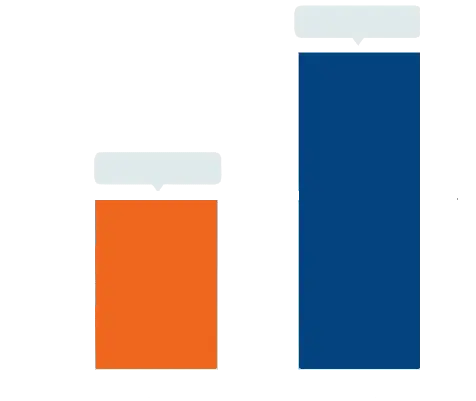
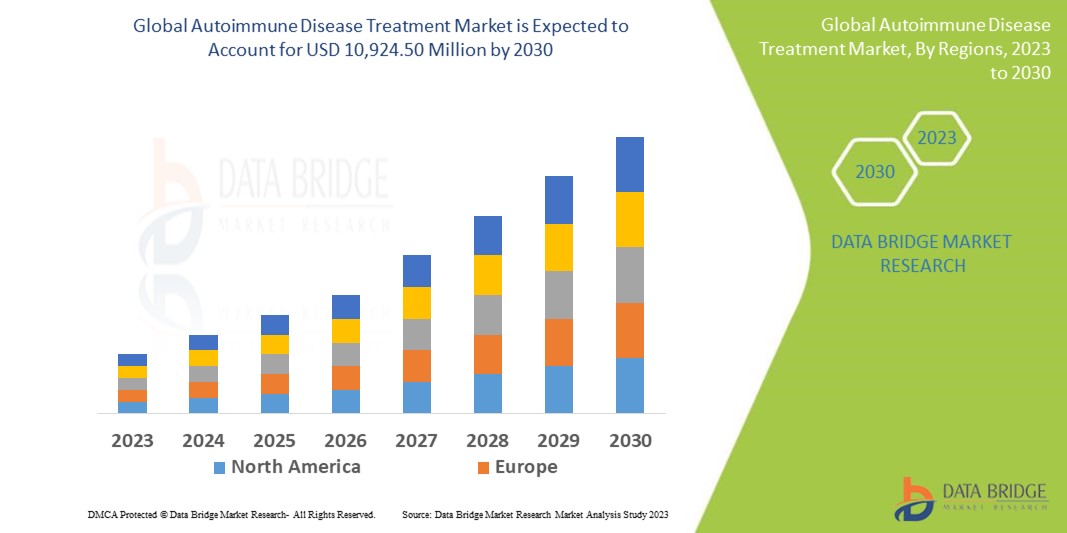
- The global autoimmune disease treatment market was valued at USD 7.03 billion in 2024 and is expected to reach USD 12.64 billion by 2032
- During the forecast period of 2025 to 2032 the market is likely to grow at a CAGR of 7.60%, primarily driven by the rising prevalence of autoimmune disorders, advancements in biologic therapies, and increasing awareness of early diagnosis and treatment
- Factors driving this growth include the increasing prevalence of autoimmune diseases, advancements in biologic therapies, and rising awareness of early diagnosis and treatment
Autoimmune Disease Treatment Market Analysis
- Autoimmune Disease Treatment involves managing disorders where the immune system attacks healthy tissues. It focuses on reducing inflammation and suppressing immune responses through therapies such as immunosuppressive drugs and biologics. These treatments aim to alleviate symptoms, prevent complications, and improve patients' quality of life
- North America dominates the market due to its well-established healthcare infrastructure, high healthcare spending, and the presence of major pharmaceutical companies. Meanwhile, the Asia-Pacific region is expected to witness the fastest growth, fueled by increasing healthcare investments and awareness
- Innovations in diagnostic tools and treatment options, including biologics and biosimilars, are transforming the market landscape. These advancements are improving patient outcomes and expanding the range of available therapies
- For instance, Biologic treatments for diseases such as rheumatoid arthritis have revolutionized care, with ongoing innovations enhancing efficacy and accessibility
- The market's expansion is underpinned by advancements in technology and growing demand for effective therapies, ensuring improved outcomes for patients globally
Report Scope and Autoimmune Disease Treatment Market Segmentation
|
Attributes |
Autoimmune Disease Treatment Key Market Insights |
|
Segments Covered |
|
|
Countries Covered |
North America
Europe
Asia-Pacific
Middle East and Africa
South America
|
|
Key Market Players |
|
|
Market Opportunities |
|
|
Value Added Data Infosets |
In addition to the insights on market scenarios such as market value, growth rate, segmentation, geographical coverage, and major players, the market reports curated by the Data Bridge Market Research also include depth expert analysis, patient epidemiology, pipeline analysis, pricing analysis, and regulatory framework. |
Autoimmune Disease Treatment Market Trends
“Rising Prevalence of Autoimmune Diseases”
- Rising prevalence of autoimmune diseases, such as rheumatoid arthritis, multiple sclerosis, and inflammatory bowel disease, is significantly increasing the demand for innovative and effective treatments
- Contributing factors include genetic predisposition, environmental triggers, and lifestyle changes, which are driving the growing incidence globally
- For instance, Biologic therapies, such as monoclonal antibodies, have transformed the treatment landscape, offering targeted solutions for managing autoimmune disorders
- The increasing prevalence of autoimmune diseases highlights the urgent need for advancements in research and development to enhance patient outcomes and address unmet medical needs
Autoimmune Disease Treatment Market Dynamics
Driver
“Growing Advancements in Medical Research and Technology”
- The development of biologics, such as monoclonal antibodies and fusion proteins, has significantly improved the precision and effectiveness of autoimmune disease treatments
- Advances in genomics and biomarker research are enabling tailored therapies, reducing side effects and enhancing treatment outcomes
- Artificial intelligence is accelerating the identification of novel drug targets and the development of innovative therapies for complex autoimmune conditions
- Innovations such as sustained-release formulations and advanced injectable devices are improving patient convenience and adherence to treatment regimens
For instance,
- In March 20, 2025, Sanofi announced its agreement to acquire DR-0201, a targeted bispecific antibody developed by Dren Bio. This innovative therapy aims to achieve deep B-cell depletion, potentially resetting the immune system for sustained remission in autoimmune diseases such as lupus
- In March 20, 2025, Climb Bio highlighted progress with its lead asset, Budoprutug, and an anti-APRIL antibody, CLYM116. These therapies target B-cell-mediated conditions and IgA nephropathy, showcasing the company's focus on improving autoimmune disease treatments
- These advancements highlight the ongoing innovation and investment in the autoimmune disease treatment market, paving the way for more effective and targeted therapies to address unmet medical needs
Opportunity
“Increasing Healthcare Expenditure”
- Rising healthcare expenditure enables the adoption of innovative treatments, such as biologics and biosimilars, which are more effective in managing autoimmune diseases compared to traditional therapies
- Increased funding allows healthcare systems to invest in advanced diagnostic tools, facilitating early detection and personalized treatment plans for autoimmune disorders
- Higher healthcare budgets support extensive R&D activities, leading to the development of novel therapies and targeted treatments for autoimmune diseases
- With increased expenditure, governments and organizations can implement patient assistance programs, improving affordability and accessibility of autoimmune disease treatments
For instance,
- In June 2024, the US government allocated significant funds to support research on biologic therapies for autoimmune diseases, enhancing treatment options for patients
- In March 2025, India announced a healthcare initiative focused on expanding diagnostic facilities for autoimmune disorders, aiming to improve early detection rates
- Rising healthcare expenditure presents a transformative opportunity in the autoimmune disease treatment market, driving advancements in diagnostics, therapies, and patient care while fostering innovation and accessibility
Restraint/Challenge
“Limited awareness about Treatment in Autoimmune Disease Care”
- Limited awareness about autoimmune diseases often leads to delayed diagnosis, as patients may not recognize early symptoms or seek timely medical attention. This delay can result in disease progression and complications
- A lack of understanding about available treatment options, such as biologics and immunosuppressive drugs, prevents patients and healthcare providers from fully utilizing advanced therapies, hindering market growth
- Insufficient public health initiatives and educational programs contribute to the lack of awareness, especially in developing regions, where autoimmune diseases are often underdiagnosed or misdiagnosed
- Cultural stigma and misconceptions surrounding autoimmune diseases discourage individuals from seeking medical help, further restraining the market's potential
For instance,
- In January 2024, a study in Southeast Asia revealed that over 60% of patients with autoimmune diseases were unaware of their condition until it reached an advanced stage, highlighting the need for awareness campaigns
- In March 2025, a report from Africa emphasized the lack of educational resources for autoimmune diseases, leading to underdiagnosis and limited access to treatment
- Addressing the lack of disease awareness is crucial for unlocking the full potential of the autoimmune disease treatment market. Increased public health campaigns, educational initiatives, and community outreach programs can help bridge this gap and improve patient outcomes
Autoimmune Disease Treatment Market Scope
The market is segmented on the basis product type, application, distribution channel, disease, mechanism of action, diagnostic, treatment, and product.
|
Segmentation |
Sub-Segmentation |
|
By Product Type |
|
|
By Application |
|
|
By Distribution Channel |
|
|
By Disease
|
|
|
By Mechanism of Action |
|
|
By Diagnostic
|
|
|
By Treatment |
|
|
By Product |
|
Autoimmune Disease Treatment Market Regional Analysis
“North America is the Dominant Region in the Autoimmune Disease Treatment Market”
- North America dominates the autoimmune disease treatment market, driven by advanced healthcare infrastructure, significant R&D investments, and the presence of major pharmaceutical companies
- The U.S., within North America, leads due to a high prevalence of autoimmune diseases and widespread adoption of biologic therapies
- The integration of artificial intelligence in drug discovery and the development of precision medicine is significantly influencing regional growth in the autoimmune disease treatment market
- The increasing availability and adoption of biosimilars are helping regions with constrained healthcare budgets improve access to effective therapies
“Asia-Pacific is Projected to Register the Highest Growth Rate”
- Asia-Pacific is the fastest-growing region in the autoimmune disease treatment market, driven by increasing healthcare investments and infrastructure development
- Efforts to raise awareness about autoimmune diseases in countries such as India and China are boosting early diagnosis and treatment rates
- Proactive government initiatives, including funding for healthcare infrastructure and awareness programs, are boosting the region's growth in the autoimmune disease treatment market
- The affordability of treatment options and the availability of high-quality healthcare services are attracting medical tourists, further fueling market expansion in the region
Autoimmune Disease Treatment Market Share
The market competitive landscape provides details by competitor. Details included are company overview, company financials, revenue generated, market potential, investment in research and development, new market initiatives, global presence, production sites and facilities, production capacities, company strengths and weaknesses, product launch, product width and breadth, application dominance. The above data points provided are only related to the companies' focus related to market.
The Major Market Leaders Operating in the Market Are:
- Autoimmune Inc (U.S.)
- LUPIN (India)
- Thermo Fisher Scientific Inc (U.S.)
- Beckman Coulter, Inc (U.S.)
- Chugai Pharmaceutical Co., Ltd.(Japan)
- GSK plc (U.K.)
- Biogen (U.S.)
- Bayer AG (Germany)
- Genentech, Inc (U.S.)
- Merck Sharp & Dohme Corp (U.S.)
- Bristol-Myers Squibb Company (U.S.)
- AstraZeneca (U.K.)
- F. Hoffmann-La Roche Ltd (Switzerland)
- Pfizer Inc.(U.S.)
- Eli Lilly and Company(U.S.)
- Johnson & Johnson Services, Inc.(U.S.)
- Amgen Inc (U.S.)
- Abbott (U.S.)
Latest Developments in Global Autoimmune Disease Treatment Market
- In June 2023, AstraZeneca partnered exclusively with Quell Therapeutics to advance engineered T-regulatory (Treg) cell therapies. The collaboration focuses on developing ground breaking treatments for Type 1 Diabetes (T1D) and Inflammatory Bowel Disease (IBD). By leveraging Quell's Treg cell engineering expertise and AstraZeneca's drug development capabilities, this alliance could pioneer curative solutions for autoimmune disorders. It marks a shift from symptom management to potential long-term remission or cures. This advancement is poised to reshape the autoimmune disease treatment market, reduce healthcare costs, and inspire further investment in cell-based therapies, reflecting a transformative era in tackling chronic autoimmune conditions
- In January 2023, Penn Medicine researchers explored chimeric antigen receptor (CAR) T cell therapy, a breakthrough typically used in cancer treatment, for myasthenia gravis (MG), a rare autoimmune disorder. This pioneering approach offers promise for personalized and potentially transformative solutions to MG, marking a significant milestone in autoimmune disease therapy. The application of CAR T cell therapy in MG highlights the potential of advanced, targeted treatments for autoimmune conditions. This innovation could shift the market focus toward curative approaches, reduce chronic treatment costs, and drive investment in personalized therapies, signaling a new era in managing autoimmune diseases
- In May 2022, Nuvig Therapeutics, Inc. was founded with a mission to develop immune-modulating therapies aimed at managing autoimmune diseases while maintaining normal immune function. The company successfully raised USD 47 million in Series A funding, showcasing strong investor confidence in its pioneering approach to autoimmune disease treatment. Nuvig's innovative focus on immune modulation could redefine the market by offering safer, more effective therapies that address the root causes of autoimmune disorders. This approach may reduce reliance on broad immunosuppressants, driving advancements in precision medicine and attracting further investment, ultimately transforming the treatment landscape for autoimmune diseases
- In June 2022, Roivant Sciences and Pfizer joined forces to establish Priovant Therapeutics, a company dedicated to developing and commercializing innovative therapies for autoimmune diseases with significant morbidity and mortality. This partnership highlights the shared commitment of both organizations to addressing critical unmet medical needs in the autoimmune disease treatment space. Priovant Therapeutics' focus on high-impact autoimmune conditions could drive advancements in targeted therapies, offering more effective solutions for patients. This collaboration reflects a growing trend toward innovation in autoimmune treatments, potentially reshaping the market by addressing severe conditions and attracting further investment in cutting-edge therapeutic approaches
- In February 2022, Revolo Biotherapeutics secured approval from the U.K. Medicines and Healthcare Products Regulatory Agency (MHRA) to initiate two Phase II trials for its autoimmune disease drug candidate "1805." This authorization marks a crucial milestone, advancing the clinical evaluation of a promising treatment for autoimmune disorders. The regulatory approval for "1805" reflects progress in innovative drug development for autoimmune diseases, emphasizing targeted and effective solutions. Phase II trials signal growing confidence in Revolo's approach, attracting attention from investors and researchers. Success could redefine treatment options, inspire further advancements, and strengthen the market's focus on new therapies
SKU-
Get online access to the report on the World's First Market Intelligence Cloud
- Interactive Data Analysis Dashboard
- Company Analysis Dashboard for high growth potential opportunities
- Research Analyst Access for customization & queries
- Competitor Analysis with Interactive dashboard
- Latest News, Updates & Trend analysis
- Harness the Power of Benchmark Analysis for Comprehensive Competitor Tracking
Research Methodology
Data collection and base year analysis are done using data collection modules with large sample sizes. The stage includes obtaining market information or related data through various sources and strategies. It includes examining and planning all the data acquired from the past in advance. It likewise envelops the examination of information inconsistencies seen across different information sources. The market data is analysed and estimated using market statistical and coherent models. Also, market share analysis and key trend analysis are the major success factors in the market report. To know more, please request an analyst call or drop down your inquiry.
The key research methodology used by DBMR research team is data triangulation which involves data mining, analysis of the impact of data variables on the market and primary (industry expert) validation. Data models include Vendor Positioning Grid, Market Time Line Analysis, Market Overview and Guide, Company Positioning Grid, Patent Analysis, Pricing Analysis, Company Market Share Analysis, Standards of Measurement, Global versus Regional and Vendor Share Analysis. To know more about the research methodology, drop in an inquiry to speak to our industry experts.
Customization Available
Data Bridge Market Research is a leader in advanced formative research. We take pride in servicing our existing and new customers with data and analysis that match and suits their goal. The report can be customized to include price trend analysis of target brands understanding the market for additional countries (ask for the list of countries), clinical trial results data, literature review, refurbished market and product base analysis. Market analysis of target competitors can be analyzed from technology-based analysis to market portfolio strategies. We can add as many competitors that you require data about in the format and data style you are looking for. Our team of analysts can also provide you data in crude raw excel files pivot tables (Fact book) or can assist you in creating presentations from the data sets available in the report.