Global Arthroscopic Shavers Market
Market Size in USD Billion
CAGR :
% 
 USD
2.21 Billion
USD
3.42 Billion
2025
2033
USD
2.21 Billion
USD
3.42 Billion
2025
2033
 Forecast Period Forecast Period |
2026 –2033 |
 Market Size (Base Year) Market Size (Base Year) |
USD 2.21 Billion |
 Market Size (Forecast Year) Market Size (Forecast Year) |
USD 3.42 Billion |
 CAGR CAGR |
% |
| Major Markets Players |
|
Arthroscopic Shavers Market Size
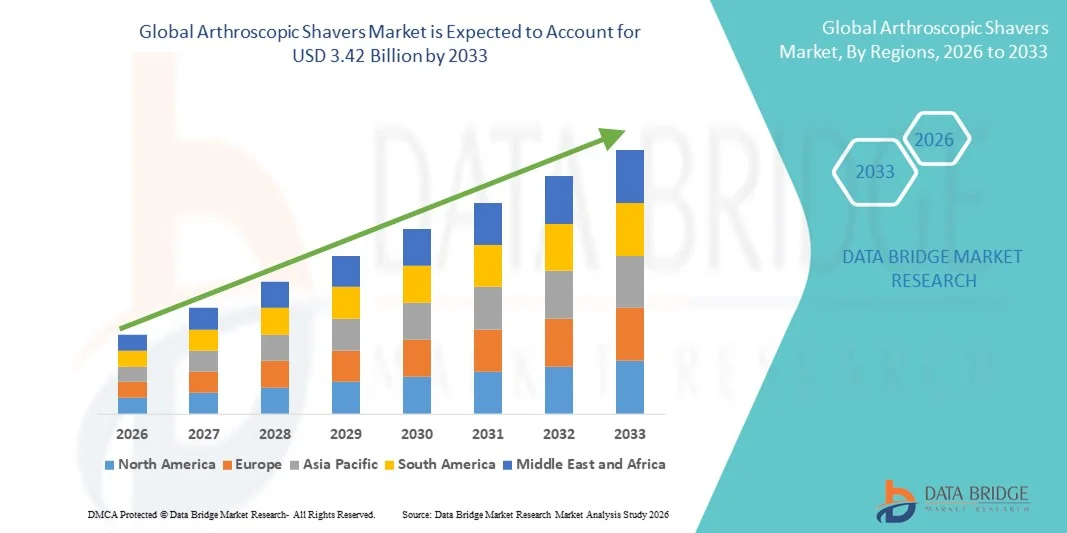
- The global arthroscopic shavers market size was valued at USD 2.21 billion in 2025 and is expected to reach USD 3.42 billion by 2033, at a CAGR of 5.63% during the forecast period
- The market growth is primarily driven by the rising prevalence of orthopedic disorders, increasing adoption of minimally invasive surgical procedures, and technological advancements in shaver design, including enhanced precision and ergonomic features
- In addition, growing awareness among surgeons and patients regarding faster recovery, reduced complications, and improved surgical outcomes is boosting the demand for arthroscopic shavers across hospitals, ambulatory surgical centers, and orthopedic clinics, thereby accelerating the overall market expansion
Arthroscopic Shavers Market Analysis
- Arthroscopic shavers, specialized surgical instruments used for minimally invasive joint procedures, are increasingly essential in orthopedic surgeries for precise tissue removal, improved procedural efficiency, and reduced recovery time in both hospitals and ambulatory surgical centers
- The rising demand for arthroscopic shavers is primarily driven by the growing prevalence of musculoskeletal disorders, increasing adoption of minimally invasive surgeries, and advancements in shaver technology, including ergonomic designs and enhanced cutting precision
- North America dominated the arthroscopic shavers market with the largest revenue share of 38.5% in 2025, supported by a strong healthcare infrastructure, high awareness of minimally invasive procedures, and the presence of leading orthopedic device manufacturers, with the U.S. showing significant growth in arthroscopic procedures due to innovation in surgical tools and increasing hospital investments in advanced surgical equipment
- Asia-Pacific is expected to be the fastest growing region in the arthroscopic shavers market during the forecast period owing to rising orthopedic surgery adoption, growing healthcare expenditure, and improving access to advanced medical devices in emerging economies such as China and India
- Knee arthroscopy segment dominated the arthroscopic shavers market with a market share of 42.3% in 2025, driven by the high prevalence of knee joint disorders, frequent use of minimally invasive procedures for diagnosis and treatment, and increasing orthopedic surgeon preference for efficient tissue removal tools during knee surgeries
Report Scope and Arthroscopic Shavers Market Segmentation
|
Attributes |
Arthroscopic Shavers Key Market Insights |
|
Segments Covered |
|
|
Countries Covered |
North America
Europe
Asia-Pacific
Middle East and Africa
South America
|
|
Key Market Players |
|
|
Market Opportunities |
|
|
Value Added Data Infosets |
In addition to the insights on market scenarios such as market value, growth rate, segmentation, geographical coverage, and major players, the market reports curated by the Data Bridge Market Research also include in-depth expert analysis, patient epidemiology, pipeline analysis, pricing analysis, and regulatory framework |
Arthroscopic Shavers Market Trends
Increasing Adoption of Minimally Invasive Orthopedic Surgeries
- A significant and accelerating trend in the global arthroscopic shavers market is the growing preference for minimally invasive joint procedures, which reduce recovery time, minimize complications, and improve surgical outcomes
- For instance, the use of advanced shavers in knee arthroscopy allows precise removal of damaged tissue while preserving healthy cartilage, enhancing patient recovery and procedural efficiency
- Innovations such as ergonomic designs, variable-speed motors, and improved cutting blades are enabling surgeons to perform complex procedures with higher precision and less fatigue
- Integration of arthroscopic shavers with imaging systems and surgical navigation platforms facilitates better visualization and accuracy during procedures, improving overall success rates
- This trend towards safer, faster, and more precise orthopedic interventions is reshaping surgical practices and driving hospitals to invest in advanced arthroscopic equipment
- The demand for arthroscopic shavers is increasing across hospitals, ambulatory surgical centers, and orthopedic clinics, driven by the shift toward outpatient and minimally invasive surgical models
- Growing collaboration between medical device manufacturers and healthcare institutions is fostering the development of tailored shaver solutions for specific joint procedures
- Increasing adoption of digital training and simulation programs for orthopedic surgeons is promoting the use of advanced arthroscopic shavers in complex surgeries
Arthroscopic Shavers Market Dynamics
Driver
Rising Prevalence of Musculoskeletal Disorders and Orthopedic Surgeries
- The increasing incidence of joint injuries, arthritis, and sports-related musculoskeletal disorders is a major driver for the growing demand for arthroscopic shavers
- For instance, the rise in knee osteoarthritis cases has led to higher adoption of arthroscopic procedures to remove damaged tissue and improve joint function
- Advancements in shaver technology, such as powered and precision cutting devices, allow surgeons to perform faster and more efficient procedures, encouraging wider usage
- Growing awareness among orthopedic surgeons and patients about minimally invasive techniques is prompting hospitals to adopt advanced arthroscopic shavers to improve surgical outcomes
- The expanding geriatric population and active lifestyle trends globally are fueling the demand for joint-preserving procedures and related surgical tools
- Increasing government initiatives and reimbursement policies supporting minimally invasive orthopedic procedures are boosting the adoption of arthroscopic shavers
- Rising investment in hospital infrastructure and operating room modernization in emerging markets is expanding the potential customer base for arthroscopic shavers
Restraint/Challenge
High Cost and Sterilization/Regulatory Compliance Concerns
- The relatively high cost of advanced arthroscopic shavers compared to standard surgical instruments limits adoption in price-sensitive regions and smaller healthcare facilities
- For instance, single-use shavers or powered devices often carry a premium price, making budget-conscious hospitals hesitant to invest in large-scale procurement
- Strict sterilization protocols and compliance with medical device regulations increase operational complexity and slow market penetration
- Regulatory variations across countries for medical devices require manufacturers to undergo multiple approvals, which can delay product launches in key regions
- Ensuring safety, reliability, and consistent performance while balancing cost and compliance remains a significant challenge for market growth
- Limited awareness and training among surgeons in emerging markets can hinder the adoption of advanced arthroscopic shavers
- Competition from alternative surgical tools and traditional methods may reduce the market share for premium arthroscopic shavers in cost-sensitive segments.
Arthroscopic Shavers Market Scope
The market is segmented on the basis of product type, application, and end user.
- By Product Type
On the basis of product type, the arthroscopic shavers market is segmented into plastic, NS, polycarbonate, stainless, and others. The stainless segment dominated the market with the largest revenue share of 40.5% in 2025, driven by its superior durability, corrosion resistance, and ability to maintain sharpness during multiple surgical procedures. Surgeons prefer stainless steel shavers for their reliability and long-lasting performance in demanding orthopedic surgeries. The material’s compatibility with standard sterilization procedures and resistance to wear enhances operational efficiency in high-volume hospital settings. In addition, stainless shavers support precise tissue removal in complex joint procedures, making them the preferred choice across knee, shoulder, and hip arthroscopies. Its wide availability and established reputation in surgical instrumentation further strengthen its dominance. The segment also benefits from ongoing innovations in blade design and ergonomics, increasing surgeon confidence and adoption.
The polycarbonate segment is anticipated to witness the fastest growth from 2026 to 2033, fueled by the rising demand for lightweight, single-use, and cost-effective shavers. Polycarbonate devices are increasingly adopted in outpatient and ambulatory surgery centers due to their disposable nature, reducing sterilization concerns and cross-contamination risks. Their versatility allows integration with powered shaver systems while maintaining precision. Hospitals and clinics are increasingly procuring polycarbonate shavers to optimize operating room turnover and reduce infection risks. The material also supports enhanced visibility during arthroscopy due to its translucent design in some models, improving surgeon accuracy. Rising awareness about infection control and the preference for one-time-use instruments are key factors driving this segment’s rapid growth.
- By Application
On the basis of application, the arthroscopic shavers market is segmented into knee arthroscopy, hips arthroscopy, spine arthroscopy, foot and ankle arthroscopy, shoulder and elbow arthroscopy, and other arthroscopy applications. The knee arthroscopy segment dominated the market with a revenue share of 42.3% in 2025, driven by the high prevalence of knee joint disorders such as osteoarthritis, meniscal injuries, and sports-related trauma. Knee arthroscopy procedures are frequently performed in hospitals and clinics due to their minimally invasive nature and quick recovery benefits. Arthroscopic shavers provide precise debridement, making them indispensable in knee procedures. The segment benefits from growing orthopedic awareness, increased insurance coverage, and the availability of advanced surgical tools. Rising demand for outpatient and day-care procedures for knee joint repair further boosts this segment. In addition, advancements in shaver designs tailored for knee anatomy enhance procedural efficiency and outcomes.
The shoulder and elbow arthroscopy segment is expected to witness the fastest growth during the forecast period, driven by rising sports injuries and aging populations experiencing joint degeneration. Shoulder and elbow procedures often require smaller, precision shavers, creating opportunities for specialized instruments. Growing awareness of minimally invasive shoulder and elbow surgeries and increasing adoption in orthopedic clinics are contributing to rapid market expansion. The segment also benefits from innovations in flexible and powered shavers that allow better maneuverability in complex joint spaces. Rising demand among athletes and active adults for early intervention and joint preservation is further propelling growth. Improved surgical outcomes and reduced recovery times in shoulder and elbow surgeries make this application increasingly preferred by healthcare providers.
- By End User
On the basis of end user, the arthroscopic shavers market is segmented into hospitals, ambulatory surgery centers (ASCs), and clinics. The hospitals segment dominated the market with the largest revenue share of 55.1% in 2025, due to their high procedure volumes, availability of skilled surgeons, and infrastructure for complex orthopedic surgeries. Hospitals have access to advanced powered shaver systems and often perform multi-joint procedures, driving demand for durable and high-performance shavers. Large hospitals also benefit from bulk procurement and long-term supplier relationships, ensuring continuous availability of surgical instruments. The segment is supported by growing investments in orthopedic departments and expanding healthcare infrastructure. Hospitals increasingly prefer versatile shaver systems compatible with multiple procedures, making them a key revenue driver. Rising patient preference for hospital-based arthroscopic surgeries also strengthens this segment’s dominance.
The ambulatory surgery centers segment is expected to witness the fastest growth from 2026 to 2033, fueled by the rising trend of outpatient orthopedic procedures and minimally invasive surgeries. ASCs are cost-effective, offer shorter recovery times, and cater to patients seeking convenience and quick turnaround. The demand for disposable or lightweight shavers in ASCs reduces sterilization concerns and enhances operational efficiency. Increasing collaboration between ASC chains and device manufacturers is promoting adoption of specialized shavers tailored for outpatient procedures. The segment benefits from growing awareness of arthroscopy and expansion of small-scale orthopedic facilities in emerging markets. Rising preference for day-care procedures and minimally invasive interventions positions ASCs as a rapidly expanding end-user segment in the market.
Arthroscopic Shavers Market Regional Analysis
- North America dominated the arthroscopic shavers market with the largest revenue share of 38.5% in 2025, supported by a strong healthcare infrastructure, high awareness of minimally invasive procedures, and the presence of leading orthopedic device manufacturers
- Hospitals and orthopedic centers in the region prioritize precision surgical instruments, including arthroscopic shavers, due to their ability to improve procedural efficiency, reduce recovery times, and enhance patient outcomes
- The market growth is further supported by the presence of leading orthopedic device manufacturers, ongoing technological innovations in shaver design, and substantial investments in surgeon training programs
U.S. Arthroscopic Shavers Market Insight
The U.S. arthroscopic shavers market captured the largest revenue share of 79% in 2025 within North America, driven by the widespread adoption of minimally invasive orthopedic procedures and high awareness of joint preservation techniques. Hospitals and ambulatory surgical centers are increasingly investing in advanced shavers for knee, shoulder, and hip arthroscopies due to their precision, durability, and efficiency. The growing prevalence of sports injuries, osteoarthritis, and an active aging population is further fueling market demand. In addition, innovations in powered and ergonomic shavers, combined with integration into surgical navigation systems, are enhancing procedural outcomes. Rising reimbursement coverage for minimally invasive surgeries supports higher adoption rates. Moreover, the U.S. market benefits from strong R&D activities and the presence of leading orthopedic device manufacturers introducing surgeon-focused innovations.
Europe Arthroscopic Shavers Market Insight
The Europe arthroscopic shavers market is projected to expand at a substantial CAGR throughout the forecast period, primarily driven by increasing orthopedic surgeries, rising sports-related injuries, and a preference for minimally invasive procedures. Strong healthcare infrastructure and high-quality hospital networks facilitate the adoption of advanced surgical instruments, including shavers. Surgeons across countries such as Germany, France, and Italy increasingly rely on arthroscopic shavers for precision tissue removal in knee, shoulder, and hip procedures. In addition, government support for orthopedic care and growing patient awareness about faster recovery times are encouraging hospitals to procure high-performance shavers. The market also sees growth in private clinics offering specialized orthopedic services. Technological advancements in shaver design, including lightweight and disposable options, further contribute to adoption across Europe.
U.K. Arthroscopic Shavers Market Insight
The U.K. arthroscopic shavers market is anticipated to grow at a noteworthy CAGR during the forecast period, driven by rising sports injuries, aging population, and increasing demand for outpatient orthopedic procedures. Hospitals and clinics prioritize minimally invasive techniques, boosting the adoption of precision shavers for knee, shoulder, and elbow arthroscopies. Growing awareness among surgeons about improved patient outcomes, shorter hospital stays, and reduced post-surgical complications is further fueling the market. Moreover, advancements in powered and disposable shaver designs enhance procedural efficiency and safety. The U.K.’s robust healthcare infrastructure, combined with favorable insurance coverage and government initiatives supporting orthopedic care, supports steady market growth. Increasing investments in orthopedic surgery training programs also contribute to the segment expansion.
Germany Arthroscopic Shavers Market Insight
The Germany arthroscopic shavers market is expected to expand at a considerable CAGR during the forecast period, fueled by advanced healthcare infrastructure, high surgical precision standards, and technological innovations in orthopedic instruments. Hospitals and specialized orthopedic centers are increasingly adopting powered and disposable shavers for knee, shoulder, and spine arthroscopies due to improved accuracy and reduced recovery times. Rising awareness of minimally invasive procedures and growing prevalence of musculoskeletal disorders further drive market demand. In addition, Germany’s focus on innovation, quality, and sustainability promotes the procurement of long-lasting and reliable shavers. Surgeons benefit from integration with navigation systems, enhancing procedural efficiency. The presence of leading device manufacturers and strong R&D activities reinforces Germany’s market growth.
Asia-Pacific Arthroscopic Shavers Market Insight
The Asia-Pacific arthroscopic shavers market is poised to grow at the fastest CAGR of 23% during the forecast period of 2026 to 2033, driven by increasing prevalence of joint disorders, growing healthcare infrastructure, and rising adoption of minimally invasive surgeries in countries such as China, Japan, and India. Expansion of orthopedic hospitals and ambulatory surgical centers, combined with government initiatives promoting advanced healthcare solutions, is accelerating adoption. Technological innovations, including lightweight, disposable, and ergonomically designed shavers, support faster surgical procedures and lower infection risks. Rising awareness among patients and surgeons regarding improved recovery times further fuels demand. In addition, increasing medical tourism in the region contributes to market growth. The availability of cost-effective and locally manufactured shavers is expanding access across emerging economies.
Japan Arthroscopic Shavers Market Insight
The Japan arthroscopic shavers market is gaining momentum due to the country’s aging population, high prevalence of sports and age-related joint disorders, and strong healthcare infrastructure. Hospitals and clinics increasingly adopt advanced shavers for knee, shoulder, and hip arthroscopies to improve procedural precision and minimize patient recovery time. The market benefits from technologically advanced instruments, including powered and ergonomic shavers that enhance surgical outcomes. Integration with imaging and navigation systems is facilitating more accurate procedures. In addition, the focus on minimally invasive surgeries and outpatient care supports steady growth. Rising patient awareness about joint preservation and healthcare providers’ preference for high-quality devices further drive market adoption.
India Arthroscopic Shavers Market Insight
The India arthroscopic shavers market accounted for the largest market revenue share in Asia-Pacific in 2025, attributed to rising sports injuries, increasing geriatric population, and growing preference for minimally invasive orthopedic procedures. Hospitals and ambulatory surgical centers are increasingly investing in advanced arthroscopic shavers for knee, shoulder, and elbow surgeries due to their precision, efficiency, and safety. The expansion of healthcare infrastructure and government initiatives promoting modern orthopedic care are key drivers. Rising awareness among patients about faster recovery and reduced post-operative complications supports market growth. In addition, the availability of cost-effective and locally manufactured shavers enhances accessibility. Increasing medical tourism and the growth of specialized orthopedic clinics further propel the market in India.
Arthroscopic Shavers Market Share
The Arthroscopic Shavers industry is primarily led by well-established companies, including:
- Stryker (U.S.)
- Smith & Nephew (U.K.)
- Arthrex, Inc. (U.S.)
- CONMED Corporation (U.S.)
- Zimmer Biomet (U.S.)
- KARL STORZ SE & Co. KG (Germany)
- Medtronic (Ireland)
- B. Braun SE Germany)
- Richard Wolf GmbH (Germany)
- Olympus Corporation (Japan)
- Integra LifeSciences Corporation (U.S.)
- DJO Global, Inc. (U.S.)
- Hologic, Inc. (U.S.)
- Shenzhen Mindray Bio-Medical Electronics Co., Ltd. (China)
- GPC Medical Ltd. (U.K.)
- Joimax GmbH (Germany)
- Sklar Surgical Instruments (U.S.)
- Tekno-Medical Optik-Chirurgie GmbH (Germany)
- Rudolf Medical GmbH + Co. KG (Germany)
What are the Recent Developments in Global Arthroscopic Shavers Market?
- In March 2025, Integrated Endoscopy and Intelliscopes announced a strategic alliance to integrate AI‑enhanced tools with wireless arthroscopy platforms, aiming to improve surgical efficiencies, streamline workflows, and support better decision‑making during arthroscopic procedures
- In January 2025, Auxein Medical unveiled the ‘Asterius’ arthroscopy range, including a shaver unit with blades & burs, at Arab Health 2025, offering surgeons enhanced tissue ablation and bone resection performance to improve precision and reduce surgery times
- In August 2024, Integrated Endoscopy released two new versions of its 4K single‑use, cordless arthroscope (NUVIS), expanding compatibility with a wider range of cannulas and reinforcing a trend toward single‑use, high‑definition instrumentation in arthroscopy
- In July 2024, Integrated Endoscopy launched the Nuvis Wireless Camera System as part of its wireless arthroscopy ecosystem, enabling surgeons to operate without traditional wired systems and potentially improve overall procedural efficiency
- In January 2024, Integrated Endoscopy partnered with Frii Medical to market a wireless, single‑use arthroscopic shaver system, offering surgeons enhanced flexibility by eliminating cables and reducing sterilization and capital equipment costs in operating rooms
SKU-
Get online access to the report on the World's First Market Intelligence Cloud
- Interactive Data Analysis Dashboard
- Company Analysis Dashboard for high growth potential opportunities
- Research Analyst Access for customization & queries
- Competitor Analysis with Interactive dashboard
- Latest News, Updates & Trend analysis
- Harness the Power of Benchmark Analysis for Comprehensive Competitor Tracking
Research Methodology
Data collection and base year analysis are done using data collection modules with large sample sizes. The stage includes obtaining market information or related data through various sources and strategies. It includes examining and planning all the data acquired from the past in advance. It likewise envelops the examination of information inconsistencies seen across different information sources. The market data is analysed and estimated using market statistical and coherent models. Also, market share analysis and key trend analysis are the major success factors in the market report. To know more, please request an analyst call or drop down your inquiry.
The key research methodology used by DBMR research team is data triangulation which involves data mining, analysis of the impact of data variables on the market and primary (industry expert) validation. Data models include Vendor Positioning Grid, Market Time Line Analysis, Market Overview and Guide, Company Positioning Grid, Patent Analysis, Pricing Analysis, Company Market Share Analysis, Standards of Measurement, Global versus Regional and Vendor Share Analysis. To know more about the research methodology, drop in an inquiry to speak to our industry experts.
Customization Available
Data Bridge Market Research is a leader in advanced formative research. We take pride in servicing our existing and new customers with data and analysis that match and suits their goal. The report can be customized to include price trend analysis of target brands understanding the market for additional countries (ask for the list of countries), clinical trial results data, literature review, refurbished market and product base analysis. Market analysis of target competitors can be analyzed from technology-based analysis to market portfolio strategies. We can add as many competitors that you require data about in the format and data style you are looking for. Our team of analysts can also provide you data in crude raw excel files pivot tables (Fact book) or can assist you in creating presentations from the data sets available in the report.